On this page
An AI product workflow is rarely one task for one model. The most effective systems coordinate specialized agents, tools, and verification steps around a shared outcome.
A long-running AI agent should not be chained to one model from the first step to the last.
A single task may begin by reading a webpage, continue with lightweight classification, switch to code generation, require deep reasoning, inspect an image, call a tool, verify a claim, and recover from a failed action. Sending every step to the most expensive model wastes budget. Sending every step to the cheapest model creates avoidable quality failures.
That is why AI Agent Routing is becoming a more useful concept than the traditional LLM router. The router is no longer choosing a model once for an isolated prompt. It is choosing the right model, provider, tool, or fallback for the agent’s current step—and sometimes changing that choice as the workflow progresses.
Atoms is built around this multi-agent idea. Instead of asking one general-purpose model to act as product manager, researcher, engineer, SEO specialist, analyst, and reviewer at the same time, Atoms coordinates a team of specialized AI agents across the product journey. The result is a workflow that can research, plan, build, test, improve, and launch with different roles contributing to the same product.
The one-model assumption is breaking
The conventional pattern looks like this:
A long-running agent looks more like this:
Each step has different requirements.
| Step | Likely best fit |
|---|---|
| Read a structured webpage | Fast, low-cost model or extraction tool |
| Classify a request | Small model with low latency |
| Write a component | Coding model with repository context |
| Design system architecture | Strong reasoning model |
| Inspect a screenshot | Vision-capable model |
| Check a factual claim | Retrieval and verification tool |
| Recover from a failed deploy | Reasoning model plus logs and deployment context |
| Run a routine transformation | Cheap specialized worker |
The “best model” is therefore a property of the step, not a permanent label attached to the entire task.
What AI Agent Routing actually optimizes
An agent router should balance more than benchmark quality:
- Quality: Is the result good enough for this step?
- Cost: What will this call add to the task budget?
- Latency: Will the model slow down the workflow?
- Reliability: Does it complete this class of task consistently?
- Context fit: Can it accept the current files, screenshots, and history?
- Tool fit: Can it call the required browser, code, data, or deployment tool?
- Privacy: Does the selected provider satisfy the workflow’s data policy?
- Progress: Is the task moving toward its acceptance criteria?
The right objective is not simply “maximize model quality.” It is closer to:
maximize probability of an accepted final result under quality, cost, latency, reliability, and policy constraints.
This is especially important for agentic coding. A fast model that makes one small edit correctly may be better than a frontier model that spends thousands of tokens explaining the same edit. A stronger reasoning model may be worth its cost only when the agent encounters an architectural conflict, a failing test, or an ambiguous requirement.
The routing loop
A production routing loop can be expressed as:
The router needs state. It should know whether the agent is:
- still gathering information;
- writing a first draft;
- blocked on a tool;
- failing tests repeatedly;
- handling a sensitive action;
- close to the acceptance criteria;
- waiting for human approval.
This makes agent routing different from a stateless API gateway. The decision depends on what has already happened.
Atoms’ multi-agent architecture
Atoms takes this principle into the product workflow rather than treating routing as an isolated infrastructure feature.
An Atoms project can involve specialized AI employees such as:
- Product Manager for goals, users, requirements, and prioritization;
- Deep Research for source-backed investigation and market context;
- Architect for application structure and technical decisions;
- Engineer for implementation and debugging;
- SEO Specialist for search structure, content, and discoverability;
- Ads or growth specialist for acquisition workflows;
- Data Analyst for measurement and iteration.
These roles are not a claim that every task needs every agent. The value is that the workflow can assign work to the role that is best suited to it, preserve the shared project context, and move the result toward a concrete product outcome.
Atoms also supports parallel generation through Race Mode. The same prompt can be run across multiple models at the same time so builders can compare outputs and choose the stronger result. Parallel generation is a practical form of routing by competition: instead of trusting one first attempt, the system creates alternatives and exposes the decision.
Read more about AI agents for building apps and websites on Atoms, Race Mode, and AI coding agents.
Why multi-agent workflows can outperform one giant prompt
A single prompt often mixes incompatible jobs:
Even a strong model may blur priorities or skip verification. A multi-agent workflow can separate the work:
Each stage can have:
- a role-specific instruction set;
- task-specific tools;
- a smaller or larger model;
- a clear handoff artifact;
- acceptance criteria;
- a review or escalation path.
This structure also improves debugging. When a product fails, the team can ask whether the problem came from research, requirements, schema design, implementation, test coverage, or deployment—not simply whether “the AI was bad.”
Red Hat’s vLLM Semantic Router: routing by request meaning
Red Hat’s vLLM Semantic Router is a useful engineering reference for the lower-level routing problem. Its architecture classifies incoming requests and sends them to an appropriate model. Simple requests can go to lightweight, inexpensive models, while more complex requests can use reasoning-capable models.
The Athena release extends the story toward agentic AI and continuous-operation workflows. The associated architecture includes signals, routing decisions, model pools, fallback behavior, caching, observability, and operational deployment concerns.
The key lesson is that routing should be based on workload meaning and operational constraints—not only on a fixed round-robin rule.
For a normal request router, the decision may be:
For an agent system, it becomes:
Model routing and provider routing are different
These terms are easy to confuse.
Model routing
Model routing chooses between model capabilities:
- fast model;
- coding model;
- reasoning model;
- vision model;
- verifier or classifier;
- fallback model.
Provider routing
Provider routing chooses where a selected model request runs.
The same model may be available through multiple providers. A provider router can choose between them based on:
- uptime;
- latency;
- price;
- context or parameter support;
- geographic requirements;
- data retention policy;
- Zero Data Retention eligibility;
- rate limits;
- provider-specific failure state.
OpenRouter’s provider-routing documentation is a useful reference for this distinction. Selecting a model does not necessarily select a single infrastructure path. The request may still be routed among providers serving that model.
In a production agent, both decisions matter:
A model switch can change behavior, context handling, tool support, and style. A provider switch can change latency, availability, retention, and operational guarantees. Teams should log both.
ProgRouter: why progress changes the right model
The most important recent research direction is ProgRouter: Online Progress-Guided Orchestration for Multi-Agent LLM Workflows.
Traditional routing often chooses a model before the task begins and keeps that choice fixed. ProgRouter argues that this is insufficient for multi-step workflows because the best model can change as the agent makes progress.
A useful long-running sequence might look like this:
This is step-by-step routing, not one-shot model selection.
The router can use workflow progress as a signal. If the agent is making measurable progress, keep the economical path. If progress stalls, escalate. If a tool fails, change the provider or fallback. If the task reaches a sensitive action, require approval regardless of model confidence.
The broader design principle is:
The right model is not only a function of the prompt. It is a function of the prompt, the current state, the previous attempts, the available tools, and the acceptance criteria.
A practical routing policy
A simple policy can begin without machine learning:
A more mature router adds:
- historical success by task type;
- accepted-result rate;
- cost per accepted result;
- latency percentiles;
- tool-call failure rate;
- context-window utilization;
- policy compliance;
- human escalation frequency.
Do not optimize for raw token cost alone. The meaningful unit is often cost per accepted finished task.
Routing an AI website builder
An AI website builder is a natural test for agent routing because one build contains several different workloads.
A realistic website request may require:
- product and audience research;
- information architecture;
- page and component planning;
- database schema design;
- authentication and authorization;
- frontend implementation;
- responsive visual review;
- form and payment testing;
- SEO metadata and content;
- deployment and post-launch fixes.
A single model can attempt all ten. A routed multi-agent team can assign each stage to the most suitable agent and escalate only where needed.
Atoms is especially relevant here because its multi-agent workflow is already organized around the product lifecycle. The platform can coordinate research, product definition, architecture, engineering, SEO, ads, and analytics instead of treating “build a website” as a single undifferentiated generation call.
Try the AI Website Builder on Atoms or AI App Builder with a prompt that includes the desired outcome, backend requirements, user roles, acceptance criteria, and deployment target.
Routing a production-ready app
Routing becomes more valuable when the application has real infrastructure.
For a production-ready app, the workflow may route:
- product discovery to a research agent;
- schema and permissions to an architecture agent;
- UI implementation to a coding agent;
- Stripe checkout and webhooks to a backend-focused agent;
- visual regressions to a browser or vision agent;
- deployment failures to a debugging agent;
- release notes and SEO to a content agent;
- performance and conversion analysis to a data agent.
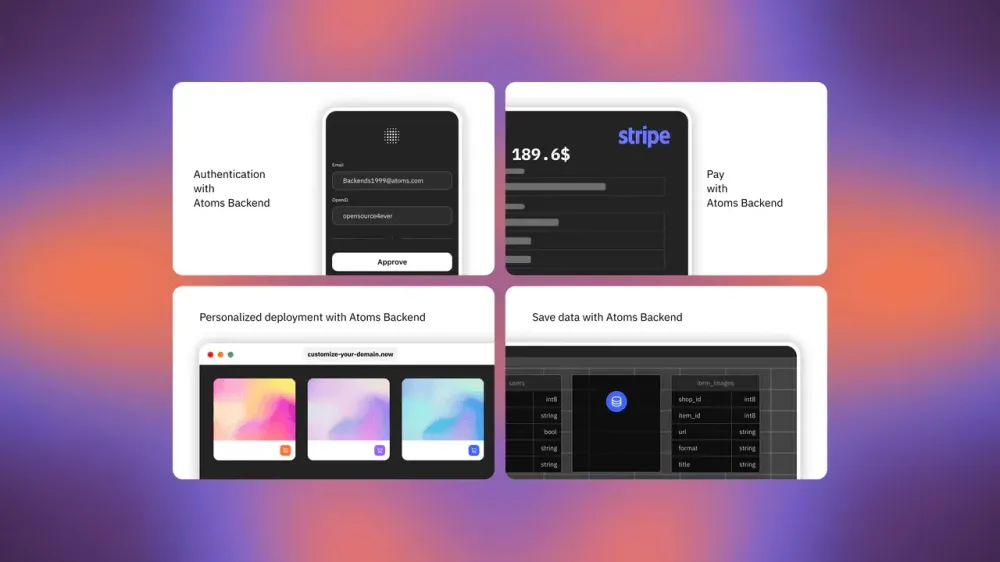
Atoms provides the downstream application surface for this workflow through Atoms Backend, Stripe integration, and managed hosting through Atoms Cloud. The routing question is therefore connected to an actual deliverable: a live app with data, users, payments, and a deployable result.
What to log in a routed agent system
To improve routing, record the decision context without storing sensitive prompts or private data unnecessarily:
- workflow ID;
- step type;
- selected model;
- selected provider;
- tool set;
- context size;
- estimated and actual cost;
- latency;
- retry and fallback count;
- progress signal;
- test result;
- accepted or rejected output;
- human escalation;
- final task outcome.
This allows teams to answer the question that matters:
Did routing reduce the cost and latency of an accepted result without lowering reliability?
What Agent Routing is not
Agent routing is not:
- sending every request to the cheapest model;
- randomly switching models between turns;
- hiding provider changes from users;
- assuming benchmark rank predicts every task;
- calling a provider fallback a model upgrade;
- replacing security review with a confidence score;
- creating many agents without clear roles or handoffs.
A multi-agent system can be worse than a single model if it creates coordination overhead, conflicting instructions, duplicated work, or unclear ownership. Routing needs observability and acceptance criteria.
The future is a routed team, not a fixed model
The AI market is moving from model selection toward workload orchestration.
Red Hat’s Semantic Router shows how request meaning can select a suitable model. OpenRouter shows why provider choice remains a separate operational decision. ProgRouter pushes the idea further: in a long-running agent, the best choice can change at every step as progress, risk, and failure state change.
Atoms applies the same product logic at the workflow level. Its multi-agent architecture separates roles across research, product, architecture, engineering, SEO, growth, and analytics, while Race Mode creates parallel alternatives when comparison improves the odds of a strong result.
The winning AI system will not ask one model to be the best at everything. It will know which capability is needed now, how much it should cost, what evidence is required, and when to escalate.
That is the real promise of AI Agent Routing: not cheaper model calls in isolation, but a higher probability of shipping the right result.
Sources
- Red Hat: vLLM Semantic Router Athena
- vLLM Semantic Router Athena release
- OpenRouter Provider Routing
- ProgRouter: Online Progress-Guided Orchestration for Multi-Agent LLM Workflows
- Atoms AI Agents
- Atoms Race Mode
- Atoms Coding Agents
- Atoms AI Website Builder
- Atoms AI App Builder
- Atoms Backend
- Atoms Cloud
