On this page
Anthropic's official “When AI builds itself” essay frames AI-assisted AI development as an accelerating internal loop, while explicitly stating that full recursive self-improvement has not yet arrived — Source
Anthropic has confirmed that it uses an unreleased internal model called Model 2. It has not confirmed that Model 2 is “Mythos 2,” nor that a public product called Mythos 3 is about to launch.
That distinction is essential because the supplied New AI Era article combines three different layers of evidence:
- an official Anthropic risk report describing Model 2;
- a SemiAnalysis podcast claim that “Mythos 2” has finished training and is not being released;
- a broader argument that withheld frontier models can still accelerate their own successors inside the lab.
The first layer is documented. The second is informed reporting, not an Anthropic announcement. The third is a serious strategic question—and Anthropic's own writing about recursive self-improvement shows why it cannot be dismissed as science fiction.
What Anthropic Has Officially Confirmed
Anthropic's August 2026 Risk Report describes Model 2 as an internal model that is somewhat more capable than Claude Mythos 5.
The company says Model 2 is a noticeable improvement on many tasks relevant to internal use, but not a capability jump on the scale of the earlier move from Claude Opus 4.6 to Mythos Preview. Anthropic also says it has no current plans to release Model 2 externally and has not run its full standard external-release evaluation suite.
Two reported comparisons help put the gap in context:
- CoBench v2: Model 2 scored 62.8%, compared with 50.3% for Mythos 5 and 54.8% for Mythos Preview;
- Anthropic's Epoch Capability Index estimate: Model 2 reached 162.79, compared with 161.29 for Mythos 5 and 158.91 for Mythos Preview.
Those values come from Anthropic's risk-report materials and related reporting. They are not a universal leaderboard. CoBench is designed around Anthropic's own real research-and-development tasks, making it especially relevant to internal productivity but less suitable for comparing consumer assistants in general.

SemiAnalysis interview context for the reported “Mythos 2” claim. The image does not verify the model name or release status; the underlying statement remains a third-party report — Source
Is Model 2 the Same Thing as Mythos 2?
That has not been officially established.
On August 18, Fireside Alpha circulated a clip from SemiAnalysis in which Dylan Patel said he had heard that Mythos 2 is done training and Anthropic is not releasing it, while the internal loop building Mythos 3 has not stopped.
The wording matters:
- “Mythos 2” is the name Patel used for what he had heard;
- “Model 2” is the label Anthropic uses in its own report;
- neither source publicly proves that the names refer to the same checkpoint;
- Anthropic has not announced a Mythos 2 or Mythos 3 product page, system card, release date, or API identifier.
The two stories are compatible: an unreleased internal successor could be known informally as Mythos 2. But compatibility is not identity. This article therefore uses Model 2 for confirmed information and Mythos 2 only when describing the SemiAnalysis claim.
Mythos Is Restricted, Not a Fictional Secret Model
The original article is right that Anthropic has a powerful model class that is not broadly available—but it exaggerates the idea of a model “forbidden worldwide.”
Anthropic publicly launched Project Glasswing, giving vetted infrastructure and security organizations access to Claude Mythos Preview for defensive cybersecurity work. Anthropic describes Mythos Preview as its most capable model yet for coding and agentic tasks, and says it has identified thousands of zero-day vulnerabilities across critical infrastructure.
The restriction is therefore real, but specific:
- Mythos Preview is a gated research preview;
- partners use it for defensive security;
- Anthropic has expanded access to selected organizations;
- it is not a normal public API model available to everyone.
That is different from saying Anthropic has locked the model away from all external users.
Is Fable Just a “Gutted” Mythos?
Public descriptions connect Claude Fable 5 to the Mythos capability class, but the claim that Fable is simply Mythos with its intelligence aggressively removed is too strong.
Model deployment involves more than deleting capability. A broadly released model can differ in:
- safety training;
- tool permissions;
- allowed cyber workflows;
- monitoring and classifiers;
- inference settings;
- usage limits;
- access to hidden system tools;
- model routing and product policy.
A restricted cyber model and a general-purpose public model can share a foundation while behaving very differently in practice.
Builders can use Claude Fable 5 and other Claude models on Atoms, then compare them with GPT, GLM, Qwen, Kimi, and other frontier models from the Atoms Models page. That is more actionable than assuming an internal model would dominate every workload merely because public access is restricted.
Why Anthropic May Withhold a Stronger Model
The supplied article frames the decision almost entirely as government regulation punishing Anthropic for advocating AI safety. That is one interpretation, but the documented reasons are broader.
1. The evaluation suite is incomplete
Anthropic says Model 2 has not gone through all the testing it would normally require before external release. A model used by employees under internal controls is not equivalent to a product available to millions of users and arbitrary tool integrations.
2. Cyber capability changes the deployment threshold
Anthropic's published exploit evaluations explain why Mythos-class models are handled carefully. Mythos Preview can move beyond identifying vulnerabilities and combine exploit primitives into complete attack chains. Anthropic says existing public exploit benchmarks were initially not difficult enough to measure it.
3. Internal use allows tighter controls
Inside the company, access can be logged, limited to approved systems, isolated from sensitive networks, and reviewed by security teams. External deployment introduces unknown prompts, toolchains, credentials, and downstream redistribution.
4. A stronger model may be more valuable internally than as a product
If a model materially accelerates research, coding, evaluation, and data generation, the lab may capture more strategic value by using it to build the next generation than by selling tokens immediately.
That last point is where the original article becomes most interesting.
The Real Question: Does Withholding the Model Break the Feedback Loop?
Dylan Patel's sharpest question is not whether Anthropic loses subscription revenue. It is whether withholding Mythos 2 prevents Anthropic from using it to improve Mythos 3.
The public-release flywheel is familiar:
- release a model;
- observe real user failures and successful workflows;
- collect preference, tool-use, and reliability data;
- improve training and post-training;
- release the next model.
If a frontier model stays internal, the lab loses some diversity and scale of real-world interaction. It may miss unusual languages, tools, organizational environments, adversarial behavior, and edge cases that controlled testing does not reproduce.
But the internal feedback loop does not disappear. It changes shape.
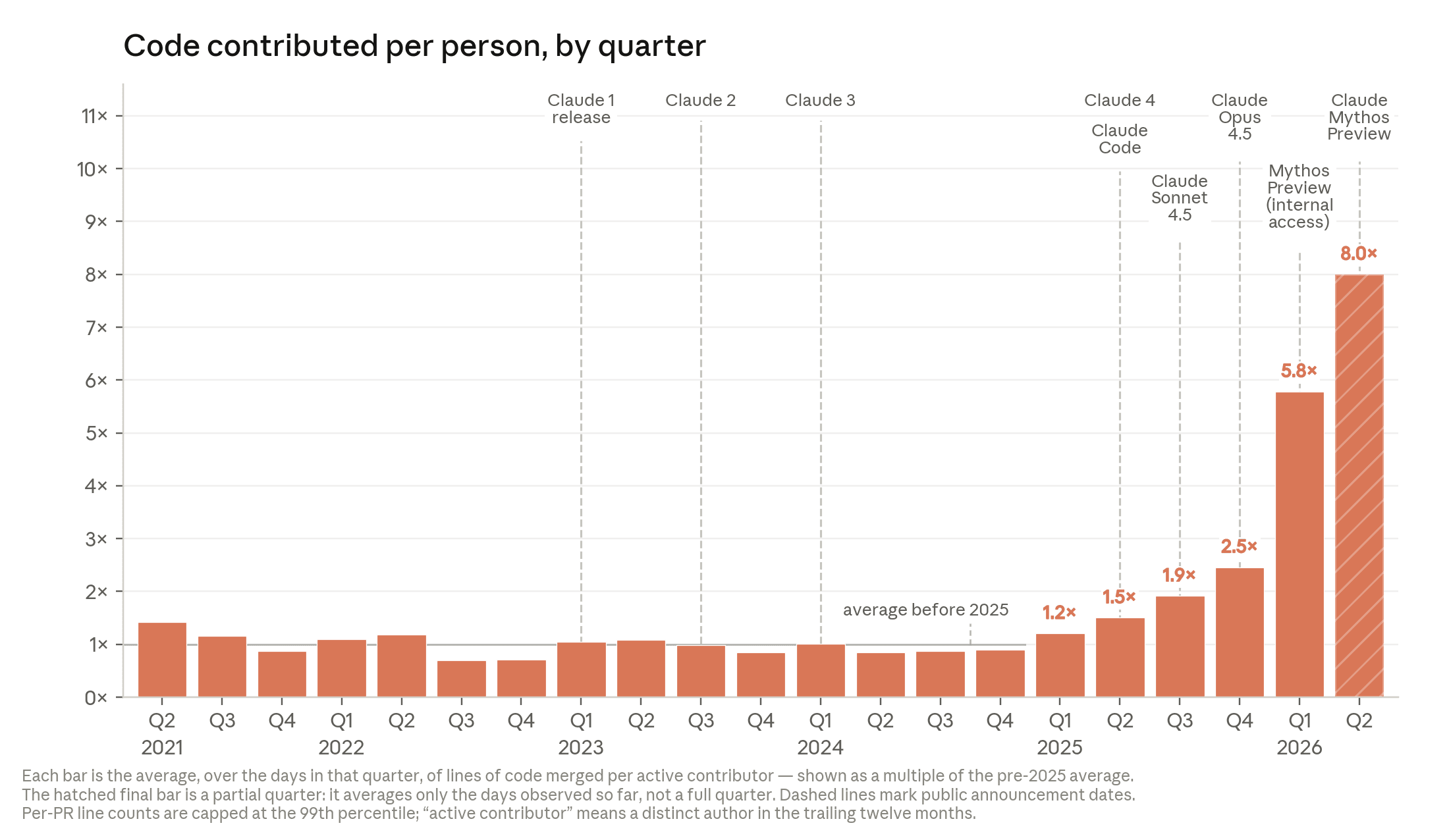
Anthropic reports normalized merged lines of code per active contributor reaching 8.0× the pre-2025 average in the observed portion of Q2 2026. This is a partial-quarter code-volume metric, not proof of an eightfold quality-adjusted productivity gain — Source
Anthropic's Internal AI Flywheel
Anthropic's own essay, “When AI builds itself”, says the company is already delegating a growing share of AI development to AI systems.
As of May 2026, Anthropic reported that:
- more than 80% of code merged into its codebase was authored by Claude;
- engineers were shipping roughly 8× as much code per quarter as the 2021–2025 baseline, although Anthropic cautions that lines of code overstate true productivity;
- agents can run code and delegate hours of work to other agents;
- AI is participating in engineering, research, experiment design, and evaluation.
This creates at least three reinforcing loops.
Data recursion
A strong model can generate code, difficult tasks, synthetic examples, critiques, and candidate solutions. Program execution, tests, formal verification, and other external signals can grade some outputs without manual labels.
The advantage is scale. The risk is recursive error: if the model generates both the task distribution and the answers, blind spots can become self-reinforcing.
Labor recursion
Models increasingly perform the engineering work required to improve model infrastructure and training systems. Human engineers move from writing every line toward specifying goals, reviewing changes, resolving ambiguity, and maintaining control over high-impact decisions.
The productivity gain can compound. So can dependency on the current model's assumptions and coding style.
Evaluation recursion
AI systems help red-team, compare, and diagnose other AI systems. That is necessary when benchmark creation cannot keep pace with capabilities—but it creates a measurement problem if the judge shares the same blind spots as the model being judged.
The internal flywheel is therefore real. It is not the same as fully autonomous recursive self-improvement, and Anthropic explicitly says it is not there yet.
Does Model 2 Prove Recursive Self-Improvement?
No.
A model writing code used by its developers is a form of AI-assisted AI development. Full recursive self-improvement would require the system to autonomously design, train, evaluate, secure, and deploy a more capable successor with minimal human intervention.
Important bottlenecks remain:
- selecting research directions;
- obtaining and allocating compute;
- designing training runs;
- interpreting ambiguous evidence;
- preventing reward hacking;
- securing model weights and infrastructure;
- approving deployment;
- evaluating social and strategic risks.
Anthropic's article presents recursive self-improvement as a possibility that institutions should prepare for, not a completed technical achievement.
What the Model 2 Scores Actually Mean
The headline “stronger than Mythos 5” is directionally supported, but it needs context.
| Evaluation | Mythos Preview | Mythos 5 | Model 2 | What it measures |
|---|---|---|---|---|
| CoBench v2 | 54.8% | 50.3% | 62.8% | Performance on Anthropic-like internal R&D tasks |
| Anthropic AECI estimate | 158.91 | 161.29 | 162.79 | Estimated general capability over a benchmark suite |
The improvement is uneven:
- Model 2 is much stronger on CoBench;
- the AECI increase over Mythos 5 is comparatively small and carries uncertainty;
- Anthropic describes it as a noticeable internal-use improvement, not an across-the-board discontinuity;
- Model 2 has not completed the full evaluation suite for external release.
That is a more useful reading than “Anthropic has an omnipotent model it refuses to share.”
Is Regulation the Main Reason?
The SemiAnalysis discussion argues that U.S. restrictions have artificially narrowed the gap between open and closed models by preventing frontier labs from releasing their best systems.
That claim should be treated as analysis, not settled fact.
Regulation and government scrutiny can affect model access. So can:
- Anthropic's own Responsible Scaling Policy;
- contractual and security obligations;
- insufficient evaluations;
- reputational risk;
- cyber misuse risk;
- product economics;
- infrastructure capacity;
- the strategic value of internal deployment.
Anthropic has indeed advocated stronger safety standards. It does not follow that the company sought regulation merely to create an excuse to monopolize intelligence. The original article presents that theory as plausible; there is no direct evidence establishing it as Anthropic's motive.
Why Open Models Can Still Close the Public Gap
Even if frontier labs have stronger checkpoints internally, developers choose among models they can actually access.
An unreleased model has no public:
- API reliability record;
- pricing;
- rate limits;
- integration ecosystem;
- latency profile;
- production support;
- community evaluation;
- reproducible real-world results.
Open and broadly available models can improve faster at the product layer because thousands of teams test them across diverse workflows. The public capability gap can narrow even while an internal lab gap remains.
This is why a multi-model workflow is strategically safer than betting on one provider's hidden roadmap. Atoms lets builders compare available models in real projects instead of optimizing around an inaccessible checkpoint.
What Comes After Model 2?
“Mythos 3” is currently a reported internal trajectory, not an announced product.
The likely development pattern is more concrete than the product name:
- deploy Model 2 internally under stronger controls;
- use it for coding, data generation, agent workflows, and evaluation;
- collect evidence from internal use and selected external partners;
- improve the next training and post-training cycle;
- decide whether the successor can be released broadly, gated, or split into multiple product variants.
The critical question is whether safety evaluation and governance can improve as quickly as the models assisting the development process.
Anthropic itself says public benchmarks are saturating and that some capabilities are reaching the upper end of what evaluators can measure. If the ruler stops growing while the object does, confidence in both safety and capability comparisons falls.
What Builders Should Do Now
Model 2 is not available, so it should not drive an immediate architecture decision.
A practical response is to prepare for faster model turnover:
- keep model routing replaceable;
- define task-specific evals before switching models;
- isolate tool execution;
- require approval for irreversible actions;
- preserve logs and rollback paths;
- compare several available frontier models on the same workflow;
- measure complete task success, not only benchmark scores.
On Atoms, teams can use Claude models, GPT-5.6 Sol, Qwen3.8-Max, Kimi, GLM, and other models without tying the product to a single vendor's release cadence.
The best response to a hidden stronger model is not to wait. It is to build a workflow that can absorb the next model when it becomes real.
A Fact-Checked Timeline
| Date | Event | Evidence status |
|---|---|---|
| April 2026 | Anthropic announces Project Glasswing and gated access to Mythos Preview | Confirmed |
| May 2026 | Anthropic publishes exploit evaluations showing Mythos Preview's step-change in exploit development | Confirmed |
| June 2026 | Anthropic reports that Claude writes more than 80% of merged code and discusses recursive self-improvement | Confirmed |
| August 14, 2026 | Anthropic publishes a risk report describing internal Model 2 and no current external release plan | Confirmed |
| August 18, 2026 | Fireside Alpha circulates Dylan Patel's statement that “Mythos 2” is trained but withheld | Third-party report |
| Future | “Mythos 3” release | Not announced |
The Bottom Line
The original article's central intuition is strong: the frontier may be moving away from public release cycles and toward internal AI systems that help build their successors.
But the dramatic version outruns the evidence.
Anthropic has not confirmed that Model 2 is Mythos 2. It has not announced Mythos 3. It has not said Fable is merely a crippled copy of Mythos. It has confirmed something more concrete:
- an internal model outperforms Mythos 5 on important internal tasks;
- Anthropic has no current plan to release it externally;
- the model is used inside a company where Claude already writes most merged code;
- Anthropic believes AI-assisted AI development is accelerating;
- evaluation, security, and human oversight may struggle to keep pace.
That is enough to matter without turning an internal checkpoint into a hidden superintelligence.
Frequently asked questions
01What is Anthropic Model 2?
Model 2 is the name used in Anthropic's August 2026 Risk Report for an unreleased internal model described as somewhat more capable than Mythos 5.
02Is Model 2 the same as Mythos 2?
Possibly, but not confirmed. Dylan Patel used the name Mythos 2 in a SemiAnalysis discussion; Anthropic's official report uses Model 2.
03Why hasn't Anthropic released Model 2?
Anthropic says it has no current plan to release it and has not completed the normal external-release evaluation suite. Cyber capability, internal controls, evaluation limits, and strategic value may all be relevant.
04What is Mythos 3?
Mythos 3 is a reported name for a future internal successor. Anthropic has not announced it as a product or provided a release date.
05Is Claude Fable 5 a weaker version of Mythos?
Fable is associated with the broader Mythos capability class, but public evidence does not justify describing it as simply an intentionally crippled copy. Deployment policy, safety training, tools, inference settings, and access controls can differ.
06Can I use Model 2 on Atoms?
No. Model 2 is not publicly available. Atoms currently offers Claude Fable 5 and other available Claude, GPT, Qwen, GLM, Kimi, and frontier models.
07Is Anthropic already recursively self-improving?
Anthropic is using AI extensively to accelerate AI engineering and research. That is not yet full autonomous recursive self-improvement, which would require a system to build and deploy a more capable successor with minimal human control.
Sources
Research cutoff: August 19, 2026.
- Anthropic: August 2026 Risk Report
- Anthropic: When AI builds itself
- Anthropic: Project Glasswing
- Anthropic: Measuring LLMs' ability to develop exploits
- Axios: Anthropic sees AI risks rising, no plan to release Model 2
- Fireside Alpha: Dylan Patel on Mythos 2 and Mythos 3
- Fireside Alpha: Jordan Nanos on withheld frontier models
- Original New AI Era article
