Claude Fable 5.1 looks like a benchmark upgrade. The more useful reading is that Anthropic is trying to make long-running agents easier to deploy and cheaper to operate.
The model improves coding, research, computer use, and multi-step work. At the same time, Anthropic cut the cache-hit price from $1 to $0.25 per million tokens, introduced new enterprise data controls, and separated the generally available Fable model from the restricted Mythos version.
Explore the verified specs on the Claude Fable 5.1 model page, then check the live Atoms model catalog for current availability.
What changed in Fable 5.1?
Anthropic released Claude Fable 5.1 and Claude Mythos 5.1 on September 1, 2026. They use the same underlying model but apply different safeguards.
- Fable 5.1 is generally available for coding and knowledge work.
- Mythos 5.1 is restricted to approved cybersecurity and life-sciences users.
- The Fable API model ID is
claude-fable-5-1. - Base input remains $10 per million tokens.
- Output remains $50 per million tokens.
- Cache hits fall from $1 to $0.25 per million tokens.
The price change is narrower than the headline suggests. Fable 5.1 is not 75% cheaper across the board. Only cached input reads received that reduction.
Why cache pricing matters for agents
A short chat may read the prompt once and return an answer. A coding agent repeatedly reads the same repository, instructions, test output, tool responses, and earlier decisions.
That repeated context can become a large part of the bill during a task that runs for several hours.
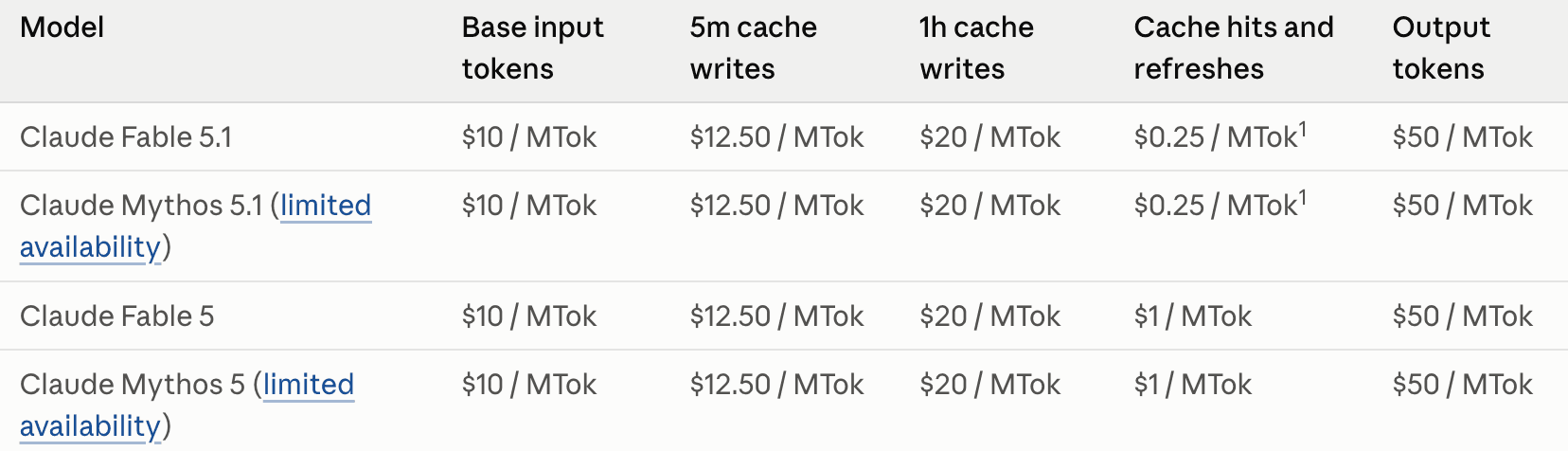
Anthropic lists Fable 5.1 at $10/MTok for base input, $0.25/MTok for cache hits, and $50/MTok for output. Verify the current provider and regional route before budgeting. Source
| Price component | Fable 5 | Fable 5.1 |
|---|---|---|
| Base input | $10 / MTok | $10 / MTok |
| Cache hits | $1 / MTok | $0.25 / MTok |
| Output | $50 / MTok | $50 / MTok |
Anthropic estimates that Fable 5.1 costs about 25% less for its typical workload mix. For highly agentic work, where cached context makes up more of the bill, the estimated reduction reaches roughly 45%.
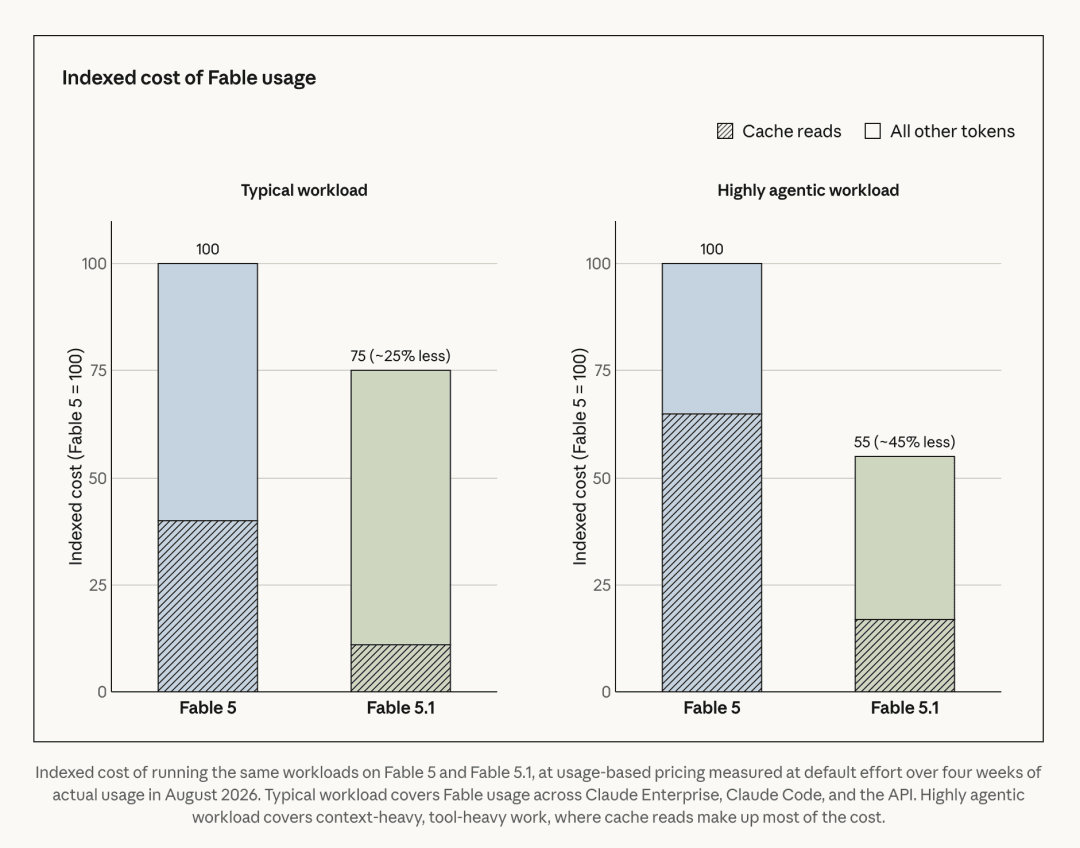
Anthropic’s August 2026 usage analysis shows an indexed cost of 75 for typical workloads and 55 for highly agentic workloads, against a Fable 5 baseline of 100. These are provider estimates for the measured workload mix, not guaranteed savings. Source
The metric worth tracking is not price per token. It is cost per accepted task:
A cheaper model can still cost more if it needs repeated corrections. A more expensive model can be economical if it finishes difficult work with fewer failed attempts.
Compare current model options before committing a long task. Open the Atoms model catalog and choose based on the job, not the headline benchmark.
The bigger upgrade is sustained execution
The Chinese source article focuses on examples where Fable 5.1 kept working after a normal assistant might have stopped.
Millennium reportedly used it to investigate a rare crash that appeared about once per million executions. The model analyzed third-party code and a core dump, then traced the problem to an external library.
Ramp reportedly ran a machine-learning task for 38 hours. The model found a labeling problem, changed the experiment, launched six parallel runs, waited overnight, and returned with results and next steps.
MongoDB engineers reportedly gave it internal code and documentation for a complex prototype. The model researched across services, implemented the prototype, and checked its work over several hours.
These are vendor-selected examples, so they should not be treated as universal outcomes. They do show the intended use case: longer tasks with tools, checkpoints, changing evidence, and multiple implementation stages.
For a coding agent, the useful test is not whether it can write one function. It is whether it can:
- understand an unfamiliar repository;
- plan a change across several files or services;
- run tests and inspect failures;
- revise the plan when the evidence changes;
- finish with a result another developer can review.
Have an existing repository? Use the Atoms AI Coding Assistant to plan, implement, test, and review changes across the codebase.
What the benchmark table does and does not prove
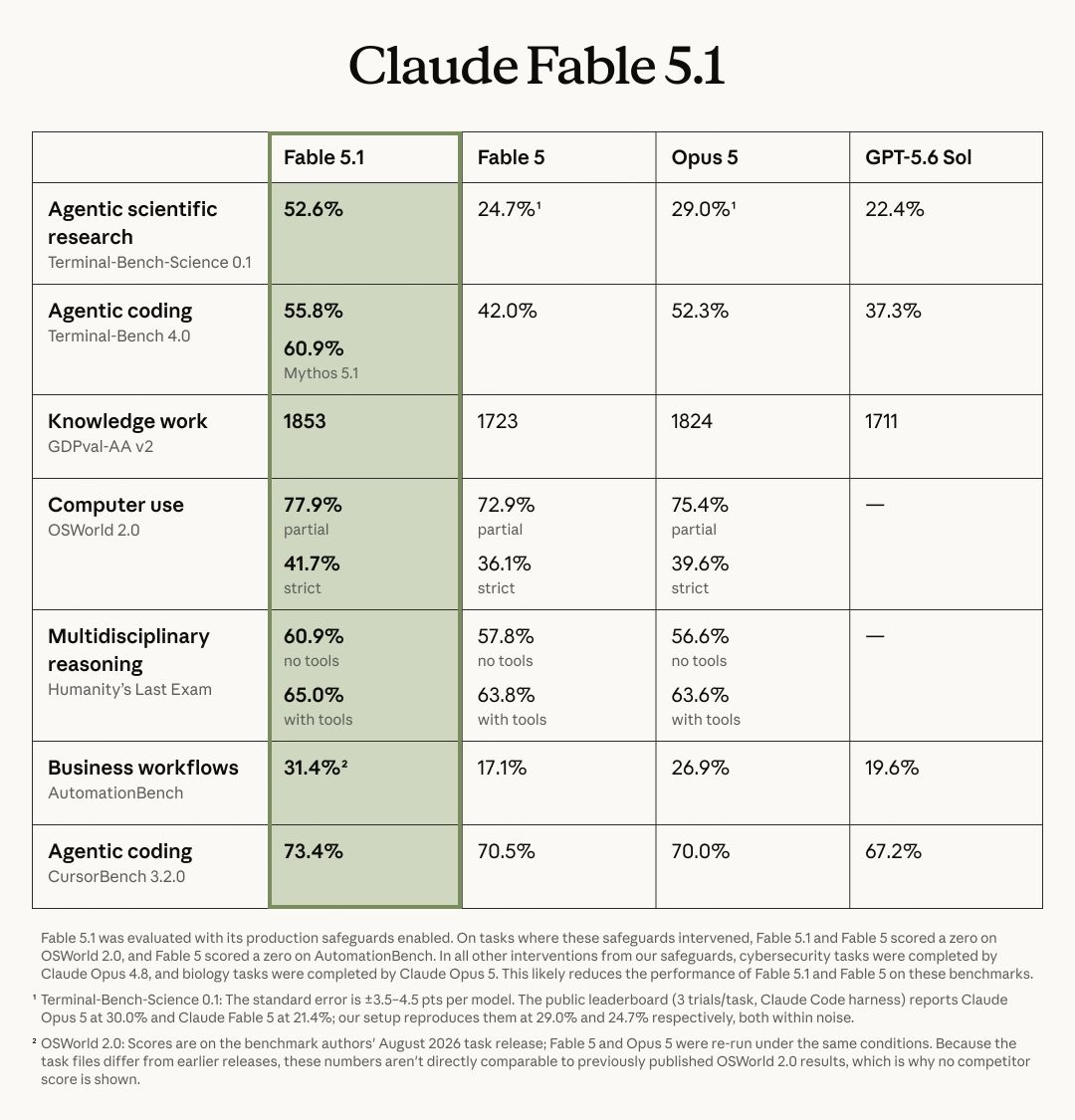
Anthropic’s provider-reported comparison covers scientific research, coding, knowledge work, computer use, and business workflows. Results depend on effort, harness, safeguards, and task versions. Source
Anthropic reports higher Fable 5.1 scores than Fable 5 across the displayed evaluations. Selected results include:
| Benchmark | Fable 5.1 | Fable 5 |
|---|---|---|
| Terminal-Bench-Science 0.1 | 52.6% | 24.7% |
| Terminal-Bench 4.0 | 55.8% | 42.0% |
| GDPval-AA v2 | 1853 | 1723 |
| OSWorld 2.0, partial | 77.9% | 72.9% |
| AutomationBench | 31.4% | 17.1% |
| CursorBench 3.2.0 | 73.4% | 70.5% |
The table supports a broad provider-reported improvement. It does not establish that Fable 5.1 is best for every application.
A few boundaries matter:
- Some GPT-5.6 Sol cells are missing. Missing is not zero.
- Anthropic published the comparison.
- Effort settings change quality and cost.
- Safeguards affected some benchmark runs.
- Anthropic says its OSWorld results use the August 2026 task release and should not be compared directly with older results.
- Terminal-Bench-Science has a stated standard error of roughly 3.5 to 4.5 points per model.
Run the same task on the models you are considering. Keep the repository, tools, tests, and acceptance criteria constant.
Why Fable and Mythos are separate
Fable 5.1 and Mythos 5.1 share the same base model. Access policy separates them.
Fable 5.1 uses production safeguards for general coding and knowledge work. Mythos 5.1 gives approved organizations broader access for cybersecurity and life-sciences research.
Anthropic says the updated Fable safeguards reduce cybersecurity false positives by about 60%. It also reports about 85% fewer false positives for basic biology and general medical questions. Defensive vulnerability discovery is more accessible, while exploit development and other high-risk work remain restricted.
This split is useful beyond Anthropic. Model capability and tool permission should be separate controls. Even a strong model should not automatically receive unrestricted access to production databases, payment systems, deployment credentials, or destructive shell commands.
Use explicit permissions, checkpoints, budgets, and approval gates.
Data retention is part of model selection
Anthropic also announced Enterprise Frontier Safeguards. The company says EFS will store customer data in cloud infrastructure controlled by the customer rather than Anthropic while keeping its frontier safeguards in place.
Anthropic plans a phased rollout. Until then, it says eligible customers can use Fable 5.1 with zero data retention.
Enterprise buyers should verify the exact contract and deployment route. The best benchmark score may not matter if the model does not satisfy requirements for data location, retention, audit logs, or access control.
Is Fable 5.1 good for building apps?
Fable 5.1 is built for complex coding and longer agent workflows. That makes it relevant to app building, but the model is only one layer.
A working product still needs:
- a product brief and clear user roles;
- frontend and backend architecture;
- authentication and server-side authorization;
- persistent data;
- integrations and payment handling;
- tests, deployment, and recovery;
- code review and ownership.
Atoms adds that surrounding workflow. You can describe the product, review the plan, build frontend and backend together, test the result, iterate, and deploy when it is ready.
Starting a new product? Open the Atoms AI App Builder and include users, permissions, data, integrations, tests, and deployment in the first brief.
A useful starting prompt:
Check the live model selector before choosing the exact claude-fable-5-1 route. A provider launch does not guarantee that every downstream platform has enabled the model at the same time.
How to evaluate Fable 5.1
Use representative work rather than a generic chat prompt.
Test a repository change
Give Fable 5 and Fable 5.1 the same issue, repository, tools, and tests. Compare files changed, regressions, human corrections, elapsed time, and total cost.
Test a long implementation
Choose a feature that crosses frontend, backend, database, and authentication. Check whether the model keeps the original constraints after many tool calls.
Test failure recovery
Introduce a failed test or changed requirement. See whether the agent updates its plan and resumes from a checkpoint instead of repeating the same action.
Measure the accepted result
Record effort, cache usage, output tokens, retries, tool calls, human review time, and whether the result passed the acceptance test.
Ready to run the comparison? Start in the Atoms model catalog, use the AI Coding Assistant for repository work, or launch a new product with the AI App Builder.
Who should use it?
Fable 5.1 is worth testing if your team runs coding agents on large repositories, works with long document sets, uses browser or computer tools, or needs agents to continue across many steps.
It may be excessive for classification, short copy edits, routine extraction, and other tasks where a smaller model already meets the acceptance bar.
Bottom line
Fable 5.1 combines three changes:
- Better provider-reported results on coding, research, computer use, and knowledge work.
- Cache hits that cost 75% less than Fable 5, producing estimated workload savings of about 25% to 45% in Anthropic’s measured usage mixes.
- A clearer split between general Fable access, restricted Mythos capabilities, and enterprise data controls.
The benchmark table is useful. The stronger test is whether Fable 5.1 finishes your work at an acceptable total cost, with permissions and data controls your team can operate.
Review Claude Fable 5.1 on Atoms, then build a full-stack app or apply it to an existing codebase.
