On this page
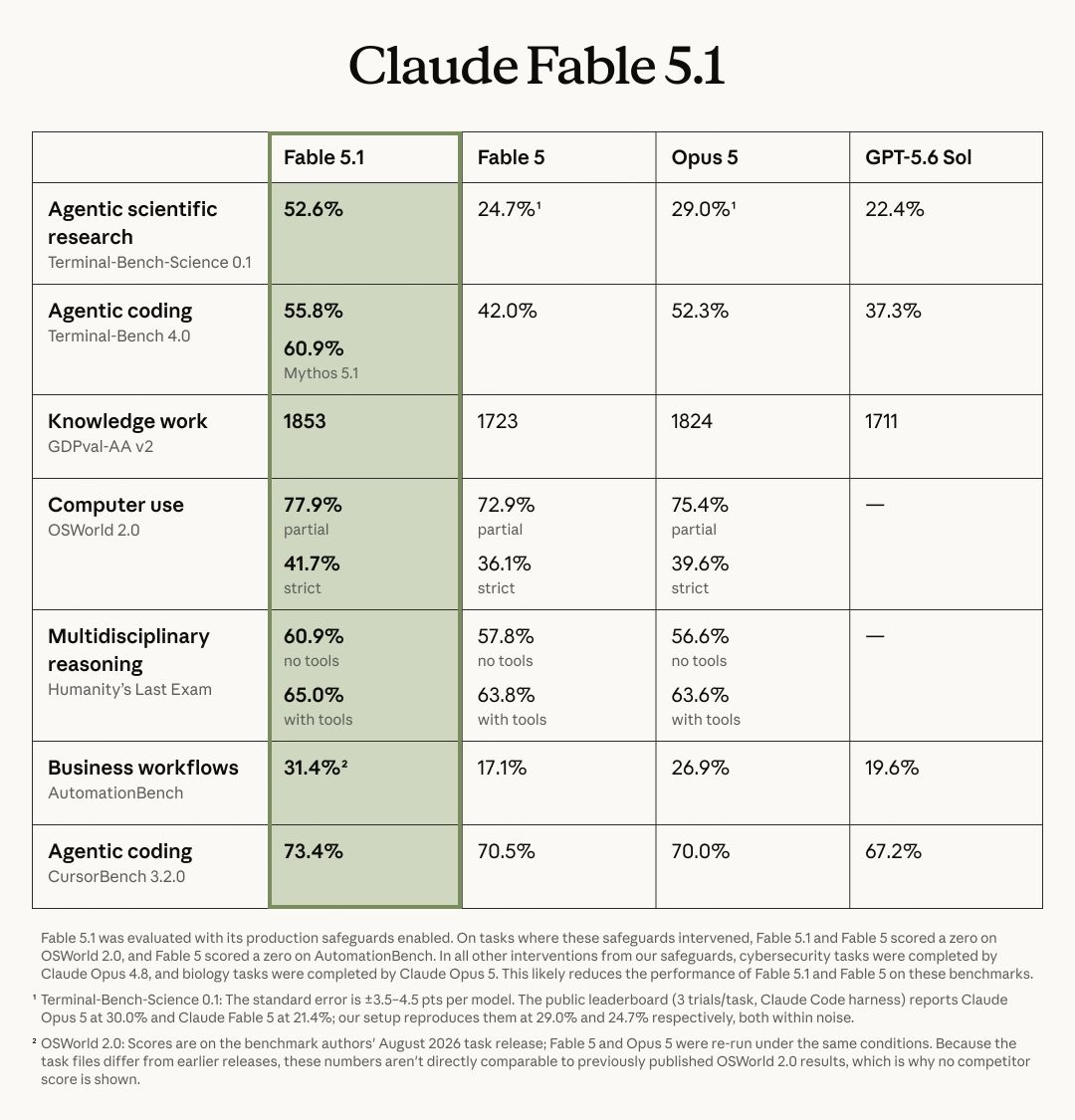
Anthropic’s launch comparison for Claude Fable 5.1. These are provider-reported results under specific benchmark, effort, harness, safeguard, and task-release conditions—not a universal ranking. Source
Claude Fable 5.1 is no longer a rumor.
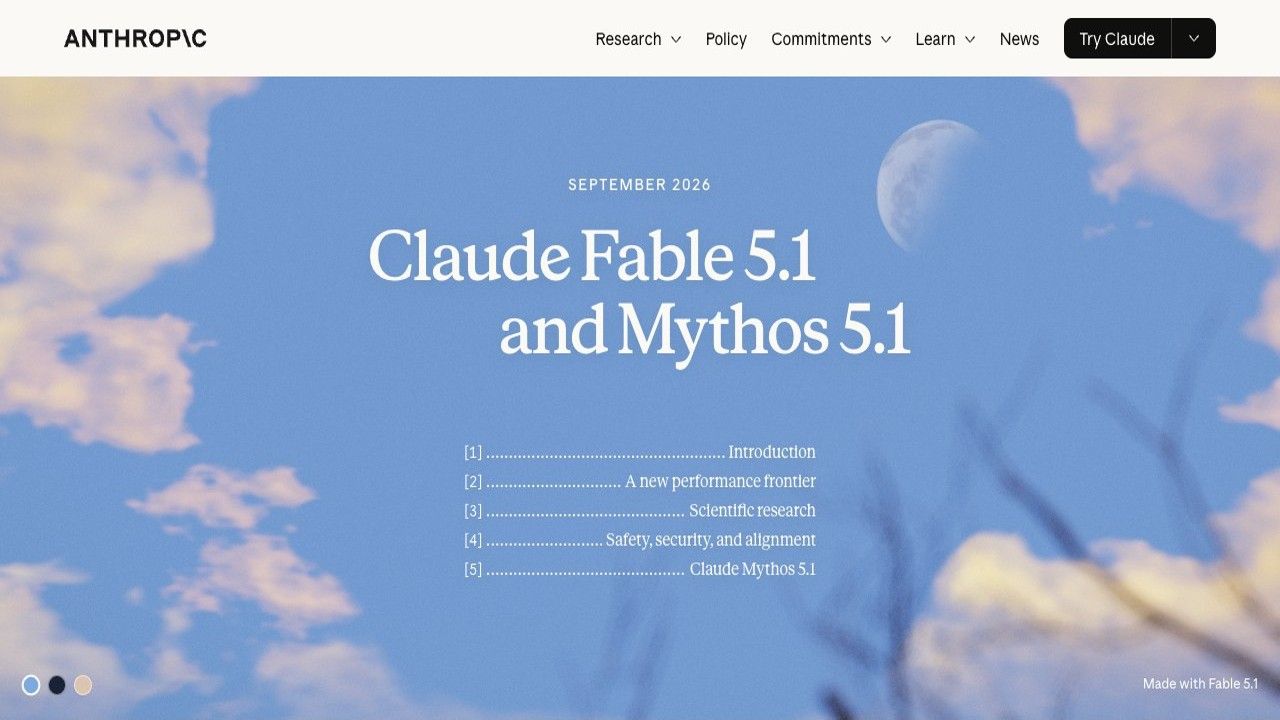
Anthropic released Claude Fable 5.1 and Claude Mythos 5.1 on September 1, 2026, describing them as the same underlying model with different safeguards. Fable 5.1 is generally available. Mythos 5.1 is limited to trusted-access programs for approved cybersecurity and life-sciences work.
The headline is not only “better benchmark scores.” Anthropic also changed the economics of long-running agents:
- base input remains $10 per million tokens;
- output remains $50 per million tokens;
- cache hits fall from $1 to $0.25 per million tokens;
- Anthropic estimates roughly 25% lower cost than Fable 5 for typical workloads;
- the provider estimates savings of up to roughly 45% for highly agentic, cache-heavy workloads.
That combination—stronger long-horizon work plus cheaper repeated context—matters for coding agents that continuously reread repositories, tool results, plans, tests, and prior steps.
Want to build with the latest Claude models? Check the live Atoms model catalog, review the Claude Fable 5.1 model page, or start with the AI App Builder.
Claude Fable 5.1 release: the verified facts
Anthropic’s official launch page confirms:
| Fact | Verified status |
|---|---|
| Model | Claude Fable 5.1 |
| Companion model | Claude Mythos 5.1 |
| Release | September 1, 2026 |
| Fable availability | Generally available |
| Mythos availability | Trusted access only |
| API model ID | claude-fable-5-1 |
| Base input | $10 / MTok |
| Cache hits | $0.25 / MTok |
| Output | $50 / MTok |
| Main focus | Coding, knowledge work, computer use, research, and long-running agents |
Anthropic says the two 5.1 models share the same underlying model. Fable 5.1 uses production safeguards for general availability. Mythos 5.1 has safeguards designed for approved work in cybersecurity and life sciences.
This distinction matters. Mythos 5.1 is not an ordinary premium plan or public API tier. Its broader permissions are access-controlled.
Fable 5.1 benchmarks: what changed?
Anthropic’s comparison table reports improvements across seven areas:
- agentic scientific research;
- agentic terminal coding;
- knowledge work;
- computer use;
- multidisciplinary reasoning;
- business workflows;
- coding in CursorBench.
Selected provider-reported figures include:
| Benchmark | Fable 5.1 | Fable 5 | Opus 5 | GPT-5.6 Sol |
|---|---|---|---|---|
| Terminal-Bench-Science 0.1 | 52.6% | 24.7% | 29.0% | 22.4% |
| Terminal-Bench 4.0 | 55.8% | 42.0% | 52.3% | 37.3% |
| GDPval-AA v2 | 1853 | 1723 | 1824 | 1711 |
| OSWorld 2.0, partial | 77.9% | 72.9% | 75.4% | Not shown |
| Humanity’s Last Exam, no tools | 60.9% | 57.8% | 56.6% | Not shown |
| AutomationBench | 31.4% | 17.1% | 26.9% | 19.6% |
| CursorBench 3.2.0 | 73.4% | 70.5% | 70.0% | 67.2% |
These numbers need boundaries.
They are not one universal leaderboard
The benchmarks test different things. Terminal-Bench-Science is not the same job as CursorBench. OSWorld’s “partial” and “strict” scores measure different completion criteria. Humanity’s Last Exam differs with and without tools.
Some competitor cells are missing
The graphic shows no GPT-5.6 Sol score for OSWorld or Humanity’s Last Exam. A missing cell is not a zero and cannot support a superiority claim for that row.
Safeguards affect scores
Anthropic says Fable 5.1 was evaluated with production safeguards enabled. When safeguards intervened, some tasks received zero or were routed to another model. That makes the published table closer to a production configuration, but it also means raw model capability and deployed behavior are not identical.
Task versions and harnesses matter
Anthropic notes that its OSWorld results use an August 2026 task release and are not directly comparable with earlier publications. It also states a standard error of roughly ±3.5–4.5 points for Terminal-Bench-Science per model.
The correct conclusion is:
Anthropic reports a broad improvement over Fable 5 and strong results against selected models under its published setups. Independent and workload-specific testing is still required.
Fable 5.1 vs Fable 5
Fable 5.1’s practical upgrade has three parts.
1. Better completion on difficult tasks
Anthropic reports higher benchmark performance and says Fable 5.1 is more likely to solve root causes rather than take shortcuts. Its customer examples emphasize rare crash debugging, multi-hour implementations, overnight experiment loops, and long-running context retention.
Vendor case studies are useful evidence that such workflows were tested. They are not guarantees that every repository or organization will see the same result.
2. Better low- and medium-effort trade-offs
Anthropic says Fable 5.1 at Low or Medium effort can match or exceed Fable 5 at lower cost on some workloads. Claude Code defaults to High effort, while Claude Cowork and Claude.ai use Medium by default according to the launch article.
Teams should compare accepted outcomes at several effort levels rather than always selecting the maximum setting.
3. Cheaper cache reads
This is the clearest economic change. Long-running agents repeatedly reread:
- source files;
- project instructions;
- conversation history;
- tool results;
- test output;
- plans and checkpoints;
- earlier generated code.
Reducing cache-hit pricing by 75% can materially change total task cost when cache reads make up a large share of usage.
Claude Fable 5.1 pricing
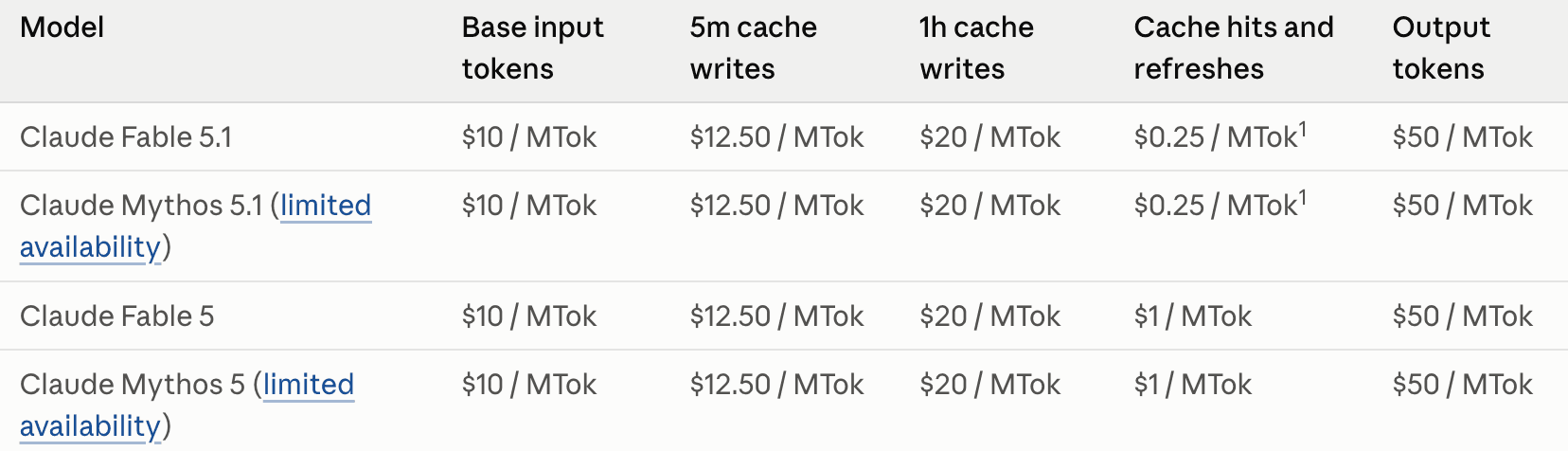
Anthropic pricing displayed for Fable 5.1, Mythos 5.1, Fable 5, and Mythos 5. The 5.1 cache-hit rate is $0.25/MTok; Anthropic’s pricing documentation defines it as 0.025x base input price. Verify the current platform and regional route before budgeting. Source
The API list prices shown by Anthropic are:
| Token category | Fable 5.1 | Fable 5 |
|---|---|---|
| Base input | $10 / MTok | $10 / MTok |
| 5-minute cache write | $12.50 / MTok | $12.50 / MTok |
| 1-hour cache write | $20 / MTok | $20 / MTok |
| Cache hits and refreshes | $0.25 / MTok | $1 / MTok |
| Output | $50 / MTok | $50 / MTok |
Base input and output prices did not fall. The change is concentrated in cache reads.
Therefore, Fable 5.1 is not automatically 75% cheaper overall. It is 75% cheaper for the cache-hit token category. Total savings depend on how much of a task’s bill comes from cached context.
Why agentic workloads can save more
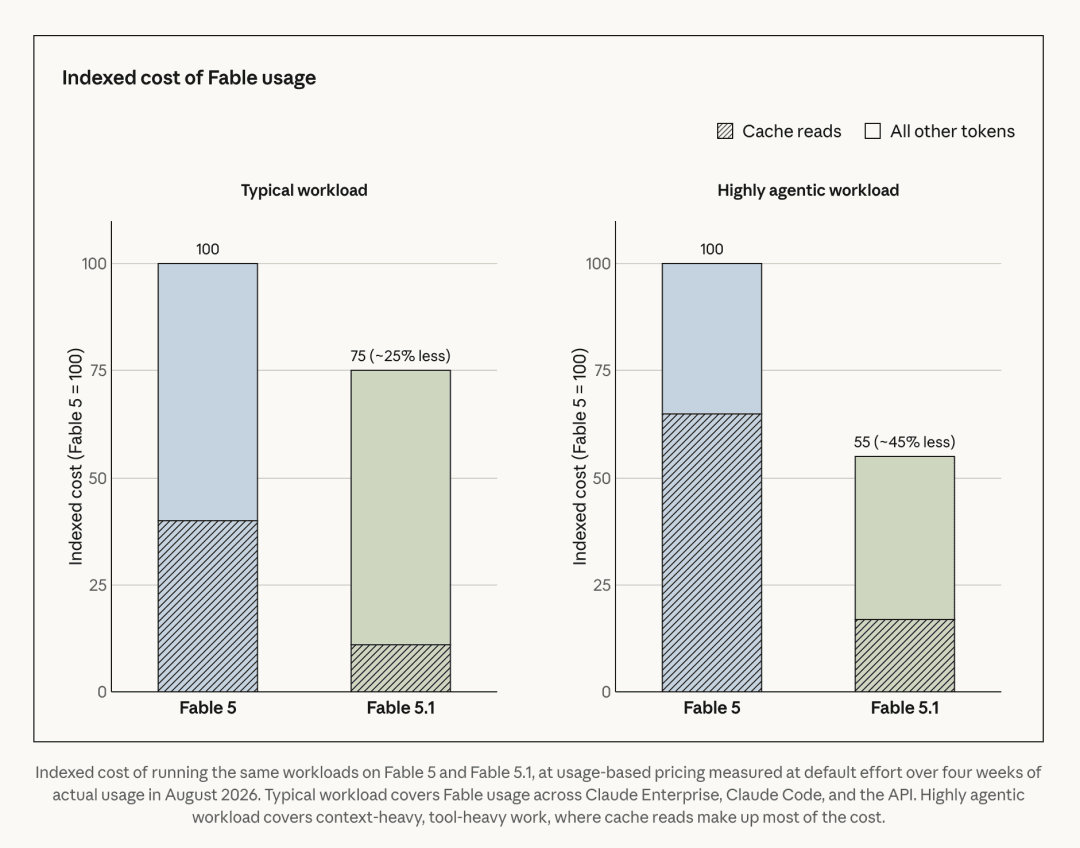
Anthropic’s indexed-cost analysis of four weeks of August 2026 usage. Fable 5.1 is shown at 75 versus a Fable 5 baseline of 100 for typical workloads, and 55 versus 100 for highly agentic workloads. These are relative provider estimates for the represented workload mix, not guaranteed savings for every user. Source
Anthropic separates two workload shapes.
Typical workload
The provider’s “typical” dataset covers Fable usage across Claude Enterprise, Claude Code, and the API. The indexed Fable 5 cost is 100; Fable 5.1 is shown at 75, or approximately 25% lower.
Highly agentic workload
The agentic workload is context-heavy and tool-heavy, with cache reads making up more of the bill. Fable 5.1 is shown at 55 versus the Fable 5 baseline of 100, or approximately 45% lower.
The chart does not prove that performance, task mix, token count, or completion rate is identical for every customer. Use it as a budgeting hypothesis, then measure your own accepted-task cost.
A useful cost comparison records:
- model and effort level;
- input, output, cache-write, and cache-hit tokens;
- elapsed time;
- tool calls;
- retries;
- safeguard interventions;
- human review time;
- tests passed;
- accepted task outcome.
Claude Fable 5.1 vs Opus 5
The benchmark table shows Fable 5.1 ahead of Opus 5 on several listed tasks, including Terminal-Bench-Science, Terminal-Bench 4.0, GDPval-AA, OSWorld, Humanity’s Last Exam, AutomationBench, and CursorBench.
That does not mean Fable 5.1 replaces Opus 5 for every task.
Choose based on:
- the target workload;
- tool and harness behavior;
- effort level;
- latency;
- total accepted-task cost;
- security and safeguard requirements;
- availability in the target platform;
- independent tests on your own data.
Anthropic positions Fable 5.1 as stronger and cheaper for many long-running workloads. Teams already using Opus as a daily coding model should test whether Fable 5.1 can meet the acceptance bar at lower cost.
Claude Fable 5.1 vs GPT-5.6 Sol
The official table includes GPT-5.6 Sol on several rows. Fable 5.1 is higher on the displayed Terminal-Bench-Science, Terminal-Bench, GDPval-AA, AutomationBench, and CursorBench values.
There are three reasons not to turn that into “Fable 5.1 is better at everything”:
- some GPT-5.6 Sol scores are not shown;
- the figure is published by Anthropic;
- model performance depends heavily on harness, effort, tools, latency, and task type.
The right test is the same-brief comparison:
- same repository or data;
- same task and acceptance criteria;
- equivalent tools and permissions;
- recorded token and time cost;
- repeated trials where results are noisy;
- blind review of the finished output where possible.
What is Claude Mythos 5.1?
Claude Mythos 5.1 uses the same underlying model as Fable 5.1 but has different safeguards. Anthropic limits it to trusted-access programs.
The reason is capability access, not ordinary product packaging. Mythos 5.1 is designed for approved cybersecurity and life-sciences work that may require fewer false-positive refusals or broader technical permissions.
General users should use Fable 5.1. Organizations needing Mythos 5.1 must qualify through Anthropic’s access process.
Do not assume:
- that Mythos 5.1 is selectable in a consumer Claude plan;
- that it is available on every cloud platform;
- that higher access removes the need for oversight;
- that benchmark rows combining Fable and Mythos can be treated as one public product.
Safety, data retention, and enterprise deployment
Anthropic says Fable 5.1 improves safeguard precision:
- roughly 60% fewer cybersecurity false-positive interventions;
- roughly 85% fewer false positives for basic biology and general medical questions;
- defensive vulnerability discovery is allowed more often;
- exploit development and other dual-use work remain restricted or handled separately.
Anthropic also announced Enterprise Frontier Safeguards (EFS). The company says EFS stores customer data in infrastructure controlled by the customer rather than Anthropic, while retaining frontier safeguards. It plans phased enterprise availability beginning later in the fall.
Until EFS is available, Anthropic says eligible customers can use Fable 5.1 with zero data retention.
These are provider statements about planned and controlled deployments. Confirm contract terms, regions, cloud configuration, audit requirements, and actual availability before making compliance claims.
Can Fable 5.1 build apps?
Yes, it is designed for complex coding and long-running agent work. But a strong model is one layer of an app-building system.
A production application still needs:
- product requirements;
- frontend and backend architecture;
- authentication and authorization;
- persistent data;
- server-side validation;
- payment and webhook handling;
- secrets management;
- tests and error states;
- deployment and recovery;
- code ownership and maintenance.
Atoms’ AI App Builder coordinates those stages around a product brief. The AI Coding Assistant is a better entry when you already have a repository.
Fable 5.1 is newly released. Check the live Atoms model catalog and model selector for current availability of the exact claude-fable-5-1 route. The Claude Fable 5.1 model page tracks verified model facts and Atoms workflow guidance.
Ready to test a long-running app build? Start with Atoms’ AI App Builder, define the app, permissions, data, tests, and budget, then choose Fable 5.1 if it is available in the current selector.
A prompt for Fable 5.1 app building
Frequently asked questions
01When was Claude Fable 5.1 released?
Anthropic released Claude Fable 5.1 and Claude Mythos 5.1 on September 1, 2026.
02What is the Claude Fable 5.1 API model ID?
The API model ID is claude-fable-5-1 according to Anthropic’s launch information.
03How much does Claude Fable 5.1 cost?
Anthropic lists base input at $10 per million tokens, output at $50 per million tokens, and cache hits at $0.25 per million tokens. Cache-write and platform-specific prices are separate.
04Is Fable 5.1 cheaper than Fable 5?
The base input and output prices are unchanged. Cache hits are 75% cheaper. Anthropic estimates about 25% lower cost for its typical workload mix and up to about 45% lower cost for highly agentic workloads. Your savings depend on cache use and task shape.
05Is Claude Fable 5.1 better than Opus 5?
Anthropic’s table shows higher Fable 5.1 results on several selected benchmarks. That does not establish universal superiority. Compare both models on your own task, tools, effort, latency, and accepted-task cost.
06Is Claude Fable 5.1 better than GPT-5.6 Sol?
The Anthropic table shows higher Fable 5.1 values on several displayed rows, but some GPT-5.6 Sol values are absent and the comparison is provider-published. Use repeated same-task testing before choosing.
07Is Claude Mythos 5.1 publicly available?
No. Anthropic says Mythos 5.1 is available only through trusted-access programs. Fable 5.1 is the generally available version.
08Can I use Claude Fable 5.1 on Atoms?
Check the current Atoms model selector for live availability of claude-fable-5-1. The model is newly released, and public documentation can update separately from runtime availability.
Bottom line
Claude Fable 5.1 is a meaningful upgrade because it targets both capability and operating cost.
Anthropic reports:
- stronger coding, computer-use, research, and knowledge-work results;
- better long-running agent behavior;
- lower effort settings that can match or exceed Fable 5 on some tasks;
- a 75% reduction in cache-hit pricing;
- estimated workload savings of about 25% to 45%;
- more precise safeguards;
- a separate trusted-access Mythos 5.1 path.
The next step is not to accept the benchmark table at face value. Test the model on the exact work you care about, measure the complete accepted-task cost, and keep permissions, tests, and human review around long autonomous runs.
Sources
- Anthropic: Claude Fable 5.1 and Claude Mythos 5.1
- Anthropic: Claude Fable
- Anthropic pricing documentation
- Anthropic system card: Fable 5.1 and Mythos 5.1
- Anthropic: Enterprise Frontier Safeguards
- Original Chinese source article
- Atoms Claude Fable 5.1 model page
- Atoms AI App Builder
- Atoms AI Coding Assistant
