On this page
The public repository card identifies the exact case-study object without inventing a generic agent scene. Source: DeepSeek Harness persona plugin repository.
A cat-speaking plugin is the hook. The more useful story is how a pre-release GLM-5.3 coding workflow reportedly approached a large, unfamiliar repository without a prepared map.
A Zhidx report described giving GLM-5.3 access to DeepSeek Harness shortly after the framework appeared publicly. According to the report, the repository contained more than 40 top-level packages, over 200 workspaces, and roughly 7,400 files. Four parallel explorer agents traced its CLI entry point, plugin system, model-provider contract, and message flow. The model then implemented a reversible persona plugin that can switch among Classical Chinese, Northeastern Chinese, and cat-speak.
The case is interesting, but its evidence boundaries need to stay visible. This was a Zhidx pre-release test, not an Atoms-run experiment and not a formal, independently reproduced benchmark. The plugin's public GitHub README corroborates its persona modes, system-prompt injection, /yayan command, reversible behavior, MIT license, and claim that 11 unit tests passed. It does not independently prove every number in the article's longer account.
We also attempted a launch-day reproduction from the public repositories. Installation was blocked because the dependency @deepseek-ai/dsh-environment returned 404 during pnpm install. That means we could inspect the code and repository history, but we could not rerun the claimed tests. Any statement below about 11 passing unit tests, 771 broader test files, six baseline failures, 28 documentation gates, 937 bilingual pairs, or 6.9 million exploration tokens is explicitly attributed to Zhidx or the plugin README.
Key takeaways
- Zhidx, not Atoms, conducted and reported the pre-release GLM-5.3 case study.
- The public DeepSeek Harness repository was created on August 13, 2026 and describes itself as an open-source developer preview built around the rule "everything is a plugin."
- A shallow local clone contained 7,412 tracked files, consistent with the report's rounded "7,400+ files" description.
- Zhidx says four parallel explorers mapped the CLI, plugin assembly, model contract, and message flow before implementation.
- The resulting public plugin supports
wenyan,dongbei, andmaoyupersonas through system-prompt injection, without rewriting user messages or history. - The plugin README says 11 unit tests passed. We could not reproduce that claim because a required DeepSeek package returned 404 during installation.
- Zhidx reports that six broader-suite failures were reproduced after removing the patch and rerunning the clean baseline, which supports an environment diagnosis. That is a reported procedure, not one independently rerun by Atoms.
- The case says as much about harness design as model capability. Parallel exploration, explicit tools, reversible state, and verification loops shape the outcome.
For the wider launch picture, including the API, pricing status, benchmark table, cyber safety, and weight-release plan, read the GLM-5.3 complete guide.
The test: a fresh model meets a fresh harness
DeepSeek AI created the public deepseek-ai/deepseek-harness repository on August 13, 2026. Zhidx's article appeared around the GLM-5.3 launch on August 14. That timing made the exercise a cold-start repository test: the model was asked to work with a framework too new to rely on mature tutorials, Stack Overflow answers, or a long tail of indexed examples.
According to Zhidx, the assignment was to understand DeepSeek Harness and add a persona plugin. The plugin should alter the assistant's speaking style among three modes:
wenyan: Classical Chinese;dongbei: Northeastern Chinese dialect styling;maoyu: cat-speak.
A toy implementation could prepend text to every user message. That would be easy, but wrong. It would contaminate conversation history, blur the boundary between user intent and system behavior, and make unloading unreliable. The reported implementation instead used the harness's system-prompt registry, preserving user messages and history while making the behavior removable.
The repository scale raised the difficulty. Zhidx described more than 40 top-level packages, 200-plus workspaces, and 7,400-plus files. A shallow clone inspected for this article had 7,412 tracked files. File count alone is not a capability test, since an agent does not need to read every file byte by byte. The hard part is finding the small set of architectural seams that govern plugin registration, commands, prompts, provider behavior, and lifecycle.
That makes repository navigation the central question. Can an agent move from thousands of possible files to a defensible implementation plan without guessing?
What official DeepSeek Harness is
The official DeepSeek Harness repository calls the project an open-source agent harness developed by DeepSeek AI. It is a developer preview, and its architecture is powered by Cordis, a framework for spatiotemporal composability. The project's own summary is concise: "everything is a plugin."
Compatibility note (August 14, 2026): DeepSeek's official README labels Harness a developer preview and explicitly warns that compatibility-breaking changes will occur. Pin the repository commit, lockfile, runtime, and registry state before reproducing this plugin.
The README provides a web launch command:
That command is useful for understanding the product surface, but the plugin model is more important for this case. Core capabilities are assembled through packages and manifests rather than hard-coded into one monolith. The repository guidance describes packages under the @deepseek-ai/dsh-* namespace and uses Cordis as a peer dependency across harness packages.
A plugin architecture changes the coding task. The agent should not search for one global main() function and patch behavior wherever it first appears. It needs to learn:
- how plugins are declared and assembled;
- which lifecycle hooks exist;
- where system prompts are registered;
- how slash commands mutate state;
- what unload or disposal must reverse;
- how tests construct the plugin environment.
The framework's youth also matters. Developer previews can have missing packages, unstable installation paths, sparse examples, or fast-moving contracts. Our blocked installation is a concrete example: pnpm install could not retrieve @deepseek-ai/dsh-environment, returning 404. A model can write correct-looking code and still be unable to validate it if the public dependency graph is incomplete.
How GLM-5.3 mapped the repository
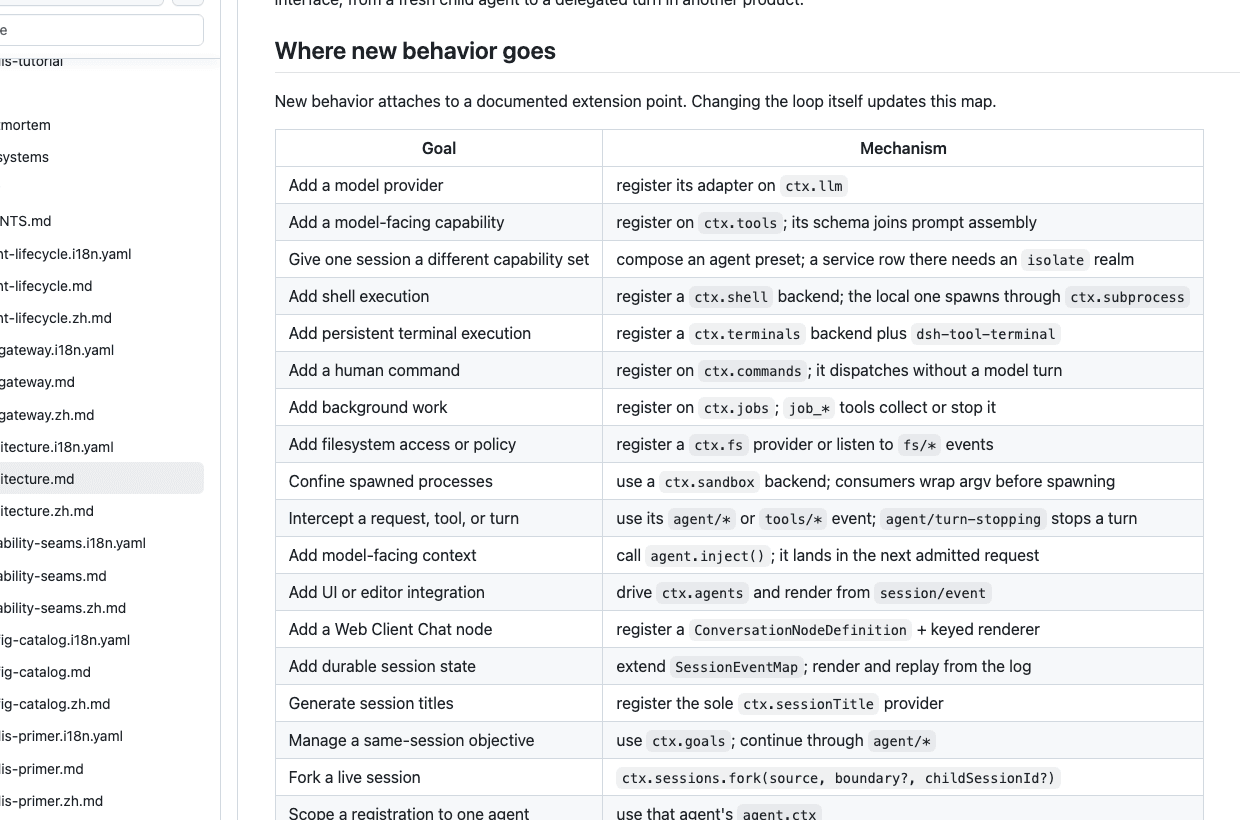
Official extension-point documentation shows the supported seams that repository reconnaissance needed to find. Source: DeepSeek Harness plugin documentation.
Zhidx says the workflow split repository discovery across four parallel explorers. Rather than asking one agent to roam through thousands of files serially, each explorer followed a specific architectural thread:
| Explorer | Question it traced | Why it mattered |
|---|---|---|
| CLI | Where commands enter and how user actions reach plugins | Identified how a persona-switch command should be exposed |
| Plugin system | How manifests and plugin assembly work | Prevented reliance on unsupported directory scanning |
| Model contract | How the LlmAdapter provider boundary is defined |
Kept the plugin away from model-provider internals |
| Message flow | Where prompts, history, and current user messages are composed | Revealed the correct system-prompt injection point |
Zhidx reports three findings that shaped the implementation. First, the harness assembled plugins through YAML manifests rather than scanning arbitrary directories. Second, model providers conformed to an LlmAdapter contract. Third, startup followed fail-fast behavior, so registration errors should surface immediately instead of leaving a half-configured runtime.
This is what productive repository exploration looks like: it ends in constraints. "There are many packages" is trivia. "Plugin assembly is manifest-driven, the prompt registry is the supported injection point, and initialization failures must be explicit" is an implementation map.
Parallel exploration is not automatically better. Agents can duplicate searches, produce contradictory summaries, or consume a great deal of context. Zhidx says additional parallel exploration used about 6.9 million tokens. That number is striking, but it lacks the detail needed for an efficiency comparison: cached versus uncached input, output tokens, exact model effort, number of subagents, and whether the count includes repeated repository content are not available in the public README.
The operational lesson is to give explorers narrow questions and require evidence such as file paths, exported symbols, manifests, and tests. Their summaries should be merged into one plan before code changes begin.
Persona plugin design
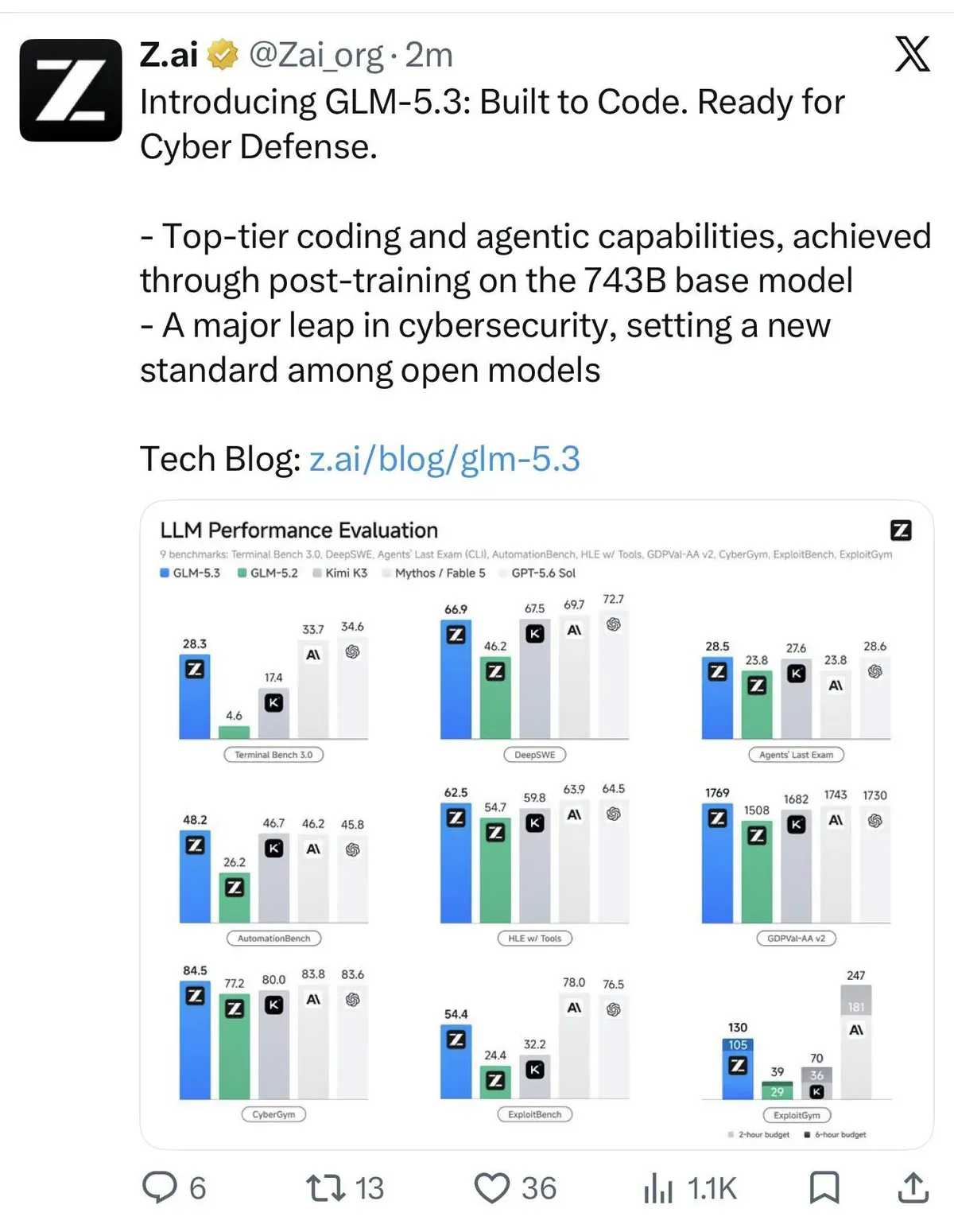
The launch post supplies model context and public reaction; it does not validate the persona-plugin outcome. Source: Z.ai GLM-5.3 launch post on X.
The public persona plugin repository corroborates the core design. It defines three persona values, adds a /yayan switching command, injects persona instructions through the system-prompt path, and removes the behavior when unloaded. The repository is MIT licensed.
The design can be summarized as a small state machine:
The crucial boundary is between system policy and conversation content. A persona is an instruction about how the assistant should answer. It should not masquerade as something the user said. Injecting it into a system-prompt registry preserves that distinction.
This produces several benefits:
- existing user messages remain unchanged;
- stored history does not accumulate persona prefixes;
- switching affects future generation without rewriting past turns;
- unloading can remove the registered contribution;
- tests can inspect plugin state and prompt composition separately.
Reversibility is more than polish. Plugins live inside long-running processes. If unload leaves a command, listener, prompt fragment, or state object behind, repeated loading can duplicate behavior and make tests order-dependent. A good plugin owns its registrations and disposes of them together.
The implementation also needed validation. Persona values should be enumerated rather than accepted as arbitrary strings. The slash command should report unsupported modes clearly. Startup should fail on a broken registration instead of silently continuing. These are ordinary engineering details, but they separate a demonstration from a component that can coexist with other plugins.
What the implementation changed
Zhidx says the initial implementation touched 20 files and added roughly 560 net lines. That scope reportedly included the plugin package, manifest wiring, command handling, persona definitions, prompt registration, tests, and documentation.
The raw line count does not tell us whether the patch was minimal. In a workspace-heavy TypeScript repository, adding one package can require metadata, exports, build configuration, bilingual docs, and test fixtures. Twenty files may be appropriate if each change follows an established pattern. It may also indicate that the agent performed extra documentation or generated boilerplate.
The more useful review questions are:
- Did the patch use existing extension points instead of changing core message handling?
- Did it avoid editing user content and stored history?
- Could the plugin be unloaded cleanly?
- Did it follow manifest and package conventions?
- Were invalid persona values and duplicate registration covered?
- Did docs match the actual command syntax?
- Could a maintainer understand why each file changed?
The public README supports the intended behavior, but a full architectural review would require checking the exact patch against the DeepSeek Harness commit it targeted. The harness repository was created only a day before the plugin's reported commit, so commit pinning matters. A plugin that matches one developer-preview snapshot may need changes as package boundaries settle.
The most convincing part was the failure analysis
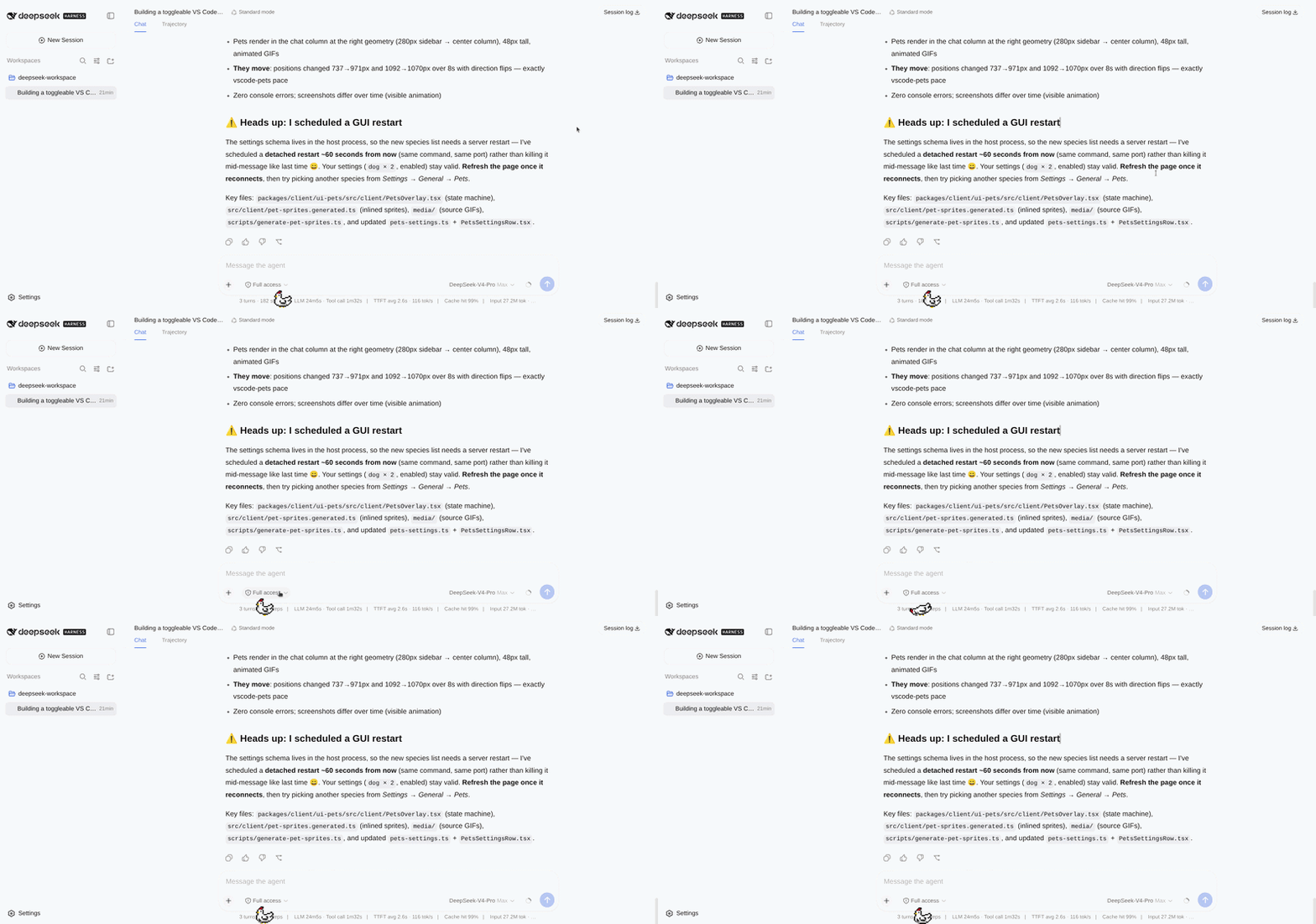
This community demo shows the Harness extension system in use; it is not the persona plugin and is not independent proof of the case-study claims. Source: DeepSeek Harness community plugin demo.
Zhidx reports that the plugin's focused unit suite passed 11 tests. A broader run then produced six failures across 771 test files. Stopping at either result would be misleading. "Eleven tests passed" proves only the focused cases. "Six tests failed" does not prove the patch caused them.
The article says the workflow removed the patch and reran the same broader tests against a clean baseline. The same six failures appeared. If performed on the same commit, machine, dependency state, command, and environment, that is strong evidence that the failures were pre-existing or environmental rather than regressions introduced by the plugin.
The logic is straightforward:
| Run | Plugin patch | Reported result | Interpretation |
|---|---|---|---|
| Focused unit run | Present | 11 passed | Plugin-specific cases passed in the reported environment |
| Broad suite | Present | 6 failures across 771 test files | Cause unknown |
| Clean baseline rerun | Removed | Same 6 failures | Supports a baseline or environment cause |
Zhidx also reports later checks in which 28 documentation gates and 937 bilingual documentation pairs passed. Those figures indicate attention to repository-wide policies, but they remain report-level claims rather than results we reproduced.
This section needs an explicit verification notice: Atoms did not run the original test. During our attempt to install the current public repositories, pnpm install stopped at a 404 for @deepseek-ai/dsh-environment. We therefore cannot confirm the 11-test result, the six-failure baseline comparison, or the documentation totals from live execution. They are attributed to Zhidx and the plugin README.
Even with that limitation, the reported diagnostic method is sound. When a broad suite fails in a new or unstable repository, rerun the same command on the untouched baseline. Keep the commit, lockfile, runtime, environment variables, and external services fixed. Without that control, "baseline failure" can become a convenient excuse.
What GLM-5.3 reportedly did well
It found extension points before patching
The workflow did not begin by modifying the message pipeline. It reportedly traced manifests, provider contracts, and prompt composition first. That reduced the risk of implementing persona behavior at the wrong layer.
It used parallelism for architectural reconnaissance
Four explorers had separate questions. This is a better pattern than launching several identical agents and hoping for diversity. The outputs could be compared and merged into a repository map.
It preserved semantic boundaries
System-prompt injection kept persona policy separate from user input and stored history. The plugin could switch behavior without corrupting previous turns.
It implemented rollback behavior
Unloading removed the persona behavior. Reversibility matters in plugin frameworks, test isolation, and production debugging.
It reportedly tested beyond the happy path
Focused tests were followed by a broad suite and documentation checks. The clean-baseline rerun, if executed as described, shows better judgment than simply labeling every red test a model failure.
None of these observations proves GLM-5.3 would reproduce the same result across other repositories. They show what a well-structured model-plus-harness workflow can look like in one reported case.
Where the workflow struggled
Zhidx's account also exposes costs that benchmark percentages tend to hide.
First, progress feedback was sparse. Long-running explorers can look stalled while they search or compact context. A human operator needs periodic, evidence-based updates: which architectural question is being answered, what paths were inspected, what remains uncertain, and whether the plan has changed.
Second, the human reportedly interrupted the process. Interruption is not necessarily failure; sometimes an agent has entered an expensive loop. But resumability should be part of harness design. An interrupted run should preserve discoveries, current hypotheses, modified files, and pending verification instead of restarting from scratch.
Third, exhaustive checks can be disproportionate for low-risk edits. Running hundreds of test files and almost a thousand documentation-pair checks may be justified by repository policy, yet the workflow should stage validation: focused tests first, affected-package checks next, then broader gates when the patch is ready. This gives faster feedback and prevents every small correction from triggering the full cost.
Fourth, the reported token use was high. About 6.9 million exploration tokens cannot be judged without cache accounting and task boundaries, but it is enough to demand an efficiency audit. Parallel agents often reread the same manifests, package metadata, and architecture docs. Shared retrieval notes and deduplicated context can reduce that waste.
Finally, the public dependency problem blocks straightforward reproduction. A developer preview whose required package returns 404 cannot support a clean external install, regardless of model quality. Evaluation reports should preserve the exact lockfile, package registry, commit SHAs, and any private or pre-release artifacts used during the original run.
What this proves about models and harnesses
The case does not prove that GLM-5.3 read every one of 7,400 files, that it is the best coding model, or that it can autonomously maintain any unfamiliar monorepo. "Read 7,400 files" is a headline shorthand for repository-scale navigation. Effective agents usually inspect indexes, manifests, search results, dependency graphs, and a targeted subset of source files.
It does support a narrower thesis: a capable model, given a harness that can parallelize discovery, preserve tool state, expose repository evidence, and run verification, can move quickly in a new codebase. The model supplies reasoning and code generation. The harness determines what the model can observe, which actions it can take, how context is shared, and how failures become feedback.
Four layers affect the outcome:
| Layer | Questions to ask |
|---|---|
| Model | Can it infer architecture, write code, and revise after feedback? |
| Harness | Can it search, edit, test, parallelize, compact context, and resume? |
| Environment | Are dependencies, registries, credentials, and services available? |
| Evaluation | Are success criteria objective, repeated, and compared with baseline? |
This is why model-only leaderboard results transfer imperfectly to real coding. A strong model in a weak harness may waste turns or miss state changes. A good harness cannot rescue a model that repeatedly misunderstands the code, but it can make competent reasoning far more usable.
For teams evaluating agent workflows, Atoms Engineer Agent provides a relevant example of structured coding-agent work.
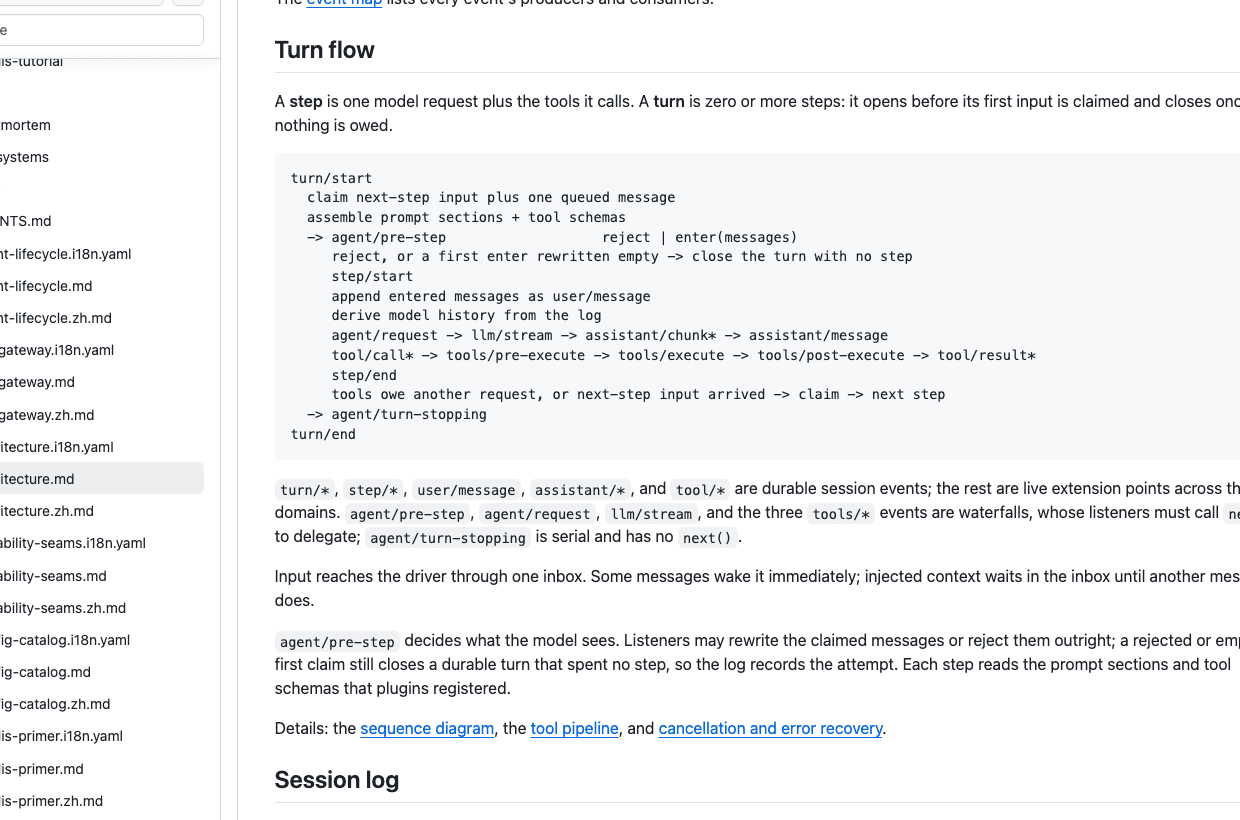
The official turn flow helps separate model behavior from prompt assembly, tools, durable events, and harness stopping logic. Source: DeepSeek Harness architecture documentation.
What it means for Atoms
Atoms did not execute the Zhidx experiment, and this article does not claim that the same plugin was built inside Atoms. The relevant connection is workflow design.
The reported case separates repository mapping, implementation, testing, and failure analysis. Atoms applies a similar division of labor at the product level through AI agent teams. Specialized agents can work across product planning, architecture, engineering, design, SEO, analytics, and deployment while sharing project context and acceptance criteria.
For coding work, the Engineer Agent and coding-agent workflows are useful starting points. The point is not to imitate the cat-speak plugin. It is to make the plan-build-test-review loop visible and to judge the finished product rather than a plausible code diff.
A product build also introduces checks beyond repository tests: responsive behavior, accessibility, analytics, search visibility, deployment configuration, and whether the application solves the requested problem. Model benchmarks rarely cover that complete chain.
A reproducible evaluation checklist
Anyone trying to reproduce or extend this case should publish enough detail for another engineer to rerun it.
Freeze the inputs
- Record the exact DeepSeek Harness commit SHA.
- Record the plugin commit SHA, package manager, runtime versions, OS, and architecture.
- Preserve the lockfile and registry configuration.
- List every pre-release, private, or unavailable package.
- Archive the original user prompt and explorer assignments.
The public plugin commit referenced in the handoff is 230d5cd, dated August 14, 2026 at 04:31 +08. The DeepSeek repository itself was created through GitHub on August 13, 2026. Those dates help establish sequence but do not replace exact commit pinning for every dependency.
Specify the model condition
- Use the effective model ID, not a friendly alias.
- Record API provider, reasoning effort, temperature, context policy, and maximum output.
- Capture subagent count and which prompts each explorer received.
- Separate cached input, uncached input, reasoning/output tokens, and retries.
- State whether the agents shared notes or reread the repository independently.
Define objective acceptance criteria
At minimum, verify:
- each supported persona can be selected;
- invalid values return a clear error;
- persona text enters through the system-prompt registry;
- user messages and stored history remain byte-for-byte unchanged;
- switching mode affects future responses;
- unloading removes commands, listeners, prompt entries, and state;
- reload does not duplicate registration;
- focused tests pass;
- the affected package builds and type-checks;
- broader failures are compared against the untouched baseline.
Preserve failure evidence
For every failed command, store the command line, exit code, stdout, stderr, duration, environment assumptions, and repository status. If a baseline rerun is needed, use the same machine state where possible and document any difference.
The current installation blocker should be part of any reproduction report:
Do not quietly replace a missing package with a local stub and then call the test reproduced. A stubbed run can be useful, but it is a different condition and must be labeled.
Report unsuccessful attempts
Publish timeouts, interruptions, wrong turns, and failed patches alongside the successful trajectory. Otherwise readers cannot assess reliability or cost per success. A single polished transcript is a case study, not a distribution.
Frequently asked questions
01Did GLM-5.3 really read 7,400 files?
A local shallow clone of DeepSeek Harness contained 7,412 tracked files, so the repository-scale figure is credible. That does not mean the model opened every file. Zhidx's wording is best understood as navigating and mapping a repository of that size.
02Who ran the test?
Zhidx conducted and reported the pre-release test. Atoms did not run the original experiment.
03Is this an independent benchmark?
No. It is an attributed case study with a public output repository. It lacks the repeated runs, fixed comparison conditions, raw trajectories, and complete reproducibility package expected of a formal benchmark.
04What is DeepSeek Harness?
DeepSeek Harness, or dsh, is an open-source developer-preview agent harness from DeepSeek AI. It is powered by Cordis and uses a plugin-based architecture.
05What did the persona plugin do?
It switched the assistant among Classical Chinese (wenyan), Northeastern Chinese (dongbei), and cat-speak (maoyu) modes. The public README documents a /yayan command, system-prompt injection, and reversible unloading.
06Why inject through the system prompt?
A persona is system behavior, not user content. System-prompt registration avoids modifying user messages or stored history and makes the behavior easier to remove.
07Did all tests pass?
The plugin README says 11 focused unit tests passed. Zhidx reports six failures in a broader run across 771 test files, followed by the same six failures on a clean baseline. It also reports 28 documentation gates and 937 bilingual documentation pairs passing. We could not rerun these claims because installation was blocked by a missing package that returned 404.
08Does the clean-baseline rerun prove the patch was correct?
No. It supports the conclusion that those six particular failures were not introduced by the patch, assuming the rerun held all other conditions constant. It does not prove there were no untested defects.
09How many tokens did the workflow use?
Zhidx reports about 6.9 million tokens for additional parallel exploration. Public evidence does not provide enough cache, output, retry, or subagent detail to compare that figure fairly with another setup.
10Can I run DeepSeek Harness now?
The official README documents npx @deepseek-ai/dsh web. However, our source-based reproduction attempt was blocked during pnpm install by a 404 for @deepseek-ai/dsh-environment. The developer preview may change quickly, so check the repository's current issues and package availability.
11Is the plugin open source?
Yes. The public persona plugin repository uses the MIT license.
Take the workflow beyond a demo
A successful plugin is useful evidence, but a finished product demands planning, architecture, implementation, testing, review, and deployment. Start a project in Atoms to run that coordinated loop without assembling a local multi-agent harness from scratch.
Sources
- DeepSeek AI: DeepSeek Harness repository
- DeepSeek Harness README
- Public persona plugin for DeepSeek Harness
- Zhidx-attributed case-study mirror: "GLM-5.3" and DeepSeek Harness
- Z.ai: GLM-5.3 launch announcement
- GLM-5.3 complete guide on Atoms
Ox Alpha: the anonymous model that turned out to be Z.AI's GLM line
In August 2026, an anonymous model called Ox Alpha appeared on OpenRouter with a one-week free-access promotion. Developers and Reddit users spent several days trying to identify its provider. Bloomberg later reported that Z.AI confirmed Ox Alpha was a new iteration of its GLM series and planned to release the weights.
The episode matters because it was not only a launch stunt. Early developer reports focused on coding and agent tasks, while the model's identity was investigated through serving behavior, tokenizer and output fingerprints, and error-message similarities. Those community tests are evidence of the investigation—not a substitute for an official model card or a controlled benchmark.
What the early evidence says
- The supplied DeepSWE screenshot reports an 80% mean on a 10-task subset for Ox Alpha, compared with 65% for Claude Fable 5 and 52% for GPT-5.6 Sol. This is a small, community-shared sample and should not be treated as a definitive leaderboard.
- OpenCode's announcement described a 1M context window, multimodal support, zero data retention, generous limits, and claimed capacity. These are service claims from a social post and require separate verification for current availability and terms.
- The practical signal is strongest in software engineering: repository changes, tool use, debugging, and long-horizon coding—not generic chat quality.
- Z.AI's public GLM-5.3 documentation is the authoritative reference for the GLM product line; Ox Alpha's exact public checkpoint name, weights, license, and serving configuration should be verified against Z.AI's release materials before deployment.
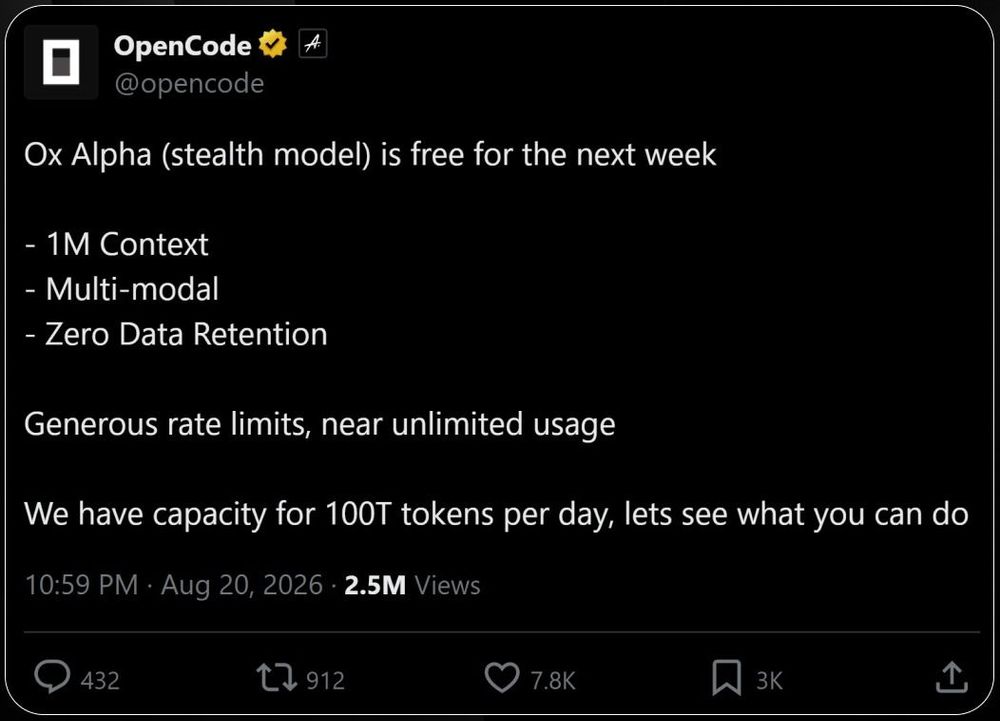
OpenCode's Ox Alpha announcement, cropped to remove unrelated publisher branding. This image documents a social-media claim, not independent verification.
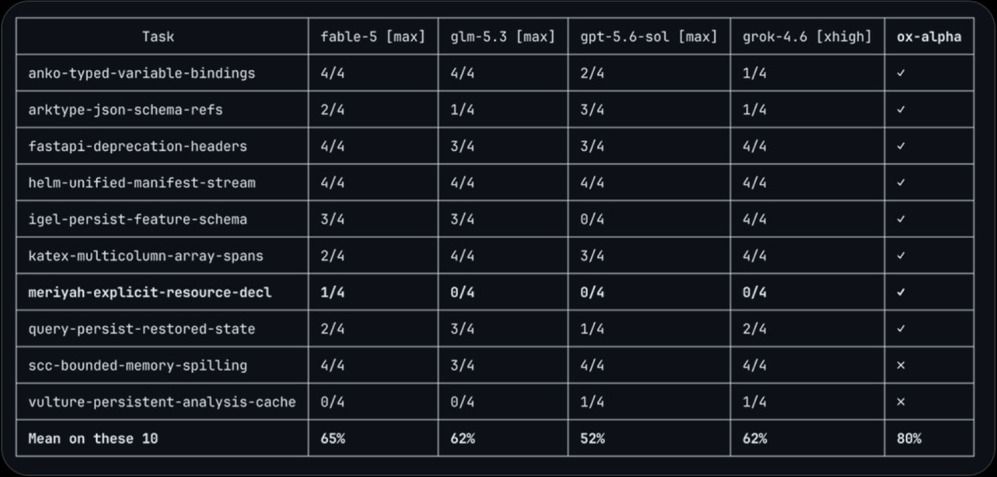
Community-shared DeepSWE subset comparison. The image itself notes that the sample is only ten tasks; it should not be generalized to overall model quality.
For builders, the right takeaway is not “Ox Alpha beats every model.” It is that Z.AI demonstrated a high-attention path from anonymous preview to confirmed GLM release, while the strongest early user signal appeared in coding workflows. Test the exact model, harness, prompt, context, retries, and accepted changes before making a production decision.
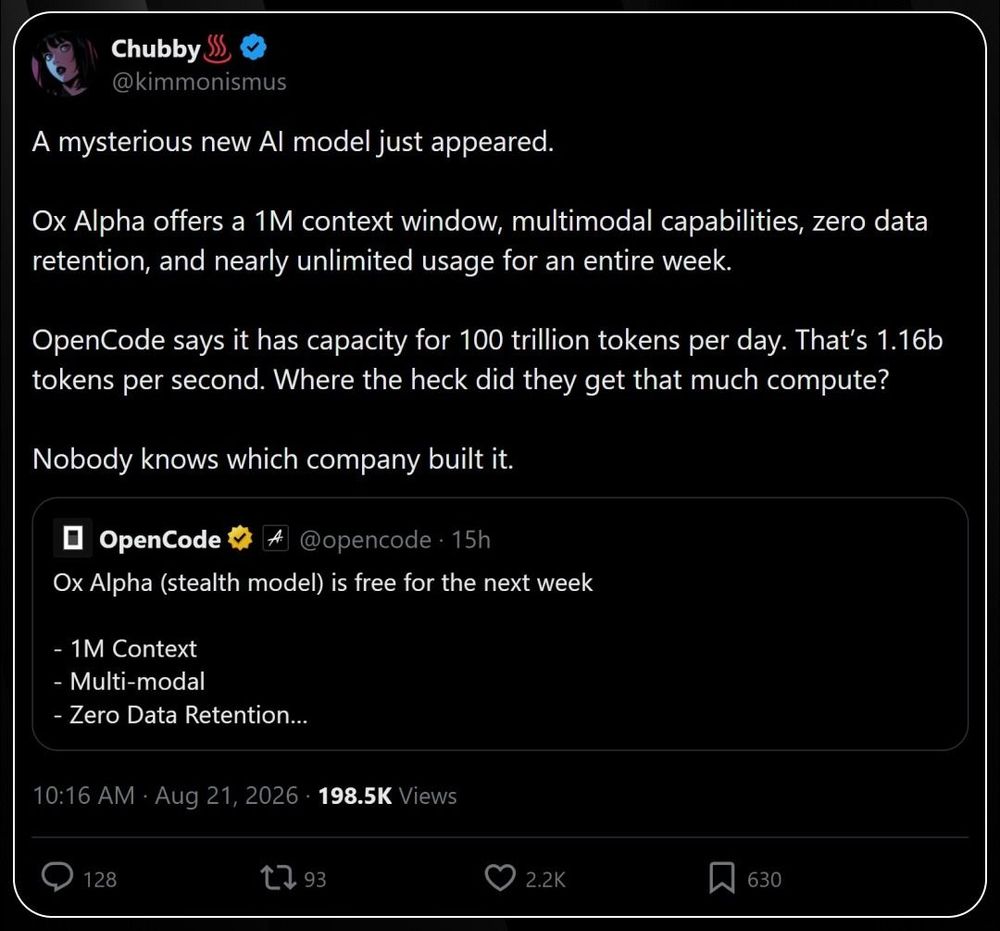
Ox Alpha evidence image, cropped to remove unrelated Evolving AI publisher branding. Treat social posts and community benchmark claims as reported evidence, not independent verification.
