On this page
GPT-5.6 Sol, Claude Fable 5, and GLM-5.2 arrive at the same moment with very different priorities. Sol is designed as a broad, tool-ready frontier model. Fable focuses on difficult analytical work that may run for a long time. GLM-5.2 competes through low API pricing, fast generation, a one-million-token context window, and downloadable weights.
There is no single winner for every workload. For most teams choosing one hosted model, GPT-5.6 Sol is the strongest default. For expensive research and judgment-heavy work, Claude Fable 5 deserves the first trial. For open deployment, Chinese-language workflows, or strict cost control, GLM-5.2 offers the clearest advantage.
This review compares the models as systems—not just as benchmark scores—using provider documentation and independent results published by Artificial Analysis.
The Short Verdict
- Best overall: GPT-5.6 Sol
- Best for premium analytical work: Claude Fable 5
- Best for coding agents: GPT-5.6 Sol in the current Artificial Analysis comparison
- Best API value: GLM-5.2
- Best for self-hosting: GLM-5.2
- Best raw generation speed: GLM-5.2 in the referenced snapshot
- Best for polished visual deliverables: GPT-5.6 Sol
A one-point benchmark gap should not decide a procurement decision. Tool reliability, output length, deployment options, retries, and human review can matter more than a small difference in an aggregate index.
Key Specifications
| Category | GPT-5.6 Sol | Claude Fable 5 | GLM-5.2 |
|---|---|---|---|
| Provider | OpenAI | Anthropic | Z.ai / Zhipu AI |
| Access | Hosted | Hosted | Hosted and open weights |
| Context window | 1.05M tokens | 1M tokens | 1M tokens |
| Maximum output | 128K tokens | 128K tokens | 128K tokens |
| Native input | Text and images | Text and images | Text |
| Input price / 1M tokens | $5 | $10 | $1.40 |
| Output price / 1M tokens | $30 | $50 | $4.40 |
| Cached input / 1M tokens | $0.50 | $1 | $0.26 |
| Intelligence Index snapshot | 59 | 60 | 51 |
| Output speed snapshot | 78 tok/s | 62.9 tok/s | 191.4 tok/s |
The independent scores and speeds are a July 2026 snapshot from Artificial Analysis. Provider configuration, reasoning effort, serving tier, and agent harness can all change the observed result.
What Each Model Is Optimizing For
GPT-5.6 Sol: the balanced flagship
OpenAI presents GPT-5.6 as a family. Sol is the flagship tier, while Terra and Luna target lower-cost or faster work. Sol's practical advantage is breadth: it combines high-end reasoning with coding, image understanding, computer use, file work, and a large first-party tool surface.
That makes Sol a good default when a workflow crosses several boundaries. A single task might begin with research, move into code and data analysis, and end as a presentation or spreadsheet. Sol is not the cheapest option, but it is less expensive than Fable at list price and currently has the clearest independent coding-agent lead among these three.
The main caveat is long-context pricing. Once a Sol request exceeds 272,000 input tokens, OpenAI applies higher rates to the full request. Teams planning to send very large repositories or document collections repeatedly should use retrieval and caching instead of treating the full context window as free storage.
Claude Fable 5: premium analysis and persistence
Fable 5 is positioned for work where quality is worth more than latency. It leads the referenced Artificial Analysis Intelligence Index by one point and has a larger advantage in the analytical and rubric-based parts of AA-Briefcase.
That pattern matters for tasks such as investment research, policy analysis, technical investigations, and complex writing projects. These jobs are not won by producing an answer quickly; they are won by preserving qualifications, resolving contradictions, and following a demanding brief across many steps.
Fable is also the most expensive model in this comparison and the slowest in the cited speed snapshot. Its value therefore depends on whether the quality improvement reduces revisions or prevents costly mistakes.
GLM-5.2: open, fast, and cost-efficient
GLM-5.2 takes a different route. It offers hosted access at much lower prices and publishes downloadable weights. Its model card describes a mixture-of-experts system with roughly 744 billion total parameters and about 40 billion active parameters per token.
The open-weight option gives teams control over hosting, networking, logging, and update timing. It also shifts responsibility for serving, security, observability, and capacity planning to the operator. This is not a laptop-scale model, so self-hosting remains a serious infrastructure project.
GLM's measured generation speed is impressive, but speed should be interpreted alongside output length. In Artificial Analysis testing, GLM used substantially more output tokens than Sol. A fast model that produces twice as much text may still require more review and tighter prompting.
Reasoning and Professional Work
The overall Intelligence Index scores—60 for Fable, 59 for Sol, and 51 for GLM—summarize the current hierarchy, but the category-level pattern is more useful.
Fable is the strongest first choice when the deliverable is primarily an argument: interpret a large evidence set, make careful judgments, and satisfy a detailed rubric. Sol comes close on general intelligence and is stronger when the final result must also be visually polished or assembled through tools. GLM remains highly capable for its price, especially when outputs can be verified automatically or reviewed by a human.
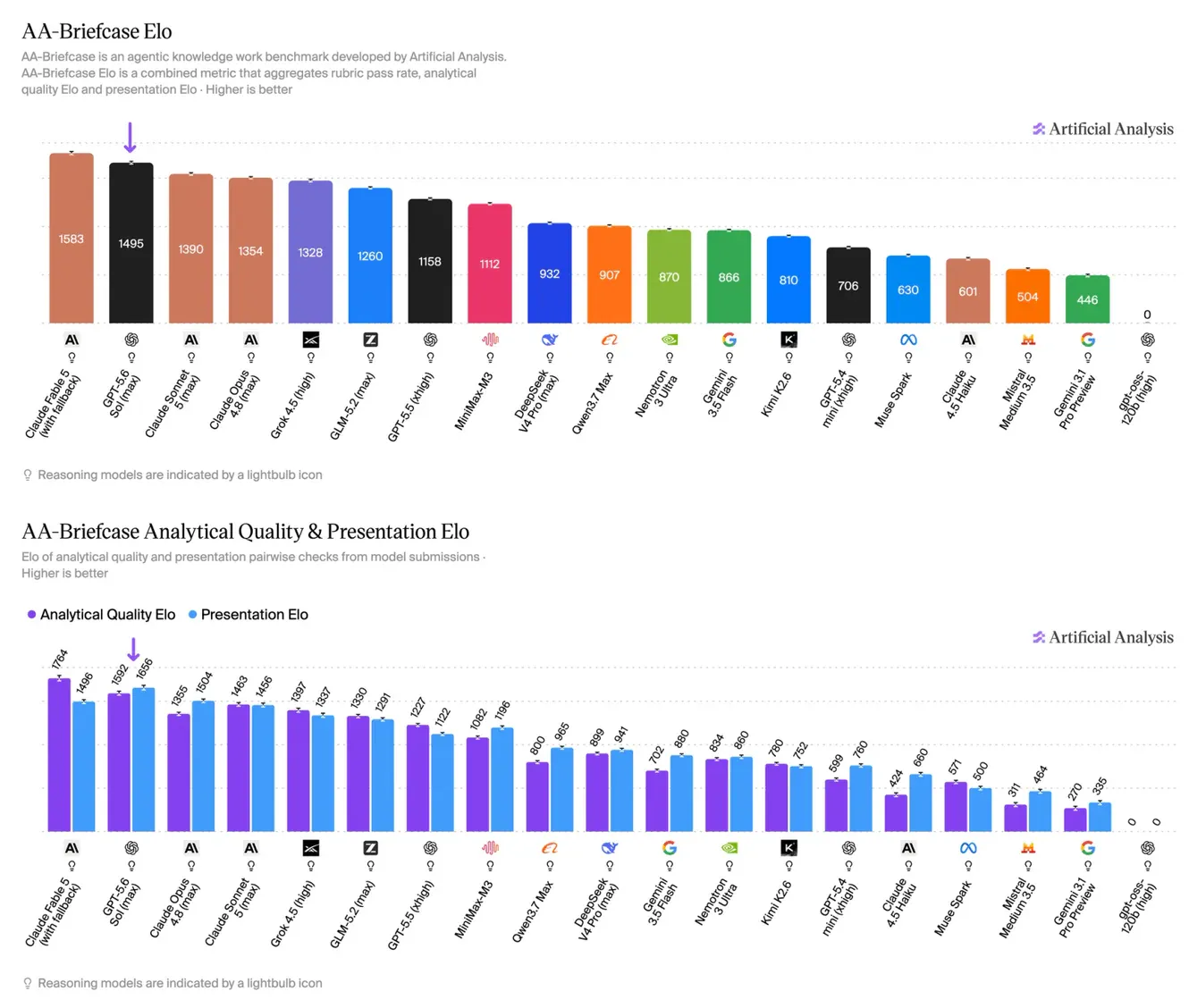
Artificial Analysis reports that GPT-5.6 Sol ranks just behind Fable 5 in AA-Briefcase while leading Presentation Elo. Source: Artificial Analysis.
A useful way to frame the choice is by the cost of a mistake:
- If a weak conclusion could invalidate an expensive project, test Fable first.
- If the work combines analysis, tools, coding, and presentation, start with Sol.
- If the workflow has strong automated checks and runs at high volume, test GLM first.
Coding and Agentic Work
Coding is Sol's strongest evidence-backed category. Artificial Analysis places Sol Max at 80 on its Coding Agent Index in the Codex harness. That evaluation combines repository and terminal-oriented tasks rather than isolated code completion.
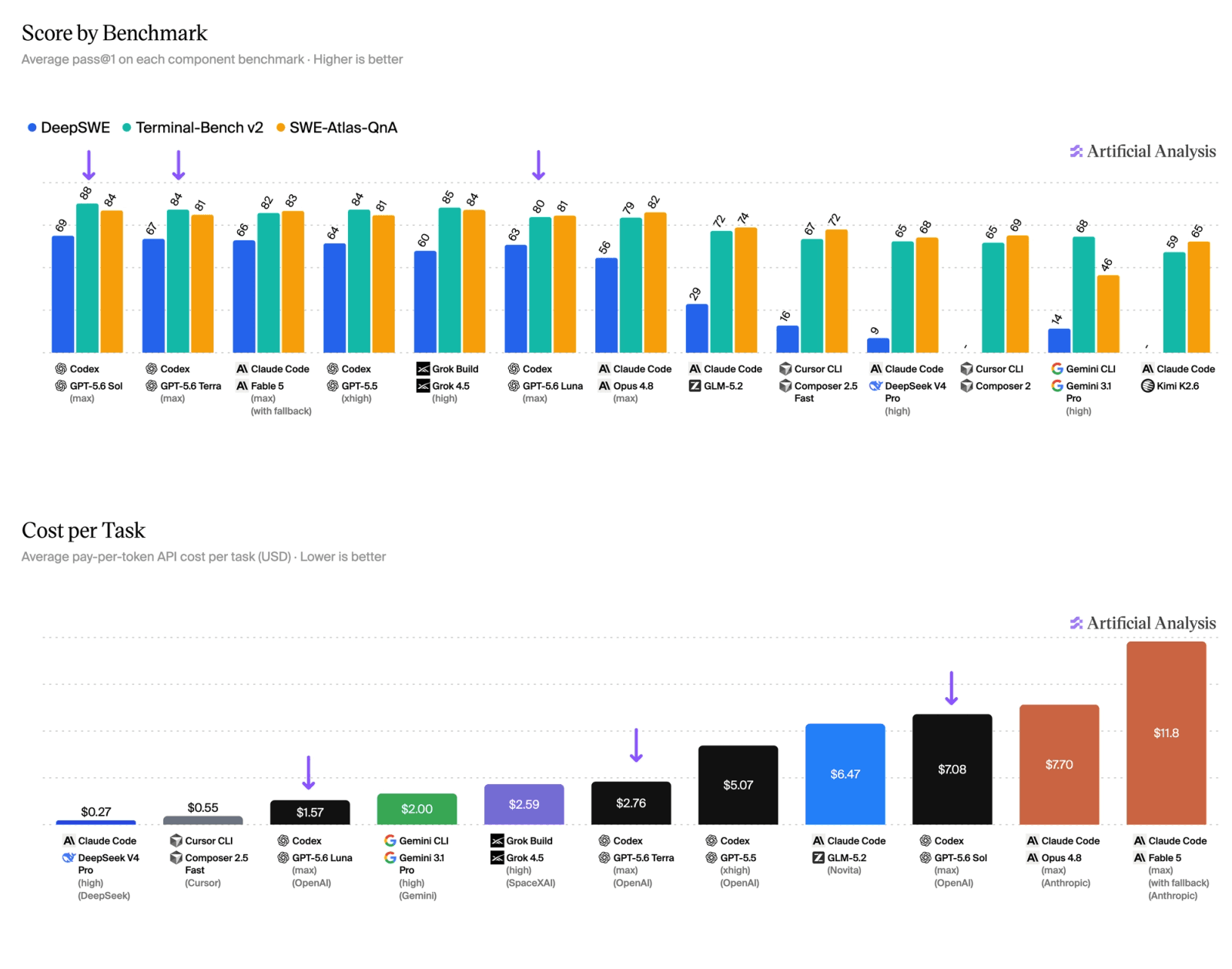
GPT-5.6 Sol leads the referenced Coding Agent Index in the Codex harness. Source: Artificial Analysis.
The harness caveat is important. Codex and Claude Code provide different tools, prompts, context management, and recovery behavior. A system-level result does not isolate the model. Teams should test the models inside the exact agent environment they intend to deploy.
A practical coding shortlist looks like this:
- Use Sol by default for hosted coding agents, repository changes, terminal work, and tool-heavy implementation.
- Test Fable on the hardest migrations or research-heavy debugging where persistence and judgment matter more than speed.
- Choose GLM when governance or deployment control is mandatory, then enforce tests, static analysis, and code review around every change.
Long Context Is Not the Same as Long-Term Reliability
All three models accept roughly one million tokens, and all list up to 128,000 output tokens. Those numbers describe capacity, not perfect recall.
A large context window does not guarantee that a model will find every buried detail, reconcile conflicting instructions, or maintain the same plan through a long tool-using run. Retrieval, file-based notes, prompt caching, compaction, and task-specific evaluations remain necessary.
Pricing also changes the picture:
- Fable keeps standard per-token rates across its advertised one-million-token window.
- GLM's current price table does not show a separate long-context premium.
- Sol applies a surcharge when input exceeds 272,000 tokens.
For routine work over giant repositories, the best architecture is usually not to resend the entire repository. Index the source, retrieve relevant files, cache stable instructions, and measure whether additional context actually improves completion rate.
Tooling and Multimodality
Sol has the broadest documented first-party tool surface: web and file search, code execution, hosted shell, patch application, computer use, MCP, function calling, structured outputs, and other managed capabilities. This can reduce the amount of infrastructure required to build a production agent.
Fable supports image input and tool use through the Claude API and Claude Code ecosystem. Its enterprise distribution across several cloud platforms may be decisive for organizations already standardized on those vendors.
GLM-5.2 supports function calling, structured output, caching, and MCP integration, but the base model is text-only. Visual workflows require a separate perception model. Open weights allow a fully custom tool environment, but the team owns the sandboxing, permissions, retries, and monitoring.
For consequential actions—deployments, purchases, account changes, or desktop control—none of the three should operate without constrained permissions and confirmation gates.
Pricing: Token Cost vs Successful-Task Cost
List prices make GLM the clear low-cost option. Sol is the better-priced proprietary flagship, while Fable carries a premium.
For a simplified request with 100,000 input tokens and 20,000 output tokens, before tools and caching:
- GPT-5.6 Sol: approximately $1.10
- Claude Fable 5: approximately $2.00
- GLM-5.2: approximately $0.23
Those estimates are not a complete cost model. The real metric is cost per accepted result. Include:
- Output tokens generated
- Retry rate
- Tool-call charges
- Infrastructure and GPU utilization
- Human review time
- Failure impact
A cheap model that needs several attempts can lose its advantage. An expensive model can be economical if it succeeds on the first run and saves hours of expert review.
Recommendations by Workload
Choose GPT-5.6 Sol when
- You want one high-end model for mixed professional work.
- Coding agents and tool integration are central to the workflow.
- You need image understanding or polished presentations and spreadsheets.
- You want near-leading intelligence at a lower list price than Fable.
Choose Claude Fable 5 when
- The task is analytical, ambiguous, and expensive to get wrong.
- Long-running research or complex source synthesis dominates the workload.
- A small quality improvement is worth higher latency and cost.
- Your organization prefers Anthropic or an existing enterprise cloud channel.
Choose GLM-5.2 when
- API budget is the primary constraint.
- Open weights or controlled deployment are required.
- Chinese-language workflows are important.
- High-volume output can be checked by tests, rules, or human reviewers.
- Native image input is not required.
Final Take
If the workload is unknown, GPT-5.6 Sol is the safest overall choice. It combines near-leading independent intelligence with the strongest coding-agent result in the referenced comparison, a broad tool ecosystem, image input, and better list pricing than Fable.
Claude Fable 5 is the specialist choice for premium analytical work. Its overall lead is narrow, but its stronger analytical-quality evidence makes it attractive when judgment and rubric adherence carry high value.
GLM-5.2 is the strategic choice for cost and control. It trails the proprietary leaders in the overall index, yet its price, speed, Chinese ecosystem, and open weights make it uniquely useful.
The best procurement process is a small workload-specific evaluation. Give each model the same representative tasks, run it in the intended tool harness, and score accepted-result quality, latency, retries, output length, and total cost. Frontier model selection is now a systems decision—not a leaderboard decision.
Sources
- OpenAI: GPT-5.6 announcement
- OpenAI Developers: GPT-5.6 Sol
- Anthropic: Claude Fable 5 and Claude Mythos 5
- Anthropic documentation: Models overview
- Z.ai: GLM-5.2 announcement
- Z.ai documentation: GLM-5.2
- GLM-5.2 model card
- Artificial Analysis: GPT-5.6 benchmarks
Disclosure: This is a documentation- and benchmark-based comparison, not a controlled private benchmark. Scores, prices, and availability are a July 2026 snapshot. Benchmark images are reproduced for comparison and commentary; the original publisher retains ownership.
Ox Alpha: the anonymous model that turned out to be Z.AI's GLM line
In August 2026, an anonymous model called Ox Alpha appeared on OpenRouter with a one-week free-access promotion. Developers and Reddit users spent several days trying to identify its provider. Bloomberg later reported that Z.AI confirmed Ox Alpha was a new iteration of its GLM series and planned to release the weights.
The episode matters because it was not only a launch stunt. Early developer reports focused on coding and agent tasks, while the model's identity was investigated through serving behavior, tokenizer and output fingerprints, and error-message similarities. Those community tests are evidence of the investigation—not a substitute for an official model card or a controlled benchmark.
What the early evidence says
- The supplied DeepSWE screenshot reports an 80% mean on a 10-task subset for Ox Alpha, compared with 65% for Claude Fable 5 and 52% for GPT-5.6 Sol. This is a small, community-shared sample and should not be treated as a definitive leaderboard.
- OpenCode's announcement described a 1M context window, multimodal support, zero data retention, generous limits, and claimed capacity. These are service claims from a social post and require separate verification for current availability and terms.
- The practical signal is strongest in software engineering: repository changes, tool use, debugging, and long-horizon coding—not generic chat quality.
- Z.AI's public GLM-5.3 documentation is the authoritative reference for the GLM product line; Ox Alpha's exact public checkpoint name, weights, license, and serving configuration should be verified against Z.AI's release materials before deployment.
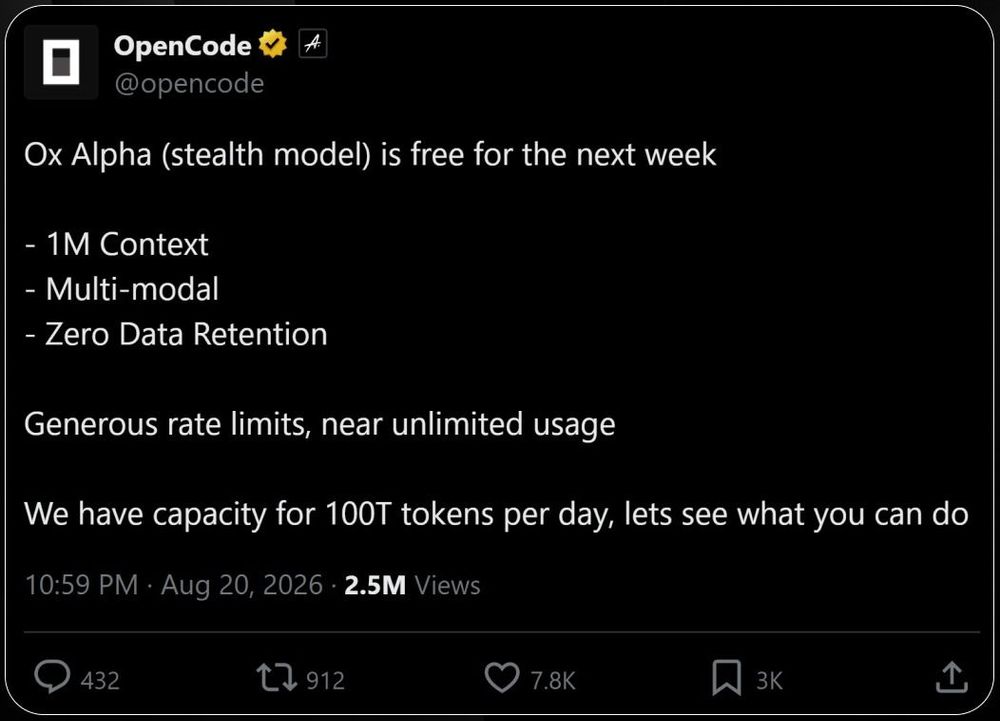
OpenCode's Ox Alpha announcement, cropped to remove unrelated publisher branding. This image documents a social-media claim, not independent verification.
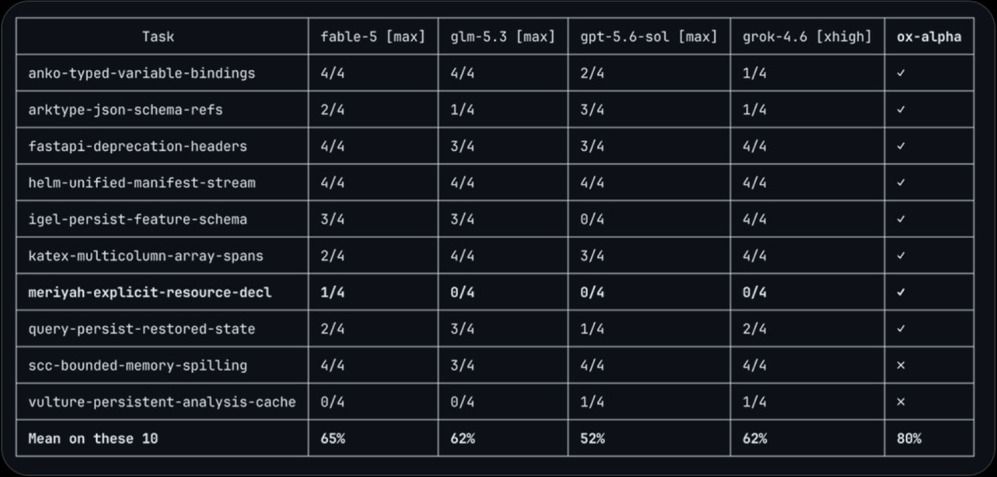
Community-shared DeepSWE subset comparison. The image itself notes that the sample is only ten tasks; it should not be generalized to overall model quality.
For builders, the right takeaway is not “Ox Alpha beats every model.” It is that Z.AI demonstrated a high-attention path from anonymous preview to confirmed GLM release, while the strongest early user signal appeared in coding workflows. Test the exact model, harness, prompt, context, retries, and accepted changes before making a production decision.

Ox Alpha evidence image, cropped to remove unrelated Evolving AI publisher branding. Treat social posts and community benchmark claims as reported evidence, not independent verification.
