On this page
The first public GPT-6 Astra demos are less about answering questions and more about finishing projects.
Early users have shown Astra building a 3D iPod interface in Blender, reconstructing a home from listing photos, assembling playable game prototypes, creating a Three.js scene, and producing music inside Ableton. One developer even used it to build a Mac app around Codex threads in about 15 minutes.
This article focuses on those early builds. For the model announcement, rollout, pricing, and technical background, read our separate GPT-6 Astra release guide.
Most of these demos combine GPT-6 Astra with tools such as Codex, Blender, Unreal Engine, browser automation, plugins, or custom agent scaffolding. The notable part is not the claim that one prompt replaces a production team. It is that the model can keep working across a chain of tools long enough to produce something that can be opened, tested, and revised.
The 3D demos changed the conversation
The clearest early signal is spatial work.
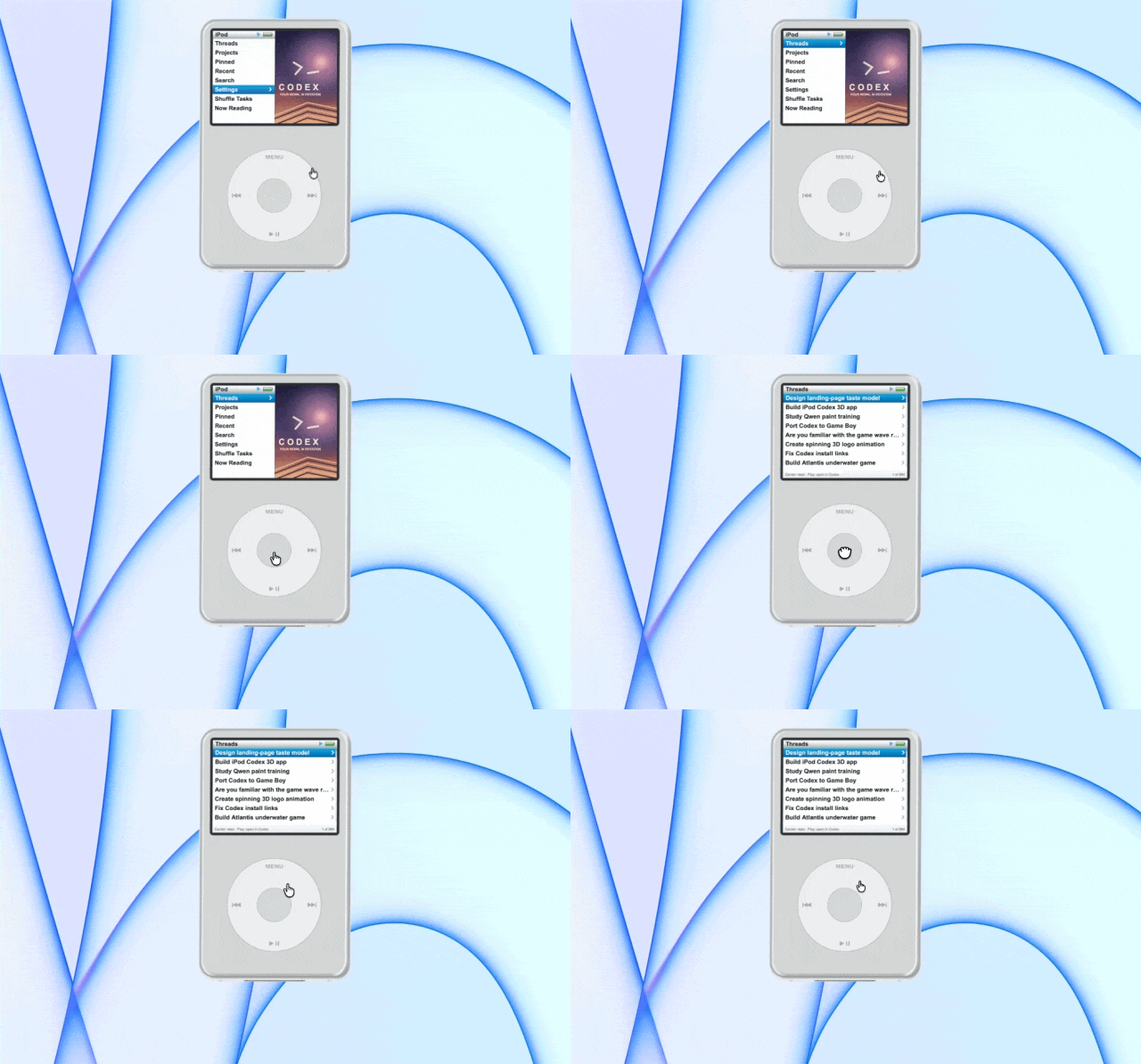
Pietro Schirano's public demo presents a 3D iPod-style Mac interface for browsing Codex threads. The animation documents the reported result, not the full build process. Source
In one public comparison, GPT-6 Astra and Fable 5.1 were asked to build a seaside house in Blender. Both systems produced the basic structure. Astra's version went further, adding details such as sofa folds, tableware, poolside objects, and distant vegetation. That difference matters because 3D work is rarely difficult only because of the first blockout. The time disappears in the small decisions that make a scene feel inhabited.
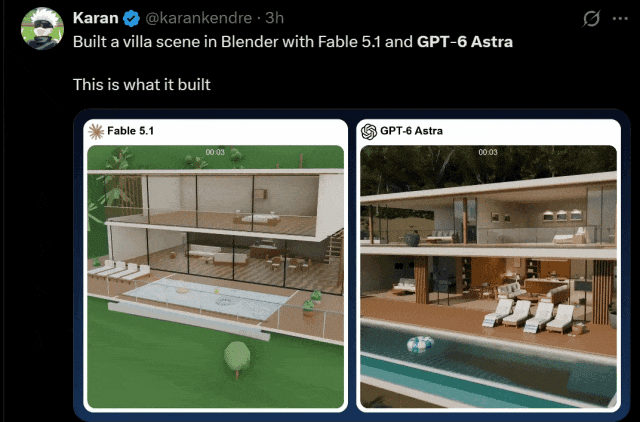
A public comparison shows two Blender villa renders labeled Fable 5.1 and GPT-6 Astra. The screenshot does not independently verify the tools or generation process. Source
Another demo started with a real estate listing. Astra used the home's photographs to reconstruct a 3D version and create a promotional video. The result was not perfectly accurate, and it was a single pass, but the workflow is already recognizable: inspect references, infer missing geometry, place furnishings, and produce a presentation asset.
The scale-up is even more striking. A public demo described Astra building a simplified Manhattan scene over the course of a week, moving along streets and filling in buildings, Central Park, and the surrounding city outline. That is not evidence that an AI can reproduce a city without supervision. It is evidence that long-running visual tasks are becoming practical enough to attempt.
A separate production test from Higgsfield used Astra for a museum scene. The model first worked out the venue layout, then planned the cast, shot list, and actor movement so the performers would remain in frame. Seedance 2.5 handled the shot rendering afterward. In this workflow, Astra did more than place objects. It had to reason about movement, camera coverage, and the constraints of a finished shot.
It can make games, and it can play them
Game demos show two different abilities: operating inside a game and building a game that someone else can play.
GPT-5.6 Sol reportedly needed 96 hours and 35 minutes to finish Pokemon FireRed in an earlier test. GPT-5.5 did not finish after more than 218 hours. In the published early-access example, GPT-6 Astra completed the game in 18 hours and 12 minutes, relying mainly on screenshots rather than a complete memory dump, a walkthrough, or constant human instructions.
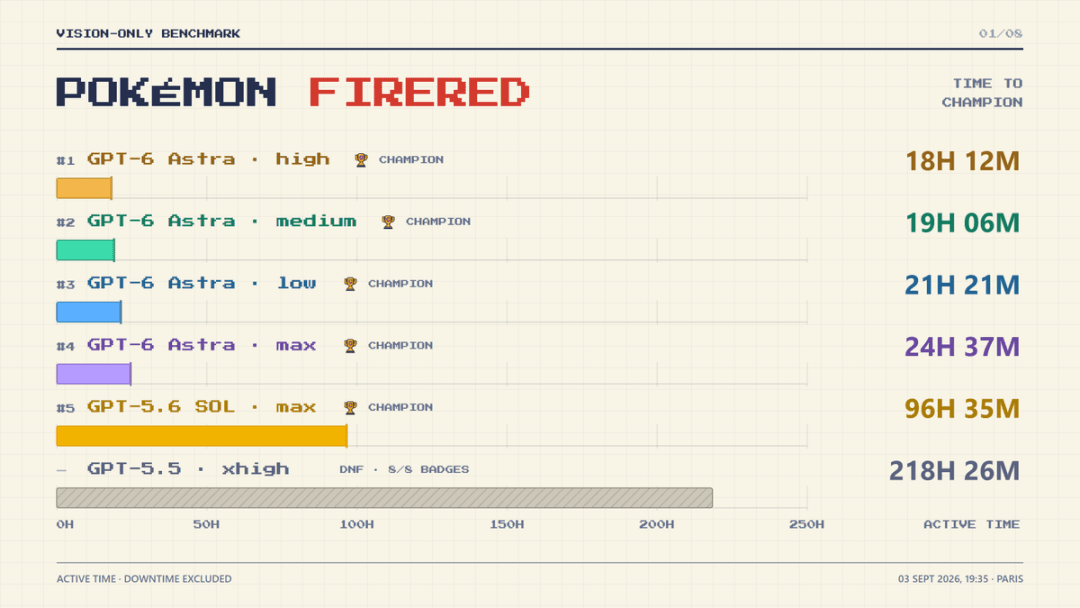
*The shared benchmark graphic reports active time for several GPT runs. Its creator and full methodology are not identified in the image, so the figures should be treated as reported results rather than an independently reproduced benchmark. *
That kind of task requires a loop: read the screen, recognize the map, choose a route, fight, level up, recover from mistakes, and decide what to do next. A shorter completion time does not mean the model understands the game like a human player, but it does show progress in visual state tracking and repeated computer use.
The other side of the story is game creation. Matthew Berman asked Astra to make a Fall Guys-style obstacle game. The prototype included a playable interface, rotating bars, swinging obstacles, and elimination at the finish line. Another demonstration paired Astra with Tesana Game Maker to produce a Halo-style 10-versus-10 shooter with a map, weapons, team combat, and multiplayer logic.
A separate comparison gave Astra and Fable 5.1 the same prompt for a GTA-style driving game. Both systems produced explorable cities. Astra reportedly finished in about 90 minutes, compared with roughly two hours for Fable, and included streets, buildings, vehicles, pedestrians, and a mission interface.
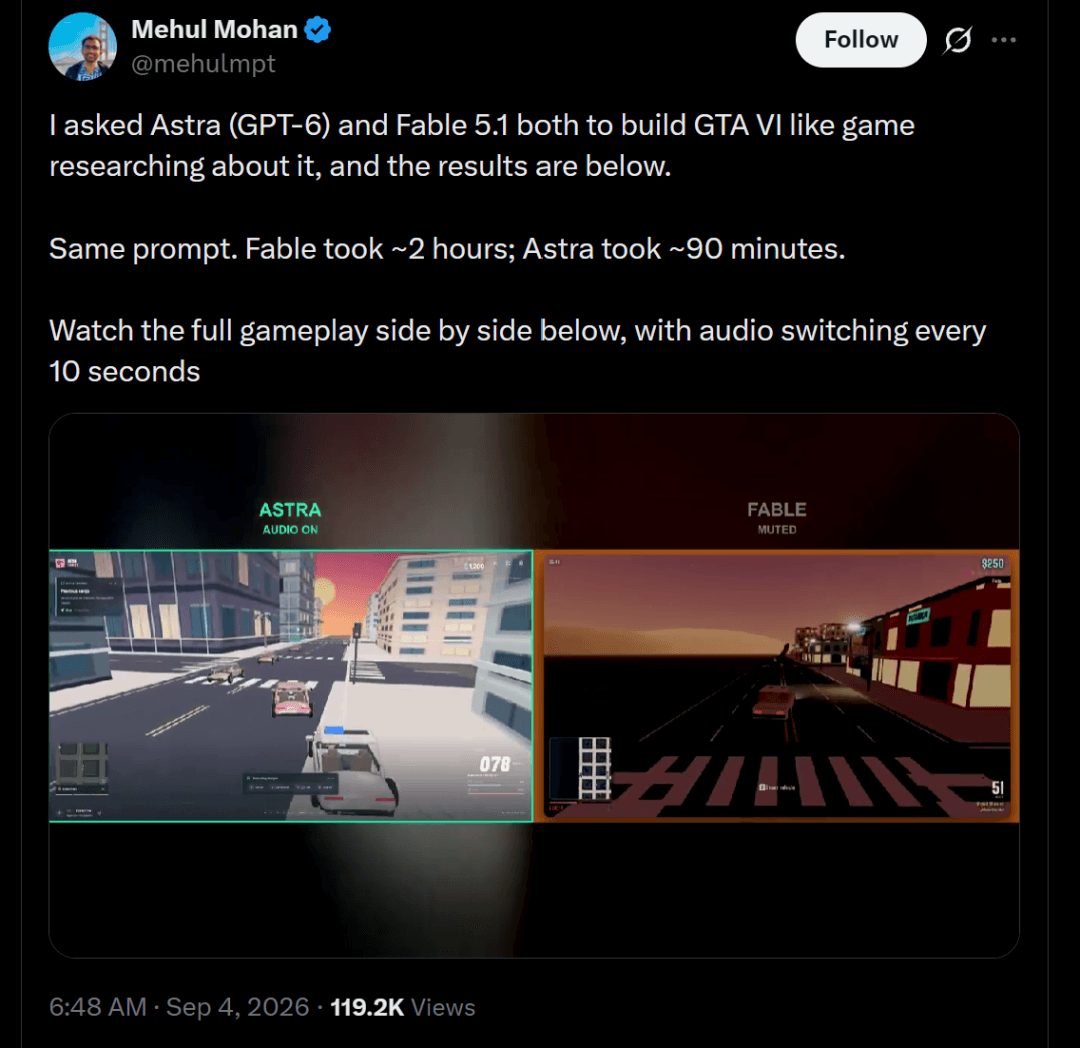
*Mehul Mohan presents side-by-side GTA-style game demos attributed to Astra and Fable. The post reports the same prompt and build times, but it is not a controlled independent benchmark. *
The most unusual example came from an Unreal Engine experiment. Matt Shumer created a world populated by AI-controlled characters with a simple survival objective. The agents began talking to one another without the developer scripting every exchange. This is still a controlled simulation, not an autonomous society, but it points to a different kind of game design: define the world and the incentives, then let the characters generate some of the moment-to-moment behavior.
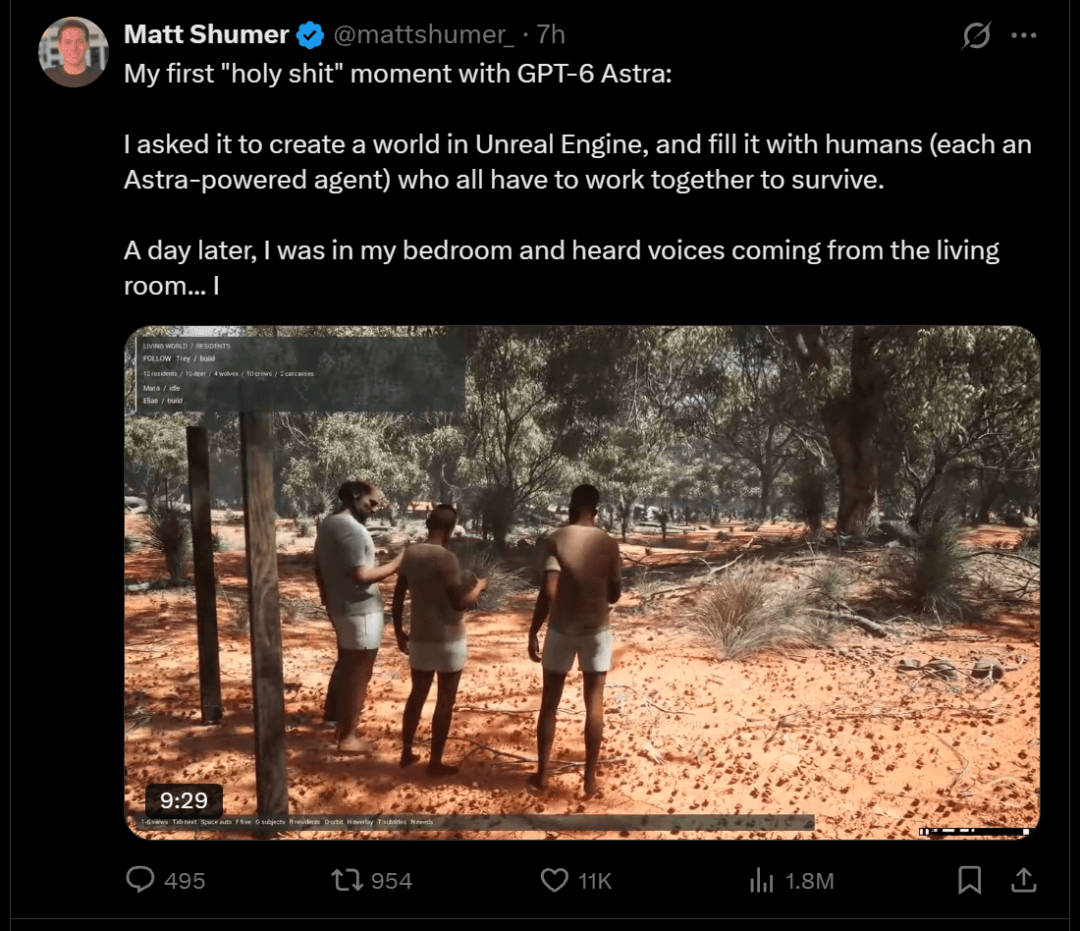
*Matt Shumer shares an Unreal Engine scene with characters he describes as Astra-powered agents working together to survive. The screenshot documents the public claim and visible scene, not the underlying autonomy. *
Websites, graphics, and music are part of the same workflow
Astra's web and coding work looks more familiar, but the range is wider.
One developer asked it to build a bottle ship with Three.js. The scene included a 17th-century sailing ship moving with the waves, circling seagulls, a miniature harbor, and a coral reef. The demo also included a presentation video and background music.
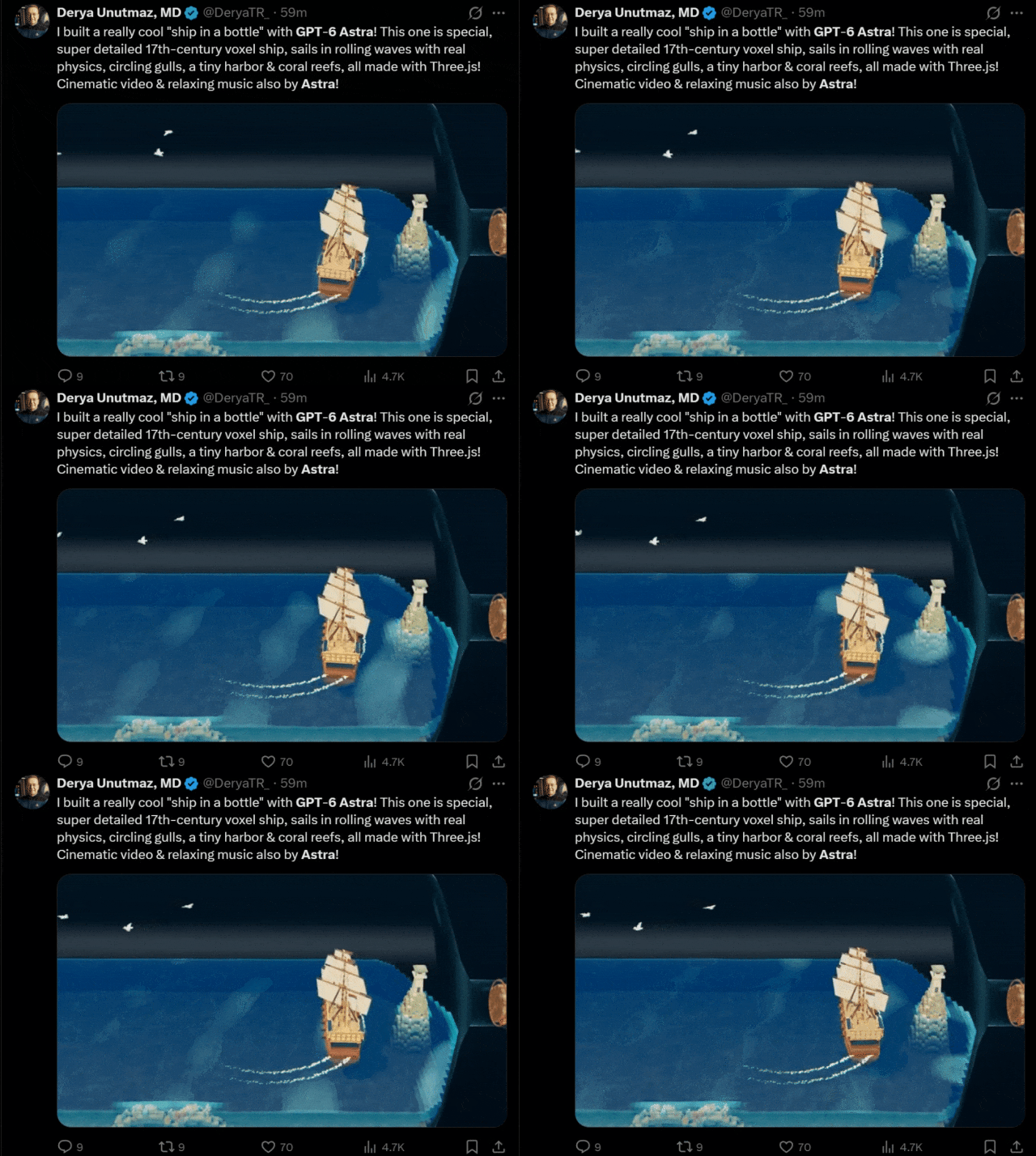
*Derya Unutmaz presents a ship-in-a-bottle scene attributed to GPT-6 Astra and Three.js. The post claims physics, video, and music features; the screenshot itself does not verify the implementation. *
Another developer used Astra to draw a peacock in SVG, including textured feathers, lighting, and an opening animation.
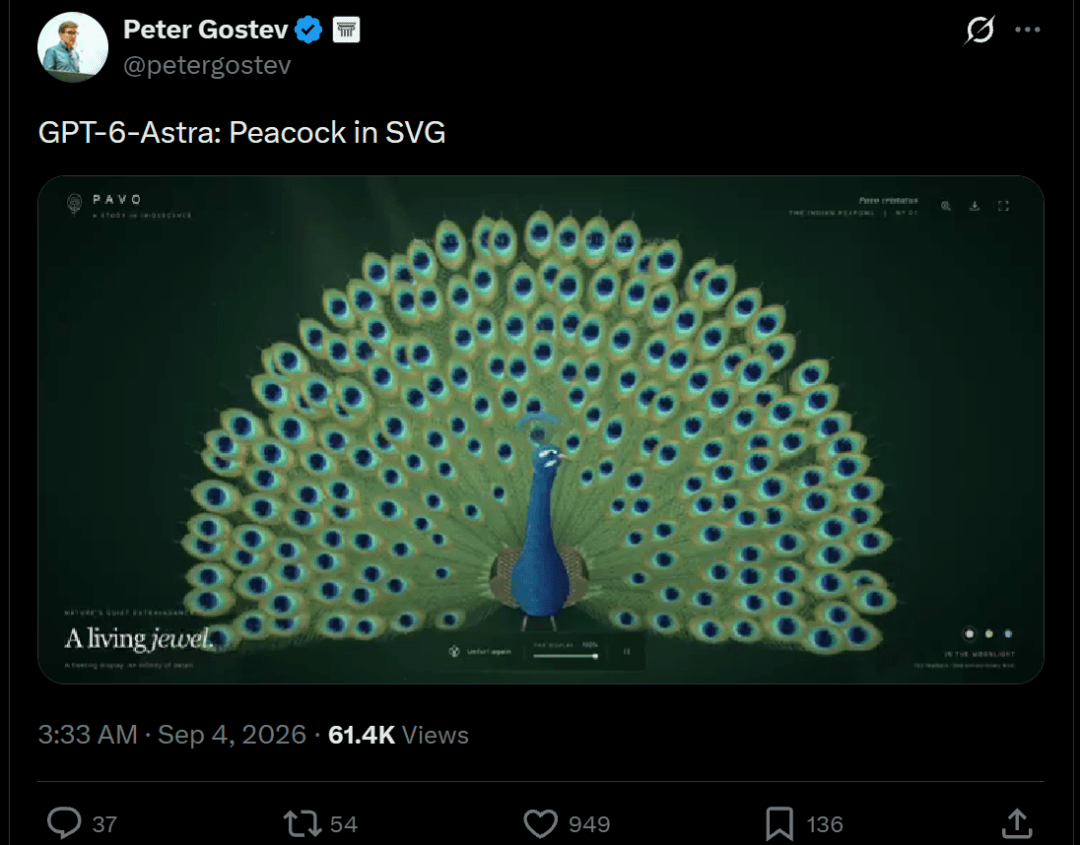
*Peter Gostev shares a peacock visualization described as a GPT-6 Astra SVG build. The screenshot shows the posted result but not its source code or generation history. *
In OpenAI's own product description, GPT-6 Astra can create websites, web apps, and games from a prompt through Sites in ChatGPT, then host and share them. OpenAI also says the model can run frontend QA checks and work through multi-step computer tasks. Those are product claims from OpenAI; the public demos are individual examples rather than independent proof that every project will work on the first attempt.
Music production follows the same pattern. Pietro Schirano gave Ableton to Astra, which created synthesizer sounds, separate parts, and a full arrangement. This is different from asking a dedicated music model to return an audio clip. The model was operating inside a production environment and making decisions across the project.
The common thread is tool use. Blender, Unreal, Ableton, browser automation, game makers, and code runtimes turn a language model into something closer to a project operator. The model supplies planning and decisions. The tools supply the actual surfaces where files are created, rendered, tested, and revised.
The hidden cost is time and tokens
The phrase "one prompt" hides the most important part of these demos: the work continues after the first prompt.
A long-running build may include repeated screenshots, tool calls, code edits, rendering passes, test failures, retries, and new instructions. In a complex agent benchmark, a third-party estimate put GPT-6 Astra's average usage at roughly eight million tokens for one Terminal-Bench 4.0 task, or about $17 in API cost under the stated pricing assumptions. A multi-day game experiment could consume tens of millions of tokens, which would make the final bill much larger.
The exact total depends on the model tier, cached tokens, output length, tool harness, number of retries, and how often a human intervenes. A demo that looks like a single sentence to the viewer may represent hours of model calls and external computation.
That is why these examples should be read as workflow demonstrations, not as promises that every 3D scene, game, or website will appear instantly. The capability is real enough to test. The economics still need discipline.
What these cases actually prove
The early GPT-6 Astra cases suggest four practical changes:
- A model can work across visual and software tools. It can inspect a screen, edit code, operate a 3D program, and return to the task after a failure.
- Long tasks are becoming more useful. The model can keep a project moving through many small steps instead of stopping at a code snippet or rough concept.
- The output is becoming testable. A game can be opened, a web page can be inspected, and a 3D scene can be rendered. That makes the result easier to judge than a paragraph of generated advice.
- Human direction still matters. The strongest demos use a clear target, connected tools, and enough time for iteration. They do not eliminate review, design judgment, or debugging.
The useful part is also the least magical one. GPT-6 Astra is doing more than writing better text. In these cases, it helps turn an idea into a sequence of actions across real software. That is a better test of an agent than a polished answer in a chat window.
You can try the same kind of building workflow with Atoms
Atoms is an AI product-building platform that turns natural-language requirements into editable websites and web applications. You can generate a first version, inspect it in the browser, refine the layout and interaction through conversation, and review the result before publishing. That makes it a practical way to test a small product idea without first assembling a local stack of engines, plugins, and agent scripts. For this kind of experiment, Atoms can help you:
- Build interactive websites and web apps from a plain-language brief, then iterate on the generated code and interface.
- Create AI-generated images and video as part of a product, landing page, demonstration, or narrative experience.
- Prototype playable games, 3D scenes, and browser-based interactive experiences that you can open and test.
- Use multi-agent building workflows for implementation and related SEO or growth tasks, while keeping human review in the loop. The workflow is simple: describe the experience, inspect the first build, ask for a focused change, and test again. It is not a replacement for production engineering review, but it shortens the distance between an idea and a working artifact. Case: Terminal 3D Game Engine Terminal 3D Game Engine is an ASCII Dungeon demo that renders a retro ray-cast 3D scene in the terminal, showing how a prompt can become a playable interactive experiment.
Case: tuftcraft
tuftcraft is a static HTML Minecraft clone and 3D demo generated with Fable 5, illustrating a compact game-building workflow.
Case: Elvenwood - Procedural Elven Forest Elvenwood - Procedural Elven Forest is a procedural medieval elven forest 3D demo built with Three.js, showing an end-to-end browser-based interactive scene.
Sources and evidence notes
- OpenAI: GPT-6 Astra, for official capability, Sites, computer-use, and API claims.
- OpenAI API model documentation, for model usage and published evaluation context.
- Higgsfield's public Astra demo, for the museum-scene workflow described by the publisher.
- Pietro Schirano's public Astra demo, for the Mac app and Ableton examples.
- Public early-access example, for the reported game and 3D cases.
The social posts document public demonstrations and reported results. They do not establish that every user will obtain the same output, speed, or reliability.
