On this page
The official Grok 4.6 launch visual establishes the exact product identity without adding speculative claims. Source: Introducing Grok 4.6.
Grok 4.6 keeps Grok 4.5's 500,000-token context window and $2/$6 base API pricing. The consequential change is xAI's stated focus on longer agent runs: codebase work, tool use, self-testing, and iterative application building.
xAI reports clear gains over Grok 4.5 on several coding and agent benchmarks. Independent and third-party evidence is more limited and workload-specific. No public result reviewed for this article proves a universal multi-hour completion advantage on real repositories.
Verified verdict: Grok 4.6 is a strong candidate to test when a workflow depends on many model and tool steps. Treat xAI's persistence and self-verification claims as vendor-reported until the model has been evaluated under your own harness, repository, permissions, and acceptance tests.
Grok 4.6 at a Glance
| Item | Grok 4.6 |
|---|---|
| Release date | August 12, 2026 |
| API model | grok-4.6 |
| Context window | 500,000 tokens |
| Knowledge cutoff | February 1, 2026 |
| Input | Text and images |
| Output | Text |
| Standard price below 200K prompt tokens | $2 / 1M input, $0.50 / 1M cached input, $6 / 1M output |
| Price at 200K prompt tokens or more | $4 / 1M input, $1 / 1M cached input, $12 / 1M output |
| Reasoning effort | low, medium, high (default), xhigh |
| API surfaces | Responses API and Chat Completions |
| Launch channels named by xAI | xAI API, Grok Build, Cursor, OpenRouter, Vercel, and Cloudflare |
The 200K threshold affects the whole request. Once the prompt reaches 200,000 tokens, xAI applies the higher rate to all tokens in that request, not only the tokens above the boundary. Long-running agents therefore need deliberate context compaction and cache strategy.
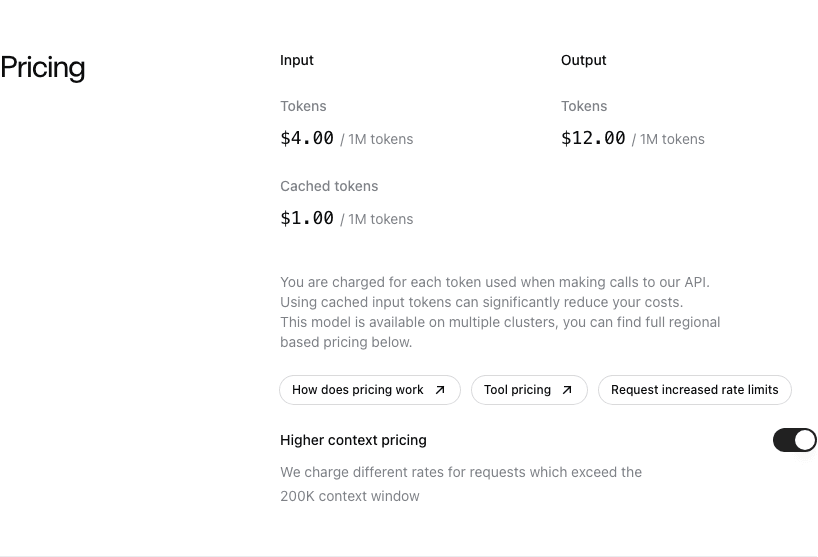
The official model page shows the long-context rates and the 200K prompt-token threshold together. Source: Grok 4.6 model documentation.
xAI also announced a faster variant at twice the standard price. As of August 14, the launch post and model documentation did not list a separate API model ID, so this article does not invent one.
What Changed from Grok 4.5?
Several headline specifications stayed the same:
- 500K context window;
- $2 per million standard input tokens;
- $6 per million standard output tokens;
- $4/$12 long-context input/output pricing at 200K prompt tokens or more.
Cached input became more expensive: $0.50 instead of $0.30 below the threshold, and $1 instead of $0.60 at or above it.
The larger change is training. xAI says Grok 4.6 received a longer supplemental run with curated reasoning and engineering data, an updated optimizer, regenerated supervised trajectories across reasoning efforts and agent harnesses, and broader reinforcement-learning environments for coding, web development, kernel optimization, knowledge work, and computer-aided design.
xAI also reports more self-testing and verification during longer trajectories, plus stronger first passes for interactive and visual applications. These are useful product hypotheses. They are not controlled proof that the model will complete every long repository task with less supervision.
What “Long-Running” Means for a Coding Agent
A long-running agent does more than emit a long answer. It has to preserve intent while the environment changes.
A repository task may require the agent to:
- inspect project rules and relevant modules;
- identify the actual failure boundary;
- edit several files without widening scope;
- run tests or visual checks;
- diagnose failed verification;
- revise the patch;
- stop only when the acceptance criteria pass.
These workflows fail when the model forgets constraints, repeats completed work, trusts tool output without checking it, or declares completion after a plausible first diff.
Grok 4.6's training direction targets this problem. The harness still controls context assembly, tools, permissions, checkpoints, retries, compaction, and termination. A larger context window does not provide durable memory by itself.
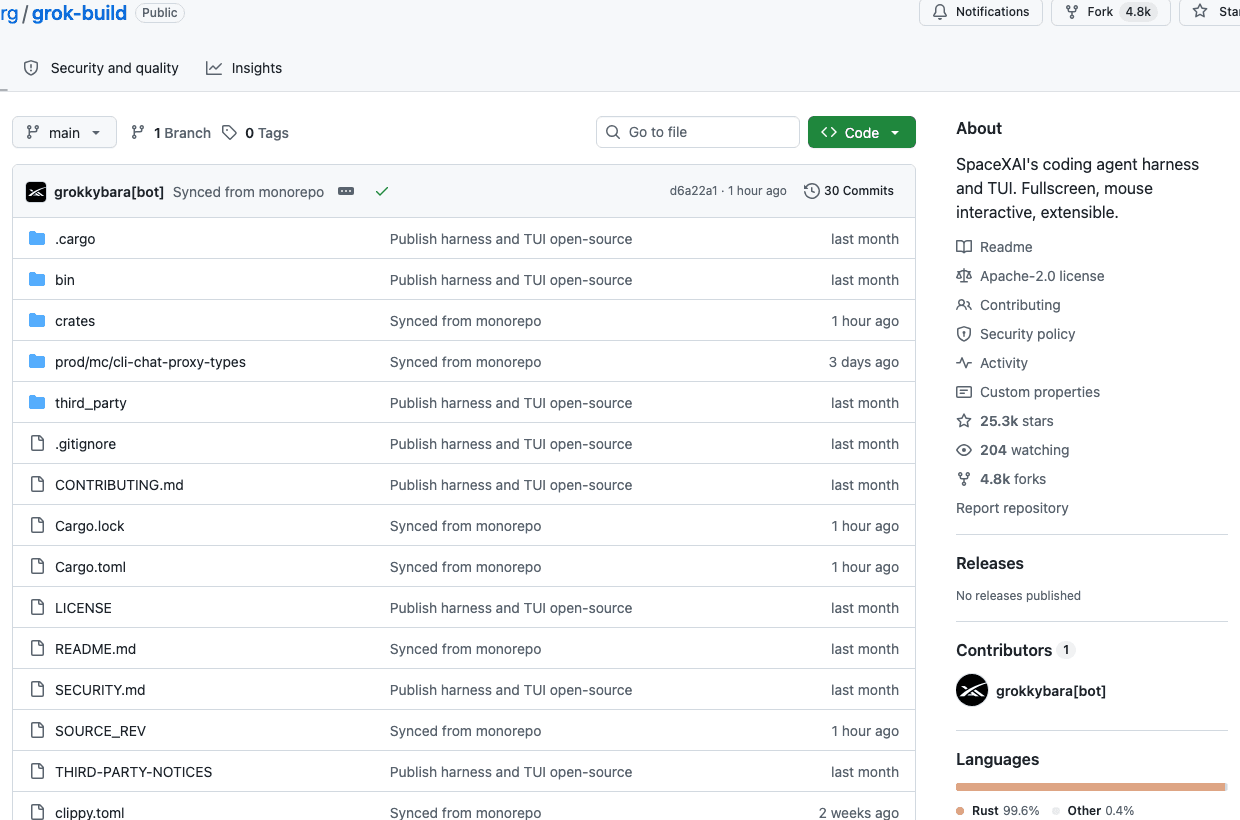
Grok Build makes the long-running agent claim concrete while keeping the model and harness roles separate. Source: xai-org/grok-build.
Grok 4.6 Benchmarks: Four Evidence Levels
Benchmark numbers are easiest to misuse when results from different sources are presented as if they came from one controlled study. This section keeps the evidence classes separate.
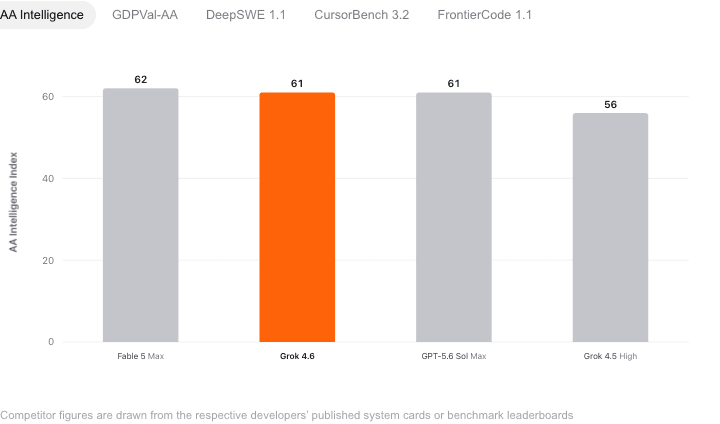
Vendor-published and cited benchmark results from the Grok 4.6 launch page; they are not one independent controlled study. Source: Introducing Grok 4.6.
1. Vendor-reported or cited results
The following comparison comes from xAI's Grok 4.6 launch table. It mixes xAI measurements with scores cited from external evaluators, so it should be read as a vendor-published summary.
| Benchmark | Grok 4.6 High | Grok 4.5 High | Change |
|---|---|---|---|
| AA Intelligence Index | 61 | 56 | +5 |
| CursorBench 3.2 | 69.9% | 66.7% | +3.2 pp |
| DeepSWE 1.1 | 65.9% | 54.0% | +11.9 pp |
| FrontierCode 1.1 Extended | 61.3% | 56.6% | +4.7 pp |
| APEX-Agents | 57.5% | 47.1% | +10.4 pp |
| Terminal-Bench 3.0 | 26.0% | 15.7% | +10.3 pp |
DeepSWE and Terminal-Bench are relevant signals for multi-step engineering work. They still measure bounded benchmark environments, not a controlled comparison of multi-hour success rates inside a private production repository.
2. Independent evaluator snapshot
On the Artificial Analysis Grok 4.6 page, the August 14 snapshot showed an Intelligence Index of 61, output speed around 65 tokens per second, and estimated cost of about $0.84 per Artificial Analysis task. These values are dynamic and should be dated whenever quoted.
Artificial Analysis supports a claim that Grok 4.6 is near the frontier on its cross-domain evaluation. Its aggregate speed and task-cost measurements do not equal coding-agent wall-clock time or cost per successful repository task.
3. Crowdsourced WebDev preference
The Arena Code leaderboard showed a preliminary WebDev score around 1630 from 1,407 votes in the snapshot reviewed for this article, with a rank spread of roughly fifth to seventh.
That result measures human preference between generated web artifacts. It does not establish accessibility, maintainability, security, state management, or general software-engineering rank.
4. Proprietary platform evaluation
Cognition reports that Grok 4.6 exceeded GPT-5.6 Sol on its FrontierCode 1.1 evaluation and trailed Opus 5 and Fable 5. Cognition's FrontierCode methodology explains the evaluation design.
This is useful platform evidence from the team operating Devin. It remains a proprietary evaluation rather than an independently reproducible open benchmark.
API, Context, and Pricing Details
The Grok 4.6 developer guide lists text and image input, text output, function calling, web and X search, code execution, configurable reasoning, prompt caching, and context compaction guidance.
For pricing:
| Prompt size | Input | Cached input | Output |
|---|---|---|---|
| Below 200K tokens | $2 | $0.50 | $6 |
| 200K tokens or more | $4 | $1 | $12 |
Prices are USD per million tokens. At or above the threshold, the entire request uses the higher rates. See the live xAI pricing page before production budgeting.
The model supports low, medium, high, and xhigh reasoning, with high documented as the default. Benchmark tables should always include the reasoning level because cost, latency, and scores can change materially across efforts.
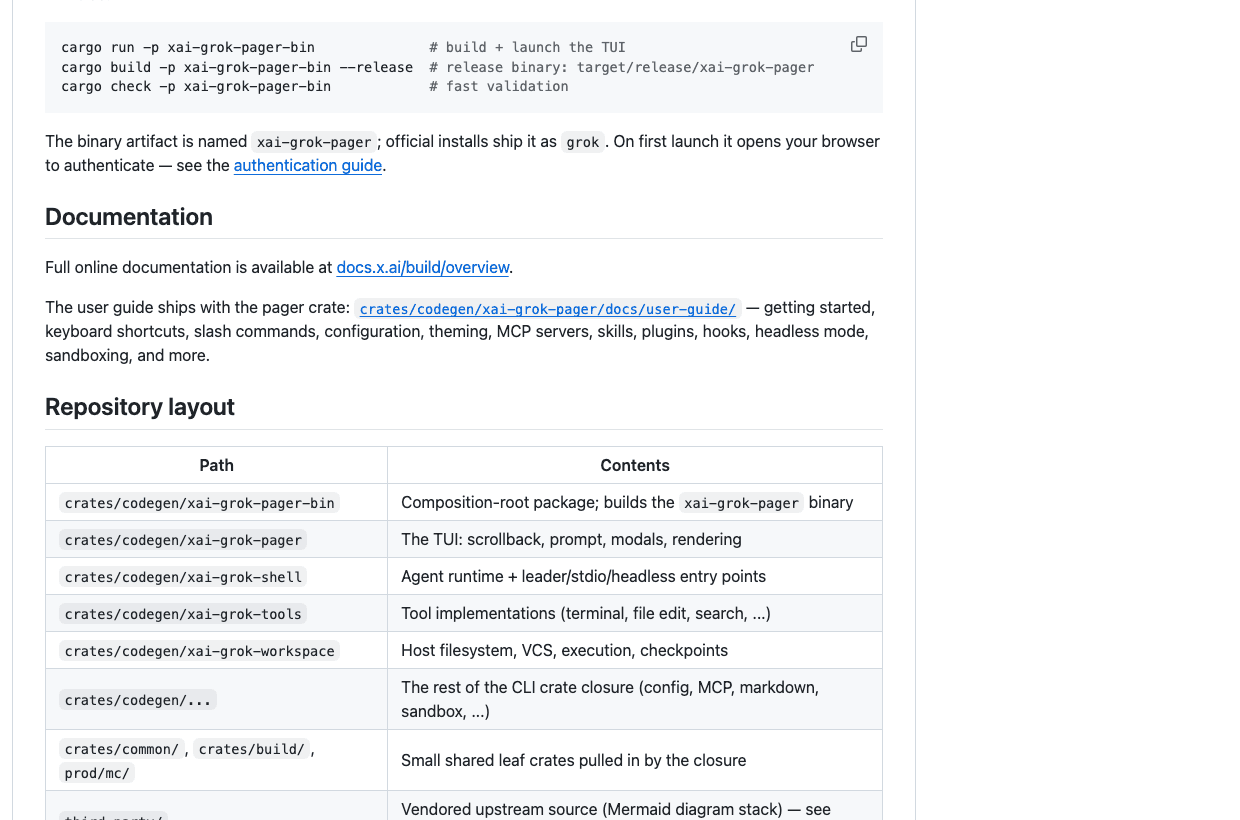
The repository layout shows that the harness owns tools, workspace, configuration, MCP, sandboxing, and the agent runtime around the model. Source: Grok Build repository layout.
Should Coding Teams Upgrade?
Grok 4.6 is worth testing when:
- tasks span several files and verification cycles;
- the agent must recover after failed tests;
- tool use and self-checking matter more than first-token latency;
- the workflow creates interactive or visual applications;
- a team can compare 4.5 and 4.6 under the same harness.
A switch is less urgent when:
- workloads are short, deterministic completions;
- latency is the dominant requirement;
- prompt caching economics matter more than incremental benchmark gains;
- the current 4.5 workflow already meets measured acceptance targets.
Avoid adopting the model from a leaderboard screenshot alone. Run both versions on real tasks and compare final test results, regressions, human intervention, cost, latency, and diff quality.
How to Evaluate Grok 4.6 on a Real Repository
- Pin the repository commit, harness version, model ID, and reasoning effort.
- Define acceptance criteria, commands to run, protected files, and a fixed timeout.
- Use a task that requires several model-tool cycles rather than one response.
- Repeat each task at least three times per model.
- Record successful completion, regressions, tool calls, retries, tokens, elapsed time, context compactions, and human interventions.
- Preserve failed runs instead of reporting only the best artifact.
For visual application work, also test responsive layout, interactions, forms, loading and error states, accessibility, and maintainability. A strong screenshot is evidence of one rendered state, not production readiness.
Frequently asked questions
01When was Grok 4.6 released?
xAI released Grok 4.6 on August 12, 2026.
02What is the Grok 4.6 API model name?
Use grok-4.6 through the xAI API. It supports the Responses API and Chat Completions.
03How large is the context window?
Grok 4.6 has a 500,000-token context window. Requests with 200,000 prompt tokens or more use the higher price tier for the full request.
04How much does Grok 4.6 cost?
Below 200K prompt tokens, the documented rates are $2 per million input tokens, $0.50 per million cached input tokens, and $6 per million output tokens. At 200K or more, the rates are $4, $1, and $12.
05Is Grok 4.6 proven to run coding agents for hours?
No controlled multi-hour completion study against Grok 4.5 was verified for this article. xAI reports stronger long trajectories and several benchmark gains, while harness design, state management, testing, and recovery still affect real outcomes.
06Is Grok 4.6 better than Grok 4.5 for coding?
xAI's published table shows gains on CursorBench, DeepSWE, FrontierCode, Terminal-Bench, and APEX-Agents. Teams should verify whether those gains transfer to their repositories and tools.
Sources
- xAI: Introducing Grok 4.6
- xAI developer guide: Grok 4.6
- xAI model details: Grok 4.6
- xAI API pricing
- Artificial Analysis: Grok 4.6
- Arena Code leaderboard
- Devin: Grok 4.6 evaluation
- Cognition: FrontierCode 1.1 methodology
Research cutoff: August 14, 2026. Dynamic leaderboard values should be rechecked before publication.
Explore the Grok model family on Atoms, see how vibe coding turns a prompt into a working product, or learn how Atoms Cloud supports deployable applications.
