On this page
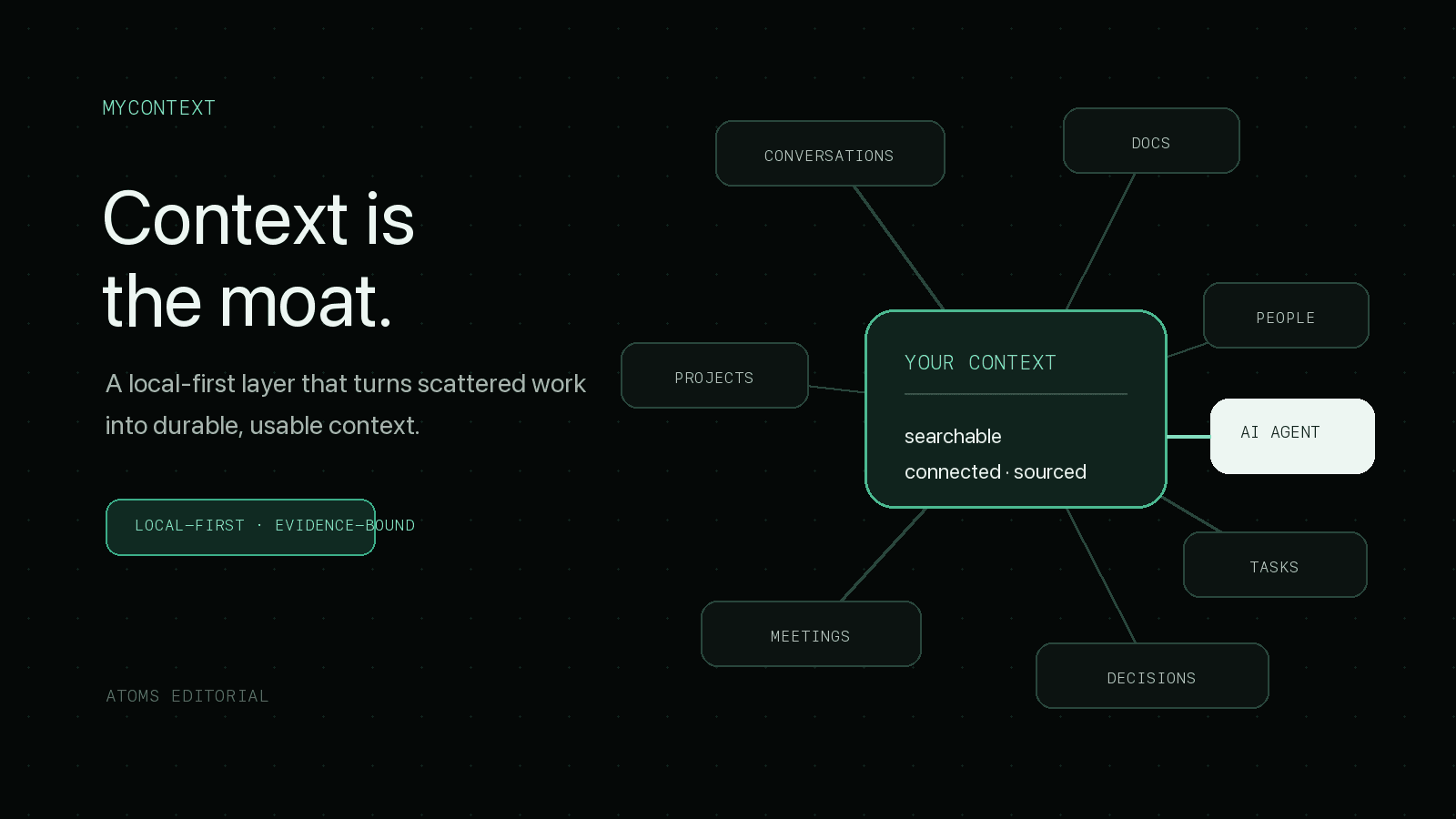
MyContext editorial overview: work sources converge into a persistent, sourced context layer for an AI agent.
MyContext is easy to misunderstand because it arrives wearing an AI label.
It is not another chatbot. It is not primarily a knowledge base, and it is not a larger model. MyContext is a local-first context layer: software that collects the fragments of work already scattered across conversations, documents, meetings, and other tools, then turns them into a persistent, searchable map of what a person knows, who they work with, and what is still in motion.
That distinction matters more than the product name.
From empty prompts to situated agents
Most AI assistants still begin every task with a blank page. You provide a prompt, paste in a few files, explain the background, and hope the model understands which detail matters. The model may be brilliant, but it is structurally amnesiac.
MyContext changes the starting point. Its repository describes a personal context graph connecting people, projects, topics, events, conversations, and source-backed facts. Search combines local full-text retrieval, semantic recall, and graph queries. Answers can point back to their evidence instead of presenting a frictionless paragraph with no audit trail.
That is a very different product category from “chat with an LLM.”
The important asset is no longer just the model’s weights. It is the continuously maintained layer between messy reality and the model: the decisions made last Tuesday, the colleague who owns a particular system, the preference that was stated in a meeting but never written into a handbook, the unresolved follow-up buried in an instant-message thread.
Why Alibaba’s move is strategically sharp
Recent reporting from PingWest describes MyContext as an open-sourced context infrastructure project from Qwen Office, aimed at turning heterogeneous personal work data into a work profile that agents can understand and use. The same reporting places it inside a wider push to connect Qwen Office with DingTalk, enterprise databases, and workflows.
If that direction holds, Alibaba is not merely trying to win the chatbot interface. It is trying to own the layer that makes an agent useful inside an organization.
That is the sharper bet.
Models can be swapped. Prompts can be copied. A generic “AI assistant” can be reproduced by dozens of vendors. But a trusted, permissioned, continuously updated map of an employee’s work is much harder to replace. It is proprietary in the most practical sense—not because it is locked in a model, but because it is embedded in relationships, history, approvals, habits, and operational context.
The competitive question shifts from:
Which model gives the best answer?
To:
Which system has the right context, at the right moment, with enough evidence and permission to act?
That is a potential platform transition.
The local-first detail is not cosmetic
MyContext’s design also exposes the political economy of the next AI layer. The project says personal work data and indexes live locally, with source references preserved and consequential actions kept behind explicit approval. That architecture is a direct answer to the obvious objection: nobody wants to hand an unbounded agent every conversation and let it silently speak in their name.
But “local-first” is not the same as “risk-free.” The project is still in developer preview, warns of breaking changes, and uses the Elastic License 2.0. The code can be used, modified, and self-hosted—including inside a company—but it cannot simply be offered to third parties as a hosted or managed service. Those constraints matter if MyContext becomes infrastructure for a commercial product rather than a desktop tool.
The harder questions are still ahead: who controls the canonical memory, how conflicts are resolved, how stale context decays, how access is revoked, and whether a user can actually inspect and delete what the system has inferred about them.
A context layer that cannot answer those questions becomes a surveillance layer with a friendly UI.
The real bet: work memory becomes infrastructure
The first wave of AI products competed for attention. The next wave will compete for continuity.
A useful agent cannot just generate. It must remember without hallucinating, retrieve without drowning the user in old messages, distinguish a current decision from an obsolete one, and stop before an irreversible action. That requires infrastructure around the model—ingestion, provenance, retrieval, identity, permissions, conflict handling, and human approval.
MyContext is an early, imperfect sign that the center of gravity is moving there.
The model is still important. It may even be interchangeable.
The context is where the work is.
Sources
- MyContext repository and README — project architecture, local-first design, retrieval, evidence, status, and license.
- MyContext official site — product positioning and principles.
- PingWest: “千问办公开源MyContext,企业上下文时代到来” — reporting on Qwen Office, enterprise context infrastructure, DingTalk, and future integrations.
