Ox Alpha editorial illustration, cropped to remove unrelated publisher branding.
Ox Alpha was the AI model nobody could name—until the mystery became the launch. It appeared on OpenRouter as an anonymous model, OpenCode made it free for a week, developers spent four days trying to identify its maker, and Bloomberg then reported that Z.AI had confirmed it as a new iteration of the GLM series, with weights scheduled for release.
The story matters beyond the reveal. It shows how a free anonymous preview can turn developers into testers, investigators, and distributors at the same time. It also produced a rare trail of evidence: service claims, coding runs, a viral benchmark subset, black-box fingerprint tests, conflicting user reports, and eventually a company attribution.
Ox Alpha at a glance
| Question | Best current answer |
|---|---|
| What was Ox Alpha? | The anonymous preview name used on OpenRouter and OpenCode |
| Who made it? | Bloomberg reported that Z.AI confirmed it was a new GLM-series iteration |
| Why did it go viral? | Free access, a 1M-context claim, multimodal support, and surprisingly strong coding reports |
| What did the viral benchmark show? | 80% on a 10-task DeepSWE subset, versus 65% for Fable 5 and 52% for GPT-5.6 Sol |
| Is 80% a definitive score? | No—the sample contained only 10 tasks and may have high variance |
| Is Ox Alpha exactly GLM-5.3? | The behavioral fingerprints pointed to GLM-5.3, but the alias, final checkpoint, and hosted configuration should not be treated as automatically identical |
Chapter 1: An anonymous model appears on OpenRouter
Ox Alpha did not arrive with a launch event, a model card, or a recognizable company logo. It surfaced as a stealth model on OpenRouter and was exposed through OpenCode as a temporary free preview.
That inversion was the first reason it spread. Usually, a lab publishes specifications and then developers test the claims. With Ox Alpha, developers received the endpoint first and had to reconstruct the product story themselves.
OpenCode advertised a one-week free period, a 1M-token context window, multimodal support, zero data retention, generous limits, and claimed capacity for 100 trillion tokens per day. These were service-side claims tied to that announcement. They should not be transferred automatically to a later downloadable checkpoint or another provider.
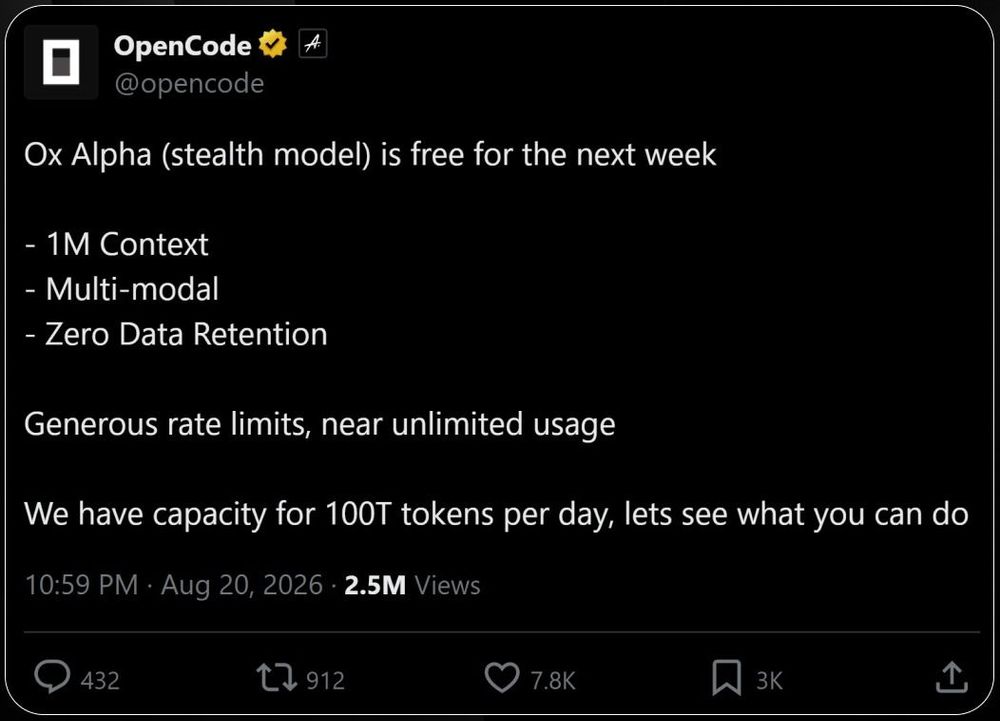
OpenCode’s announcement, cropped to remove unrelated publisher branding. It documents the claims shown in the post; it does not independently verify them.
Chapter 2: Reddit turns the launch into a guessing game
Developers quickly began comparing Ox Alpha with known frontier models. Theories reportedly moved through several candidates, including Gemini and multiple Chinese model families. The strongest theory eventually centered on Z.AI and GLM.
The speculation was not based only on writing style. Investigators looked for repeatable implementation fingerprints: token counts, error messages, multilingual behavior, code tokenization, and serving-layer responses.
This was useful forensic work, but it had a clear limit. Black-box similarity can narrow a family; it cannot reveal a model’s private training process, exact checkpoint, or every service wrapper.
Chapter 3: The coding result that made the mystery impossible to ignore
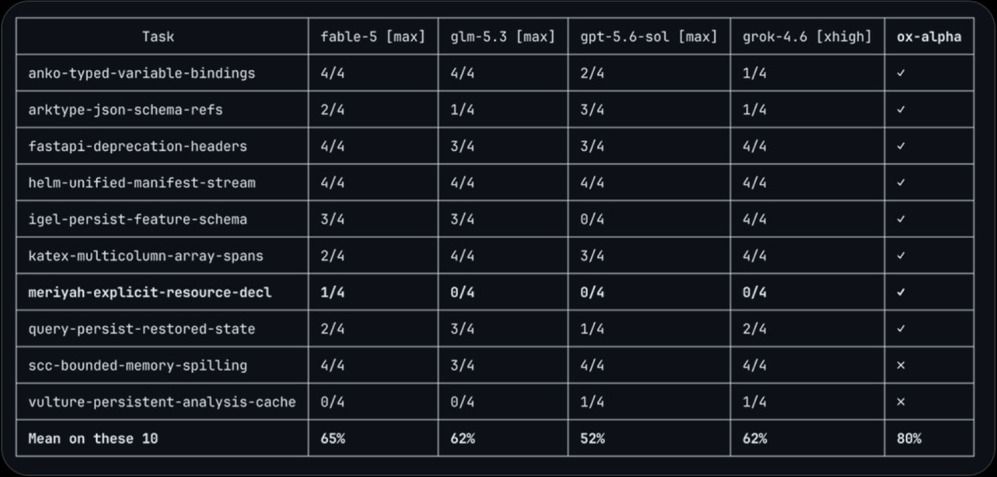
Community-shared DeepSWE subset. The image covers only 10 tasks and should be treated as an early smoke test, not a complete leaderboard.
The viral comparison showed:
- Ox Alpha: 80%
- Claude Fable 5: 65%
- GLM-5.3: 62%
- Grok 4.6: 62%
- GPT-5.6 Sol: 52%
Those numbers explain the excitement, but the sample explains the caution. Ten tasks are not enough to establish a general ranking. Task selection, harness configuration, effort settings, temperature, number of attempts, and reruns can all move the result materially.
A credible reproduction would publish the exact task IDs, model endpoints, context settings, tool permissions, attempts, failures, token use, cost, and accepted patches. It should include the two tasks Ox Alpha missed, not only the eight it passed.
Chapter 4: What developers actually liked
The most consistent positive reports were not about conversation style. They were about software engineering:
- finding bugs in an existing repository;
- making direct, useful code changes;
- navigating longer contexts;
- using fewer words before acting;
- reaching a conclusion without narrating several rounds of self-checking.
One reported test said Ox Alpha found two real bugs in a maintained Python project that other models had missed. That is interesting because repository debugging is harder to fake than a polished answer. It is still one operator’s experience, not a measured failure rate.
The low-verbosity observation may also be task-dependent. Fewer tokens can mean efficient execution; it can also mean less visible checking. The right metric is not “talked less.” It is accepted work per unit of time, cost, and human repair.
Chapter 5: How fingerprint tests pointed toward GLM-5.3
A widely discussed fingerprint test sent Ox Alpha and suspected models a set of prompts across languages and code. The reported result was that Ox Alpha’s token counts matched GLM-5.3 across the probes, with a constant offset of 75 tokens.
Investigators interpreted the fixed difference as a hidden wrapper or system prompt. They also reported error messages resembling Z.AI’s public service. Together, those clues made the GLM theory substantially stronger than a guess based on prose style.
The later Bloomberg report provided the stronger attribution evidence: Z.AI confirmed Ox Alpha as a new GLM-series iteration and said weights would be released. Even then, three labels should remain separate:
- Ox Alpha — the anonymous preview alias;
- GLM — the documented model family;
- Z.AI — the company attribution reported after the reveal.
Until the final model card, checkpoint name, license, and hosted-to-open parity are clear, those names should not be collapsed into one exact technical configuration.
Chapter 6: The hidden-prompt meme
The investigation produced a memorable side story: users reported extracting a hidden system-prompt fragment beginning, “Good morning China, now I have ice cream.” The line references an internet meme and immediately escaped the technical community.
OpenRouter’s visible reaction helped amplify it. The joke became part of the distribution loop: a hidden model had a hidden prompt, and the hidden prompt was funny enough to make the investigation legible to people who did not care about tokenizers.
It is entertaining launch culture—not evidence that the model is more capable.
Chapter 7: Where Ox Alpha looked weak
The strongest criticism was specialization. Some users described Ox Alpha as excellent at coding but ordinary in general chat. Others reported problems that GPT-5.6 could solve and Ox Alpha could not.
There were also reports of refusal or non-response on politically sensitive questions. That behavior may matter for general-purpose assistant use, localization, customer support, and research, even if it has little effect on a repository coding benchmark.
The balanced conclusion is not that Ox Alpha was a half-finished model or the new universal champion. It was a coding-focused preview with unusually strong early signals and visible weaknesses outside its best lane.
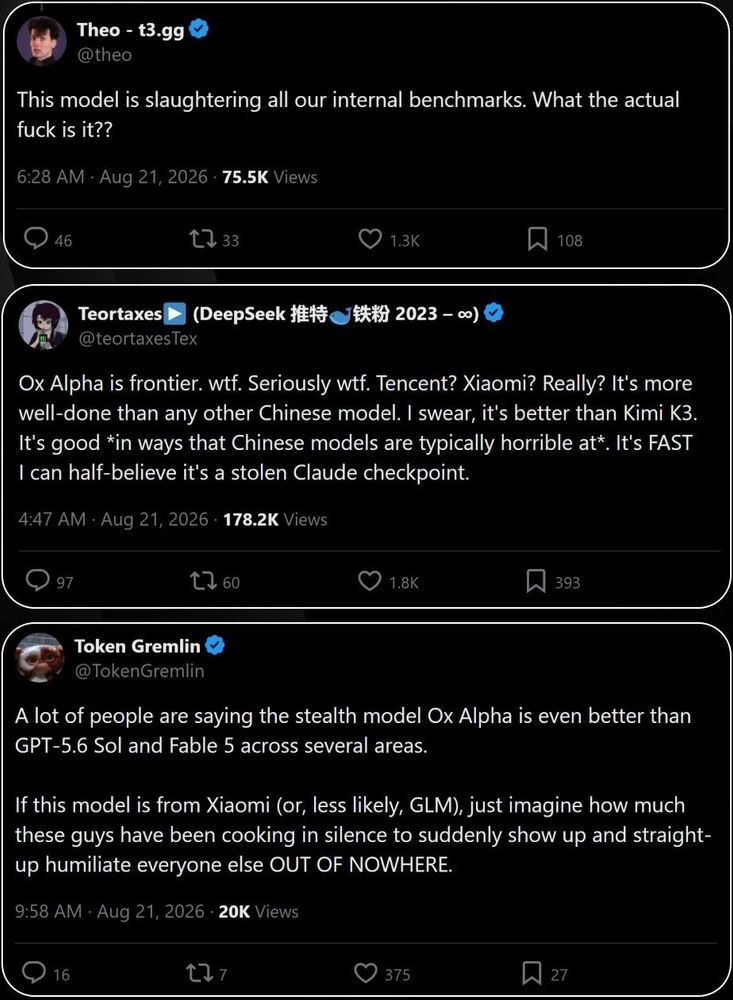
Early community reactions, cropped to remove unrelated publisher branding. They document sentiment and reported experiences, not controlled evaluation.
Chapter 8: Why Z.AI’s launch strategy worked
The launch compressed a conventional marketing campaign into a puzzle:
- release anonymously;
- remove price friction for a week;
- let developers generate the examples;
- allow identity speculation to compound attention;
- confirm the maker only after the model has earned interest;
- follow with a weight-release announcement.
That sequence works only if the product survives contact with developers. A weak model would have turned the mystery into indifference. Ox Alpha generated enough credible coding reports to keep the investigation alive.
The strategy also created risk. Anonymous previews raise questions about data retention, jurisdiction, service continuity, intellectual property, and accountability. OpenCode’s zero-retention claim was therefore important, but production teams still need contractual and technical verification.
What production teams should verify
Before adopting the final Z.AI/GLM release connected to Ox Alpha, verify:
- exact model and checkpoint name;
- hosted-preview versus open-weight parity;
- commercial license and distribution terms;
- context-window behavior at realistic lengths;
- image and video input behavior;
- retention and logging policy;
- tool-use and structured-output support;
- repeated coding performance under a matched harness;
- latency, throughput, and hardware requirements;
- accepted changes per dollar and per hour;
- human repair time after the first model pass.
A viral score is a reason to run a test. It is not a procurement decision.
What this means for AI website builders
Website construction is a useful stress test because it combines code generation with information architecture, copy, responsive design, navigation, forms, data behavior, visual QA, and deployment.
Use the Ox Alpha AI Website Builder to turn the story into a concrete brief. Compare the result with the original AI Website Builder cases, and record which flows actually work rather than judging only the screenshot.
Final judgment
Ox Alpha’s launch succeeded because the mystery and the technical signal reinforced each other. Free access created a large test surface. Coding quality created curiosity. Fingerprint evidence made the puzzle solvable. The Bloomberg-reported Z.AI confirmation provided the reveal, and the announced weight release converted a temporary preview into a potentially durable developer story.
The technical verdict is narrower: Ox Alpha showed enough evidence to justify serious evaluation as a coding and agent model. The 10-task result was too small to establish supremacy, community reports were mixed outside coding, and the final open checkpoint still needed separate verification.
Sources
- Bloomberg: China’s Z.AI Made Ox Alpha Stealth Model
- Z.AI GLM-5.3 documentation
- Z.AI GLM-5.3 Flash documentation
- OpenRouter model directory
- OpenCode
- DeepSWE benchmark
A separate benchmark image: GLM-5.3-Flash, not Ox Alpha
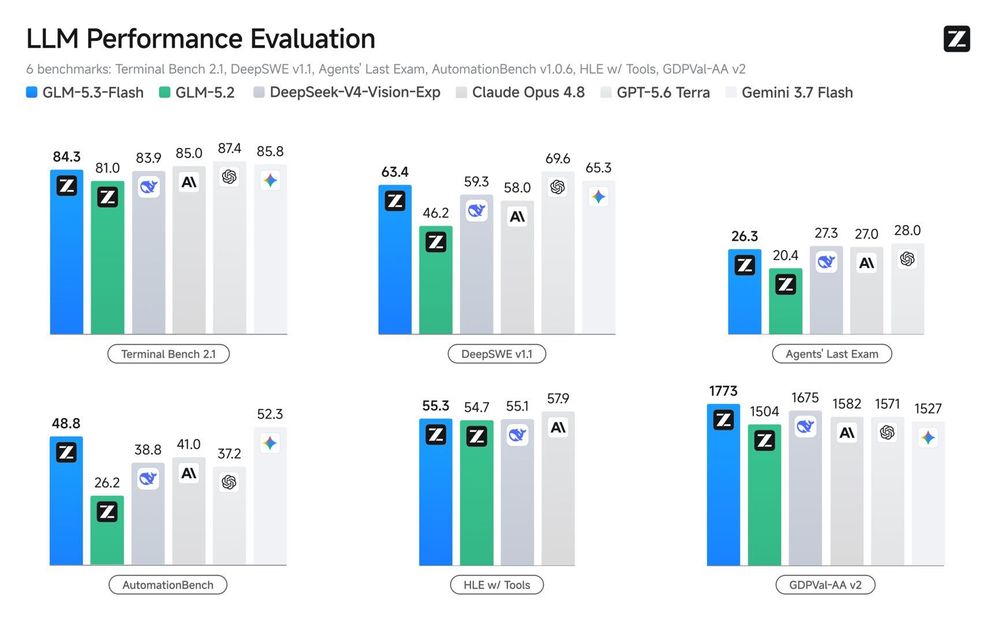
The supplied graphic identifies the blue series as GLM-5.3-Flash. It is included as GLM-family context and should not be read as a direct Ox Alpha scorecard.
The chart compares GLM-5.3-Flash with GLM-5.2, DeepSeek-V4-Vision-Exp, Claude Opus 4.8, GPT-5.6 Terra, and Gemini 3.7 Flash across Terminal Bench 2.1, DeepSWE v1.1, Agents’ Last Exam, AutomationBench, HLE with Tools, and GDPVal-AA v2. The image reports 63.4 on DeepSWE v1.1 for GLM-5.3-Flash and 48.8 on AutomationBench, among other displayed values. Because the supplied graphic does not by itself establish the full harness, date, sampling, or evaluator, those numbers are visual evidence from the chart—not an independently verified universal ranking.
Z.AI’s official documentation names the model code glm-5.3-flash and describes native multimodal capability and a 1M-token context window. Keep that documented model identity separate from the Ox Alpha alias. The relevance to this investigation is that the image helps readers understand the GLM-5.3-Flash name and model family; it does not prove that Ox Alpha equals every GLM-5.3-Flash configuration or that Ox Alpha achieved the chart’s exact scores.
