On this page
Qwen3.8-Max is the latest Qwen-Max-class model, but it is easy to misunderstand. The model name refers to two closely related deployment forms: the open-weight Qwen3.8-2.4T-A95B checkpoint and the managed Qwen Cloud service Qwen3.8-Max.
They share the Qwen3.8 foundation, but they do not expose exactly the same capabilities. The open checkpoint is text-only and carries a custom qwen3.8-max license. The managed service adds vision input, non-thinking requests, built-in tools, and a 1M-token context configuration.
This guide explains the distinction, the architecture, API pricing, context limits, agent features, open-weight license, and the practical questions developers should answer before adopting Qwen3.8-Max.
Qwen3.8-Max at a Glance
| Question | Answer |
|---|---|
| What is it? | Qwen's latest Max-class model family |
| Open checkpoint | Qwen3.8-2.4T-A95B |
| Total parameters | 2.4 trillion |
| Activated parameters | 95 billion |
| Architecture | Mixture of Experts with Gated DeltaNet and Gated Attention blocks |
| Native open-checkpoint context | 262,144 tokens |
| Extended checkpoint context | Up to 1,010,000 tokens |
| Managed Qwen Cloud context | 1M tokens by default |
| Managed max input | 991K tokens |
| Managed max output | 131K tokens |
| Modalities in managed service | Text, image, video input; text output |
| Open-checkpoint modality | Text generation |
| License | Custom qwen3.8-max license; not Apache 2.0 |
| Managed API price | $2 / 1M input tokens, $6 / 1M output tokens |
| Implicit cache input | $0.25 / 1M tokens |
| Built-in tools | Code interpreter, web extractor, web search, text-to-image search, image-to-image search |
The managed limits and prices above come from the Qwen Cloud model page checked on August 16, 2026. Model availability, quotas, and promotional pricing can change.
The Most Important Distinction: Open Weights vs Managed API
Qwen3.8-Max is not one identical artifact with one identical interface.
Open-weight checkpoint
The Hugging Face repository is:
The model card describes a post-trained checkpoint compatible with Transformers-format tooling and inference engines such as vLLM, SGLang, and TokenSpeed.
The open checkpoint provides:
- 2.4T total and 95B activated parameters;
- text generation;
- thinking-oriented inference;
reasoning_effortandpreserve_thinkingcontrols described by the model card;- 262K native context, extensible to approximately 1.01M tokens;
- self-managed hardware, inference, scaling, and safety boundaries.
It does not automatically provide the hosted service's vision input, built-in web tools, or managed 1M-token configuration.
Managed Qwen3.8-Max
The managed version is available through Qwen Cloud. Its page describes a 2.4-trillion-parameter MoE flagship for coding and professional work.
The service adds:
- image and video understanding;
- non-thinking mode;
- 1M context by default;
- official built-in tools;
- function calling;
- structured outputs;
- context caching;
- batch processing;
- web search and web extraction;
- code interpreter workflows.
This is why a comparison that copies the hosted model's 1M context and vision features into a local-checkpoint setup would be misleading.
Launch Reaction: What Developers Asked First
The Qwen3.8-Max launch generated unusually strong developer attention. The official launch post reached more than 1,100 points on Hacker News in early August, while the subsequent open-weight checkpoint post also drew hundreds of points. These are community-interest signals, not evidence of model quality.
The discussion focused less on headline benchmark scores than on four practical questions:
- Would the Max-class weights actually be released?
- How much would reasoning and long agent runs cost?
- What hardware could realistically host a 2.4T checkpoint?
- Would the smaller Qwen3.8-27B be the more useful local model?
Those questions are now partly answerable. The 2.4T-A95B checkpoint is available on Hugging Face, the model card lists 213 safetensors shards, and Qwen Cloud publishes managed-service prices and context limits. But deployment cost and benchmark token budgets remain workload-specific.
One Hacker News commenter summarized the most useful skepticism: benchmark charts did not show how many reasoning tokens each result consumed. That is exactly why this guide separates vendor scores from cost-per-successful-task evidence.
Community source: Hacker News discussion of the Qwen3.8-Max launch. Comments reflect individual opinions, not verified product facts.
Industry Context: Why This Release Matters
Alibaba formally launched Qwen3.8-Max on August 3, 2026, after previewing it during the World AI Conference period in July. The Alibaba Cloud press release positioned it as a multimodal model for coding, real-life work, research, and long-horizon tasks, with the open weights scheduled for the following week. The checkpoint was subsequently published.
The strategic change is as important as the parameter count: this is the first Qwen-Max-class checkpoint released as open weights. Reuters reported before the final license appeared that Alibaba was considering charging large commercial users or seeking revenue-sharing arrangements. The final public license does not publish a general revenue-share percentage; instead, it uses attribution and separate-license thresholds. That distinction matters when reading early coverage.
Industry coverage also surfaced a useful counterweight to the launch narrative. VentureBeat noted that Qwen's first-party results look strong on several agentic and computer-use evaluations, but not on every software-engineering benchmark, and the longest autonomous demonstrations have not yet been broadly reproduced. The New Stack emphasized the deployment paradox: a 2.4T open checkpoint expands access to weights, yet the full model remains a data-center-scale system for most users.
NVIDIA's deployment article makes that constraint concrete. Its day-zero recipe used a rack-scale GB300 NVL72 system with 72 GPUs. NVIDIA reported more than 4,000 tokens per second per GPU and more than 350 tokens per second per user in FP8, but these are vendor measurements on specialized hardware—not a promise for ordinary self-hosting.
Architecture: 2.4T Total, 95B Active
Qwen3.8-2.4T-A95B is a sparse Mixture-of-Experts model. Its headline parameter count is 2.4 trillion, but a single token activates a much smaller routed computation path.
The official model card reports:
- 92 layers;
- 512 experts;
- 10 routed experts plus one shared expert activated per token;
- hidden dimension of 8,192;
- a repeated layout combining Gated DeltaNet and Gated Attention with MoE blocks;
- multi-token prediction training.
The architecture builds on Qwen3.5's hybrid direction. Linear-attention-style Gated DeltaNet blocks help manage long sequences, while Gated Attention blocks retain full-attention capacity where it matters. Sparse routing reduces the active computation relative to the total model size, but it does not make the model lightweight to store or casually self-host.
95B active is not the same as a 95B model. A deployment still needs access to the complete checkpoint, routing infrastructure, memory for weights, and KV cache for the requested context. Do not turn the active-parameter figure into an unsupported single-GPU hardware promise.
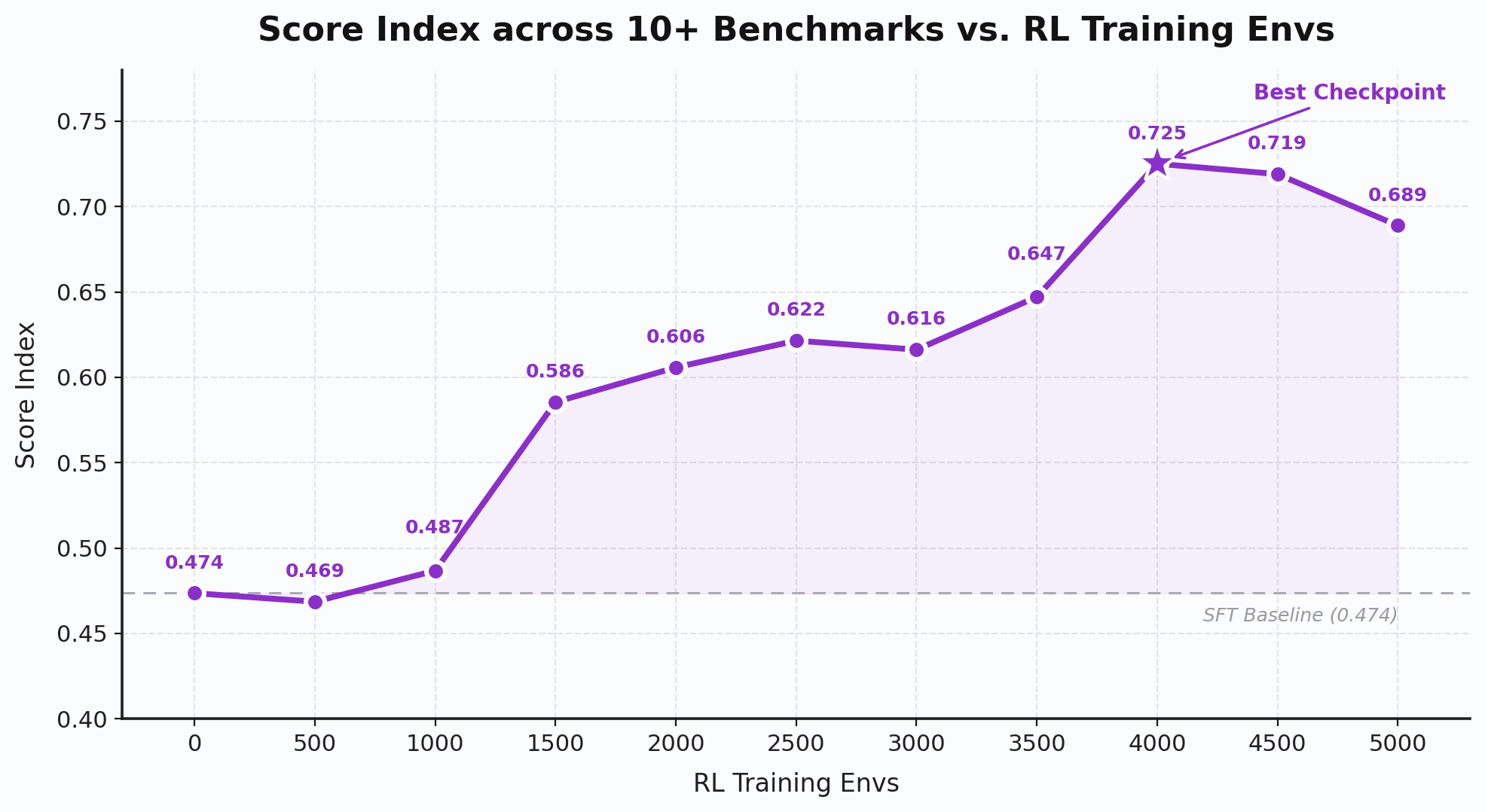
Source: Qwen3.8 official launch page. This first-party composite chart reports improvement as the number of RL training environments grows; it does not disclose every benchmark weight, error interval, or an independent reproduction.
Context Window: 262K Native vs 1M Managed
There are three different claims that should not be collapsed into one number:
- 262,144 native tokens — the open checkpoint's native context length;
- approximately 1.01M extended tokens — the checkpoint's documented extensibility;
- 1M by default — the managed Qwen Cloud service configuration, with a maximum input of 991K and maximum output of 131K.
A 1M context window does not mean every request should include 1M tokens. Long prompts increase:
- input cost;
- time to first token;
- KV-cache memory;
- retrieval noise;
- the amount of irrelevant evidence the model must reason over.
For a coding agent, test context at realistic sizes: 32K, 128K, 262K, and only then larger windows. Record success rate, tool errors, output length, latency, and cost. A longer context is a capability ceiling, not an automatic quality improvement.
Coding and Long-Horizon Agent Work
Qwen positions Qwen3.8 around coding, professional work, research, and long-horizon agentic tasks. The model card specifically describes stronger autonomous planning, environment feedback handling, downstream harness compatibility, and more reliable end-to-end completion.
The managed service lists function calling, code interpreter, structured outputs, web extraction, web search, and context caching. Those features make it suitable for workflows such as:
- repository inspection and patch planning;
- document-heavy research;
- browser-assisted investigation;
- structured data extraction;
- code execution and verification;
- long-running professional workflows.
However, a model card or vendor benchmark does not establish a universal coding-agent ranking. Agent performance depends on the model, reasoning settings, prompt, tool schemas, harness, permission policy, retry budget, evaluator, and task distribution.
A useful evaluation record is:
Change one variable at a time when comparing Qwen3.8-Max with another model.
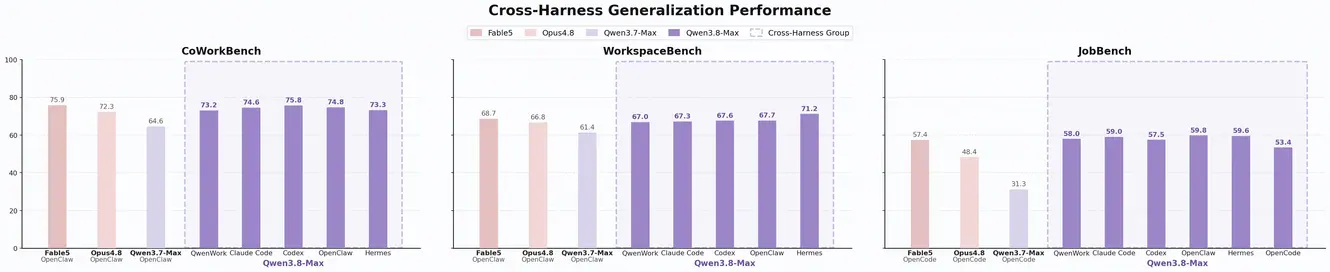
Source: Qwen3.8 official launch page. The first-party chart shows different results across QwenWork, Claude Code, Codex, OpenClaw, Hermes, OpenCode, and other harnesses. Coverage is not complete for every model-harness pair.
Vision: Hosted Feature, Not a Local-Checkpoint Assumption
Qwen Cloud lists image and video input for Qwen3.8-Max. This enables workflows that combine:
- screenshots and UI analysis;
- diagrams and technical documents;
- long video understanding;
- visual verification after code execution;
- multimodal research.
The open Qwen3.8-2.4T-A95B model card is tagged for text generation and describes the text checkpoint. Do not present the hosted vision capability as proof that the downloaded checkpoint accepts images without a compatible vision model and serving stack.
This distinction is especially important for coding-agent articles. A local text checkpoint and a managed visual agent may share a family name while offering different tools, context defaults, and input modalities.
API Pricing and Agent Cost
Qwen Cloud currently lists the following price structure for Qwen3.8-Max:
| Usage | Price per 1M tokens |
|---|---|
| Input | $2.00 |
| Implicit cache input | $0.25 |
| Output | $6.00 |
The cache-hit input rate is 87.5% lower than the regular input rate. That can materially change the economics of repeated system prompts, repository instructions, tool schemas, and long-running sessions.
A simple cost model is:
For cached prefixes, replace the relevant input tokens with the implicit-cache rate. For an agent task, calculate the complete run rather than one request:
The model's list price is not the same as cost per successful task. A cheaper attempt that needs more repairs may cost more than a stronger attempt that completes in fewer steps.
The Qwen Cloud page also lists 2M tokens per minute and 15K requests per minute as rate-limit figures for the managed model page. Treat those as service limits, not as guaranteed latency or throughput for every account.
Qwen3.8-Max vs the Open Checkpoint: Decision Guide
Choose Qwen Cloud when you need
- managed inference without owning 2.4T-class infrastructure;
- image and video input;
- built-in web and code tools;
- 1M context by default;
- predictable API integration;
- function calling and structured outputs;
- automatic context caching;
- production-oriented scaling.
Choose the open checkpoint when you need
- control over weights and serving infrastructure;
- self-managed data boundaries;
- experimentation with vLLM, SGLang, or TokenSpeed;
- custom quantization and routing;
- reproducible local or private deployment research;
- the ability to inspect and modify the inference stack.
The open checkpoint is not a shortcut to cheap inference. It transfers the operational burden to you: hardware, serving, monitoring, batching, context management, upgrades, and responsible-use controls.
License: Open Weights Is Not Apache 2.0
The Hugging Face model card lists the qwen3.8-max custom license. That is different from an Apache 2.0 model license.
Before using the open checkpoint commercially, read the license itself. The August 16 license text grants broad rights to use, modify, distribute, host, fine-tune, and create derivatives, but it also adds conditions that Apache 2.0 does not contain. In particular:
- products or services above 100 million monthly active users or $20 million monthly revenue must prominently display the model name;
- a Model-as-a-Service or AI Work Assistant business whose group revenue exceeds $50 million over twelve consecutive months must obtain a separate Qwen license for commercial use;
- copyright and permission notices must be retained;
- applicable-law and third-party intellectual-property obligations remain.
These are a plain-language summary, not legal advice. Verify your intended use with counsel and the official license text.
Do not describe Qwen3.8-2.4T-A95B as “Apache-licensed” or use “open source” as a synonym for “open weights.”
Vendor Benchmarks: What They Show
The official model card publishes results across coding-agent, general-agent, professional-work, and research evaluations. Those results are useful for understanding what Qwen chose to measure and how it positions Qwen3.8-Max.
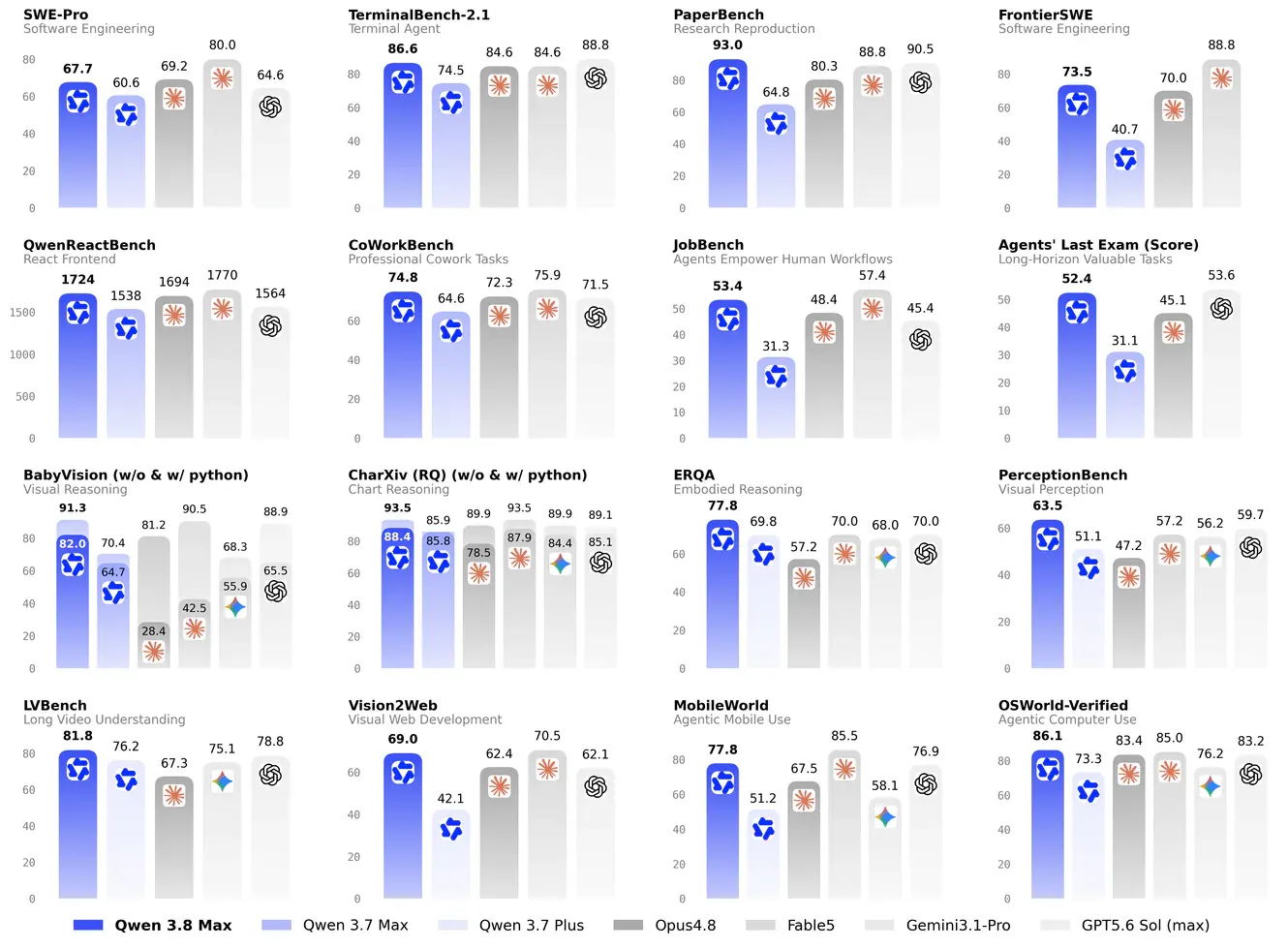
Source: Qwen3.8 official launch page. These are first-party results. Harnesses, judges, prompt variants, timeouts, token budgets, and comparison sources are not uniform across all panels.
They do not independently prove that Qwen3.8-Max will win every workflow. For a fair comparison, record:
- exact model ID and revision;
- endpoint and region;
- thinking mode and
reasoning_effort; - maximum output and timeout;
- prompt and system instructions;
- tool definitions and harness;
- repository state;
- retry and escalation policy;
- evaluator and acceptance criteria;
- input cache hit rate;
- tokens, latency, tool failures, and operator intervention.
Atoms should label these as vendor-published results until matched independent runs exist.
Qwen3.8-Max vs Earlier Qwen Models
Qwen3.8-Max vs Qwen3.7-Max
Qwen3.8-Max is the newer generation and is positioned around stronger coding, professional work, research, and long-horizon execution. The managed 1M context and built-in-tool story also makes the deployment distinction more explicit.
Check the current Qwen Cloud and Alibaba Model Studio catalogs before choosing an API ID. Documentation can lag behind a newly released model, and regional availability may differ.
Qwen3.8-Max vs Qwen3.8-27B
Qwen3.8-27B is the practical open deployment option:
- 27B dense;
- native vision-language;
- Apache 2.0;
- designed for local and private inference;
- substantially smaller than the 2.4T-A95B checkpoint.
Qwen3.8-Max is the capability and managed-service option. Qwen3.8-27B is the deployment and cost-control option. They should not be compared only by model name.
Qwen3.8-Max vs Qwen3-Coder-Next
Qwen3-Coder-Next is specialized around low-cost coding agents and executable environment feedback. Qwen3.8-Max is a broader Max-class model with coding, professional work, research, and managed tools.
The right choice depends on whether your workload prioritizes:
- broad multimodal and professional capabilities;
- low-cost coding-agent execution;
- local deployment;
- managed built-in tools;
- maximum context;
- predictable per-task economics.
How to Test Qwen3.8-Max Responsibly
Use a disposable or access-controlled workspace and a fixed task set. Start with at least three task categories:
- Repository repair: reproduce a bug, edit multiple files, run tests, and explain the patch.
- Long-document research: answer questions whose evidence appears at the beginning, middle, and end of a large corpus.
- Multimodal verification: inspect a screenshot or diagram, make a change, and verify the visual result.
For each run, record:
- first-pass success;
- retries and failed tool calls;
- total input and output tokens;
- cached input tokens;
- wall-clock time;
- operator interventions;
- evaluator result;
- cost per successful task.
Do not infer a production ranking from one impressive demo or one vendor benchmark table.
Frequently asked questions
01Is Qwen3.8-Max open source?
The Qwen3.8-2.4T-A95B checkpoint is available as open weights, but its model card lists a custom qwen3.8-max license rather than Apache 2.0. Read the license before commercial use.
02What is the difference between Qwen3.8-Max and Qwen3.8-2.4T-A95B?
The latter is the open-weight checkpoint underlying the managed Max service. Qwen Cloud adds managed inference, vision input, non-thinking support, built-in tools, and a 1M context configuration.
03Does Qwen3.8-Max support vision?
The managed Qwen Cloud service lists image and video input. The open text checkpoint should not be assumed to support vision without a compatible vision model and serving stack.
04What is the Qwen3.8-Max context window?
Qwen Cloud lists 1M context, with a maximum input of 991K and maximum output of 131K. The open checkpoint documents 262,144 native tokens and extensibility to approximately 1.01M.
05How much does Qwen3.8-Max cost?
The Qwen Cloud page currently lists $2 per million input tokens, $0.25 per million implicit-cache input tokens, and $6 per million output tokens. Recheck the official page before purchase because prices and availability can change.
06Is Qwen3.8-Max good for coding agents?
It is designed for coding and long-horizon agentic tasks, and the managed service provides function calling, code interpreter, web tools, structured outputs, and caching. Independent performance still depends on the harness, tools, prompts, reasoning settings, and task.
07Can I run Qwen3.8-Max locally?
You can download the Qwen3.8-2.4T-A95B checkpoint and use compatible serving software, but it is a 2.4T-class model. Local deployment requires serious infrastructure and careful memory, quantization, and context planning.
08Is Qwen3.8-Max better than DeepSeek V4?
There is no universal answer from the available vendor evidence. Compare the same tasks with the same tools, harness, reasoning budget, evaluator, and cost accounting. See our DeepSeek V4 Pro vs Flash cost analysis for the broader cost-per-successful-agent-task framework.
09What should I use for a smaller local deployment?
Consider Qwen3.8-27B or a specialized coding model instead of the 2.4T-A95B checkpoint. Measure quality, VRAM, throughput, context, and cost on your own workload.
Evidence Limits and Missing Technical Report
As of August 16, 2026, Qwen had not published a standalone document titled “Qwen3.8 Technical Report.” The strongest technical evidence is the official launch page plus the versioned model card, configuration, and license files. Do not cite the older Qwen3 technical report as proof of Qwen3.8-specific architecture or scores.
The official autonomous case studies—including multi-day coding and research-reproduction runs—illustrate intended capability boundaries. They are selected demonstrations, not controlled estimates of general task success. The same applies to official arena positions and benchmark panels unless independently reproduced with matched settings.
Sources
- Qwen3.8-2.4T-A95B model card
- Qwen3.8-Max on Qwen Cloud
- Qwen3.8-Max official Qwen page
- Qwen3.8-27B model card
- Alibaba Cloud Model Studio supported models
- Alibaba Cloud Model Studio pricing
Qwen3.8-Max is best understood as a model family plus a service boundary. The open checkpoint gives infrastructure control; Qwen Cloud gives managed multimodal tools and a 1M-token production configuration. The right choice depends on your workload, governance requirements, and measured cost per successful task.
