On this page
Seedance 2.5 landing-page hero on the ByteDance Seed website. The flame image is the page's hero media, not independent evidence that the frame itself was generated by Seedance 2.5 — Source
Seedance 2.5 makes a strong first impression: a native 30-second audio-video clip, multiple connected shots, synchronized sound, up to 50 reference assets, timestamp-level editing, and support for green-screen and clay-render workflows.
But the more important question is not whether the demos look cinematic. It is whether film, advertising, game, and industrial teams can turn those capabilities into a repeatable production system.
The two supplied Chinese articles approach that question from opposite directions. QbitAI stress-tests the launch features and finds a model moving from short visual experiments toward usable creative work. Shixiang interviews working creators and finds a less glamorous reality: higher compute costs, stricter prompting requirements, continuity failures, falling outsourcing prices, and a growing gap between “movie-like” shots and an actual movie.
Taken together, they tell a more useful story than either launch hype or industry pessimism alone:
Seedance 2.5 lowers the cost of generating and revising ambitious shots. It does not eliminate the need for scripts, direction, asset management, quality control, rights clearance, post-production, or economic discipline.
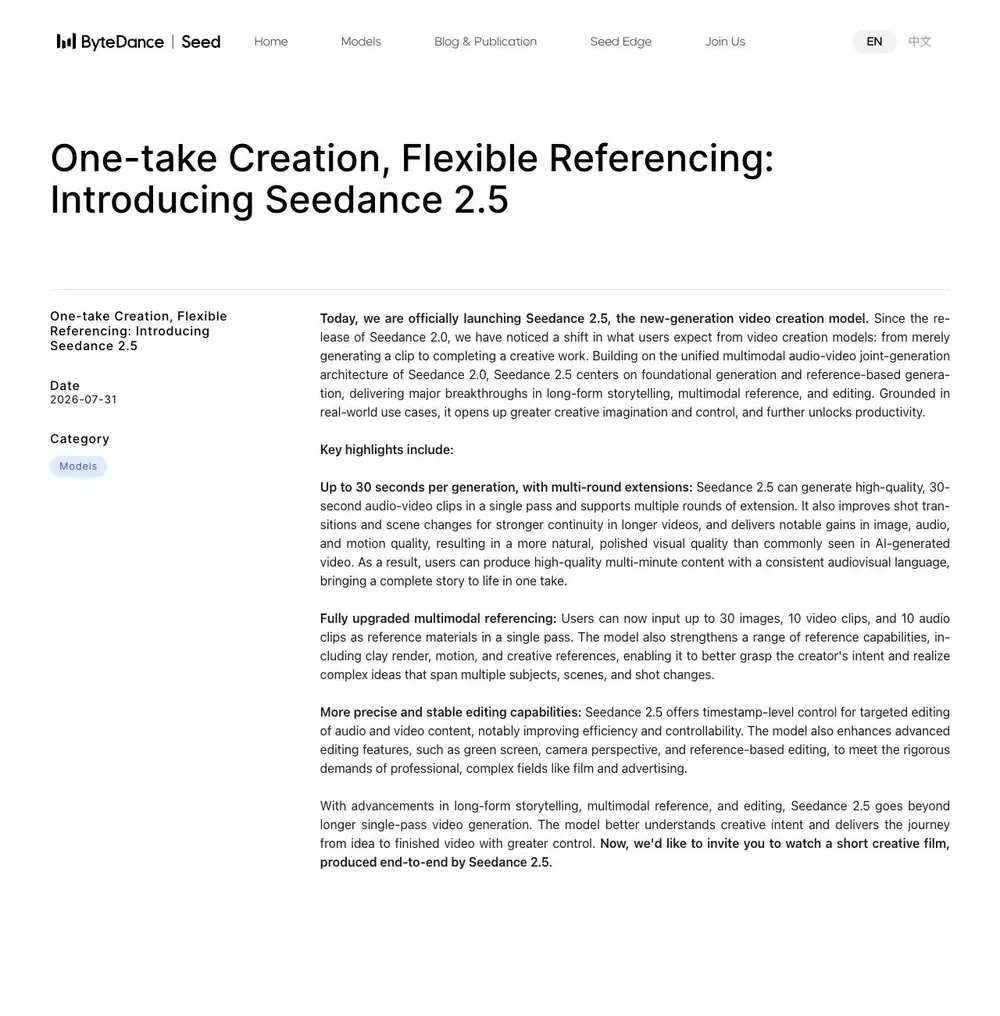
ByteDance Seed launch article dated July 31, 2026. The page states the model's 30-second generation, multimodal reference, and timestamp-editing claims; the screenshot documents the claims rather than independently validating them — Source
What ByteDance Officially Confirmed
ByteDance officially launched Seedance 2.5 on July 31, 2026. Its launch post describes a new-generation video creation model built on Seedance 2.0's unified multimodal audio-video architecture.
The confirmed feature set includes:
- up to 30 seconds of audio-video in one generation;
- multi-round video extension;
- up to 30 images, 10 videos, and 10 audio clips as reference material in a single pass;
- timestamp-level control for targeted audio and video editing;
- green-screen editing;
- camera-perspective and reference-based editing;
- clay-render reference for blocking, subject trajectories, camera paths, lighting, and spatial structure;
- availability through Jimeng AI, Doubao Pro, and other ByteDance products at launch;
- BytePlus ModelArk API access announced as coming soon in the original launch post.
The model page summarizes the product around three ideas: longer narratives, smarter reference and editing, and an explicit aim at professional production.
That language matters. ByteDance is no longer marketing Seedance as a novelty clip generator. It is positioning the model as a component in a production workflow.
Why Native 30-Second Generation Matters
Most AI video systems trained creators to think in five- or ten-second fragments. A longer scene required repeated generation, manual shot matching, continuity repair, audio work, and editing.
Seedance 2.5 doubles Seedance 2.0's stated single-pass limit from 15 to 30 seconds. More importantly, ByteDance says the model can organize several logically connected shots within that window: setup, development, turn, and resolution rather than one moment stretched over time.
The QbitAI tests illustrate why that matters. Its examples include:
- a cyberpunk chase through a ruined city;
- a rain-soaked rescue sequence with frequent cuts;
- a highly symmetrical period-fashion film;
- an illustrated Chinese-fantasy narrative;
- a space-survival short with synchronized electronic sound.
The article reports that character appearance, camera language, pacing, and atmosphere often remain coherent across the 30-second output. Those are editorial observations from selected tests, not controlled benchmark results, but they capture the practical change: 30 seconds is long enough to evaluate storytelling rather than only surface texture.
It is still not a finished long-form pipeline. Thirty seconds of consistency does not guarantee consistency across a ten-minute short or a feature film.
Fifty References Change the Job From Prompting to Directing
Seedance 2.5 accepts up to 50 multimodal references in one generation:
- 30 images;
- 10 video clips;
- 10 audio clips.
That allows a team to separate different dimensions of creative intent:
- character identity;
- wardrobe and product details;
- visual style;
- location and composition;
- camera movement;
- acting and blocking;
- speech, music, and sound design.
This is a larger conceptual shift than “better prompt following.” A prompt is ambiguous. A reference package is closer to a production brief.
For advertising, that can mean supplying product photography, brand colors, model references, existing campaign footage, and audio cues together. For games, it can mean combining concept art with a clay render that establishes level geometry and camera motion. For film, it can mean using a shot reference without copying every surface detail from that source.
The hard problem moves upstream: curating references, deciding which source controls which attribute, resolving conflicting signals, documenting permissions, and keeping a stable asset library across revisions.
ByteDance has not publicly documented a universal priority system for conflicting reference inputs. Teams therefore need to test what the model preserves, what it averages, and what it ignores.
Editing Is More Important Than the First Generation
The most production-relevant upgrade may be editing rather than generation.
Seedance 2.5 supports timestamp-level instructions and targeted changes to characters, actions, plot elements, audio, and camera movement. The QbitAI article demonstrates deleting selected shots from a generated space sequence and adding a brand mark at a specified point in an advertisement.
ByteDance's official examples go further:
- replacing a green-screen background while retaining the subject;
- changing camera movement without changing characters, actions, or style;
- specifying different camera instructions for 0–4, 4–7, 7–11, and 11–15 seconds;
- controlling when an action or transition occurs;
- using references to guide the intended edit.
This addresses a costly failure mode of AI video: regenerating an entire clip because one shot, hand, prop, subtitle, or camera transition is wrong.
However, “targeted edit” should not be interpreted as deterministic non-linear editing. Teams still need to test whether an edit preserves every unaffected frame, voice, product detail, and legal disclaimer. For regulated advertising or exact product visualization, a plausible revision is not enough; the result must be compared against the source assets.
Green Screen and Clay Render Connect AI to Existing Pipelines
The two articles agree that professional adoption depends on connecting generation to tools and assets teams already use.
Green-screen workflows
Instead of manually extracting a subject and rebuilding a scene from scratch, creators can use green-screen footage as a structural reference. Seedance 2.5 can replace the environment while attempting to preserve subject motion and adapt hair, clothing, gait, and lighting to the new setting.
That is valuable for commercials, music videos, and virtual production. It also creates a clear QA requirement: edge quality, contact shadows, reflections, product shape, and motion continuity must be inspected frame by frame.
Clay-render and white-model workflows
A textureless 3D preview can define:
- scene layout;
- character pose;
- motion path;
- blocking;
- lens and camera trajectory;
- timing and shot size.
The model then renders a more complete visual treatment around that structure. This can accelerate game cinematics, animation previsualization, architectural visualization, automotive sequences, and pitch films.
It does not make Maya or Blender irrelevant. Those tools become the control layer that supplies geometry and camera intent. Seedance becomes a renderer and interpretation layer—not necessarily the source of truth for final assets.
Why the Industry Is Still Divided
The Shixiang article reports a split response from working creators.
Some short-drama and motion-comic teams consider Seedance 2.5 expensive and slow for high-volume production. Traditional film creators see the improvement in light, space, composition, and camera control as a meaningful step toward higher production value.
Both can be right because their economics differ.
A team producing a large number of low-margin episodes optimizes for:
- generation speed;
- cost per accepted shot;
- predictable prompts;
- staff familiarity;
- throughput;
- client price.
A team building a premium commercial, game trailer, or festival short may accept more iteration in exchange for:
- art direction;
- complex camera work;
- brand consistency;
- performance control;
- fewer manual VFX steps;
- a stronger final frame.
The “best” model is therefore workload-dependent. A higher-capability model can be worse for a production line if its output is less predictable, more expensive, or slower for operators who already know the previous version.
Better Tools Do Not Automatically Make Better Stories
The critical argument in the industry article is that successful AI video projects are usually driven by experienced creators, not by model choice alone.
It cites two popular Chinese AI productions. In both cases, the creators had prior experience in writing, visual design, games, advertising, or live-action IP. The model amplified existing judgment; it did not create that judgment.
That distinction explains why a technically stronger second season or upgraded workflow can still disappoint audiences. A team may gain better rendering while losing time for character development, pacing, and script revision. Higher audience expectations can erase the visible advantage of the new tool.
Seedance 2.5 can help answer “Can this shot be made?” It cannot answer “Is this scene worth watching?”
The scarce skills shift toward:
- story and character judgment;
- visual development;
- shot design;
- directing performance;
- choosing references;
- editing rhythm;
- continuity supervision;
- knowing when not to generate.
“Movie-Like” Is Not the Same as a Movie
A convincing isolated shot can hide structural weaknesses. A feature film cannot.
Long-form production requires continuity across hundreds or thousands of decisions:
- facial identity;
- costume details;
- prop geometry;
- screen direction;
- physical space;
- lighting logic;
- action state;
- voice and emotion;
- cause and effect;
- narrative memory.
The Shixiang report describes a team attempting a 4K semi-realistic 3D CG feature. After months of work and substantial generation, the usable result remained around twenty minutes. The team reportedly reduced its target from 4K to 1080p as compute costs grew.
The article also cites the AI feature Hell Grind, reporting that more than 16,000 video clips and 10,000 images were generated for the first 22 minutes, with only 253 shots selected. Those figures are reported project data and should not be generalized to every production, but they highlight the metric that matters:
The cost is not price per generation. It is cost per accepted, continuity-safe shot.
Higher resolution can introduce another problem. A low-resolution test may be compositionally acceptable, while a later HD generation changes details or motion. If the high-resolution pass is not deterministic, the low-resolution approval does not fully transfer.
What ByteDance Itself Says Is Still Weak
ByteDance's official launch post is unusually clear about two remaining limitations:
- the physical plausibility of complex motion;
- the stability of scenes involving interactions among multiple subjects.
Those are exactly the areas that become more visible in longer clips.
Independent hands-on reports also mention:
- occasional voice inconsistency;
- morphing artifacts;
- identity or detail drift over longer interactions;
- products changing shape during rotation;
- difficulty when several references conflict;
- revision results that alter more than the requested region.
These reports vary by interface, resolution, prompt, and provider. They should be treated as failure patterns to test, not fixed failure rates.
Seedance Studio Signals the Next Competitive Layer
The Shixiang article reports that ByteDance is testing a platform called Seedance Studio, intended to cover creative planning, material generation, revision, and final-film progression rather than only producing a clip.
ByteDance has not provided a public global launch page or technical specification for Seedance Studio in the official sources reviewed here. Treat the platform details as reported, not confirmed product availability.
The direction is credible: model competition is moving upward into the creative operating system.
A production platform needs more than generation:
- scripts and shot lists;
- reusable character and product assets;
- reference provenance;
- version history;
- review and approval;
- timeline editing;
- collaboration;
- render queues and budgets;
- rights and safety checks;
- delivery presets.
If Seedance Studio becomes that orchestration layer, it may matter more commercially than another incremental model score.
Industry Readiness Is a Workflow Question
The phrase “Is the industry ready?” is often framed as a labor question: will AI replace directors, animators, VFX artists, or outsourcing teams?
The more immediate question is operational readiness.
A team is ready for Seedance 2.5 when it can answer:
- What counts as an accepted shot? Define identity, motion, product, audio, and continuity checks.
- Who owns each reference? Track licenses, talent releases, trademarks, music, and training-data constraints.
- What is the retry budget? Measure accepted-shot cost rather than celebrating the best sample.
- Which assets are authoritative? Decide whether the model, 3D scene, product CAD, or live-action plate is the source of truth.
- How are revisions reviewed? Compare local edits against unaffected frames and approved references.
- Can the workflow switch models? Avoid locking an entire pipeline to one interface or one release.
- Where must humans approve? Preserve control around likeness, brand claims, safety, legal text, and irreversible publication.
Without those answers, a stronger model can increase waste by encouraging more generation without improving delivery.
A Practical Seedance 2.5 Production Test
Do not judge the model with one beautiful prompt. Run a small production benchmark.
Test package
Create a 20–30 second brief containing:
- two recurring characters;
- one product or prop with exact geometry;
- three locations or shot setups;
- spoken dialogue and ambient audio;
- one camera move specified from a clay render;
- one green-screen plate;
- one timestamp-specific revision;
- one extension round.
Record the real metrics
Track:
- total generations;
- total compute or credits;
- time to first usable cut;
- identity failures;
- product-detail failures;
- audio or lip-sync failures;
- continuity repairs;
- percentage of frames changed by a local edit;
- human editing hours;
- final accepted seconds.
The key number is:
total workflow cost ÷ accepted finished seconds
That metric allows a fair comparison with Seedance 2.0, another video model, or a hybrid 3D/live-action workflow.
Seedance 2.5 vs Seedance 2.0
| Capability | Seedance 2.0 | Seedance 2.5 |
|---|---|---|
| Single-pass duration | Up to 15 seconds in ByteDance's comparison | Up to 30 seconds |
| Inputs | Text, image, video, and audio references | Up to 30 images, 10 videos, and 10 audio clips |
| Editing | Multimodal reference and editing | More precise timestamp, green-screen, camera, and reference editing |
| Long-form workflow | Short clips plus extension | Longer narrative structure plus multi-round extension |
| Professional control | Strong cinematic reference control | Adds deeper clay-render, blocking, and targeted-edit workflows |
| Availability on Atoms | Available on Atoms | No dedicated Atoms model page found at the research cutoff |
Seedance 2.5 is the more ambitious production model. Seedance 2.0 may remain useful when shorter clips, known behavior, lower workflow friction, or current platform availability matter more.
How to Use Seedance in an Atoms Workflow
Seedance 2.5 was not listed on a dedicated Atoms model page at the August 19 research cutoff. Do not imply that it is already available there.
Creators can use Seedance 2.0 on Atoms for multimodal video generation today. Atoms can also support the surrounding production work with models from the broader Models catalog:
- use a strong GPT or Claude model to turn a treatment into a structured shot list;
- generate continuity checklists and reference manifests;
- create prompt variants with explicit camera and timing instructions;
- review scripts, claims, captions, and delivery metadata;
- compare video outputs against the same acceptance rubric.
The best AI video stack will not be one model. It will combine planning, generation, verification, editing, and human approval.
Confirmed Features vs Marketing Interpretation
| Claim | Evidence status |
|---|---|
| Up to 30-second audio-video generation in one pass | Confirmed by ByteDance |
| 30 images + 10 videos + 10 audio references | Confirmed by ByteDance |
| Timestamp-level editing | Confirmed by ByteDance |
| Green-screen and clay-render workflows | Confirmed by ByteDance |
| Multi-round extension for multi-minute output | Confirmed as a product capability; continuity quality remains task-dependent |
| Perfect character consistency for 30 seconds | Not guaranteed |
| One-click three-minute native generation | Misleading: longer output uses extension, not a single native three-minute pass |
| Ready to replace a professional film pipeline | Not established |
| Seedance Studio provides an end-to-end platform | Reported as an internal test; public details remain limited |
| Every creator will need fewer skills | Not supported; more control can require more directing knowledge |
The Bottom Line
Seedance 2.5 is a significant upgrade because it attacks workflow bottlenecks rather than only improving image quality.
Its 30-second native output gives stories more room. Fifty references give teams a richer language for controlling identity, product, style, motion, and sound. Timestamp editing can reduce full rerenders. Green-screen and clay-render support connect AI video to existing film, advertising, and game pipelines.
That does not mean the industry is fully ready—or that Seedance 2.5 is ready for every production.
The remaining bottlenecks are less photogenic:
- continuity across many shots;
- physical and multi-subject stability;
- accepted-shot economics;
- operator training;
- rights and provenance;
- collaboration and version control;
- long-form story quality;
- dependable local revision;
- human approval.
The model makes it easier to produce footage. The industry still has to build the system that turns footage into work worth watching.
Frequently asked questions
01What is Seedance 2.5?
Seedance 2.5 is ByteDance's next-generation joint audio-video creation model for longer storytelling, multimodal reference generation, and targeted editing.
02How long can Seedance 2.5 generate?
ByteDance says it can generate up to 30 seconds in one pass and then use multi-round extensions for longer output. A multi-minute result is not the same as one native multi-minute generation.
03How many references can it use?
Up to 30 images, 10 video clips, and 10 audio clips in one generation.
04Can Seedance 2.5 edit an existing video?
It supports timestamp-level targeted edits, green-screen editing, camera-perspective changes, and reference-guided edits. Exact preservation of unaffected details should still be tested.
05Does it support Blender or Maya workflows?
The Chinese hands-on report describes Maya and Blender integration, while ByteDance's official materials confirm clay-render reference workflows. Teams should verify current plugin availability in the specific Jimeng, Dreamina, or enterprise environment they use.
06Is Seedance 2.5 production-ready?
It is production-relevant, but readiness depends on the workload. Advertising concepts, previsualization, short narratives, and game cinematics are stronger near-term fits than fully autonomous feature-film production.
07Is Seedance 2.5 available on Atoms?
No dedicated Seedance 2.5 page was found on Atoms at the research cutoff. Seedance 2.0 is available on Atoms.
08Will Seedance 2.5 replace filmmakers and artists?
It can automate or compress parts of generation, previs, compositing, and revision. Story, direction, aesthetics, rights decisions, continuity, and final accountability remain human responsibilities.
Sources
Research cutoff: August 19, 2026.
