Building AI-Enhanced E-Commerce Experiences
Introduction
In today's hyper-competitive digital landscape, the pace of change in e-commerce is not just fast—it's blistering. Just as indie hackers are leveraging AI to launch groundbreaking products at unprecedented speeds, e-commerce businesses face an intensifying pressure to innovate constantly and deliver increasingly superior customer experiences. This demands a strategic embrace of cutting-edge technologies to build compelling AI-enhanced e-commerce experiences that stay relevant and competitive.
Traditional retail strategies, relying on broad marketing campaigns and static storefronts, are simply no longer sufficient to capture and retain modern customer attention. Today's consumers expect highly personalized interactions, seamless shopping journeys, and instant gratification, pushing businesses to find more intelligent ways to enhance both front-end engagement and back-end operational efficiency. The demand for bespoke experiences, from product discovery to post-purchase support, is higher than ever before.
This is precisely where Artificial Intelligence emerges as the definitive solution for transforming online retail. AI is far more than just a technological buzzword; it represents a powerful, transformative force capable of revolutionizing e-commerce personalization, significantly streamlining operational efficiency, and unlocking unprecedented growth potential for businesses of all sizes. By intelligently processing vast amounts of data, AI can predict trends, automate complex tasks, and tailor every customer interaction.
This report aims to serve as a comprehensive and practical guide for e-commerce founders and digital marketers. We will explore how to strategically build truly AI-enhanced e-commerce experiences that not only meet contemporary demands but also drive measurable results in sales, conversion, and customer loyalty. Our focus is on demystifying AI's application in real-world scenarios, offering actionable insights for implementation.
Core Strategy: AI for Competitive Advantage
AI is no longer an optional add-on for e-commerce businesses; it's a core strategic imperative for competitive advantage in today's rapidly evolving digital marketplace. The global AI-enabled e-commerce market is experiencing explosive growth, projected to reach $64.03 billion by 2034 from $7.25 billion in 2024, demonstrating a remarkable compound annual growth rate (CAGR) of 24.34% 1. This surge underscores AI's transformative power, making it a top priority for 84% of e-commerce businesses, with 97% of retailers planning increased AI spending in the next fiscal year . To stay ahead and build truly AI-enhanced e-commerce experiences, founders and digital marketers must leverage AI across key strategic pillars: hyper-personalization, operational efficiency, and intelligent pricing.
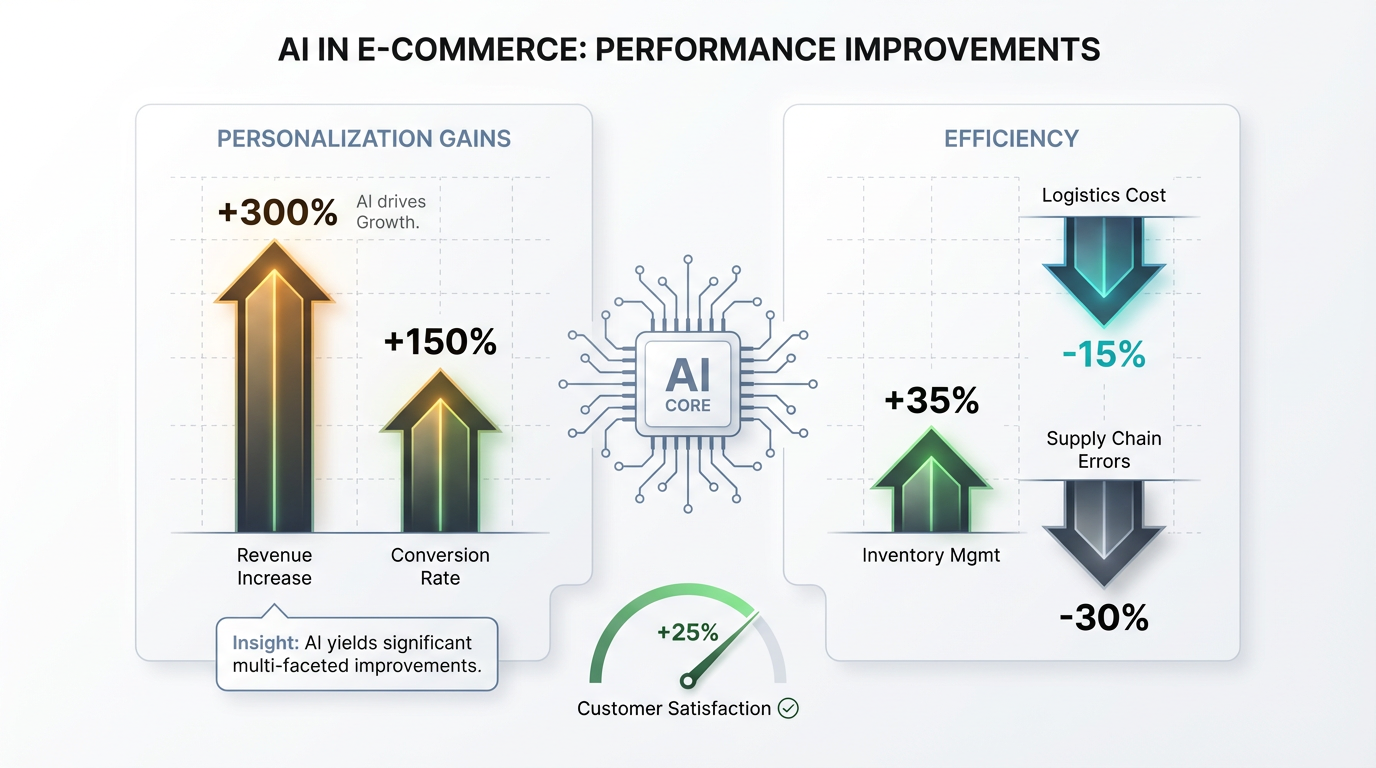
One of the most potent applications of AI in e-commerce is hyper-personalization, which radically transforms the customer journey and significantly boosts revenue. AI-powered recommendations can lead to a substantial 300% revenue increase and a 150% rise in conversion rates 2. This capability, exemplified by Amazon's AI engine driving 35% of its annual sales, creates highly relevant shopping experiences . By analyzing past purchases, browsing history, and demographics, AI tailors product suggestions, ensuring customers find exactly what they need, faster . Furthermore, AI personalization boosts conversion rates by up to 23% and can generate revenue increases up to 40%, with companies employing these strategies reporting an average revenue uplift of 10-12% . Shoppers complete purchases 47% faster when assisted by AI, and returning customers engaging with AI chat spend 25% more during their session 1. This not only enhances satisfaction—with 74% of U.S. consumers believing AI improves their shopping experience—but also fosters long-term loyalty, a crucial factor for sustainable growth .
Beyond the customer-facing aspects, AI offers immense potential for operational efficiency and automation, delivering substantial cost savings across the e-commerce value chain. Implementing AI in logistics can result in a 15% reduction in costs, a 35% improvement in inventory management, and a 65% boost in service levels 2. AI-powered forecasting is particularly impactful, cutting supply chain errors by 30% to 50% and leading to a 65% reduction in lost sales, alongside 10-40% lower warehousing costs . These improvements are critical for optimizing resource allocation and streamlining complex supply chains. Machine learning enhances stock accuracy by 30% through real-time tracking systems, while AI optimizes logistics with smarter route planning, reducing fleet downtime by 40% 3. Companies utilizing AI for workforce and asset allocation achieve 29% better resource utilization and a 33% reduction in idle time costs 4. Moreover, AI-powered fraud detection tools, such as those used by PayPal, are vital for preventing fraudulent activities, safeguarding both merchants and customers . The significant cost reductions, experienced by 72% of AI adopters, highlight the technology’s power to improve a business’s bottom line, with average operational savings of 35-45% within two years for AI cost optimization strategies .
To maximize profitability and responsiveness, e-commerce businesses are increasingly turning to dynamic pricing and predictive analytics, both powered by AI. Dynamic pricing platforms automatically adjust product prices in real-time, considering demand, competition, inventory levels, and customer behavior . This agile approach ensures optimal pricing strategies, enhancing revenue and profitability by responding instantly to market shifts. Coupled with dynamic pricing, predictive analytics analyze customer data and historical trends to forecast future behaviors, which is essential for optimizing inventory and tailoring services more effectively . AI-driven supply chain analytics can cut forecasting errors by an impressive 50% while simultaneously reducing operational costs by 20% 3. Furthermore, predictive analytics proactively identify potential cost overruns, reducing unexpected expenses by an average of 34%, ensuring financial stability and improving strategic planning 4. These AI-driven insights empower businesses to make informed decisions, mitigate risks, and maintain a sharp competitive edge.
Real Example: A Case Study in Action
While the theoretical benefits of AI in e-commerce are compelling, seeing it in practice brings its true power into focus. Consider a rapidly growing Direct-to-Consumer (DTC) fashion and lifestyle brand, operating with 35 employees, which encountered significant friction in converting its substantial traffic into actual sales 5. This brand, like many others, was grappling with a high cart abandonment rate, where a staggering 70% of carts were left unrecovered 5. Adding to their woes were rising Customer Acquisition Costs (CAC) across major platforms like Meta and Google Ads, coupled with rapid ad creative fatigue that consistently diminished their Return On Ad Spend (ROAS) 5. Their marketing efforts, lacking a unified source of truth for ROI, often felt like mere guesswork, preventing targeted and efficient spending 5.
To overcome these challenges, the brand implemented a specialized e-commerce AI marketing model from marktgAI, seamlessly integrating it into their existing tech stack, including Shopify, Klaviyo, and Meta Ads 5. This AI solution wasn't a silver bullet but a strategic set of interconnected functionalities. It employed Predictive Purchase Scoring to pinpoint high-intent shoppers before they disengaged from their buying journey 5. AI-powered content generation automated the creation of ad copy and cart recovery emails, all while meticulously preserving the brand's unique voice 5. Perhaps most critically, Smart Ad Spend Optimization dynamically shifted budgets between Meta and Google Ads in real-time, ensuring optimal returns based on live performance data 5. A unified dashboard further consolidated data from Shopify, Klaviyo, GA4, and Meta Ads, providing an AI-powered, single source of truth for marketing performance 5.
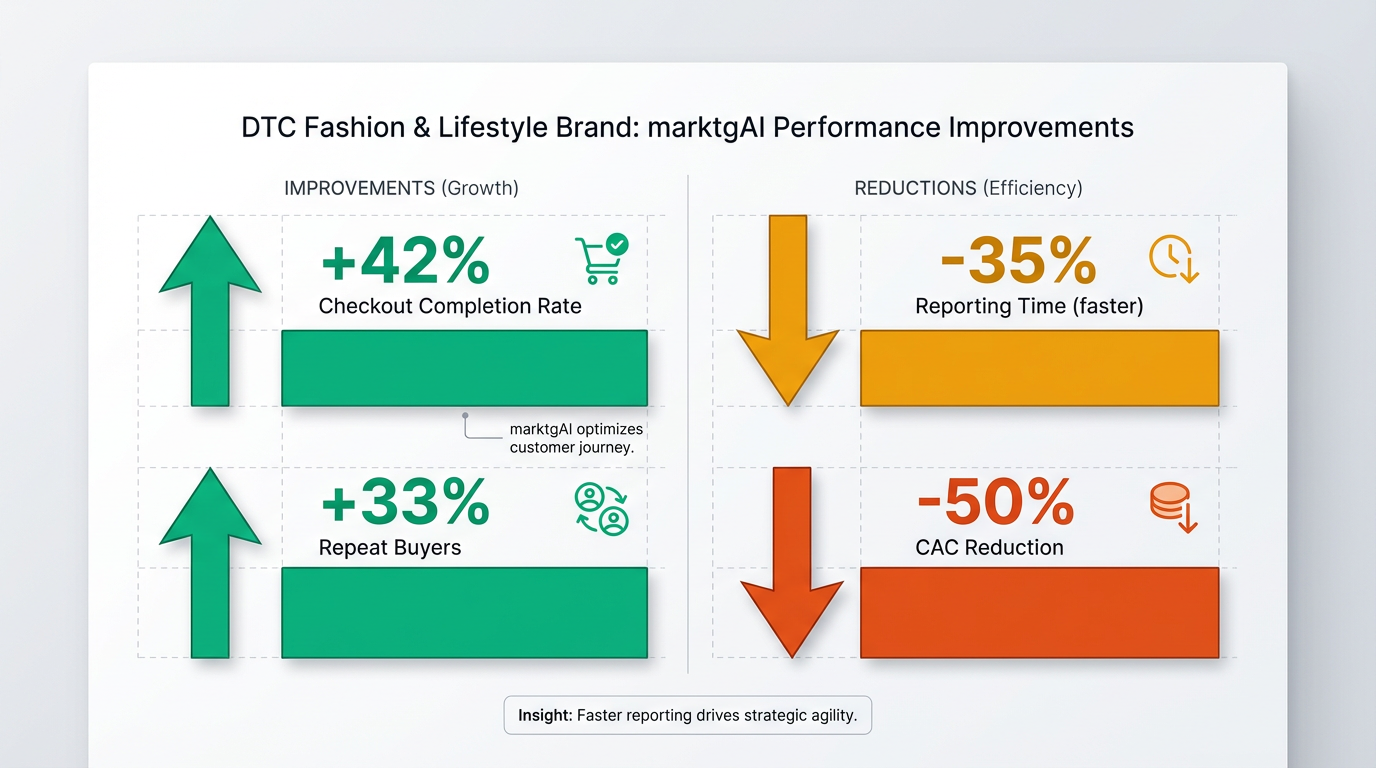
The results, achieved within just 60 days, were transformative and unequivocally demonstrated the ROI of targeted AI implementation. The brand witnessed a remarkable 42% increase in their checkout completion rate 5. Customer loyalty saw a significant boost, with 33% more repeat buyers 5. Operational efficiency also improved, leading to a 35% faster reporting time 5. Critically for profitability, their Customer Acquisition Cost (CAC) was cut by half, signifying a 50% reduction, alongside dramatically improved cart recovery rates and a substantial increase in ROAS 5. These outcomes illustrate how moving from guesswork to data-driven AI significantly refines marketing spend and elevates core business metrics.
The success of this implementation lies in its strategic focus on key pain points. By unifying disparate data sources and employing AI for predictive analysis, content generation, and real-time budget allocation, the brand was able to understand customer intent at a deeper level and react with unprecedented agility 5. For e-commerce founders and digital marketers, the key learning here is clear: leverage AI not just for superficial improvements, but to fundamentally optimize your entire marketing and sales funnel, from identifying high-intent shoppers to re-engaging abandoned carts and maximizing ad spend efficiency. This holistic approach is what truly drives measurable, impactful growth.
Build It Yourself: Implementing AI Tools
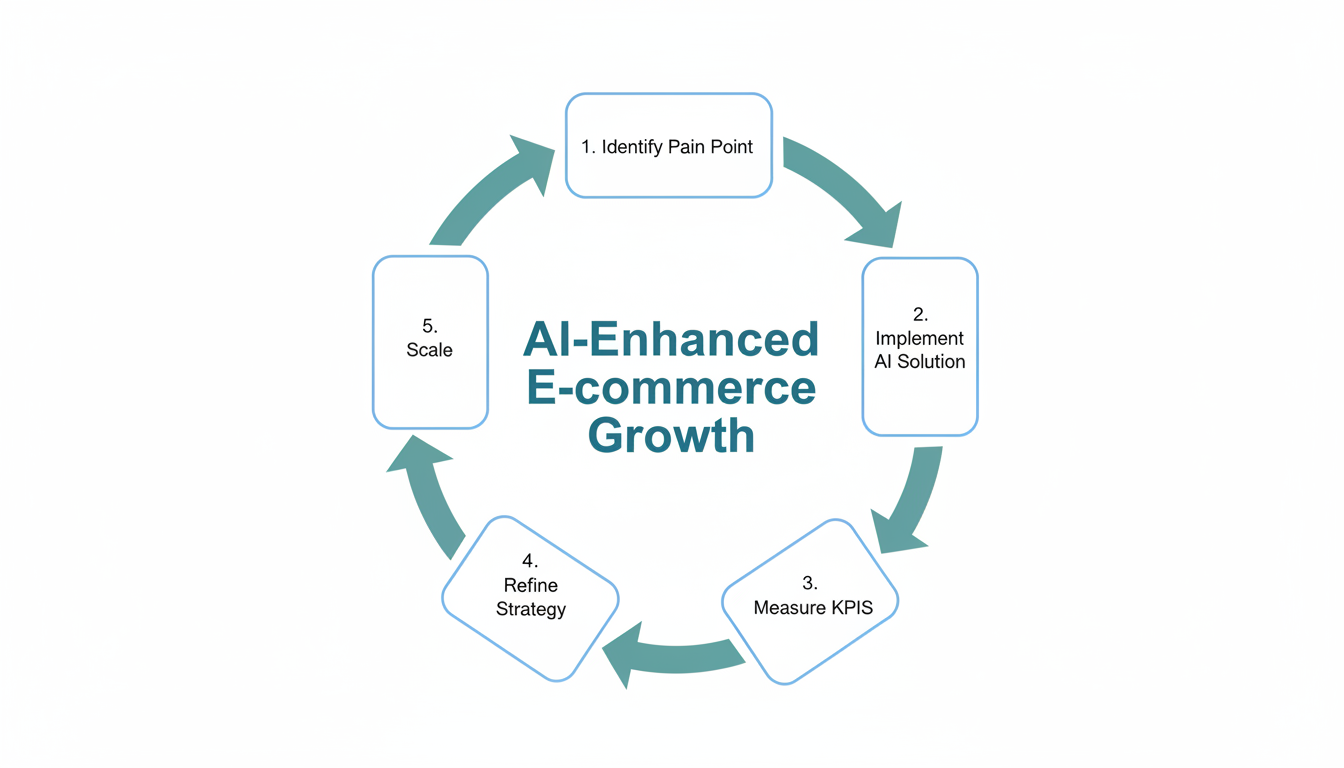
For the indie hacker or small business, the chasm between a great e-commerce idea and a functional, AI-powered product often feels immense. Yet, the current landscape of AI tools has drastically narrowed this gap, making advanced capabilities accessible without extensive coding or enterprise-level budgets. The first step is to pinpoint specific pain points or opportunities where AI can deliver significant value, whether it’s automating product descriptions, offering personalized recommendations, or streamlining customer service. Once identified, selecting the right accessible tools becomes paramount.
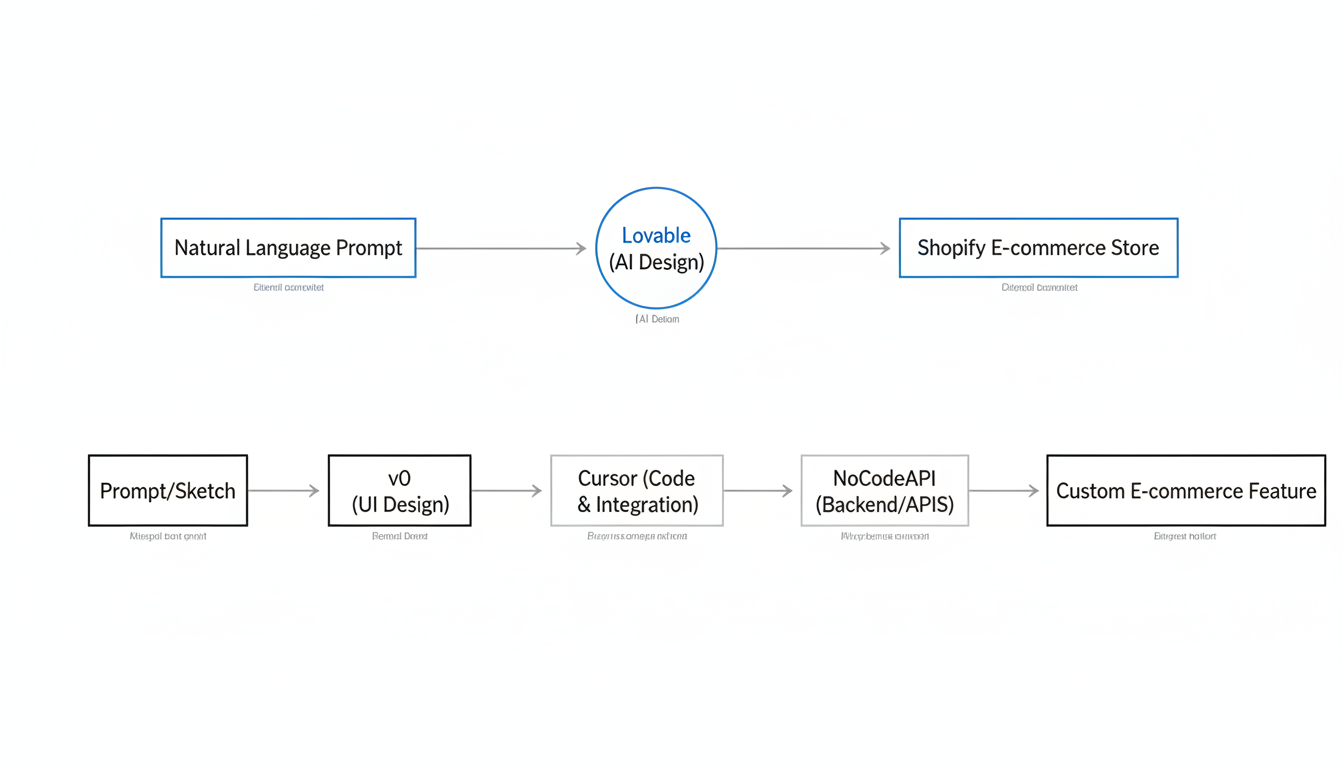
A rapid path to launching an e-commerce store with AI at its core is through platforms like Lovable. This AI-powered no-code builder can construct entire Shopify stores from simple chat descriptions, automatically setting up backend infrastructure, including databases, authentication, and payment processing . Imagine outlining your clothing brand's requirements to Lovable, which then generates a fully functional draft complete with a working checkout and add-to-cart features. You can then simply upload product images, tell Lovable what to sell, and even have it write product descriptions before publishing directly to Shopify 6. This approach dramatically reduces the time and technical expertise needed to get an AI-enhanced store off the ground.
When building more custom features, such as intelligent search or bespoke recommendation engines, a combination of specialized AI tools offers robust capabilities. The workflow might begin with v0 from Vercel, which can quickly generate UI components or entire frontends based on prompts, using ShadCN components . This initial design then moves into an AI editor like Cursor, built on Visual Studio Code, where developers can refine the code, generate new logic, and integrate APIs, even for React Native applications . Cursor acts as an intelligent co-pilot, debugging, testing, and ensuring control over the codebase . To connect custom features to external services, like OpenAI for unique AI functionalities or various third-party apps, NoCodeAPI transforms these services into secure API endpoints without requiring server-side coding. This means your Cursor-developed application can effortlessly interact with complex backend services 7.
For broader website or application development, low-code/no-code platforms offer varying degrees of flexibility. Webflow, for instance, provides a visual editor for rapid prototyping of functional landing pages or simple e-commerce sites, easily integrating with payment gateways . For more intricate web applications demanding custom logic, Bubble stands out as a powerful visual programming platform. While it presents a steeper learning curve, its extensive flexibility and API connectors allow for integrating advanced AI services, enabling sophisticated functionalities previously exclusive to enterprise solutions . Meanwhile, Softr integrates directly with Airtable, making it ideal for creating data-driven applications like product catalogs or customer portals without code 8.
While these tools significantly lower the barrier to entry, it's crucial to acknowledge the learning curve associated with mastering their full potential. Even with AI assistance, understanding core development concepts, effective prompt engineering, and debugging skills remain vital for refining and testing AI-generated code . However, this investment in learning equips indie hackers with the power to iterate quickly and build scalable, AI-driven e-commerce experiences independently, a stark contrast to traditional development cycles.
Next Steps: Your AI E-Commerce Action Plan
The landscape of e-commerce is not merely changing; it is being fundamentally reshaped by artificial intelligence. As we've seen, AI offers unparalleled opportunities for small businesses and indie hackers to achieve significant gains in efficiency, deliver highly personalized customer experiences, and dramatically boost sales and conversion rates. From automating tedious tasks to uncovering deep customer insights, AI is no longer a luxury but a strategic imperative for staying competitive and fostering growth in a crowded market .
For founders eager to harness this power, the path to AI integration need not be daunting. Start by identifying a single, high-impact area that addresses a critical business challenge, whether it's reducing cart abandonment, improving product discovery, or enhancing customer retention. The most successful implementations begin with a clear problem and a targeted AI solution . Once an area is chosen, embrace the philosophy of starting small, piloting your solution, and iterating quickly. This allows for rapid learning, minimizes risk, and provides tangible proof of concept, enabling you to refine your approach based on real-world data and user feedback 9.
Prioritizing data quality and ethical AI considerations is paramount. AI models are only as good as the data they are trained on, meaning clean, relevant data is essential for accurate predictions and effective personalization . Simultaneously, fostering ethical AI practices builds trust with your customers, ensuring transparency in data usage and preventing biased outcomes. Regularly monitoring Key Performance Indicators (KPIs) related to your AI initiatives is crucial for demonstrating ROI and understanding the impact of your investments . Continuously refine your AI strategy based on these metrics, adapting to new technologies and evolving customer behaviors.
The journey of AI in e-commerce is just beginning, with new tools and approaches emerging almost daily. Embracing a mindset of continuous learning is essential for founders who want to leverage this transformative technology. The market for AI-enabled e-commerce is projected to grow exponentially, indicating that innovation in this space will only accelerate 1. Those who dedicate themselves to understanding and integrating these tools will be best positioned to carve out defensible niches and outmaneuver larger competitors 10.
Now is the moment for indie hackers and e-commerce entrepreneurs to embrace AI, to experiment with generative AI for content, predictive analytics for customer insights, and no-code platforms for rapid development. By doing so, you can build smarter, more engaging, and ultimately more profitable e-commerce experiences.