Building SaaS with $0: Bootstrap Success Stories
Introduction: The Zero-Budget Revolution
"Building SaaS with $0" might sound like a pipe dream in today's capital-intensive tech world, especially as traditional venture capital funding becomes increasingly elusive. Yet, as investor appetites shift and the cost of capital rises, a compelling new paradigm is empowering aspiring entrepreneurs: the bootstrapped SaaS model. This isn't merely about cutting costs; it's a strategic and sustainable response to a more challenging funding landscape, enabling solo founders and indie hackers to launch and scale their innovative ideas without relying on external investment. The dream of independent, profitable software development is now more accessible than ever.
This "new normal" for software entrepreneurship is profoundly shaped by an unprecedented array of modern tools and methodologies. Low-code platforms, accessible cloud infrastructure, and advanced artificial intelligence capabilities have dramatically lowered the barriers to entry for developing, deploying, and even marketing a software product. AI, in particular, acts as a powerful force multiplier, automating complex development tasks, streamlining content creation, and dramatically reducing the need for large, expensive teams. This rapid technological evolution transforms "building SaaS with $0" from a theoretical aspiration into a tangible, growing reality for those willing to embrace radical frugality and smart technological leverage.
This article will delve into the inspiring world of successful bootstrapped SaaS founders who have achieved remarkable growth with minimal financial outlay. We will dissect their real-life success stories, extracting actionable, low-cost strategies that can be replicated. Our focus will be on proving that with ingenuity, persistence, and the right approach to organic growth and AI-powered development, launching a profitable SaaS business without needing a single dollar of external funding is not only possible but increasingly common for the savvy indie hacker.
Core Strategy: Crafting Your Lean Launchpad
Launching a SaaS business with limited resources demands a razor-sharp strategic focus. Instead of trying to be everything to everyone, bootstrapped founders excel by making deliberate choices about their market, their product, and their growth channels. This lean approach isn't a limitation; it's a powerful differentiator that often leads to more robust, user-centric products.
One foundational strategy is hyper-focused niche targeting, a deliberate choice to avoid feature bloat and broad appeal in a competitive landscape. Forgoing the pressure to cater to a general audience allows companies to carve out a distinct identity and achieve a deeper product-market fit 1. This specificity provides the courage to decline features, ideas, or even potential customers that don't align with the core vision, as seen with Tally 1. By concentrating on a specific demographic—such as users valuing high-quality UX, Notion enthusiasts, no-code creators, and indie hackers—founders infuse their product with a unique "soul" that resonates deeply with their chosen community 1.
Complementing niche targeting is Product-Led Growth (PLG), an approach where the product itself becomes the primary driver of user acquisition, conversion, and expansion. For bootstrapped ventures, this means designing a product that is inherently simple, viral, and easily adopted with minimal barriers 1. Imagine a user being able to start building without a sign-up, credit card, or complex onboarding process, quickly reaching their "time-to-value" 1. This user-centric design, often characterized by transparent pricing, a clean aesthetic, and delightful interactions, fosters a powerful growth loop where free usage drives word-of-mouth referrals, increasing visibility and conversions to paid plans 1.
Finally, Community-Led Growth (CLG) combined with strategic content marketing serves as an indispensable engine for organic lead generation. Without a significant marketing budget, founders embed themselves in niche online communities, offering genuine value and expertise 90% of the time before subtly mentioning their product . This builds credibility and positions them as helpful contributors, not just marketers . Simultaneously, high-value content marketing, focusing on long-form guides and blog posts that address user pain points and target low-competition keywords, provides sustainable, high-ROI organic traffic over time . Tally exemplifies this by engaging with users daily, "co-building" through dedicated channels, and leveraging transparency to cultivate a robust community—their "best insurance policy" 1.
Founder's Blueprint: The Tally.so Story
Bootstrapping a SaaS business from the ground up requires not just an innovative idea, but also an unwavering commitment to a core vision and an exceptional understanding of one's target audience. The journey of Tally.so, founded by Marie Martens and Filip, serves as a compelling case study for indie hackers aiming to build a successful product with minimal external funding. Nearly five years ago, they set out to revolutionize the form-building market, an arena already crowded with cumbersome and expensive solutions, by making form creation enjoyable, efficient, and most importantly, free to start 1. Their decision to bootstrap meant fostering a deeply symbiotic relationship with their users, garnering direct feedback that shaped their product organically and at their own pace 1.
Tally's success stems from several deliberate strategic choices. They adopted a philosophy of "Doing One Thing Really, Really Well," consciously avoiding feature creep and horizontal expansion into adjacent markets like CRM or scheduling 1. Instead, they poured all their energy into perfecting an exceptional form builder, distinguished by its intuitive, text-editor-like interface, transparent single pricing tier, and a clean aesthetic reminiscent of Notion 1. This dedication to simplicity became their primary competitive advantage, requiring them to learn the difficult art of declining feature requests and even potential customers that didn't align with their focused vision 1.
Their approach to product development was equally unique: "Building With Users, Not Just For Them." The Tally team maintains a highly engaged dialogue with their user base, meticulously reviewing every piece of feedback across emails, tweets, and messages 1. This unscalable yet invaluable commitment extends to co-building through dedicated Slack channels, beta testing groups, and a public feedback board where users actively vote on new features 1. This transparency, often termed "building in public," has cultivated a robust and loyal community, which the founders consider their most significant insurance policy 1.
Central to Tally's growth has been its Product-Led Growth (PLG) model. Their product is inherently simple, viral, and removes virtually all barriers to entry; users can begin building forms instantly without signing up or providing credit card details 1. This rapid "time-to-value" fuels a powerful growth loop: free usage leads to organic word-of-mouth referrals, generating more forms, increasing visibility through "Made with Tally" badges, and ultimately driving conversions to their Pro plans 1. Their intense focus on user experience ensures that the product itself is the primary engine of adoption and advocacy 1.
Operating without significant funding in a competitive landscape, Tally also embraced "Niche Positioning." They deliberately chose not to build for everyone, instead targeting users who value high-quality UX and design, no-code creators, indie hackers, and existing Notion users—a demographic closely aligned with the founders themselves 1. This focused strategy allowed them to infuse their product with a distinctive "soul," enabling bold product decisions and marketing that prioritized distinctiveness over broad, bland appeal 1. They understood that the greatest risk was being perceived as boring or overlooked 1.
Their commitment to these principles has translated into impressive, transparently documented growth. Starting from $0 MRR in September 2020, Tally quickly gained traction, reaching $10,000 MRR by February 2022 1. By September 2023, coinciding with the launch of Tally 2.0, they hit $75,000 MRR, further accelerating to $100,000 MRR by February 2024 1. The latter part of their journey saw an even steeper incline, projecting $2 million ARR by February 2025, and an impressive $4 million ARR by October 2025, demonstrating the power of their bootstrapped approach 1.
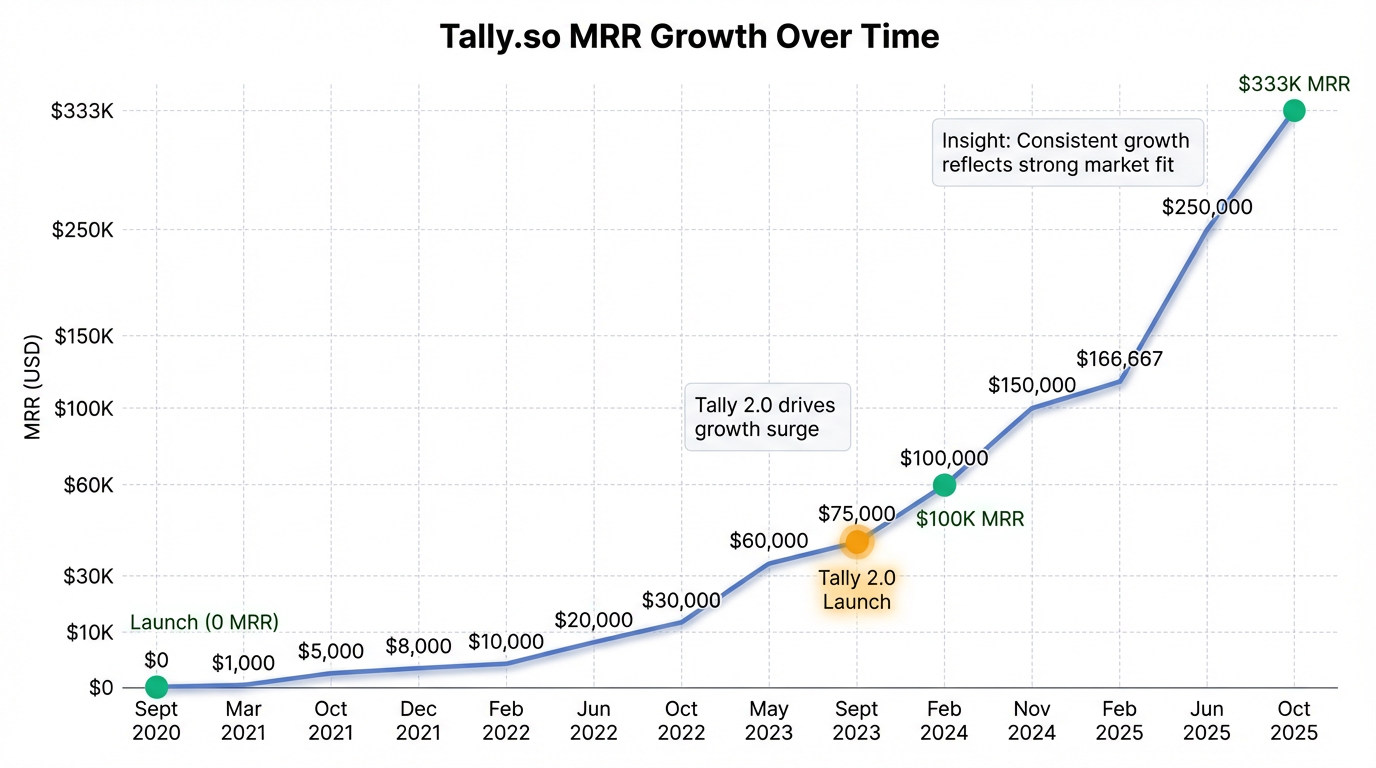
The most significant challenge for Tally was maintaining simplicity amidst constant pressure to add complexity, all while operating in a competitive market without venture capital or a large team 1. They overcame this by steadfastly adhering to their core product philosophy, rigorously prioritizing features, and learning to gracefully decline requests that deviated from their focus 1. The lessons learned from Tally's journey underscore the importance of strategic focus, authentic user engagement, simplicity as a strength, transparency, product-led adoption, and embracing a defined niche 1. Their story proves that consistent principles—continuous user interaction, unwavering focus, rigorous prioritization, agile execution, and active community involvement—are the true accelerators of sustainable, bootstrapped growth 1.
AI as Your Co-founder: Building with Modern Tools
The dream of building a SaaS product with minimal capital and a lean team is no longer a distant fantasy, thanks to the advent of sophisticated AI tools like Cursor, Lovable, and v0. These platforms are rapidly reshaping the landscape for indie hackers and early-stage startups, drastically cutting down both development time and financial outlay 2. What once demanded months or even years of development and hundreds of thousands of dollars can now be achieved in weeks for a fraction of the cost, empowering solo founders to compete effectively 2. This new era heralds AI as a true co-founder, democratizing software creation.
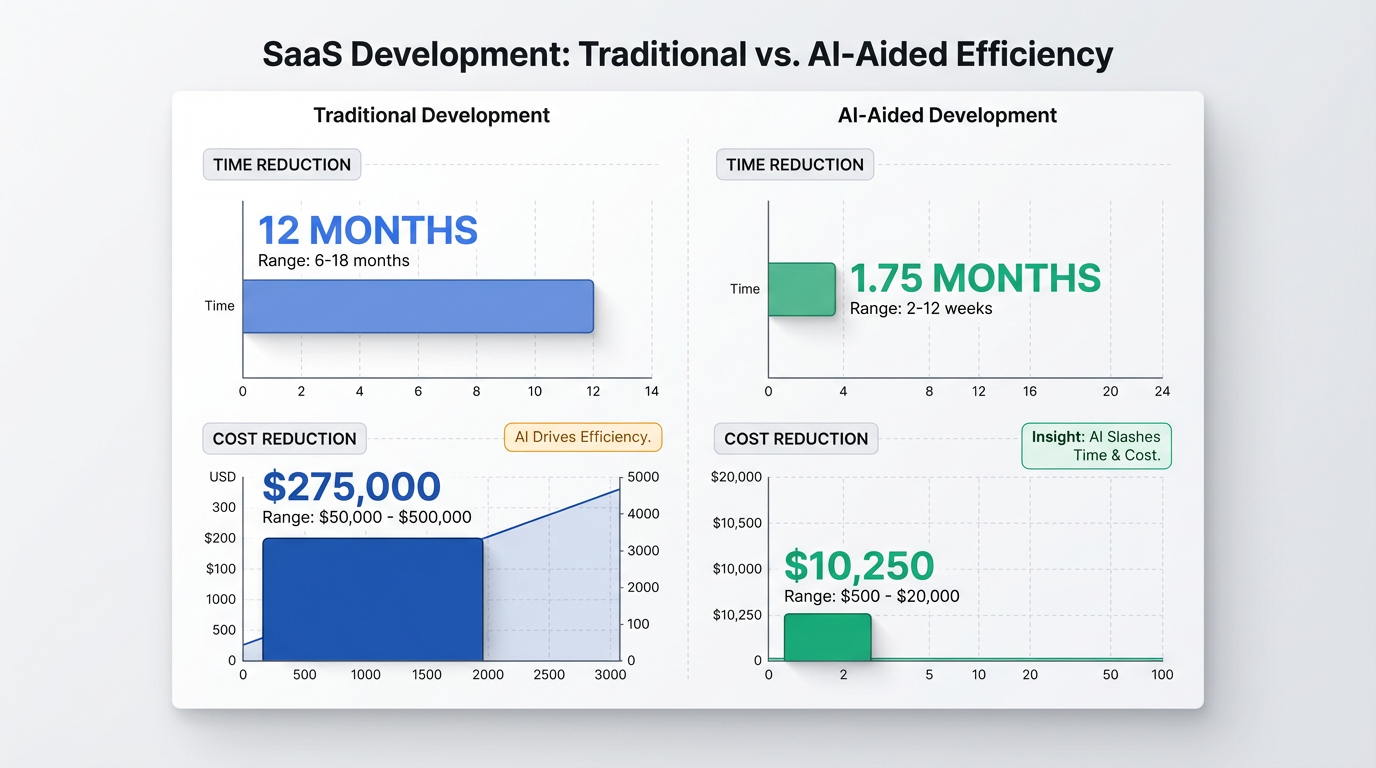
Cursor, an AI-powered code editor built on a VSCode fork, exemplifies this shift by integrating advanced AI capabilities directly into the development workflow 3. It offers intelligent code completion, boilerplate generation across numerous languages, and in-editor chat, allowing for rapid prototyping and full-stack SaaS development with popular tech stacks like Next.js, Supabase, and Stripe 3. Indie hackers have successfully built entire SaaS products in under a week, spending minimal resources, with Cursor assisting in everything from authentication setup to payment integration 5. Beyond code generation, Cursor aids in debugging and maintaining code quality, especially when guided with clear context and .cursorrules files 5.
Complementing this, Lovable emerges as an AI app builder designed for even non-technical founders, allowing them to construct full-stack SaaS applications through natural language descriptions 9. It handles everything from UI components and backend logic to user accounts and database structures, natively integrating with services like Supabase and Stripe for seamless authentication and payment processing 10. This platform enables rapid MVP creation in hours rather than weeks, eliminating the need for extensive coding experience or large developer teams 13.
For frontend polish, v0.dev, from Vercel, excels at instantly generating beautiful UI and React components from simple prompts 10. While primarily focused on crafting polished front-end prototypes and stakeholder demos, it significantly accelerates the visual development process for React-based projects 15.
Here's a comparison of these powerful tools:
| Tool Name | Primary Focus | Target User | Key Features/Contribution |
|---|---|---|---|
| Cursor | AI-powered code editor and assistant for enhanced development | Indie hackers, early-stage startups, solo founders, small teams, developers | VSCode fork with AI, supports third-party LLMs, in-editor chat, context-aware suggestions, rapid prototyping, boilerplate generation, full-stack SaaS dev, debugging, code quality via .cursorrules |
| Lovable | AI app builder for rapid full-stack SaaS construction via natural language | Non-technical founders, indie hackers, early-stage startups | Generates screens, backend logic, UI components, user accounts, database structures; chat-based editing, visual component editing, one-click deployment, integrated Supabase & Stripe |
| v0 | Frontend UI and React component generation from text prompts | Developers (React ecosystem), product managers | Generates React components instantly, polished frontend prototyping, crafting UI, aids in stakeholder demos |
The overall benefits are undeniable: these AI tools remove significant technical barriers, offering a massive productivity boost by handling up to 80% of development and even marketing tasks 16. This extreme cost-effectiveness, often leveraging free tiers of services alongside AI, leads to an accelerated time-to-market, allowing founders to validate ideas and iterate rapidly 5. However, success still hinges on good product management, clear prompt engineering, and understanding core architectural concepts to avoid "vibe-coded apps" that might falter at scale 6.
Your Launch Sequence: A Practical Roadmap
Having seen how AI tools are democratizing software development, making it possible to build robust SaaS applications with unprecedented speed and minimal cost, the next logical step is understanding how to harness these capabilities into a successful launch sequence. This isn't just about coding; it's about a strategic approach that combines lean development with smart, community-centric growth, echoing the successes of companies like Tally and countless indie hackers. To launch a SaaS with minimal resources, you need a disciplined, user-focused roadmap.
Your journey begins not with code, but with clarity: identify a specific problem for a well-defined niche and then commit to solving that problem exceptionally well, as Tally demonstrated with their singular focus on form building1. Resist the urge to build for everyone; instead, channel your energy into understanding a specific audience, like Notion users or no-code creators, and crafting a product that deeply resonates with them1. This laser focus simplifies development, marketing, and fosters a distinct product identity.
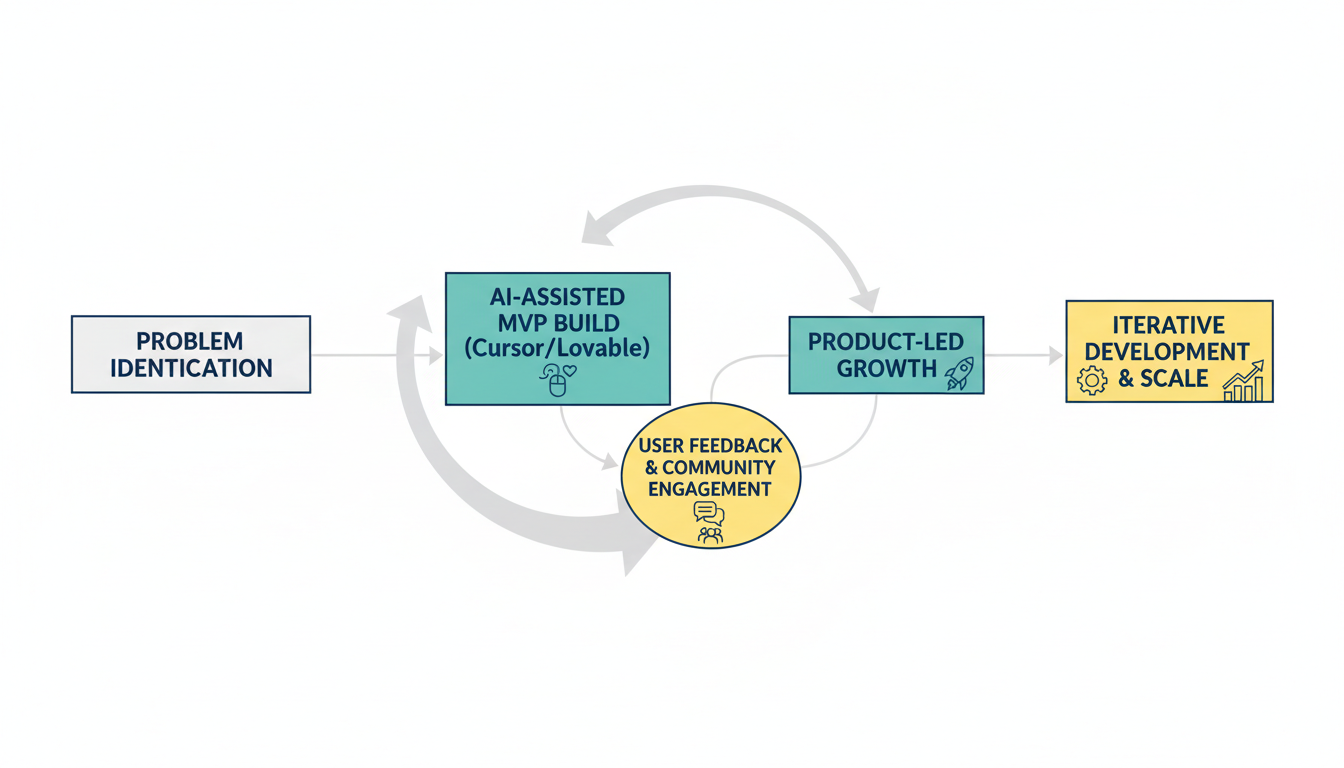
Next, embrace the power of AI as your co-pilot, treating it as a "brilliant intern" rather than a magic bullet7. Leverage tools like Cursor for rapid code generation and prototyping, guiding it with detailed prompts and a product-first mindset3. For full-stack applications, Lovable can abstract away much of the complexity, enabling non-technical founders to build robust backends and user interfaces by simply describing their vision9. Even for UI design, v0 can quickly turn prompts into polished React components, accelerating your frontend development significantly10. Remember to break down complex tasks, provide extensive context, and iterate frequently, testing each component before moving on4.
Once your Minimum Viable Product (MVP) is taking shape, shift your attention to organic growth and user engagement, adopting the "build with users, not just for them" philosophy1. Actively embed yourself in relevant online communities, contributing genuine value 90% of the time before subtly introducing your solution18. Optimize your product for "aha moments" and seamless onboarding, understanding that retaining existing users is far more cost-effective than acquiring new ones19. Personalized direct outreach and consistent content creation, sharing your journey and insights on platforms like Medium, will further build credibility and attract early adopters without requiring significant marketing spend20.
Finally, cultivate resilience and a disciplined mindset. Tally's founders continuously resisted feature bloat, sticking to their core principles even under pressure1. Your growth will be a testament to continuous user interaction, rigorous prioritization, agile execution, and active community involvement1. Success with $0 isn't about cutting corners; it's about strategic focus, smart leverage of modern tools, and an unwavering commitment to your users.