Claude Sonnet 4.6: Unveiling Anthropic's Next-Generation AI Model
Introduction: The Official Launch of Claude Sonnet 4.6
Anthropic officially unveiled its latest large language model, Claude Sonnet 4.6, on February 17, 2026 1. This significant release quickly follows the introduction of Claude Opus 4.6 on February 5, 2026 2. Positioned as Anthropic's most capable Sonnet model to date, Sonnet 4.6 marks a pivotal moment in the rapidly evolving AI landscape 2. Its immediate impact stems from its ability to deliver advanced capabilities and near Opus-level intelligence at a significantly lower cost, making sophisticated AI more broadly accessible 3.
Unpacking Sonnet 4.6's Core Enhancements
Claude Sonnet 4.6, officially released on February 17, 2026, quickly followed Opus 4.6 and is positioned as Anthropic's most capable Sonnet model to date, introducing a suite of significant enhancements and new features . These advancements solidify its impressive standing, offering near Opus-level intelligence at a substantially lower cost .
At the forefront of its capabilities is an Expanded Context Window, boasting 1 million tokens in beta, a fivefold increase over Sonnet 4.5's standard 200K window . This monumental expansion allows the model to process vast amounts of information—such as entire codebases, lengthy contracts, or dozens of research papers—within a single request .
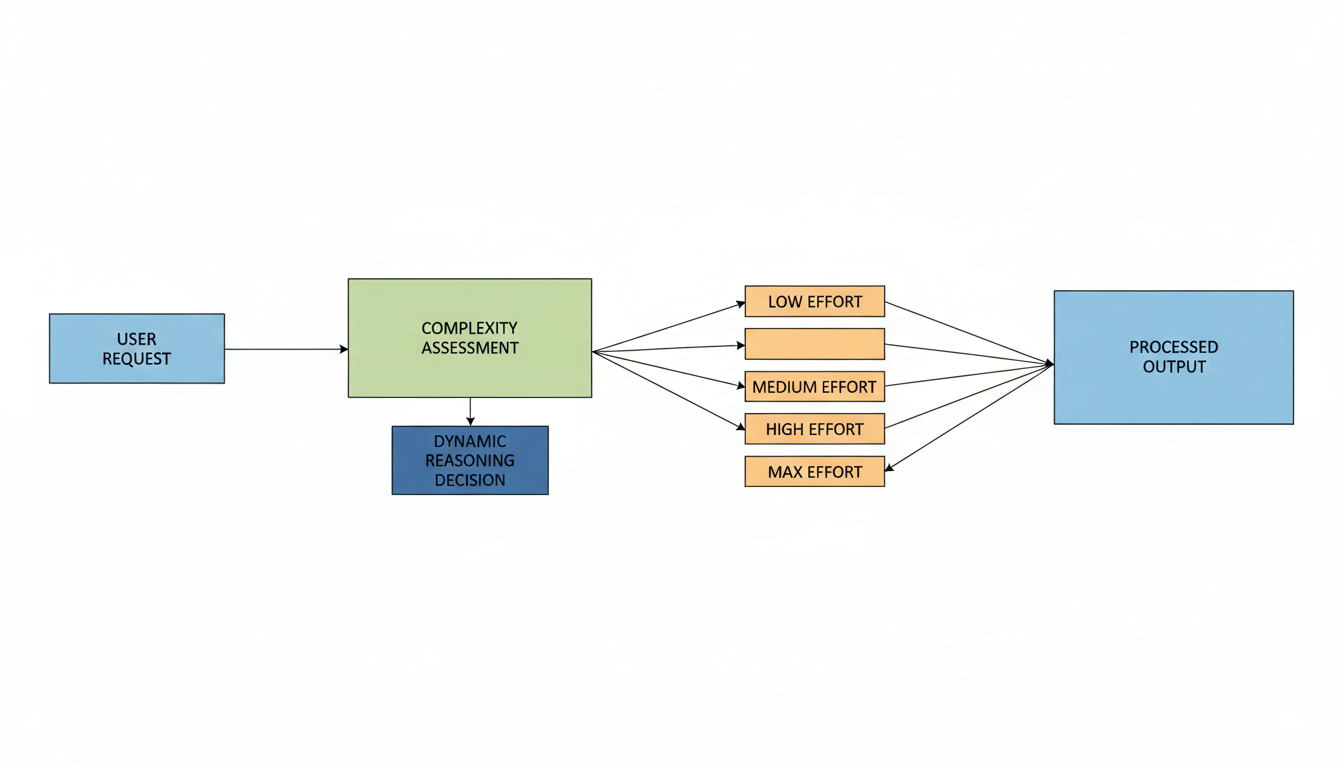
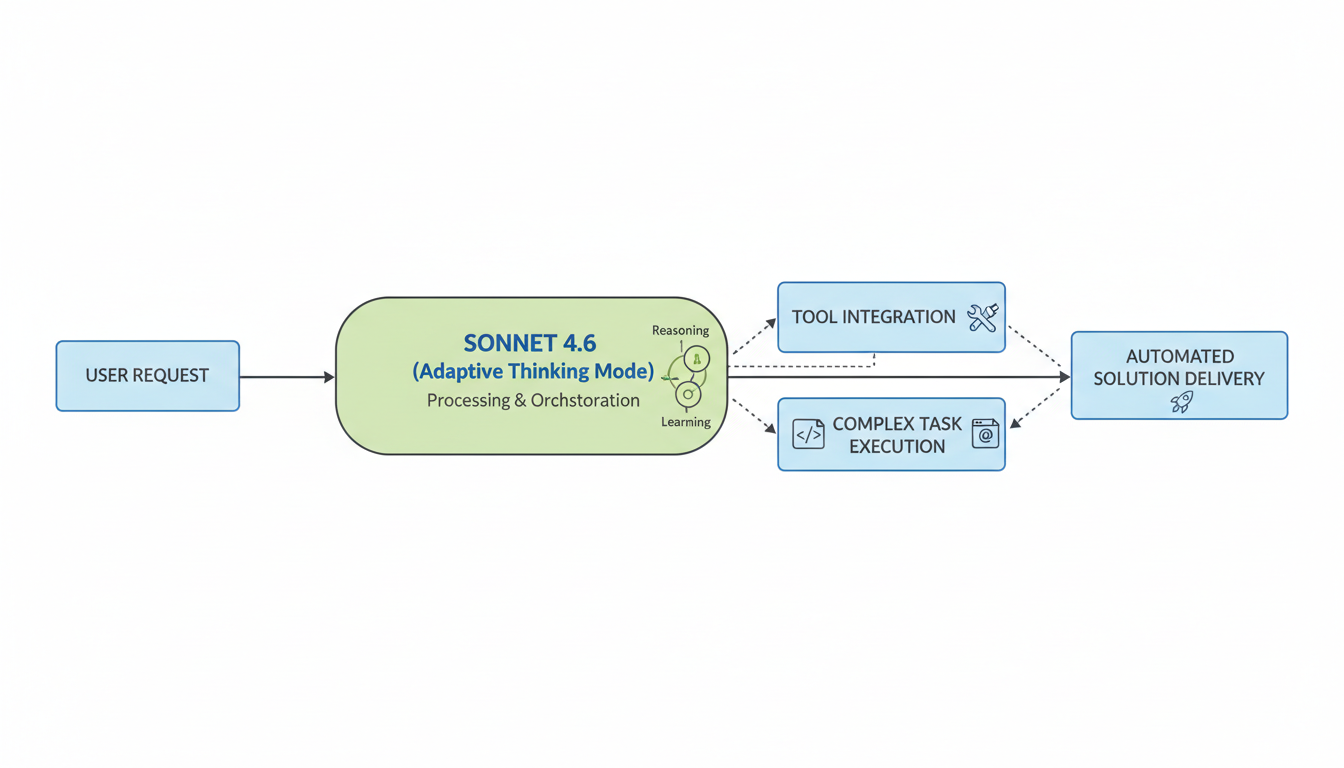
A novel Adaptive Thinking Mode further elevates its intelligence, enabling Claude to dynamically determine the depth and approach of reasoning based on the complexity of the input . This feature effectively replaces manual token budgeting and automatically facilitates interleaved thinking, with users able to control reasoning effort across low, medium, high (default), and max levels .
Sonnet 4.6 also showcases Improved Coding Skills, delivering frontier performance across the software development lifecycle. It excels in reasoning through complex, multi-file codebases, producing precise implementations, and iterating efficiently . Its Enhanced Computer Use Capabilities allow it to perform human-level tasks, such as navigating intricate spreadsheets or multi-step web forms, and reliably handle any browser-based task, thereby automating workflows that previously demanded human intervention . These capabilities contribute to superior Agentic Task Execution, demonstrating advanced instruction following, tool selection, and error correction for autonomous AI workflows that require sustained coherence and adaptive decision-making 4.
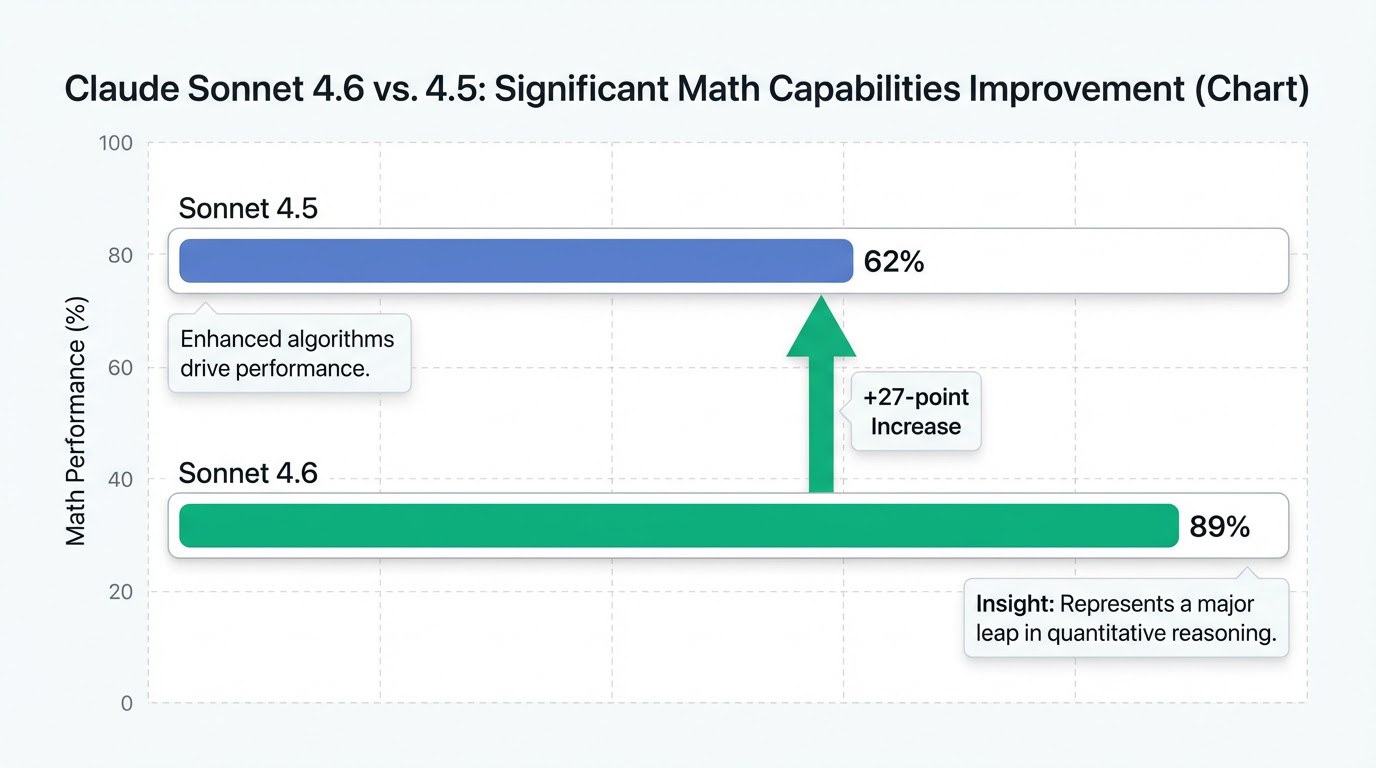
The model exhibits a Significant Jump in Math Performance, with its score rising by 27 points from Sonnet 4.5's 62% to an impressive 89% 5. Furthermore, Anthropic reports that Sonnet 4.6 achieves Opus-Level Safety, displaying strong safety behaviors, low overall misaligned behavior, and improved resistance to prompt injection attacks, aligning closely with Opus 4.6 in this regard. It has been deployed under the AI Safety Level 3 (ASL-3) Standard .
Supporting these core enhancements are several key technical features:
- Context Compaction API (Beta): This API offers automatic, server-side context summarization, facilitating effectively infinite conversations by condensing older parts of a dialogue as it nears the context window limit .
- Free Code Execution with Web Tools: Code execution is now available without cost when integrated with web search or web fetch, enhancing accuracy and reducing token consumption through dynamic filtering 6.
- General Availability of Key Tools: Essential tools like Code Execution, Web Fetch, Programmatic Tool Calling, Tool Search Tool, Tool Use Examples, and Memory Tool are now generally available 6.
- Data Residency Controls: Users can specify the geographical location for model inference, choosing options such as "global" or "us" 6.
Performance Benchmarks and Cost-Effectiveness
Claude Sonnet 4.6 demonstrates considerable improvements across various benchmarks, often nearing or matching the performance of the more powerful Opus models, while maintaining cost efficiency. Its knowledge cutoff extends to August 2025, an update of 6 months over Sonnet 4.5 5.
The following table summarizes Sonnet 4.6's key performance metrics:
| Benchmark | Sonnet 4.6 Performance | Comparison / Notes |
|---|---|---|
| Context Window (Beta) | 1 Million Tokens | 5x larger than Sonnet 4.5 |
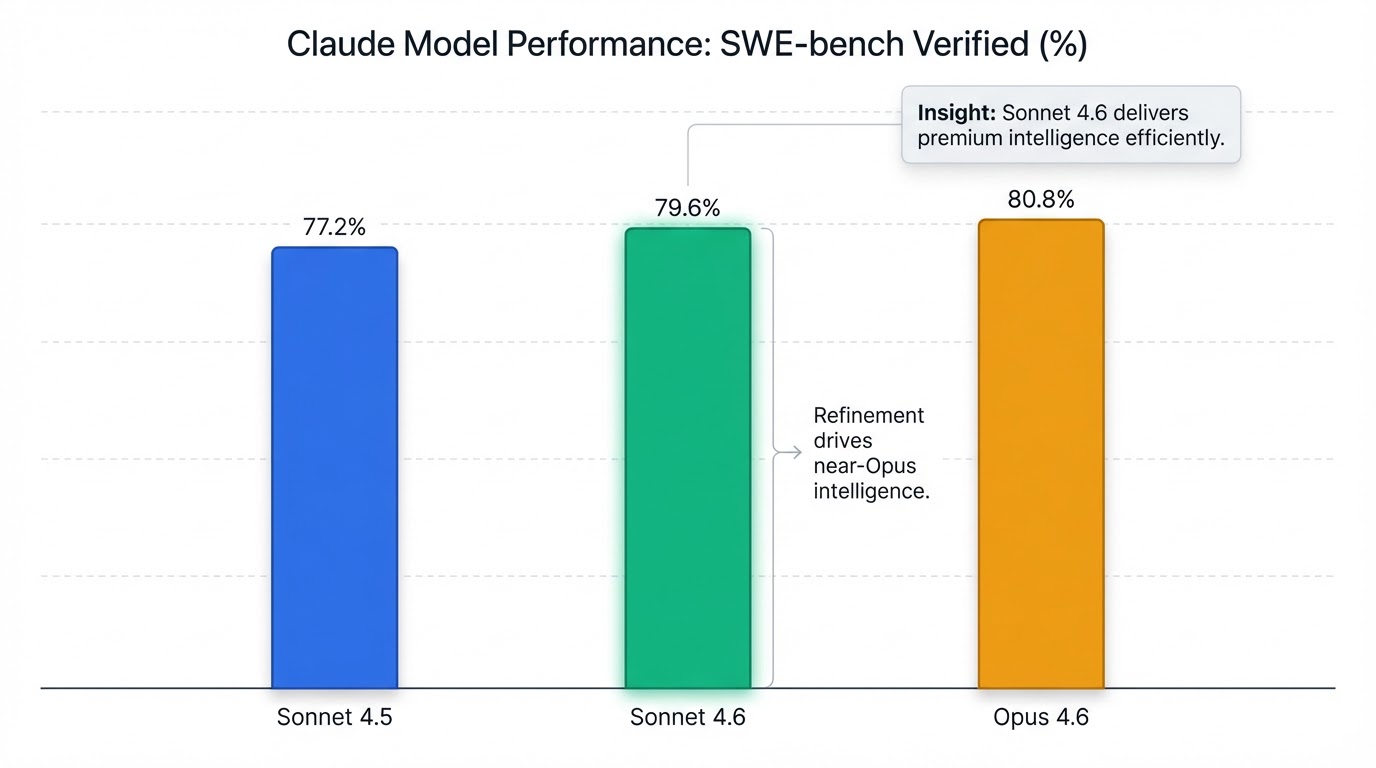
| SWE-bench Verified | 79.6% | 1.2 points behind Opus 4.6 (80.8%) and 2.4 points ahead of Sonnet 4.5 (77.2%) 5 |
| OSWorld-Verified (Computer Use) | 72.5% | Nearly matches Opus 4.6 (72.7%) 5 |
| GPQA Diamond | 89.9% | Strong, though Opus 4.6 scores higher (91.3%) |
| ARC-AGI-2 | 58.3% | Approaches Opus 4.6 (~65%) and significantly better than Sonnet 4.5 (~45%) |
| MMMLU | 89.3% | |
| Humanity's Last Exam (HLE) | 49.0% (with tools), 33.2% (without tools) | Opus 4.6 scored higher |
| Math | 89% | A 27-point increase over Sonnet 4.5 (62%) 5 |
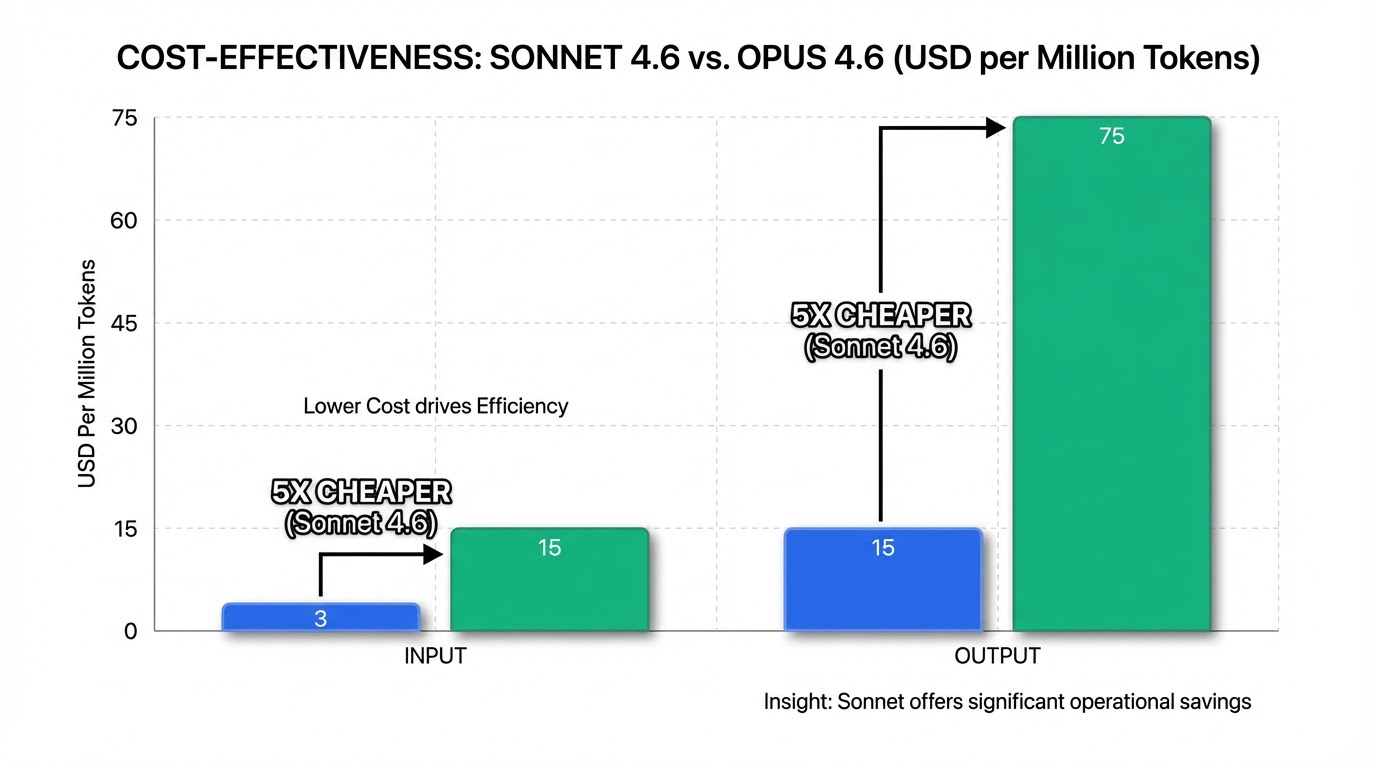
| Cost (Input/Output) | $3 / $15 per million tokens | Same as Sonnet 4.5, making it 5 times cheaper than Opus 4.6 ($15/$75) |
Notably, Sonnet 4.6's 1 million token context window is five times larger than its predecessor . It nearly matches Opus 4.6 in OSWorld-Verified (Computer Use) and trails it by only 1.2 points on SWE-bench Verified, outperforming Sonnet 4.5 by 2.4 points 5. While Opus 4.6 still holds an edge in deeply scientific reasoning tasks like GPQA Diamond and HLE , Sonnet 4.6's performance-to-cost ratio is extraordinary. At $3 per million input tokens and $15 per million output tokens, its cost remains the same as Sonnet 4.5, making it five times more cost-effective than Opus 4.6, which costs $15/$75 per million tokens . This makes advanced AI capabilities significantly more accessible.
Real-World Impact: What These Upgrades Mean for Users
Claude Sonnet 4.6 represents a significant leap forward, translating its core enhancements into tangible, practical benefits and real-world applications across various user domains. This model's ability to deliver near Opus-level intelligence at a substantially lower cost makes advanced AI capabilities more accessible than ever before, addressing complex problems with efficiency and sophistication.
Enhanced Accessibility and Unmatched Cost-Effectiveness
Sonnet 4.6 democratizes access to frontier AI. It is now the default model for free and Pro plan users on claude.ai and Claude Cowork, broadening access to its advanced intelligence. Beyond Anthropic's direct platforms, it is also readily available via API, Amazon Bedrock, Google Cloud's Vertex AI, and Microsoft Foundry, ensuring wide adoption possibilities for enterprises and developers alike. This widespread accessibility is underpinned by an extraordinary performance-to-cost ratio; Sonnet 4.6 maintains the same input/output cost as its predecessor, Sonnet 4.5, at $3 / $15 per million tokens, making it five times cheaper than Opus 4.6. This cost-efficiency allows organizations to deploy powerful AI solutions at scale without prohibitive expenses.
Significant Boost in Developer Productivity and Code Quality
For developers, Sonnet 4.6 delivers frontier coding performance across the entire software development lifecycle. It excels in reasoning through complex, multi-file codebases, producing precise implementations, and iterating efficiently. Developers have shown a clear preference for Sonnet 4.6, choosing it over Sonnet 4.5 approximately 70% of the time, and even over Opus 4.5 (from November 2025) 59% of the time. This preference stems from its superior instruction following, better context reading, reduced overengineering, and improved logic consolidation. Customer testimonials highlight its prowess in complex code fixes across large codebases, achieving strong resolution rates, and even producing the best iOS code tested by Rakuten AI, noted for its better spec compliance and architecture.
Revolutionizing Automation and Agentic Workflows
Sonnet 4.6 brings human-level capability to complex computer use tasks, such as navigating intricate spreadsheets or multi-step web forms, making it capable of reliably handling virtually any browser-based task. This capability allows for the automation of workflows that previously required significant human intervention4. Furthermore, its superior instruction following, tool selection, and error correction establish it as a robust platform for autonomous AI workflows, reliably managing complex, multi-step tasks that demand sustained coherence and adaptive decision-making4. The model's effective long-horizon planning was demonstrated in the Vending-Bench Arena evaluation, where it strategically invested early and then pivoted to profitability, outperforming competitors.
Diverse Enterprise Applications
The versatile capabilities of Sonnet 4.6 are well-suited for a wide array of enterprise applications, including financial analysis, in-depth research, sophisticated content generation, and critical business operations4. It matches Opus 4.6 performance on OfficeQA benchmarks for reading and reasoning from enterprise documents. A notable achievement includes scoring 94% on a complex insurance computer use benchmark, the highest for any Claude model tested, showcasing its ability to reason through failures and self-correct. Its "perfect design taste" in frontend pages and data reports also reduces the need for manual iteration, speeding up design processes4.
Underlying Technical Advancements Enabling Practical Benefits
These practical benefits are made possible by core technical advancements within Sonnet 4.6. The Adaptive Thinking Mode allows Claude to dynamically determine the optimal reasoning depth based on request complexity, effectively optimizing for both speed and quality. This intelligent resource allocation ensures efficiency. Concurrently, the Context Compaction API, currently in beta, provides automatic server-side context summarization, which allows for effectively infinite conversations by summarizing older conversation parts as the context window limit is approached. These features are crucial enablers for the model's enhanced performance in complex tasks and long-running agentic systems.
Comparing Sonnet 4.6: Setting a New Standard
Claude Sonnet 4.6, officially released on February 17, 2026, quickly follows the launch of Claude Opus 4.6 on February 5, 2026 . Positioned as Anthropic's most capable Sonnet model to date, it sets a new industry benchmark by delivering near Opus-level intelligence at a significantly lower cost, thereby broadening the accessibility of advanced AI capabilities . This makes Sonnet 4.6 an extraordinary offering in terms of performance-to-cost ratio, capable of handling complex agentic workloads with high efficiency .
Its impact on accessibility is evident as it has become the default model for free and Pro plan users on claude.ai and Claude Cowork . Furthermore, it is widely available via API, Amazon Bedrock, Google Cloud's Vertex AI, and Microsoft Foundry, ensuring broad reach for developers and enterprises . Developers have shown a strong preference for Sonnet 4.6, choosing it over its predecessor, Sonnet 4.5, approximately 70% of the time, and even surpassing Opus 4.5 (from November 2025) 59% of the time, citing superior context reading, logic consolidation, and instruction following .
Sonnet 4.6 showcases superior performance across a range of key benchmarks, often approaching or matching the capabilities of the more powerful Opus models, while maintaining the same cost structure as Sonnet 4.5 . For instance, its SWE-bench Verified performance reaches 79.6%, only 1.2 points behind Opus 4.6, and notably 2.4 points ahead of Sonnet 4.5 5. In computer use tasks, its OSWorld-Verified score of 72.5% nearly matches Opus 4.6's 72.7% 5. The model also boasts a significant 27-point jump in math performance, from 62% for Sonnet 4.5 to 89% 5. A substantial improvement is seen in its beta 1 million token context window, which is five times larger than Sonnet 4.5's standard 200K window . This enhanced capability is provided at a cost of $3 per million input tokens and $15 per million output tokens, making it five times cheaper than Opus 4.6 . The model's knowledge cutoff is August 2025, which is six months newer than Sonnet 4.5, ensuring greater relevance and up-to-date information 5.
Despite these impressive advancements, it is important to note that while significantly improved, Sonnet 4.6 still lags behind the most skilled humans in computer use . The 1 million token context window is currently in beta, and while powerful, it introduces the risk of less relevant details overshadowing key information if prompts are not meticulously designed 7. Moreover, Opus 4.6 continues to hold an advantage in deeply scientific reasoning tasks 5.
Conclusion: The Future Trajectory of Claude Sonnet 4.6
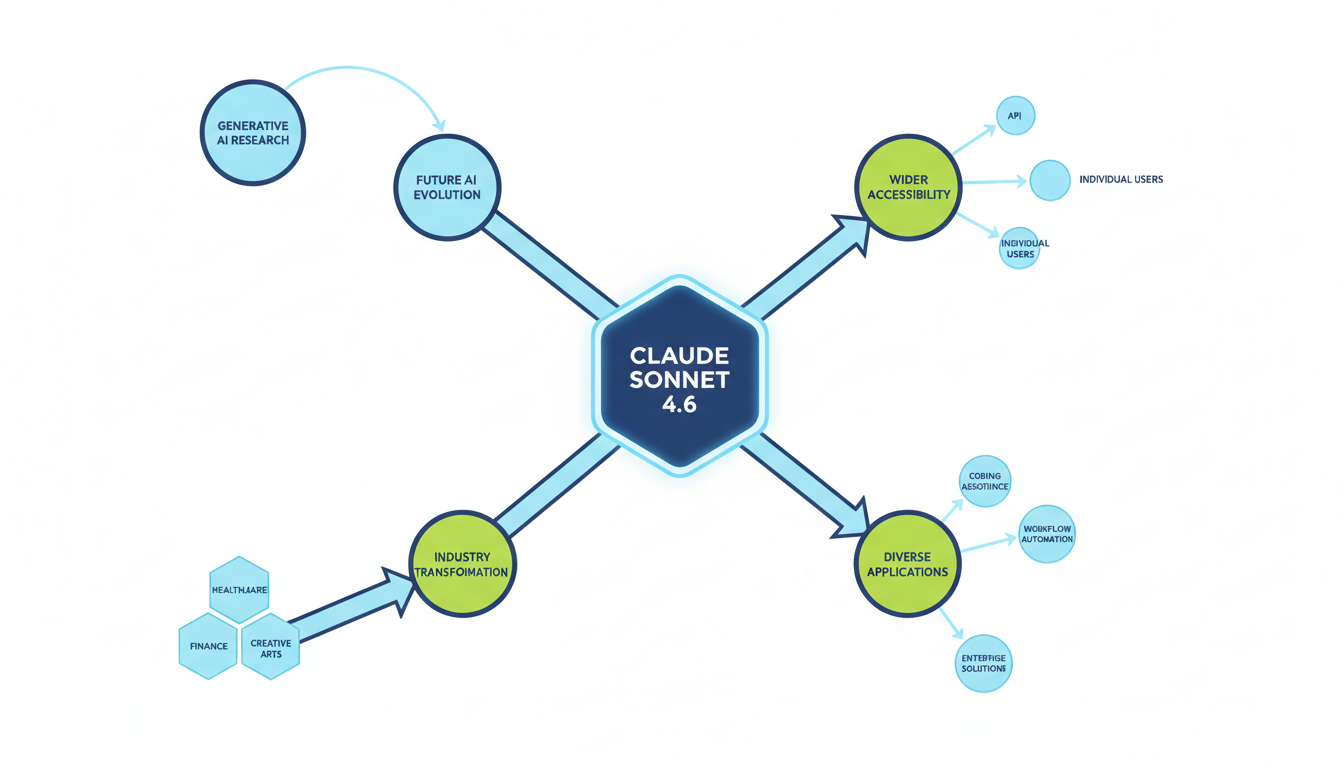
The release of Claude Sonnet 4.6 marks a pivotal moment in the advancement and accessibility of artificial intelligence, positioning it as a highly significant model within the industry . It represents a remarkable leap forward by delivering near Opus-level intelligence at a significantly lower cost, thereby democratizing access to advanced AI capabilities .
Sonnet 4.6's key strengths are multifaceted and impactful. Its expanded 1 million token context window, currently in beta, allows it to process vast amounts of information, from entire codebases to extensive research papers, within a single request . The model exhibits frontier coding performance across the software development lifecycle and demonstrates human-level capabilities in complex computer use tasks like navigating spreadsheets or multi-step web forms . Furthermore, its superior instruction following and error correction facilitate robust agentic task execution , while a 27-point jump in math performance underscores its enhanced analytical prowess 5. Its widespread accessibility, being the default for free and Pro users on claude.ai and Claude Cowork, alongside availability via major cloud platforms, significantly broadens the reach of sophisticated AI tools . Developers have shown a strong preference for Sonnet 4.6 over its predecessors and even some Opus models, citing improved context reading and instruction following . The model's impressive long-horizon planning abilities, demonstrated in evaluations like Vending-Bench Arena, further highlight its strategic reasoning capabilities .
Underpinning these advancements are critical technical innovations such as the Adaptive Thinking Mode, which dynamically optimizes reasoning based on task complexity , and the Context Compaction API, which enables effectively infinite conversations through server-side context summarization . These features not only enhance performance but also contribute to a more efficient and coherent AI experience.
Claude Sonnet 4.6 is set to play a crucial role in future AI developments by democratizing advanced intelligence, enabling a broader range of complex applications across industries, from advanced coding and long-running agentic systems to enterprise-level financial analysis and business operations . While still trailing the most skilled humans in certain computer use tasks and Opus 4.6 in deeply scientific reasoning , its current trajectory suggests a continued effort to bridge these remaining performance gaps. Future iterations are expected to further enhance its ability to consistently operate with extreme precision across even the most nuanced and complex human-level tasks 5. Ultimately, Sonnet 4.6, with its extraordinary performance-to-cost ratio, stands as a pivotal model, pushing the boundaries of what is possible with accessible, highly capable AI .