Gemini 3 Deep Think: Unpacking Its Official Release and Exceptional Modeling Capabilities
Introduction: The Dawn of Gemini 3 Deep Think
The artificial intelligence landscape has witnessed a significant advancement with the official release of "Gemini 3 Deep Think," an enhanced reasoning mode within Google's Gemini 3 model family . This innovation marks a pivotal moment, ushering in a new era of AI capabilities focused on profound analytical thought.
Gemini 3 Deep Think was initially introduced on November 18, 2025, concurrently with the broader launch of Gemini 3, making it available to safety testers and subsequently to Google AI Ultra subscribers . A major upgrade announcement on February 11-12, 2026, further detailed its significantly enhanced reasoning capabilities and comprehensive benchmark results, accompanied by an official Google DeepMind research blog post .
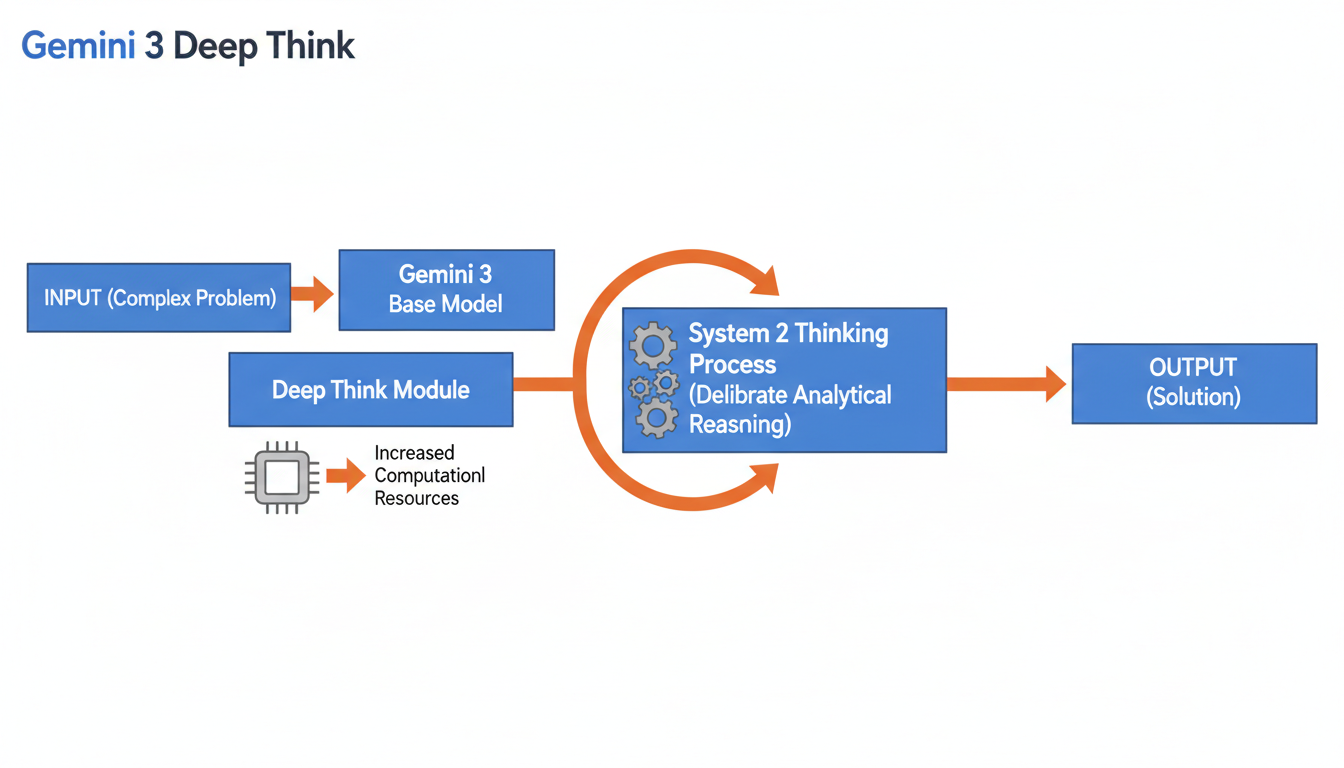
Deep Think is not a standalone model but rather a specialized reasoning mode integrated within Gemini 3, specifically Gemini 3 Pro . Its core concept revolves around dedicating significantly more computational resources during inference to "think" before generating a response, thereby tackling complex problems with unprecedented accuracy . This specialized mode is designed to implement "System 2" thinking, which emphasizes deliberate, analytical reasoning, a distinct departure from the faster, pattern-matching capabilities often associated with standard AI models 1. Tech news and experts have characterized Gemini 3 Deep Think as Google's "most powerful AI model yet" and its "most advanced reasoning capability ever," heralding it as a clear pivot in Google's AI strategy towards deeper reasoning and agent-like systems .
Core Innovations: Unpacking Its Exceptional Modeling Capabilities
Gemini 3 Deep Think represents a significant evolution, showcasing exceptionally strong modeling capabilities rooted in specialized architectural innovations and unique operational mechanisms. This advanced reasoning mode within Google's Gemini 3 Pro model family tackles highly complex problems demanding rigorous and creative intelligence .
Core Architectural Innovations
Gemini 3 Deep Think functions as an enhanced inference mode that dedicates substantially more computational resources to an extended "thinking" process before producing a response 2. While a mode rather than a standalone model, it leverages and optimizes the architectural advancements of the broader Gemini 3 family. Key contributions to its capabilities include:
- Enhanced Inference Mode: Unlike sequential token generation, Deep Think incorporates an extended reasoning phase. During this phase, it generates internal reasoning chains, explores multiple hypotheses, and self-verifies conclusions 2.
- Sparse Mixture-of-Experts (MoE) Architecture: The underlying Gemini 3 Pro model utilizes an MoE architecture. This design allows for the activation of only a subset of its specialized sub-networks for a given query, which reduces computational cost while maintaining or improving performance and enabling scalability . This helps balance the high computational demands of "deep thinking" with efficiency.
- Custom TPU Clusters: Gemini models are built entirely on Google's custom Tensor Processing Unit (TPU) clusters. These chips are optimized for large-scale machine learning workloads, providing faster training, lower latency, higher throughput, and better energy control compared to general-purpose GPUs, thereby contributing to its performance and cost-efficiency .
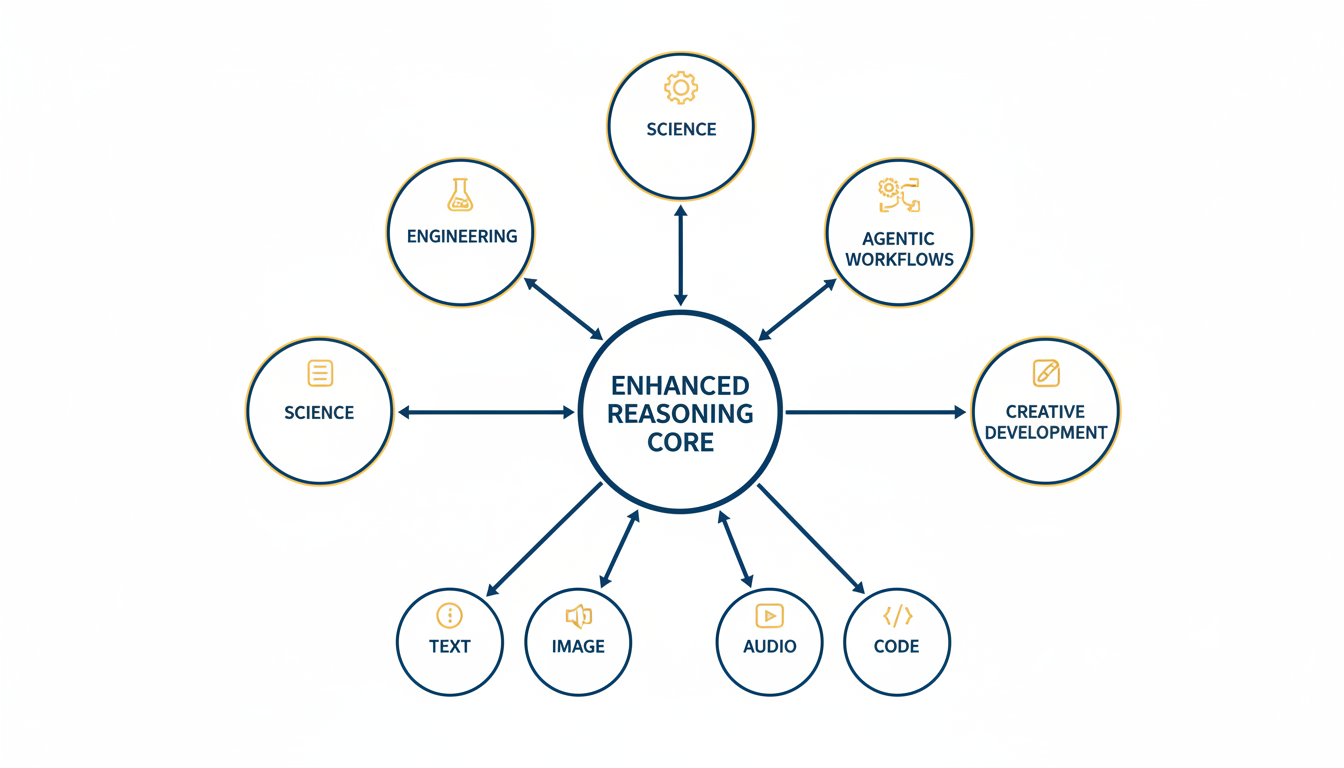
- Multimodal Architecture: The Gemini family, including Deep Think, is natively multimodal. It was designed from the ground up to jointly process and understand various data types such as text, images, audio, video, and code within a unified framework, rather than having multimodal capabilities added as an afterthought .
Exceptionally Strong Modeling Capabilities
Gemini 3 Deep Think achieves robust modeling capabilities across diverse domains through its specialized reasoning mode and native multimodal foundation.
1. Complex Reasoning
Deep Think excels in advanced, multi-step logical and analytical tasks, described as being akin to an "ultra-focused scientist" capable of unraveling complicated, long-chain logic 3. Its internal reasoning process involves decomposing problems, generating and evaluating multiple potential solution paths, identifying errors through self-verification loops, and even "backtracking" to abandon unproductive avenues before synthesizing a final answer 2. This approach mirrors human expert problem-solving by considering various angles and refining conclusions 2.
Its performance on demanding benchmarks underscores its reasoning prowess:
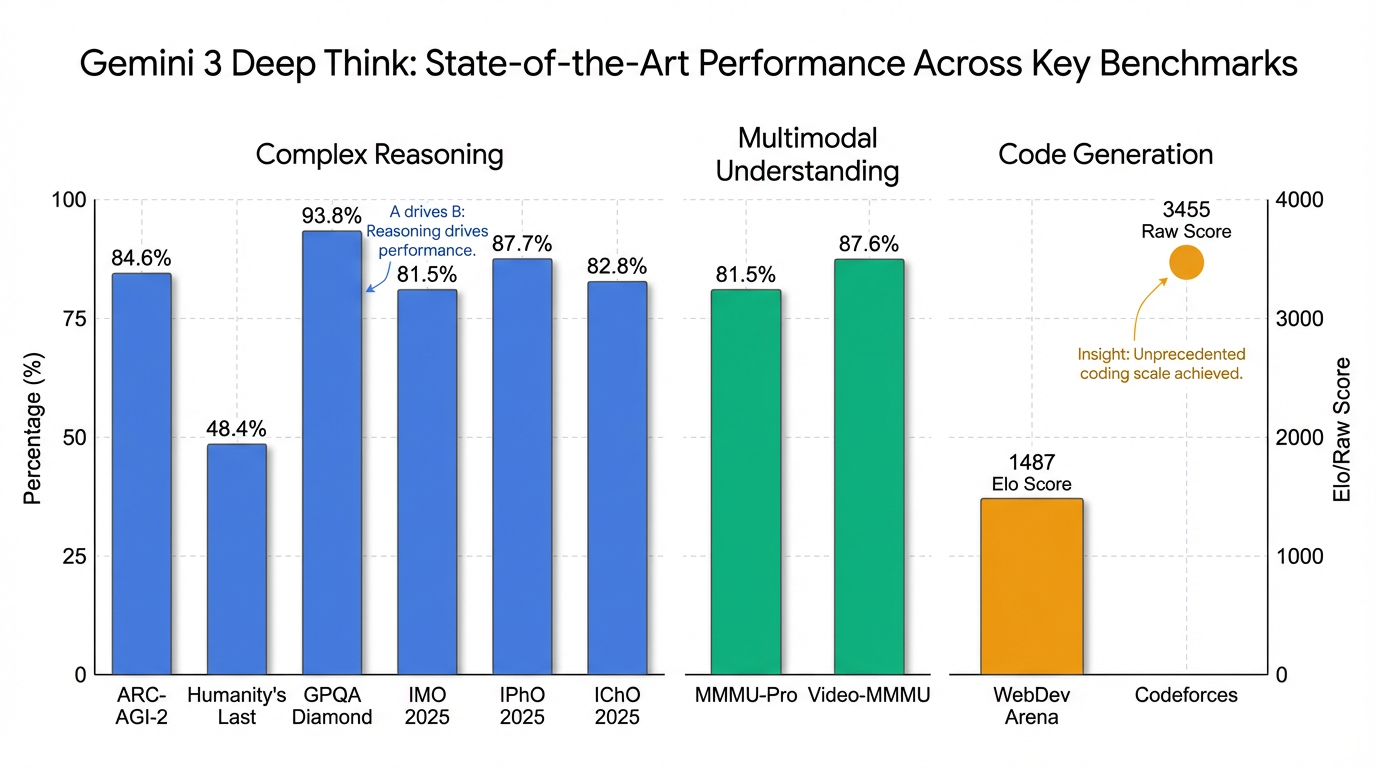
- ARC-AGI-2 (Abstract Reasoning Puzzles): Achieved 84.6% 4.
- Humanity's Last Exam (Doctoral-level Thinking): Scored 48.4% without tools, signifying doctoral-level reasoning capabilities .
- GPQA Diamond (Grad-Level Reasoning): Achieved 93.8% accuracy .
- International Math Olympiad 2025: Achieved 81.5% 4.
- International Physics Olympiad 2025 (theory): Achieved 87.7% 4.
- International Chemistry Olympiad 2025 (theory): Achieved 82.8% 4.
- CMT-Benchmark (Advanced Theoretical Physics): Scored 50.5%, demonstrating proficiency in complex theoretical physics 4.
2. Multimodal Understanding
As part of the Gemini 3 family, Deep Think delivers world-leading multimodal understanding, seamlessly blending and comprehending text, images, videos, audio, and code simultaneously . Its native multimodal architecture ensures that input from various modalities is processed as first-class citizens, enhancing reasoning accuracy and cross-modal reasoning .
Practical applications of its multimodal understanding include:
- Deep Video Analysis: It can analyze hours of lecture videos to generate interactive flashcards or sports videos to identify weaknesses and suggest training plans 3.
- Visual Translation: Deep Think can translate handwritten recipes that mix different languages, organizing and digitizing them directly from an image .
- Multimodal Awareness: Enabled by advancements in Project Astra, it can interpret visual input from a camera in real-time, understanding spatial context and temporal flow for real-time visual Q&A 5.
Its multimodal performance is demonstrated by benchmarks such as:
- MMMU-Pro (Multimodal Understanding and Reasoning): Achieved 81.5% without tools 4.
- Video-MMMU: Scored 87.6% .
3. Code Generation and Understanding
Gemini 3, including its Deep Think mode, demonstrates exceptional capabilities in understanding and generating code, extending beyond mere syntax to grasp functional and aesthetic intent.
- Vibe Coding: This innovative feature allows users to provide vague concepts or "vibes," from which Gemini 3 can generate fully functional, interactive applications, including 3D games complete with sound effects and background music .
- Intelligent Engineering Assistant: It serves as an intelligent engineering assistant, capable of understanding entire software systems, identifying refactoring opportunities, detecting cross-repository issues, proposing optimizations, evaluating dependencies, and explaining complex code logic 6.
- Agentic Development: Through platforms like Google Antigravity, AI agents are empowered to plan and execute code, interact through precise artifacts, and test/validate their own code based on high-level tasks .
Key benchmarks for code capabilities include:
- WebDev Arena: Ranked first with an Elo score of 1487 for frontend code generation .
- Codeforces (Competitive Programming): Achieved a score of 3455 without tools 4.
Key Differentiators and Advancements
Gemini 3 Deep Think stands apart from previous Gemini versions and competing models due to several crucial factors:
- Evolutionary Leap: It builds upon Gemini 1's native multimodality and long context, and Gemini 2's agentic planning and stronger reasoning, combining and significantly advancing these capabilities into a powerful generalist model .
- Context Window: Deep Think maintains a massive 1 million token context window . This allows it to process entire books, extensive codebases, or long video files within a single prompt, significantly surpassing competitors like GPT-4.1 and Claude 3 Opus, which typically offer around 200K tokens, and OpenAI's o1/o3 with 128K tokens .
- Differentiated Reasoning Approach: Unlike OpenAI's o1/o3, which are described as separate, purpose-built reasoning models, Deep Think is an enhanced mode of the flagship Gemini 3 Pro, integrating advanced reasoning directly into a generalist model 2.
- Superior Benchmark Performance: It consistently achieves state-of-the-art results across a wide array of reasoning and multimodal benchmarks, frequently outperforming competitors . Notably, Gemini 3 Pro topped the LMSys Elo Arena with 1501 points, surpassing GPT-5.1 3.
- Tight Hardware-Software Integration: Google's control over both custom TPU hardware and software provides an inherent efficiency and performance advantage for training and deployment at scale .
Performance Benchmarks and Standout Features
Gemini 3 Deep Think represents a significant evolutionary leap, positioning itself as an advanced reasoning mode within Google's Gemini 3 Pro model family. It is specifically engineered to address exceptionally complex problems requiring rigorous and creative intelligence, differentiating itself from competitors through core architectural innovations and unique operational mechanisms . This section provides concrete evidence of Deep Think's advanced capabilities, detailing its performance across various benchmarks, comparing it to other leading models, and highlighting its unique features.
Exceptionally Strong Modeling Capabilities
Deep Think's robust performance is evident across multiple demanding domains, powered by its specialized reasoning mode and native multimodal foundation.
1. Complex Reasoning
Deep Think excels in advanced, multi-step logical and analytical tasks, akin to an "ultra-focused scientist" dissecting intricate, long-chain logic 3. Its internal reasoning process involves decomposing problems, generating and evaluating multiple solution paths, self-verifying conclusions, and backtracking when necessary, mirroring human expert problem-solving 2.
Its performance on key benchmarks demonstrates this exceptional capability:
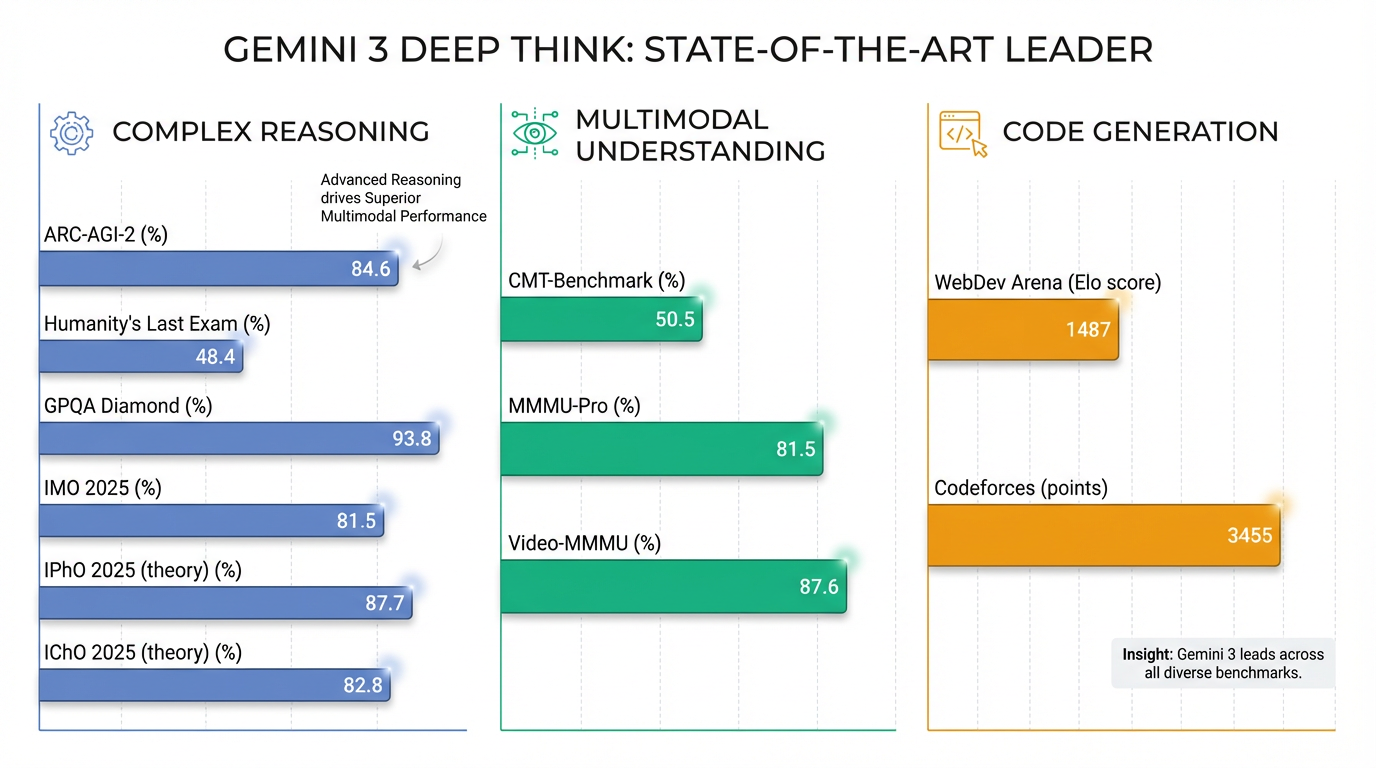
- ARC-AGI-2 (Abstract Reasoning Puzzles): Achieved an impressive 84.6% .
- Humanity's Last Exam (Doctoral-level Thinking): Scored 48.4% without tools, indicative of doctoral-level reasoning proficiency .
- GPQA Diamond (Grad-Level Reasoning): Achieved 93.8% accuracy .
- International Math Olympiad 2025: Scored 81.5% 4.
- International Physics Olympiad 2025 (theory): Attained 87.7% .
- International Chemistry Olympiad 2025 (theory): Reached 82.8% .
- CMT-Benchmark (Advanced Theoretical Physics): Scored 50.5%, showcasing its proficiency in complex theoretical physics .
2. Multimodal Understanding
As a core part of the Gemini 3 family, Deep Think offers world-leading multimodal understanding, seamlessly blending and comprehending text, images, videos, audio, and code simultaneously . Its native multimodal architecture ensures various input modalities are processed as first-class citizens, enhancing reasoning accuracy and cross-modal understanding .
Benchmark results highlight its multimodal excellence:
- MMMU-Pro (Multimodal Understanding and Reasoning): Achieved 81.5% without tools .
- Video-MMMU: Scored 87.6% .
3. Code Generation and Understanding
Gemini 3 Deep Think demonstrates exceptional capabilities in understanding and generating code, extending beyond mere syntax to grasp functional and aesthetic intent. Its "Vibe Coding" feature allows users to provide vague concepts, enabling the generation of fully functional, interactive applications, including 3D games with sound effects and background music . It also acts as an intelligent engineering assistant, understanding entire software systems, identifying refactoring opportunities, and explaining complex code logic 6.
Key benchmarks include:
- WebDev Arena: Ranked first with an Elo score of 1487 for frontend code generation .
- Codeforces (Competitive Programming): Achieved a score of 3455 without tools .
Key Differentiators and Advancements
Gemini 3 Deep Think stands apart from previous Gemini versions and competing models through several critical factors, showcasing superior benchmark performance and strategic advantages.
Deep Think maintains a massive 1 million token context window , allowing it to process entire books, extensive codebases, or long video files within a single prompt. This significantly surpasses competitors such as GPT-4.1 and Claude 3 Opus, which typically offer around 200K tokens, and OpenAI's o1/o3 with 128K tokens .
| Model Name | Context Window Size (Tokens) |
|---|---|
| Gemini 3 Deep Think | 1 million |
| GPT-4.1 | ~200K |
| Claude 3 Opus | ~200K |
| OpenAI's o1/o3 | 128K |
Unlike OpenAI's o1/o3, described as separate, purpose-built reasoning models, Deep Think functions as an enhanced mode of the flagship Gemini 3 Pro. This integrates advanced reasoning directly into a generalist model rather than requiring a distinct model 2. This enhanced inference mode allocates significantly more computational resources for an extended "thinking" process before generating a response 2.
Overall, Deep Think consistently achieves state-of-the-art results across a wide array of reasoning and multimodal benchmarks, often significantly outperforming competitors . For instance, Gemini 3 Pro topped the LMSys Elo Arena with 1501 points, surpassing GPT-5.1 3.
Furthermore, Google's tight hardware-software integration provides a strategic advantage. Gemini models are built entirely on Google's custom Tensor Processing Unit (TPU) clusters, which are specifically optimized for large-scale machine learning workloads. This vertical integration allows for faster training, lower latency, higher throughput, and better energy control compared to general-purpose GPUs, contributing to its superior performance and cost-efficiency at scale .
Industry Impact and Future Potential
The advanced capabilities of Gemini 3 Deep Think translate into significant real-world applications and hold substantial promise for various industries and future AI development.
Deep Think is already actively being used in research and engineering fields. It assists in scientific research labs, particularly for tasks such as semiconductor material design . Furthermore, it excels in peer-reviewing highly technical mathematical papers, demonstrating the ability to identify logical flaws that human experts might overlook .
In education, Deep Think serves as a powerful assistant. It can verify student solutions to complex physics problems and understand handwritten content, providing detailed and correct reasoning . It also enhances learning by generating interactive flashcards from extensive lecture videos 3.
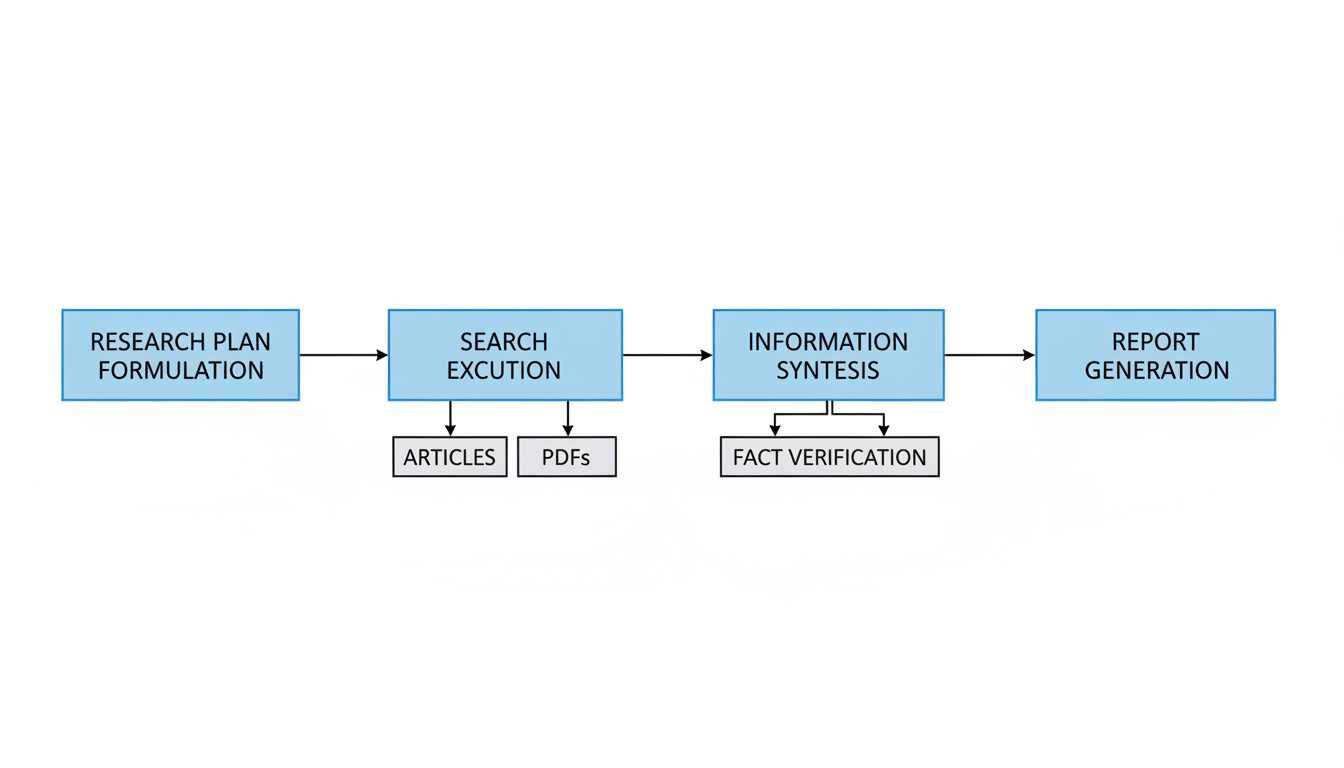
The model significantly advances agentic workflows, exemplified by "Deep Research." This autonomous analyst can formulate research plans, execute searches, synthesize information from diverse sources including articles and PDFs, verify facts, and generate comprehensive reports 5. Deep Think also showcases long-term planning and independent tool use within complex simulations 3.
For creative content and development, Deep Think enables innovative approaches such as "vibe coding," which facilitates the rapid development of interactive applications and games based on vague concepts . Its integration with tools like Veo for generative video and Nano Banana for advanced image editing further expands creative possibilities 5.
Finally, Deep Think's capabilities are seamlessly integrated into the broader Google ecosystem. It is utilized in Google Search to create interactive "Generative UIs" 3 and integrated into Workspace to index personal context, enabling cross-app queries such as drafting emails using data from spreadsheets 5.
Conclusion: A New Era in AI
Gemini 3 Deep Think marks a significant advancement in AI, moving towards a "slower, smarter" paradigm for complex reasoning tasks where accuracy is paramount. It integrates enhanced System 2 thinking, emphasizing deliberate, analytical reasoning over fast pattern matching1. This specialized mode operates within the Gemini 3 Pro model, providing native multimodal understanding and advanced agentic capabilities.
Its record-breaking benchmark performance across diverse, challenging domains—such as achieving an Elo score of 3,455 in Codeforces and excelling in International Physics and Chemistry Olympiads—demonstrates its superior problem-solving prowess. Coupled with its real-world applications in identifying logical flaws in mathematics papers, optimizing semiconductor material fabrication, and enabling rapid "vibe coding" for interactive applications, Deep Think's transformative potential is undeniable.
Deep Think's strategic importance lies in its ability to tackle previously intractable problems by dedicating substantially more computational resources to "thinking" through multi-step internal analysis, self-verification, and error correction loops. This capability, accessible to Google AI Ultra subscribers and through the Gemini API to select researchers and enterprises, heralds a new era of intelligent systems that prioritize rigorous reasoning, ushering in unprecedented possibilities for scientific discovery, engineering, and beyond.