GLM-5's Official Debut: Reshaping the AI Landscape and Challenging Claude 4.5
Introduction: GLM-5's Official Debut – Reshaping the AI Landscape?
Zhipu AI, also known as Z.ai, has officially released its latest large language model, GLM-5, which became accessible around February 11-12, 2026 . This new model is available through Z.ai's own platform, the WaveSpeed API, and OpenRouter 1.
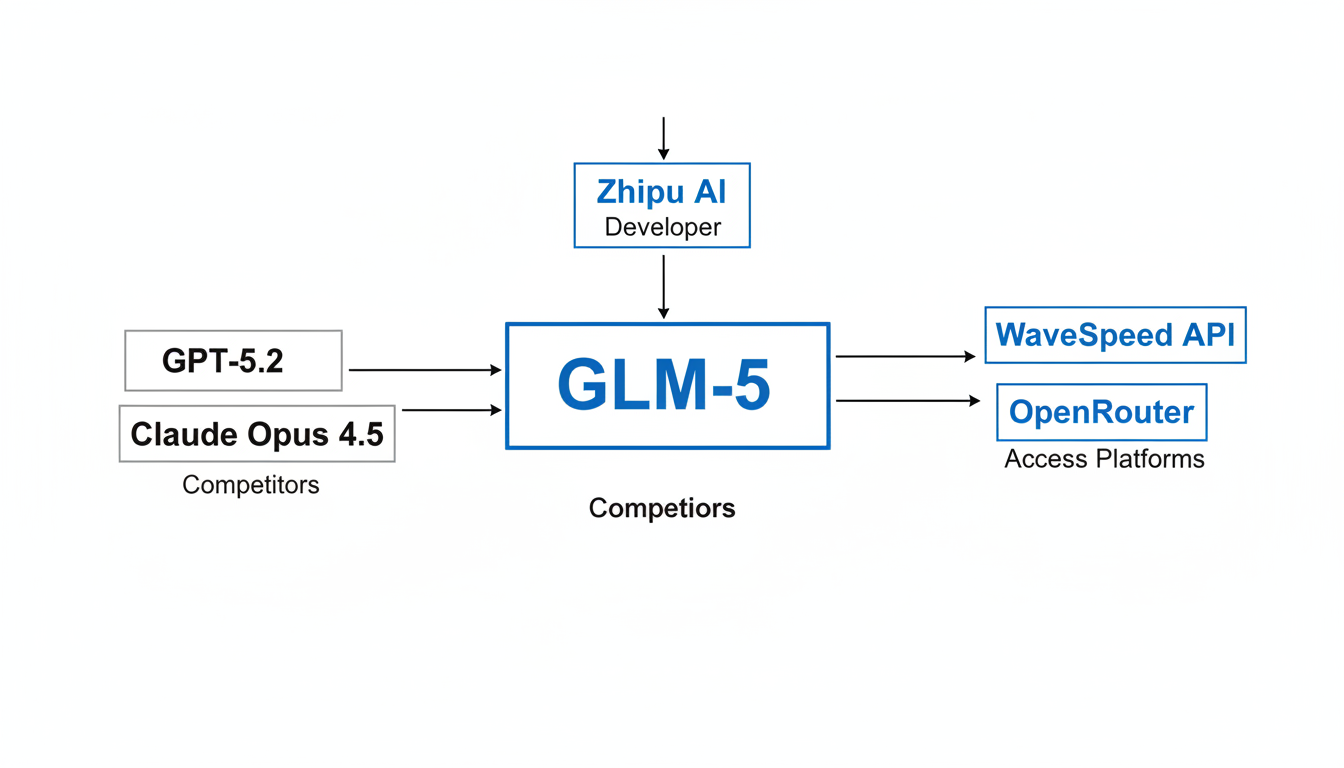
The strategic positioning from Zhipu AI’s official announcement highlights GLM-5 as a formidable direct challenger to established frontier models such as OpenAI's GPT-5.2 and Anthropic's Claude Opus 4.5 2. Beyond its advanced capabilities, GLM-5 carries a significant strategic message: it was trained entirely on Huawei Ascend chips using the MindSpore framework, underscoring China's commitment to self-reliance in AI infrastructure and independence from US-manufactured semiconductor hardware 2. Zhipu AI further emphasizes GLM-5's potential to transform AI from merely "chat" to "work," envisioning it as an essential "office" tool for the burgeoning AGI era 3. This report aims to delve into GLM-5's exceptional capabilities, benchmark results, and overall position within the rapidly evolving artificial intelligence landscape, particularly in comparison to its key competitors.
Exceptional Capabilities: What Makes GLM-5 Stand Out?
GLM-5, developed by Zhipu AI (also known as Z.ai), represents a significant leap forward in AI capabilities, engineered specifically for complex systems engineering and long-horizon agentic tasks . Its architecture and innovative features position it as a direct challenger to leading models like OpenAI's GPT-5.2 and Anthropic's Claude Opus 4.5, aiming to transition AI from mere "chat" functionalities to an indispensable "office" tool for the AGI era .
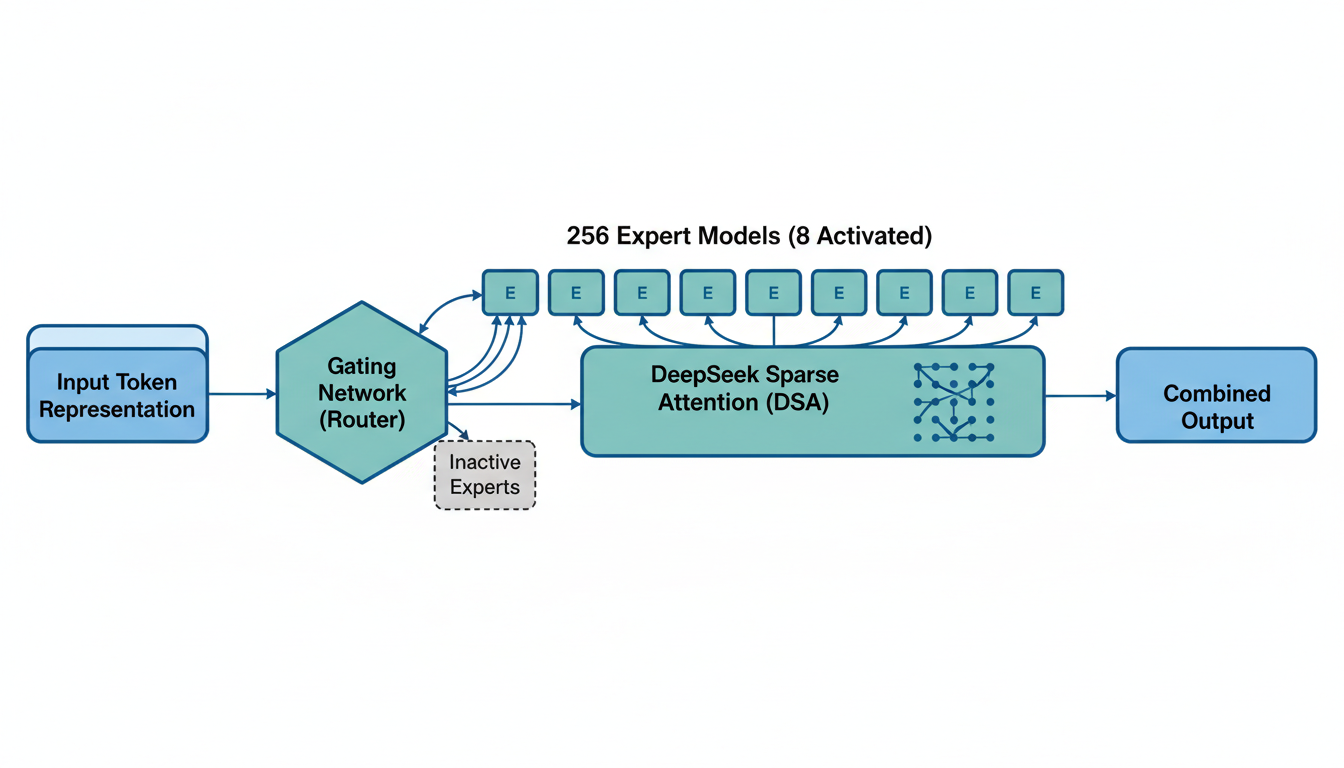
At its core, GLM-5 utilizes a Mixture of Experts (MoE) architecture comprising approximately 745 billion total parameters, with 256 experts, eight of which are activated per token, resulting in a 5.9% sparsity rate and 44 billion active parameters per inference 1. This advanced design is complemented by the integration of DeepSeek Sparse Attention (DSA) for highly efficient handling of extended contexts 3.
The model's exceptional capabilities span several critical areas:
- Creative Writing: GLM-5 is adept at generating high-quality, nuanced creative content with remarkable stylistic versatility, marking a significant improvement over its predecessor, GLM-4.7 2.
- Coding (Agentic Engineering): It excels in systems engineering and full-stack development, moving beyond conventional coding to "agentic engineering." This involves decomposing complex tasks, orchestrating various tools, and executing workflows autonomously to produce desired results 3. The GLM-5 family further extends its prowess with specialized variants like GLM-Image, dedicated to high-fidelity image generation, and GLM-4.6V/4.5V, designed for advanced multimodal reasoning 2.
- Advanced Reasoning: GLM-5 demonstrates frontier-level multi-step logical reasoning, significantly reducing hallucinations. It achieved a record-low hallucination rate on the Artificial Analysis Intelligence Index v4.0 with a score of -1, setting a new industry standard for knowledge reliability 4.
- Agentic Intelligence: Equipped with a built-in agentic architecture, GLM-5 facilitates autonomous planning, efficient tool utilization, seamless web browsing, and comprehensive multi-step workflow management. This "Agent Mode" is capable of producing ready-to-use documents in formats such as .docx, .pdf, and .xlsx directly from text or source materials 3.
- Long-Context Processing: The model boasts an extensive 200K-token context window, enabling it to process and understand massive documents, entire codebases, and lengthy video transcripts within a single session. Its maximum output length extends to 131,000 tokens 2.
A visual representation of Zhipu AI's innovative approach to model development is highlighted below.
To bolster its training throughput and efficiency, particularly for intricate agentic behaviors, Zhipu AI developed a novel asynchronous Reinforcement Learning (RL) infrastructure dubbed "slime" 3. This infrastructure addresses long-tail bottlenecks prevalent in traditional RL by allowing independent trajectory generation and integrating system-level optimizations, such as Active Partial Rollouts (APRIL) 4.
Benchmark Brilliance: GLM-5's Performance Metrics and Results
GLM-5 has undergone a comprehensive evaluation across major agentic, reasoning, and coding benchmarks, demonstrating robust performance . These evaluations position GLM-5 as a top-ranked open-source model globally, competitive with frontier closed-source models .
Key Comparative Benchmarks Against Frontier Models
Official benchmarks released by Zhipu AI provide a detailed comparison of GLM-5 against leading frontier models such as Claude Opus 4.5/4.6, OpenAI's GPT-5.2, and Google's Gemini 3 Pro .
The following table summarizes GLM-5's performance relative to its competitors across key benchmarks:
| Benchmark | GLM-5 | Claude Opus 4.5 | GPT-5.2 | Gemini 3 Pro |
|---|---|---|---|---|
| Humanity's Last Exam (w/ Tools) | 50.4 | 43.4* | 45.8* | 45.5* |
| SWE-bench Verified | 77.8% | 80.9% | 76.2% | 80.0% |
| SWE-bench Multilingual | 73.3% | 77.5% | 65.0% | 72.0% |
| Terminal-Bench 2.0 | 56.2% | 59.3% | 54.2% | 54.0% |
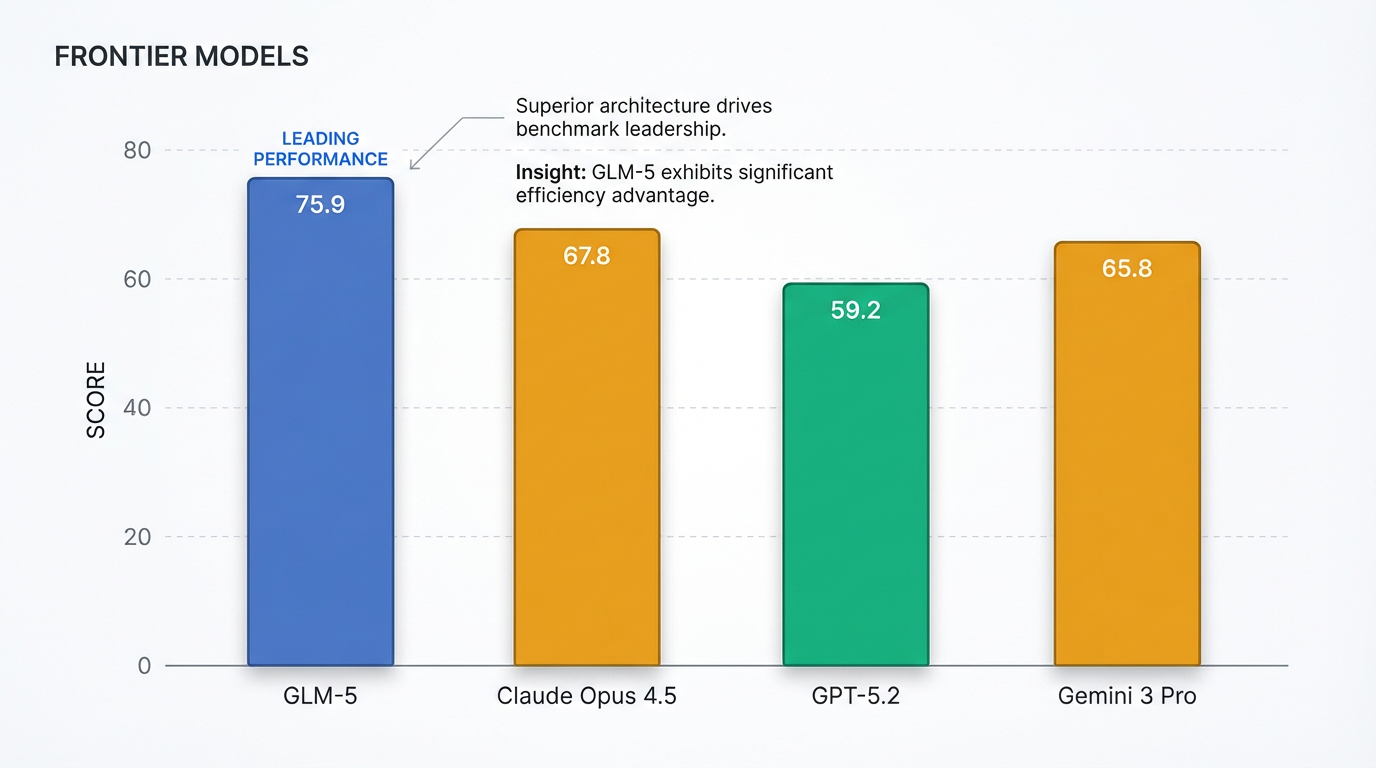
| BrowseComp | 75.9 🥇 | 67.8 | 59.2 | 65.8 |
| MCP-Atlas | 67.8 | 65.2 | 66.6 | 68.0 |
| τ²-Bench | 89.7 | 91.6 | 90.7 | 85.5 |
| Vending Bench 2 | $4,432 🥇 OS | $4,967 | $5,478 | $3,591 |
Note: 🥇 indicates the highest score among all models, while 🥇 OS denotes the highest score among open-source models. Scores marked with * refer to their full set scores .
GLM-5 notably outperforms Claude Opus 4.5 on "Humanity's Last Exam (w/ Tools)" and leads all models in the "BrowseComp" benchmark, achieving a score of 75.9 2. In the "Vending Bench 2" simulation, GLM-5 secured the top spot among open-source models with a score of $4,432, approaching the performance of Claude Opus 4.5, highlighting its strong long-term planning and resource management capabilities . While Claude Opus 4.5 shows a slightly higher score on SWE-bench Verified (80.9% vs GLM-5's 77.8%), GLM-5 remains highly competitive in coding tasks 2.
Internal Engineering Evaluation
Zhipu AI's internal evaluations, specifically using CC-Bench-V2, further demonstrate GLM-5's advancements, particularly against Claude Opus 4.5 2.
The results of the CC-Bench-V2 evaluation are presented below:
| Metric | GLM-5 | Claude Opus 4.5 |
|---|---|---|
| Frontend Build Success | 98.0% | 93.0% |
| E2E Correctness | 74.8% | 75.7% |
| Backend E2E Correctness | 25.8% | 26.9% |
| Long-horizon Large Repo | 65.6% | 64.5% |
| Multi-Step | 52.3% | 61.6% |
GLM-5 significantly narrows the performance gap with Claude Opus 4.5 on CC-Bench-V2, showcasing particular strength in frontend tasks with a 98.0% Frontend Build Success rate. This represents a 26% increase in build success rate over its predecessor, GLM-4.7 2.
Strategic Comparison with Claude Opus Series
GLM-5 is strategically positioned by Zhipu AI to be highly competitive with models like the Claude Opus 4.5/4.6 series, particularly in reasoning, coding, and agentic tasks 1. Beyond its performance, GLM-5 offers significant advantages as an open-source model released under the MIT license, contrasting with the proprietary nature of Claude models .
Its pricing model is disruptive, costing approximately $1.00 per million input tokens and $3.20 per million output tokens. This makes GLM-5 approximately 6 times cheaper on input and nearly 10 times cheaper on output compared to Claude Opus 4.6, which is priced at $5 per million input and $25 per million output tokens 4. However, early users have observed that while effective, GLM-5 might be "far less situationally aware" and prone to achieving goals through "aggressive tactics" rather than comprehensive reasoning or leveraging prior experience compared to some other models 4. Overall, GLM-5 stands as a powerful, cost-effective, and open-source alternative to leading frontier models, distinguished by its agentic capabilities, reasoning, coding prowess, and advancements in hardware independence .
GLM-5 in Context: A Peer to Claude 4.5 and Other Leading Models
The official announcement of GLM-5, developed by Zhipu AI, strategically positions it as a direct challenger to OpenAI's GPT-5.2, Anthropic's Claude Opus 4.5/4.6, and Google's Gemini 3 Pro . A key differentiator for GLM-5 is its open-source nature, with model weights released under the MIT License on platforms like Hugging Face and ModelScope, setting it apart from its proprietary competitors . Furthermore, Zhipu AI highlights that GLM-5 was trained entirely on Huawei Ascend chips using the MindSpore framework, underscoring China's self-reliance in AI infrastructure and independence from US-manufactured semiconductor hardware .
GLM-5 has undergone evaluation across major agentic, reasoning, and coding benchmarks, demonstrating strong competitive performance and establishing itself as a top-ranked open-source model globally, vying with frontier closed-source models .
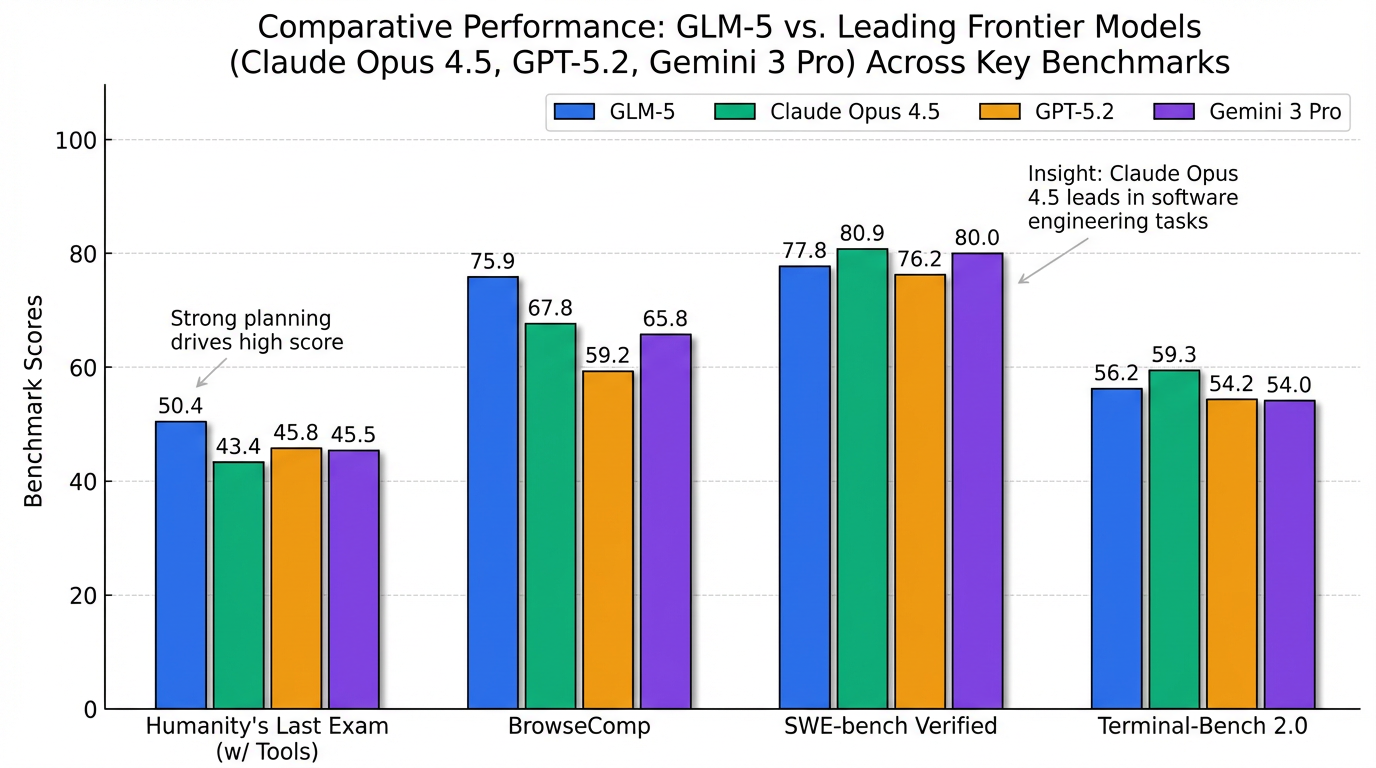
As evidenced by Zhipu AI's official benchmarks, GLM-5 showcases competitive performance against leading models like Claude Opus 4.5, GPT-5.2, and Gemini 3 Pro :
- Reasoning and Agentic Tasks: GLM-5 demonstrates leadership in specific metrics, notably outperforming Claude Opus 4.5 on Humanity's Last Exam (with Tools) and leading all models on BrowseComp 2. In the Vending Bench 2 simulation, GLM-5 secured the top position among open-source models, approaching Claude Opus 4.5's score and indicating robust long-term planning and resource management capabilities .
- Coding Capabilities: While Claude Opus 4.5 achieved a slightly higher score on SWE-bench Verified (80.9% compared to GLM-5's 77.8%), GLM-5 closely approaches its performance 2. It also exhibits strong performance in coding benchmarks such as Terminal-Bench 2.0 and excels in specific areas like frontend build success, showing a 26% increase over its predecessor, GLM-4.7, on internal engineering evaluations (CC-Bench-V2) 2.
- Cost-Efficiency: Beyond its technical prowess, GLM-5 presents a significant advantage in terms of cost. Its disruptive pricing model is approximately $1.00 per million input tokens and $3.20 per million output tokens, making it roughly 6 times cheaper on input and nearly 10 times cheaper on output than Claude Opus 4.6 ($5/$25) 4.
Despite its robust performance and strategic positioning, early user observations note that GLM-5, while effective, might be "far less situationally aware" and prone to achieving goals through "aggressive tactics" without as much nuanced reasoning or leveraging prior experience compared to some other models 4. Nevertheless, GLM-5 stands as a powerful, cost-effective, and open-source alternative to leading frontier models, marking significant advancements in agentic capabilities, reasoning, coding, and hardware independence .
Conclusion: The Future Implications of GLM-5
GLM-5, developed by Zhipu AI (Z.ai), officially released around February 11-12, 2026, marking a significant advancement in AI capabilities . Available via Z.ai's platform, WaveSpeed API, and OpenRouter, its model weights are also open-sourced on Hugging Face and ModelScope under the MIT License, enhancing accessibility for the global AI community . Engineered for complex systems engineering and long-horizon agentic tasks, GLM-5 boasts approximately 745 billion total parameters in a Mixture of Experts (MoE) architecture and integrates DeepSeek Sparse Attention (DSA) for efficient long-context handling . Its exceptional capabilities span creative writing with nuanced stylistic versatility, advanced reasoning with a record-low hallucination rate of -1 on the Artificial Analysis Intelligence Index v4.0, and agentic engineering for full-stack development . The model also features a robust built-in agentic architecture for autonomous planning and tool utilization, along with a massive 200K-token context window and 131,000-token output length for extensive processing . Zhipu AI also leveraged a novel asynchronous RL infrastructure called "slime" to enhance training throughput and efficiency for complex agentic behaviors .
Positioned as a direct challenger to models like OpenAI's GPT-5.2 and Anthropic's Claude Opus 4.5, GLM-5 demonstrates strong performance across major benchmarks, proving competitive with frontier closed-source models . It notably outperforms Claude Opus 4.5 on Humanity's Last Exam (with tools) and leads all models on BrowseComp with a score of 75.9 2. In the Vending Bench 2 simulation, GLM-5 emerged as the top open-source model . While Claude Opus 4.5 holds a slight edge on SWE-bench Verified, GLM-5 significantly narrows the gap, particularly showing a 26% increase in frontend build success over its predecessor GLM-4.7 on internal CC-Bench-V2 evaluations 2. The provided chart illustrates GLM-5's competitive standing against leading models across various benchmarks.
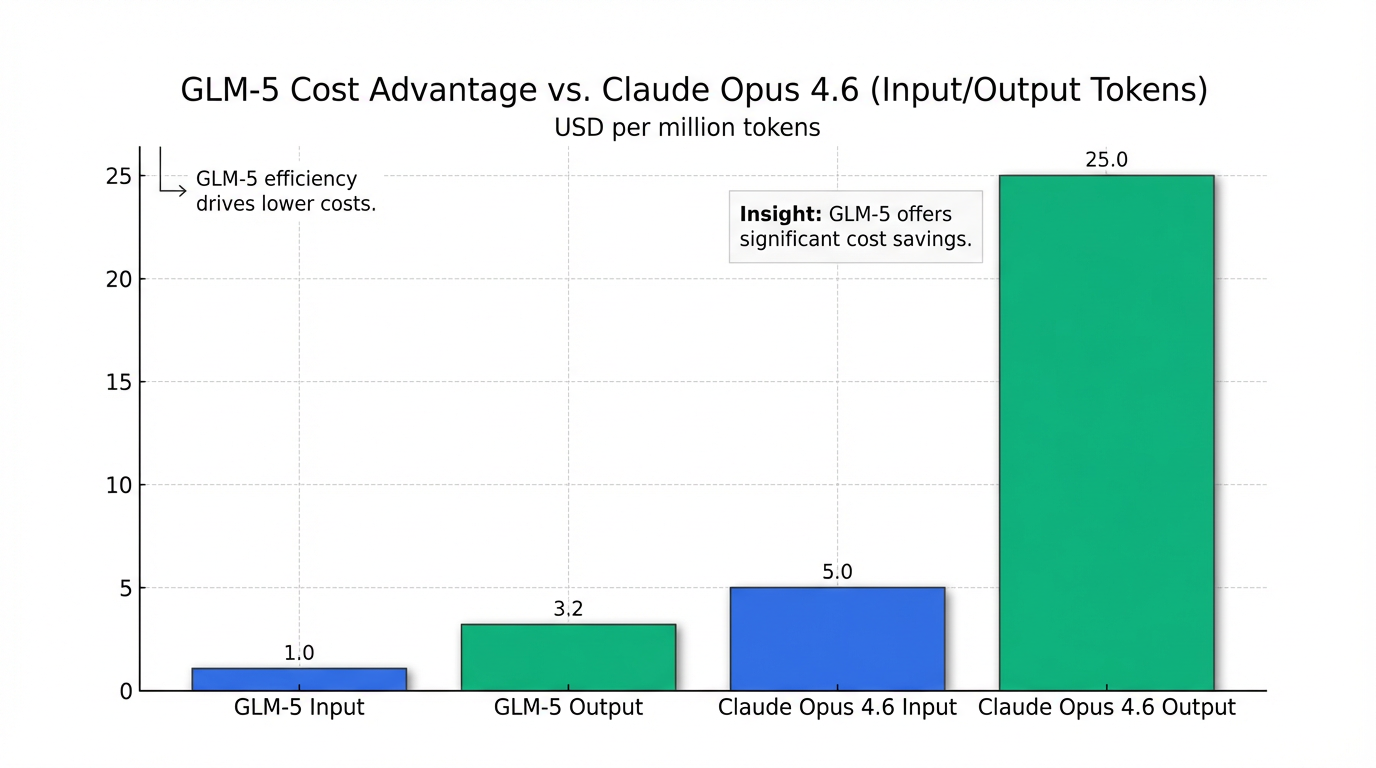
Beyond its raw performance, GLM-5 offers compelling unique advantages. Its open-source release under the MIT license makes it a powerful and accessible alternative to proprietary solutions . Furthermore, GLM-5 presents a disruptive pricing model, being approximately 6x cheaper on input and nearly 10x cheaper on output than Claude Opus 4.6, offering significant cost efficiency 4. Strategically, GLM-5 represents a milestone in China's AI independence, having been trained entirely on Huawei Ascend chips using the MindSpore framework, showcasing self-reliance in AI infrastructure .
Zhipu AI strategically positions GLM-5 to transition AI from "chat" to "work," aiming for it to become an essential "office" tool for the AGI era . Its advanced agentic architecture, enabling autonomous planning, tool utilization, and the creation of ready-to-use documents (.docx, .pdf, .xlsx), underscores this vision . While early user observations note it might be "far less situationally aware" than some counterparts and uses "aggressive tactics" to achieve goals, its design explicitly targets complex agentic and systems engineering tasks .
In conclusion, GLM-5 emerges as a powerful, cost-effective, and strategically significant open-source alternative in the rapidly evolving AI landscape. With its exceptional capabilities in agentic engineering, advanced reasoning, and long-context processing, coupled with its open-source nature and cost-efficiency, GLM-5 is poised to drive innovation and reshape how AI is deployed, particularly in complex workflow automation and systems engineering, propelling the industry closer to the AGI era .