Rebuilding Next.js with AI: The Cloudflare Vinext Experiment and its Implications for Web Development
1. Introduction: The AI Revolution in Web Development
The landscape of web development is in constant flux, characterized by rapid technological advancements and an ever-increasing demand for dynamic, high-performance applications. In recent years, Artificial Intelligence (AI) has emerged not merely as a tool for application features, but as a transformative force capable of fundamentally reshaping the very infrastructure and methodologies of software creation. This evolution prompts a critical examination of current development paradigms, particularly the challenges embedded within popular modern frameworks.
While frameworks like Next.js have gained considerable popularity for their ability to build modern React applications, offering features such as server-side rendering (SSR) and static site generation (SSG), they are not without inherent complexities and pain points 1. Developers frequently encounter significant hurdles spanning developer experience (DX), performance, scalability, and maintainability. For instance, the introduction of features like React Server Components (RSC), the App Router, and server actions has led to substantial architectural complexity, often resulting in tightly coupled, monolithic applications . Developers struggle to predict whether code executes on the server or in the browser, with these boundaries often remaining opaque until they lead to errors 2.
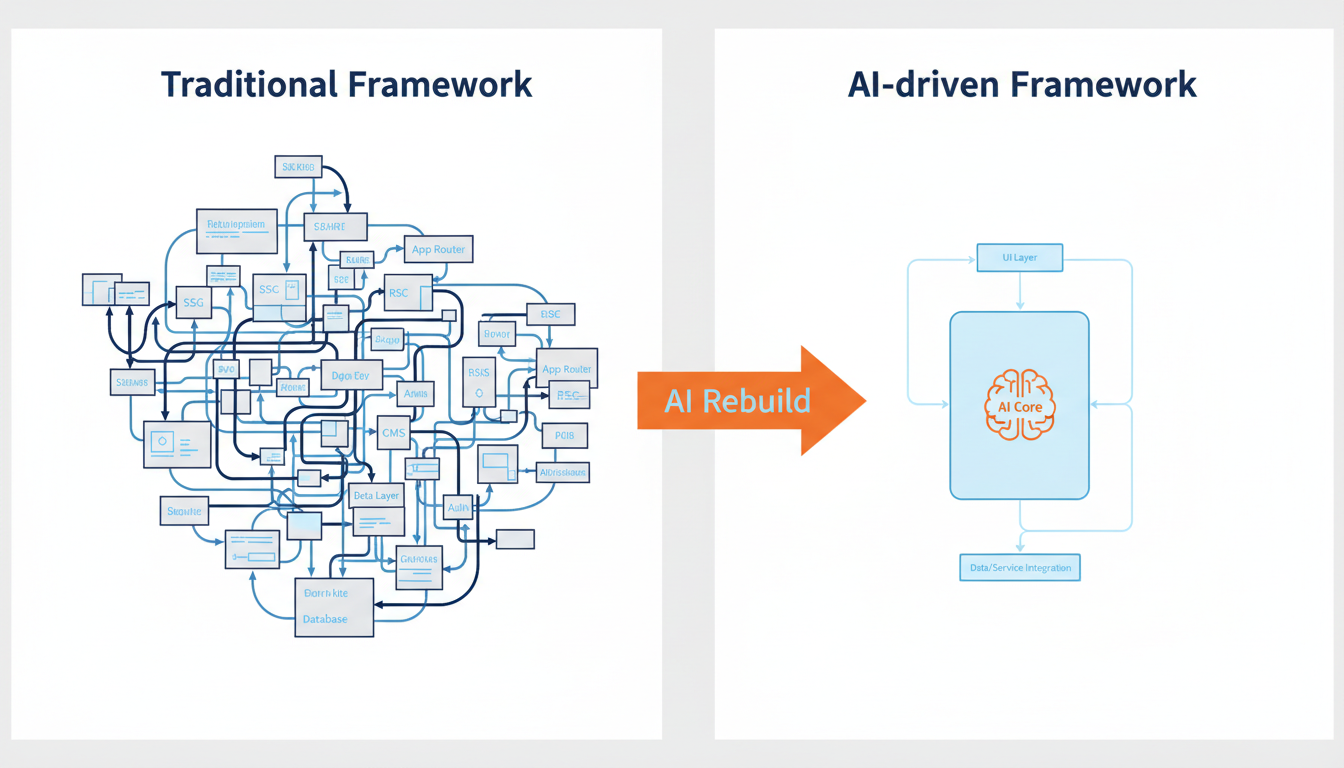
The learning curve for Next.js is notably steep, requiring an understanding of complex concepts such as client vs. server components, multiple rendering strategies (SSR, SSG, ISR), and edge runtime constraints, making onboarding new team members a slow process . Moreover, the framework is prone to frequent breaking changes, such as the major transition from Pages Router to App Router, often necessitating significant code rewrites . Debugging becomes progressively difficult as applications scale, particularly with RSCs, and error messages are frequently unhelpful in pinpointing root causes .
Performance is another critical area of concern. The daily development experience can become sluggish, and build times can drastically increase from minutes to over 30 minutes for larger applications or when adding certain features, impacting CI/CD efficiency . At scale, Next.js can be "painfully slow," with page renders extending beyond 700ms for large, dynamic content, and issues like slow server-side rendering and JSON bloat negatively affecting Time to First Byte (TTFB) . Scalability and maintenance are further hampered by architectural coupling, creating monolithic build processes that hinder cross-team collaboration . Additionally, the close ties between Next.js and Vercel introduce vendor lock-in, limiting flexibility for deployments outside the Vercel ecosystem . Maintaining large Next.js applications is also challenging due to the framework's constant evolution, leading to rapidly deprecated patterns and increasing code complexity . Recent critical security vulnerabilities, such as insecure deserialization in the React Server Components "Flight" protocol (CVE-2025-66478), further highlight potential attack surfaces within the framework's internal mechanisms 3.
It is against this backdrop of increasing framework complexity and maintenance challenges that Cloudflare embarked on an ambitious project: the AI-driven rebuilding of a Next.js-like framework, dubbed 'Vinext,' all within the span of one week. This remarkable undertaking serves as a testament to the burgeoning capabilities of AI in software engineering. This article posits that such achievements herald a new era in framework design and development efficiency, demonstrating AI's profound potential to mitigate current pain points, streamline architectural decisions, and redefine the boundaries of what is achievable in modern web development.
The Genesis of Vinext: Why Rebuild Next.js with AI?
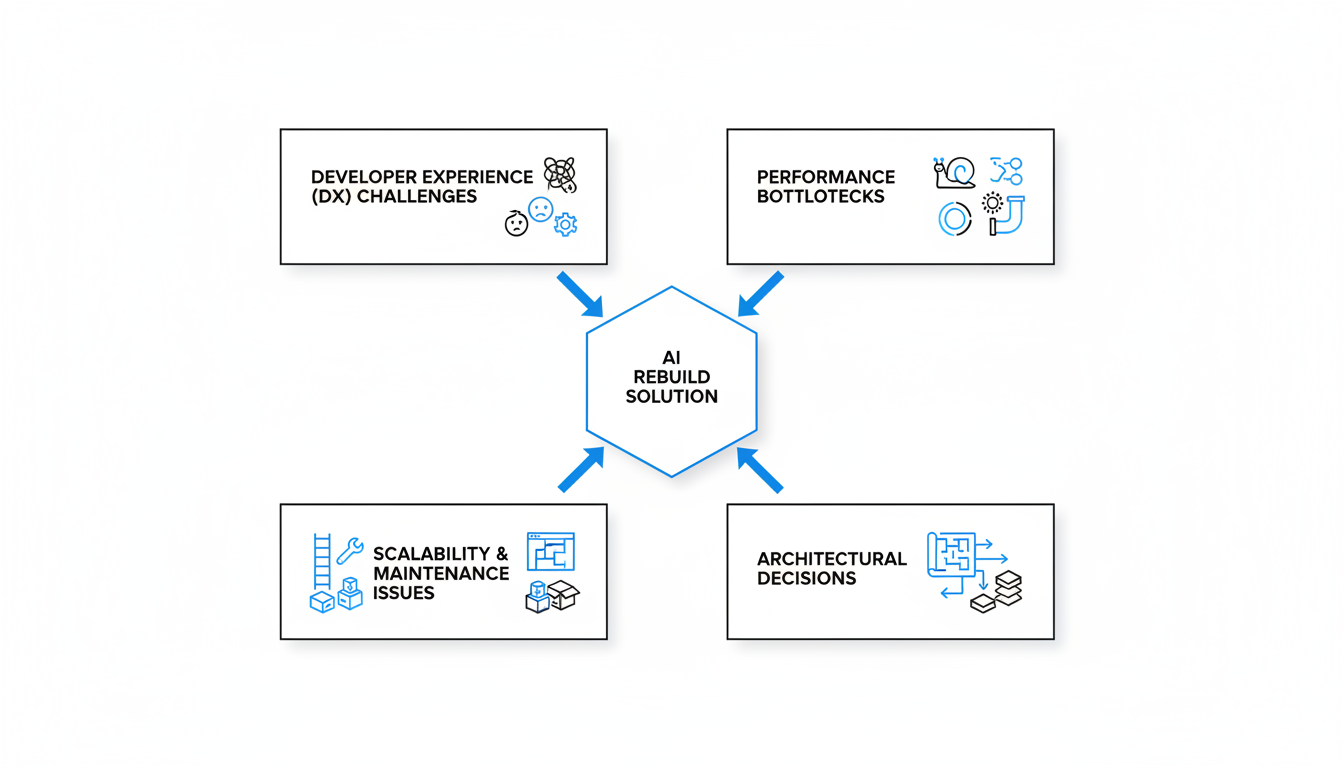
While Next.js has gained widespread popularity for developing modern React applications, leveraging features like Server-Side Rendering (SSR) and Static Site Generation (SSG) for performance and productivity 1, it simultaneously introduces inherent complexities and significant pain points that Cloudflare's Vinext project aimed to address through an AI-driven rebuild. The strategic motivations behind Vinext were rooted in tackling these pervasive challenges across developer experience, performance, scalability, and maintainability within the Next.js ecosystem.
The limitations and complexities of existing frameworks, particularly Next.js, presented clear targets for Vinext's innovative approach. These issues can be categorized as follows:
Developer Experience (DX) Challenges and Mental Overhead
Developers frequently encounter a substantial mental overhead when working with Next.js. The introduction of features like React Server Components (RSC), the App Router, and server actions has markedly increased architectural complexity 1. What might begin as a straightforward application can quickly become tightly coupled and monolithic . A significant struggle for developers is predicting whether code executes on the server or in the browser, with the boundary often remaining invisible until it leads to a failure 2.
This complexity contributes to a steep learning curve, as Next.js demands understanding a new mental model beyond plain React, encompassing client vs. server components, multiple rendering strategies (SSR, SSG, ISR), layouts, nested routing, and edge runtime constraints . This makes onboarding new team members a slow process 4. Moreover, major shifts between versions, such as the transition from Pages Router to App Router, frequently introduce breaking changes that necessitate rewriting parts of applications . Documentation, while initially clear, struggles to keep pace with rapid feature development . Debugging, particularly with newer features like RSCs, becomes slower and more challenging as applications scale 1. When Next.js encounters a crash, the resulting error messages are often unhelpful, obscuring the root cause of issues 5. While conventions like file-based routing simplify initial setup , they can become restrictive for scenarios requiring greater flexibility, leading developers to "fight the framework" 4. Achieving fine-grained control over caching headers or managing shared utilities across client/server boundaries can also be cumbersome 4. Finally, integrating advanced state management, complex data fetching, or non-React components (e.g., Three.js) often pushes the limits of Next.js's full-stack capabilities in larger projects 1.
Performance Bottlenecks and Optimization Difficulties
Beyond developer experience, Next.js applications can suffer from significant performance bottlenecks. The daily development experience itself can become sluggish for larger applications, especially when building, debugging, and iterating with RSCs 1. The development server, for instance, can take over five minutes to start, severely impacting team velocity 6. Build times can extend drastically, from minutes to over 30 minutes, particularly with features like CSS modules or in large codebases . This consumes valuable CI/CD budget and delays deployments 6, with contributing factors including aggressive TypeScript compilation, dependency resolution issues, CSS-in-JS processing, and unoptimized source map generation 6.
At scale, Next.js can be "painfully slow" 5. Page renders can take hundreds of milliseconds, occasionally spiking beyond 700ms for large, dynamic pages 5. Slow server-side rendering and excessive JSON bloat can severely degrade Time to First Byte (TTFB) and overall load times . The framework also struggles with inefficient resource handling, resulting in large JavaScript bundles and unoptimized images or scripts, despite built-in components designed to address these issues . Inefficient data fetching, especially synchronous or sequential operations on the server, can further delay HTML responses, leading to perceived slowness and a poor user experience 7. Additionally, Next.js's built-in caching mechanism can be unpredictable and inefficient, particularly across multiple replicas in scaled deployments, often necessitating manual cache management 5.
Scalability and Maintenance Issues
The initial simplicity of a Next.js application can quickly evolve into a monolithic build process that struggles to scale effectively across different teams and domains, ultimately decreasing productivity when small refactors impact the entire pipeline . The tight coupling of Next.js's core components—CLI, Bundler, Router, and Runtime—makes it challenging to substitute or extend individual layers without significant friction 8.
A notable concern is vendor lock-in, as Next.js is closely tied to Vercel, and many of its features either work best or exclusively on their platform . This creates friction and limits flexibility for teams deploying outside Vercel, particularly concerning infrastructure costs or custom rendering behavior 1. Deploying a Next.js application outside Vercel can feel like "untying the spaghetti JS" 9. The maintenance burden for large Next.js applications is substantial, due to factors such as outdated dependencies, flaky tests, and increasing code complexity 10. The framework's constant evolution means that what constituted best practice one year might be deprecated the next, eroding long-term project confidence 4. Furthermore, large Next.js applications can face resource exhaustion, particularly memory issues during the build process, as Node.js runs out of heap space when processing extensive dependency trees 6. Security vulnerabilities are also a concern, with recent critical flaws discovered in core components, including insecure deserialization in the React Server Components "Flight" protocol (CVE-2025-66478) leading to Remote Code Execution, and middleware bypasses (CVE-2025-29927) 3. These highlight the potential for the framework's internal mechanisms to become attack surfaces 3.
Architectural Decisions Contributing to Complexities
Several fundamental architectural decisions within Next.js contribute to these complexities. The framework's hybrid rendering model, which combines Client-Side Rendering (CSR), SSR, SSG, and Incremental Static Regeneration (ISR), offers flexibility but forces developers to juggle multiple performance profiles and execution contexts, which can "get messy" . The default server-side rendering can introduce unnecessary complexity for applications that do not heavily benefit from pre-rendering .
Additionally, Next.js relies on "magical entry points" and implicit, compiler-driven special functions for aspects like data fetching and server components 8. This design blurs the clarity of "where code runs and how systems compose," making it difficult to reason about systems and often leading to "pet-groomed code-bases that are expensive to build and maintain" 8.
In light of these formidable challenges, the definition of "rebuilding Next.js" within the context of Cloudflare's Vinext project was ambitious. It specifically entailed addressing core functionalities such as rendering and routing, aiming to fundamentally rethink how these elements could be managed more efficiently and intelligently. The project’s audacious "one-week" timeline was not merely a constraint but a significant challenge designed to push the boundaries of what was thought possible, demonstrating a rapid, AI-driven approach to solving deep-seated framework issues.
3. The AI-Powered Reconstruction: How Vinext Was Built
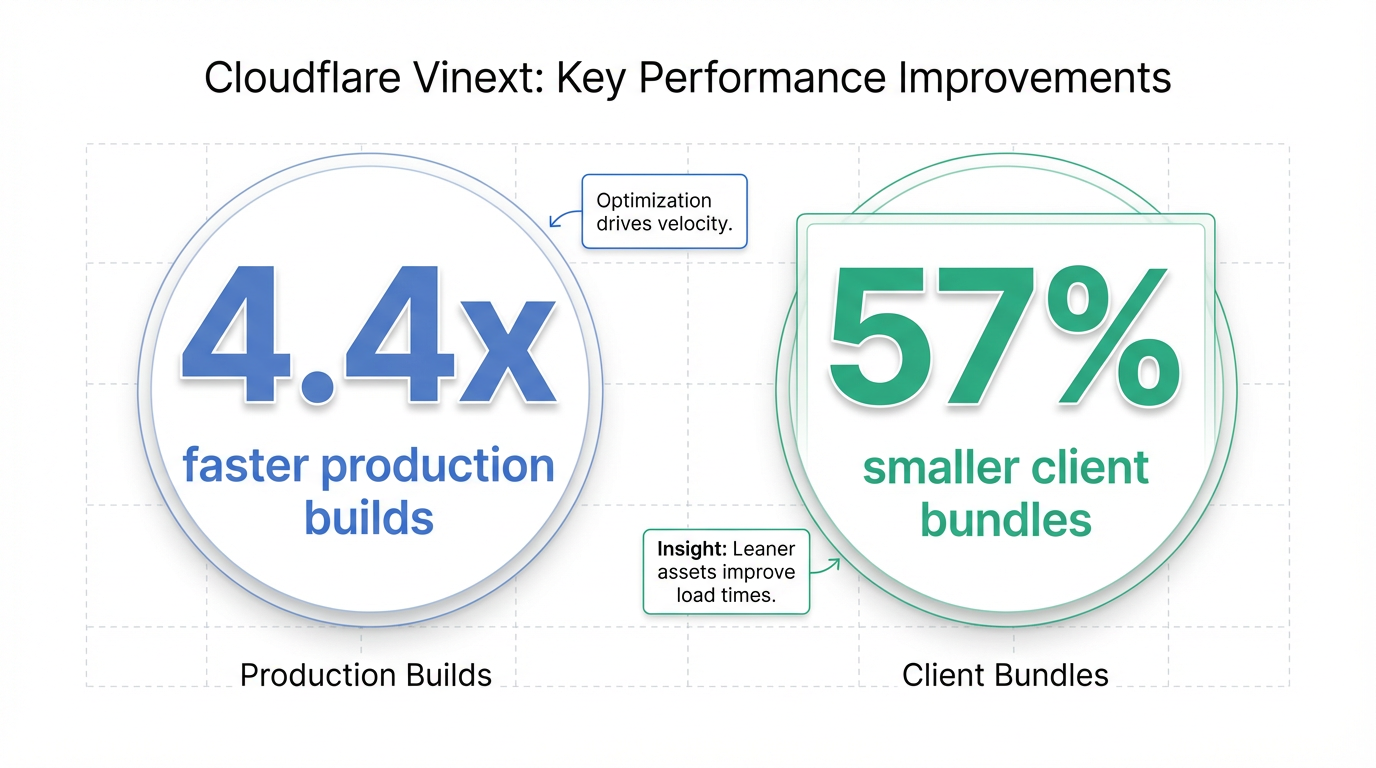
The Cloudflare Vinext project undertook a remarkable ground-up reconstruction of the Next.js framework, primarily driven by artificial intelligence and overseen by a single human engineer [0-1, 0-3, 1-1, 1-9]. This ambitious effort aimed to resolve deployment complexities and significantly boost performance, ultimately achieving 4.4x faster production builds and 57% smaller client bundles compared to Next.js 16 [0-1, 0-3, 1-1, 1-9].
AI Models, Tools, and Techniques Employed
The Vinext project leveraged AI extensively, with the "vast majority of the code, tests, and documentation" being written by AI, specifically Claude Code [0-5, 1-3]. The development process involved a single engineer directing Claude through over 800 AI coding sessions [0-1, 1-1, 1-9]. Cloudflare's broader AI ecosystem plays a crucial role, offering various tools and models accessible via Workers AI, which supports a catalog of open-source models like Meta's Llama 3.1 and specialized models such as @cf/meta/llama-4-scout-17b-16e-instruct [0-7, 0-8]. Furthermore, the AI SDK provides a unified interface for interacting with different AI providers, including Workers AI, OpenAI, Anthropic, and Google Gemini [1-8].
Key AI techniques and practices observed include:
- Prompt Engineering: Cloudflare emphasizes best practices for prompting, such as using tags to structure prompts, providing API and usage examples, and guiding the AI in generating configuration files (e.g.,
wrangler.jsonc) [0-0]. Prompt structure often utilizessystem,user, andassistantroles [0-4]. - Model Context Protocol (MCP): Cloudflare provides MCP servers (e.g.,
cloudflare-docsMCP andcloudflare-observabilityMCP) to "teach" AI agents about Workers APIs, best practices, and to enable automatic issue detection and fixing through log analysis [0-0]. The Context7 MCP, for instance, provided fast access to documentation and source code for relevant libraries like/vercel/next.jsand/vitejs/vite-plugin-react[1-5]. - AI Coding Tools: Vinext's migration Agent Skill is compatible with various AI coding tools like Claude Code, OpenCode, Cursor, and Codex [0-5, 1-3]. Cloudflare's documentation also highlights the use of AI-enabled editors like Cursor and Windsurf for indexing documentation to provide context to AI [0-0].
These AI-driven approaches allowed for significant efficiencies, culminating in a rapid development time of just one week and a remarkably low token cost of $1,100 [0-1, 0-3, 1-1, 1-9].
| AI Model/Tool/Technique | Primary Function/Application |
|---|---|
| Claude Code | Wrote the vast majority of Vinext's code, tests, and documentation. |
| Prompt Engineering | Technique using structured prompts (tags, examples, roles) to guide AI in generating code and configuration files. |
| Model Context Protocol (MCP) | Provided servers to 'teach' AI agents about Workers APIs and enable automatic issue detection and fixing. |
| Tests as Guardrails | Methodology where AI iterated against extensive test suites to ensure compatibility and correctness with Next.js APIs. |
High-Level Architecture of the AI-Generated Framework
Vinext is engineered as a Vite plugin that meticulously reimplements the public Next.js API surface, including core functionalities like routing, server rendering, React Server Components (RSC), server actions, caching, and middleware [0-3, 0-5, 1-1, 1-3]. It is not merely a wrapper but a complete, alternative implementation built directly on Vite [0-3, 1-1, 1-3]. The framework harnesses Vite's architecture, particularly Rolldown (the Rust-based bundler for Vite 8), for its inherent performance advantages [0-3, 1-1].
Architectural components and deployment specifics include:
- Core Functionality: Reimplementation of Next.js features such as
app/andpages/directory handling,next.config.js, routing, Server-Side Rendering (SSR), React Server Components (RSC), and server actions [0-3, 1-1, 1-3]. - Build Tool: Based on Vite, with
@vitejs/plugin-rscproviding robust React Server Components support [0-5, 1-3]. - Deployment Target: Primarily targets Cloudflare Workers, facilitating deployment with a straightforward
vinext deploycommand [0-3, 0-5, 1-1, 1-3]. The entire application operates within theworkerdruntime during both development and deployment phases [0-3, 1-1]. - Cloudflare Integrations: Vinext offers seamless access to Cloudflare platform APIs and services like KV (for caching and Incremental Static Regeneration - ISR), Durable Objects, R2, D1, and AI bindings [0-3, 1-1, 1-4]. For instance, a
KVCacheHandleris provided for production caching requirements [0-3, 1-1]. - Modularity: Approximately 95% of Vinext consists of pure Vite code, meaning that critical components like core routing, module shims, the SSR pipeline, and RSC integration are not Cloudflare-specific [0-3, 1-1]. This modular design suggests significant potential for deployment to other platforms beyond Cloudflare Workers [0-3, 1-1].
The project's performance gains are substantial, illustrating the effectiveness of this architectural approach.
Human-AI Interaction and Iterative Development Process
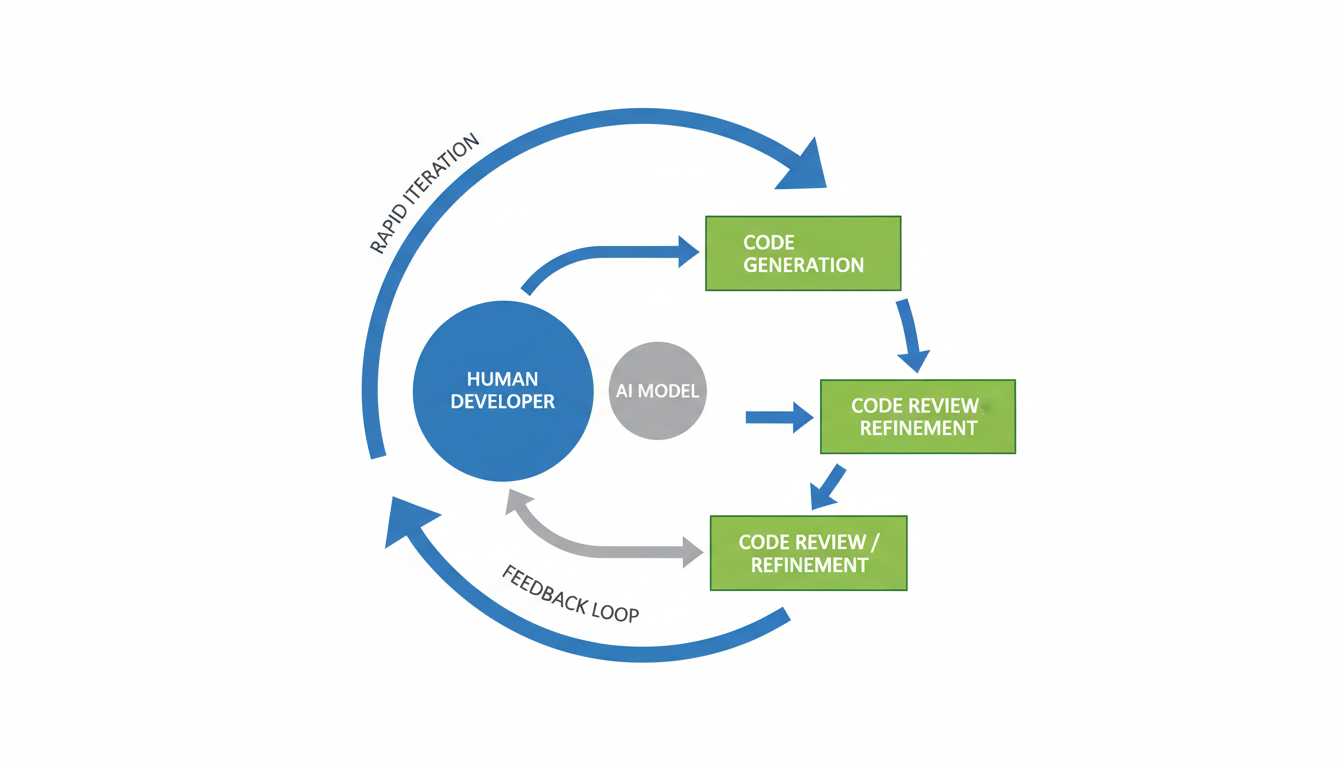
The development of Vinext was a highly iterative and deeply AI-driven process, guided meticulously by a single human engineer. The project is explicitly framed as an "experiment in AI-driven software development" [0-5, 1-3].
Central to the methodology was the use of tests as guardrails for the AI models. The AI iterated continuously against these tests to ensure compatibility and correctness with Next.js APIs, effectively having "executable specifications to satisfy" [0-2]. The test suite is extensive, comprising over 1,700 Vitest tests and 380 Playwright E2E tests, some of which were directly ported from Next.js and OpenNext's conformance suite [0-3, 0-5, 1-1, 1-3].
While AI wrote most of the code, human oversight remained critical. Human developers were responsible for directing the "architecture, priorities, and design decisions," although they did not perform line-by-line code reviews [0-5, 1-3]. The AGENTS.md file within the Vinext repository outlines specific guidelines for AI agents, emphasizing an iterative development workflow that begins with checking Next.js source for expected behavior, advocating for "add tests first," then implementing features, and running the full test suite before committing changes [1-5]. Debugging strategies included checking development server logs and addressing issues related to RSC streaming and module resolution [1-5].
To aid the AI in understanding context and finding solutions, developers utilized specific research tools:
- Context7 MCP: Provided rapid access to documentation and source code for relevant libraries such as
/vercel/next.js,/llmstxt/nextjs_llms_txt, and/vitejs/vite-plugin-react[1-5]. - EXA Search: Employed for broader web searches to discover workarounds, alternative solutions, and discussions not covered by Context7 [1-5].
Cloudflare's broader AI strategy incorporates "Human-in-the-Loop" (HITL) workflows, where processes can pause for human review or decision-making [2-1, 2-3, 2-5, 2-6, 2-9]. The Agents SDK, built on Durable Objects, supports these long-running, stateful workflows, allowing AI agents to persist their state over extended periods while awaiting human input [2-1, 2-3, 2-5, 2-6, 2-9]. This approach intelligently combines the efficiency of automation with essential human expertise [2-3]. This collaborative human-AI workflow is a cornerstone of the project's success.
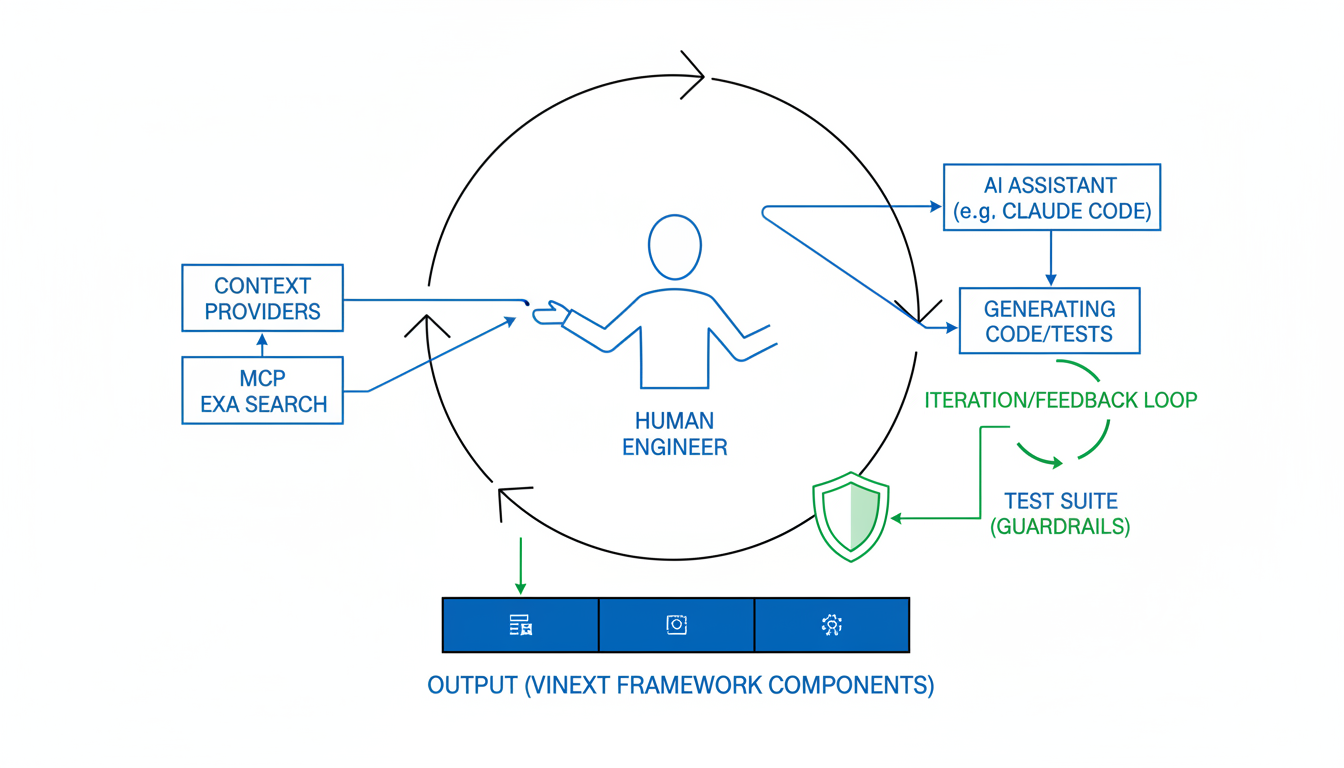
The remarkable speed of development (one week) and the minimal token cost ($1,100) are strong indicators of the efficiency gained through this advanced AI-powered approach [0-1, 0-3, 1-1, 1-9]. Despite its experimental nature, Vinext functions effectively for demonstrations and exploration [0-3, 0-5, 1-1, 1-3].
Technical Achievements, Challenges, and Learnings
Cloudflare's Vinext project represents a significant stride in AI-assisted software development, undertaking an AI-assisted re-implementation of the Next.js front-end framework within a single week 11. This ambitious initiative, costing approximately $1,100 in tokens, showcases Cloudflare's broader vision of integrating AI into developer tools to fundamentally transform how software is built and shipped .
Key Innovations and Cloudflare Ecosystem Integration
The core innovation behind Vinext is its clean re-implementation of the Next.js API surface directly on Vite, rather than merely adapting Next.js's existing output 11. This approach allowed for the native integration of crucial functionalities such as routing, server rendering, React Server Components, server actions, caching, and middleware, all built as a Vite plugin 11. A key architectural advantage is that Vite output, enabled by the Vite Environment API, is designed to run on any platform 11.
Vinext offers several key technical achievements specific to the Cloudflare ecosystem:
- One-command Deployment: Users can deploy their application to Cloudflare Workers with a single
vinext deploycommand, which automatically handles the build process and Worker configuration 11. - Platform-specific API Integration: The framework supports both App Router and Pages Router on Workers, complete with full client-side hydration, interactive components, client-side navigation, and React state 11.
- Enhanced Caching: Vinext incorporates a Cloudflare KV cache handler to provide Incremental Static Regeneration (ISR) out of the box, with a pluggable caching layer that supports alternative backends like R2 11.
- Native Cloudflare Service Usage: The framework enables direct use of Cloudflare services such as Durable Objects, KV, and AI bindings without the need for workarounds like
getPlatformProxy, as the entire application operates within theworkerdenvironment during both development and deployment 11. - Open-Source Collaboration: Approximately 95% of Vinext consists of pure Vite components, making it largely independent of Cloudflare-specific dependencies and encouraging broader adoption and contributions from other hosting providers 11.
The ability of AI to generate and execute code within environments like Cloudflare Workers was pivotal in enabling such rapid development .
Overcoming Hurdles
A primary challenge Vinext sought to resolve was the pervasive "Next.js deployment problem" within the broader serverless ecosystem 11. Next.js's reliance on proprietary tooling, such as Turbopack, made deploying its build output to platforms like Cloudflare, Netlify, or AWS Lambda difficult and often fragile 11. Previous attempts, like OpenNext, struggled with "whack-a-mole" issues due to reverse-engineering Next.js's build output and unpredictable version changes 11. Furthermore, Next.js's early adapters API primarily covered build and deploy functions while remaining tied to Turbopack, and its next dev environment exclusively ran in Node.js, impeding the testing of platform-specific APIs 11.
The team initially approached the project with skepticism regarding the feasibility of directly reimplementing the Next.js API surface on Vite 11. This conceptual barrier was overcome by:
- Direct Reimplementation: Shifting from merely adapting Next.js output to building an entirely new implementation of its API surface on Vite 11.
- Leveraging Vite's Architecture: Capitalizing on Vite's inherent structural advantages for build performance, particularly with future bundlers like Rolldown, a Rust-based bundler anticipated in Vite 8 11.
- AI as an Enabler: The project underscores that AI's capabilities have fundamentally altered "the cost of building software" in 2026, making such an ambitious re-implementation within a one-week timeframe significantly more attainable 11.
Code Quality, Maintainability, and Performance
Vinext exhibits promising performance improvements and a strong foundation for code quality and maintainability.
Performance Metrics
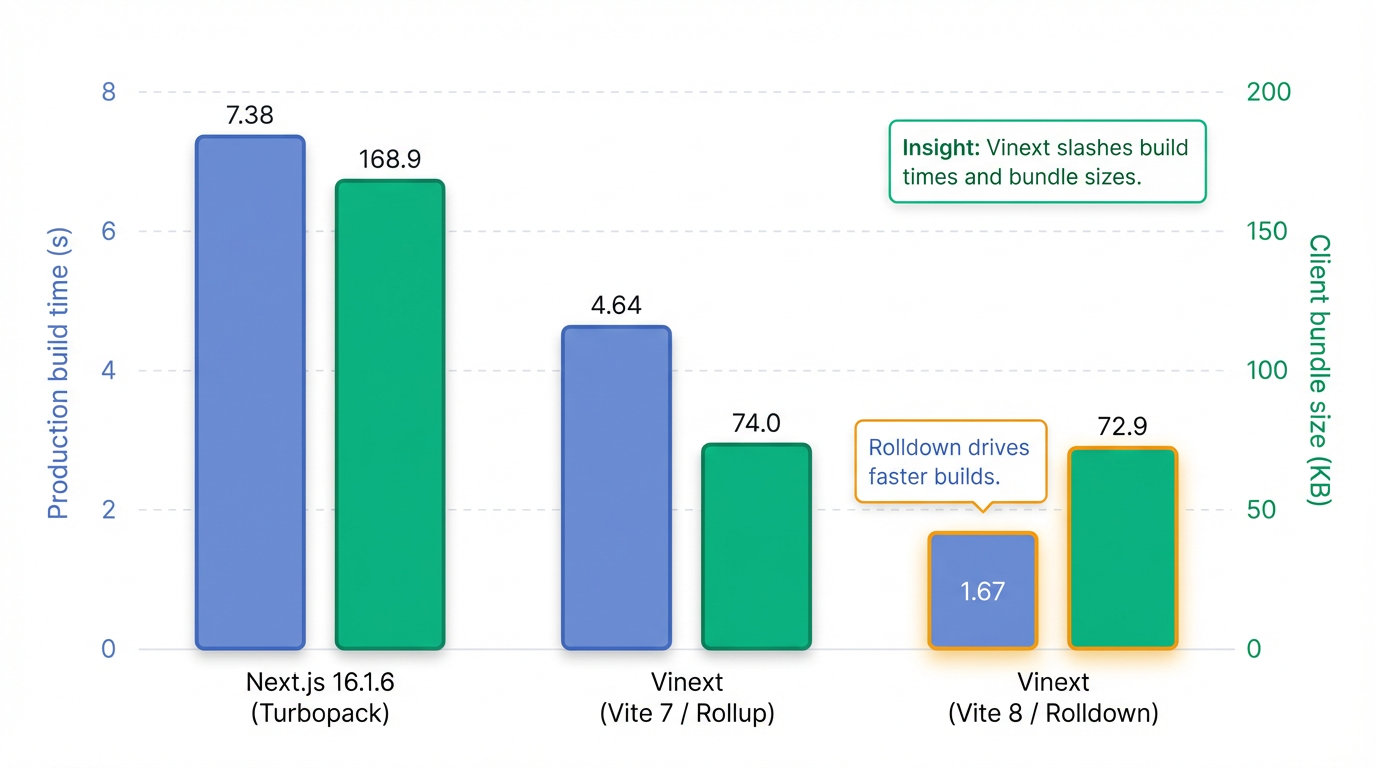
Early benchmarks using a shared 33-route App Router application demonstrate significant performance gains for Vinext compared to Next.js 16.1.6 (Turbopack) 11.
| Metric | Next.js 16.1.6 (Turbopack) | Vinext (Vite 7 / Rollup) | Vinext (Vite 8 / Rolldown) |
|---|---|---|---|
| Production build time | 7.38s | 4.64s (1.6x faster) | 1.67s (4.4x faster) |
| Client bundle size (gzipped) | 168.9 KB | 74.0 KB (56% smaller) | 72.9 KB (57% smaller) |
These benchmarks primarily measure compilation and bundling speed rather than production serving performance. They are based on a specific test fixture, not a wide range of production applications, and are considered directional, with expectations for further evolution 11. Vite's architecture, especially with the anticipated Rolldown bundler, provides structural advantages for build performance 11.
Code Quality and Maintainability
- Extensive Testing: Vinext features an extensive test suite, including over 1,700 Vitest tests and 380 Playwright E2E tests. Some of these tests were adapted directly from the Next.js test suite and OpenNext's Cloudflare conformance suite 11.
- High Test Coverage: The project reports an impressive 94% test coverage, indicating a thorough validation process 11.
- Drop-in Compatibility: As a "drop-in replacement" for Next.js, Vinext allows existing
app/,pages/, andnext.config.jsfiles to function without modification, suggesting high compatibility and simplifying migration for developers 11. - Vite-based Architecture: The fact that 95% of Vinext consists of "pure Vite" components enhances its maintainability, aligning it with a widely adopted and modern front-end ecosystem 11.
Learnings and Current Status
Despite the encouraging results, Cloudflare explicitly states that Vinext is "experimental" and "not even one week old." It has not yet been battle-tested with meaningful traffic at scale, and caution is advised for production evaluations 11. The project is open-source, and Cloudflare is actively seeking collaboration with other hosting providers to adopt the toolchain and contribute to its long-term success 11.
5. Implications, Future Outlook, and Conclusion
5.1 The Paradigm Shift: AI's Role in Software Development
The Cloudflare Vinext project stands as a compelling illustration of AI's transformative impact on modern framework development and rapid prototyping. Built by a single engineer and an AI model in just one week, costing approximately $1,100 in tokens, Vinext fundamentally challenges traditional software development paradigms 11. This initiative underscores Cloudflare's broader vision, where AI is viewed as a force that will fundamentally alter how software is constructed and delivered . The rapid creation of a drop-in Next.js replacement in such a short timeframe, specifically noted to be a full re-implementation rather than an adaptation, signifies a dramatic shift in developer productivity 11. This accomplishment points to a future where the "cost of building software has completely changed," a notion projected for 2026, implying that AI's advanced capabilities now render ambitious re-implementations achievable within previously inconceivable timelines 11.
5.2 Vinext in the Context of AI-Assisted Code Generation
Vinext's one-week, AI-assisted re-implementation of a complex front-end framework like Next.js positions it as a significant advancement within the broader landscape of AI-driven software engineering. While AI has long been used for code completion and static analysis, Vinext demonstrates a qualitative leap towards comprehensive framework development with AI as an active, generative partner 11. The project highlights that AI's ability to not only generate but also run code in environments such as Cloudflare Workers was a critical enabler for this accelerated development cycle . This capability is crucial, moving beyond mere code suggestions to actual functional output that can be deployed and tested, thereby significantly compressing the development feedback loop.
5.3 Next Steps for Vinext: From Experiment to Ecosystem
Despite its groundbreaking achievements, Vinext remains an "experimental" project, explicitly stated by Cloudflare as "not even one week old" 11. Its current status necessitates battle-testing with meaningful traffic at scale before it can be widely adopted for production environments, with caution advised for such evaluations 11. Cloudflare is actively fostering an open-source collaboration model, inviting other hosting providers to engage with the toolchain and contribute to its long-term success 11. This collaborative approach is vital for evolving Vinext beyond its current experimental phase into a robust, widely adopted ecosystem component. Furthermore, Vinext's foundational reliance on Vite's architecture, particularly with an eye towards future bundlers like Rolldown (a Rust-based bundler anticipated in Vite 8), suggests ongoing performance enhancements and structural advantages for its continued development 11.
5.4 Feasibility of AI-Generated Production-Ready Code and Ethical Considerations
The rapid development of Vinext, while impressive, raises questions about the path to making AI-generated code truly "production-ready." Given its experimental status and lack of large-scale battle-testing 11, the transition from a proof-of-concept to a robust, enterprise-grade solution requires careful validation. The project's extensive test suite, including over 1,700 Vitest tests and 380 Playwright E2E tests, achieving 94% test coverage, indicates a strong foundation for quality assurance 11. However, the journey to production readiness for AI-generated code involves not only functional correctness but also long-term maintainability, security, and adaptability to evolving requirements.
Ethical considerations are also paramount in increasingly AI-centric development workflows. As AI systems become more involved in code generation, questions surrounding intellectual property, accountability for defects, and the potential impact on developer roles become pressing. While AI significantly boosts productivity, ensuring code quality and understanding its underlying logic remains critical. Developers' roles may evolve from primary coders to architects, reviewers, and AI orchestrators, emphasizing different skill sets such as prompt engineering, system design, and ethical oversight. The transparency and interpretability of AI-generated code will be key to fostering trust and responsible adoption.
5.5 Conclusion: A Symbiotic Future for Software Development
The Vinext project by Cloudflare represents a pivotal moment in the evolution of software development, showcasing the profound impact of AI on modern engineering practices 11. By re-implementing the Next.js API on Vite with significant AI assistance in just one week, Cloudflare has demonstrated not only rapid prototyping capabilities but also substantial performance improvements in build times and bundle sizes 11. This achievement underscores the growing belief that AI is fundamentally reshaping how software is built and shipped, altering the economics and timelines of development .
Looking forward, the future of software development appears to be a symbiotic relationship between AI and human developers. While Vinext is currently experimental, its existence heralds a new era where AI acts as a powerful co-pilot, accelerating complex tasks and enabling unprecedented levels of productivity. The call for open-source collaboration and the ongoing refinement of AI tools will be crucial in moving such projects from experimental stages to established components of the software ecosystem. Ultimately, the Vinext project is a testament to an evolving partnership, where AI augments human ingenuity, paving the way for more efficient, innovative, and impactful software solutions.