The Future of AI in SaaS Development: A Blueprint for Indie Hackers
Introduction
Imagine building and shipping a new SaaS product in mere days, not months. This isn't a fantasy for today's indie hackers and AI entrepreneurs; it's increasingly becoming the norm, thanks to the explosive growth of AI in SaaS Development. Over 82% of developers now leverage AI tools for coding, with nearly 50% using them for debugging, collectively doubling development speed and dramatically boosting productivity by 81% 1. This profound shift defines AI's dual role: not only is it being embedded directly into SaaS products to deliver unprecedented user value, but it's also revolutionizing the development workflows that create these very products 3.
For indie hackers and AI entrepreneurs navigating the competitive landscape of software as a service, embracing AI is no longer optional; it's a critical differentiator for success 5. Startups, in particular, are at the forefront of this innovation, leveraging product-led growth strategies powered by AI to achieve rapid user adoption and capture a significant market share, often outperforming incumbents 7. This paradigm shift marks a profound move from traditional, labor-intensive processes to a true augmentation of human capabilities. AI agents and co-pilots are reshaping software development, enabling small teams to tackle complex challenges with incredible efficiency and speed that was previously unattainable, fundamentally changing how products are conceived and built 8.
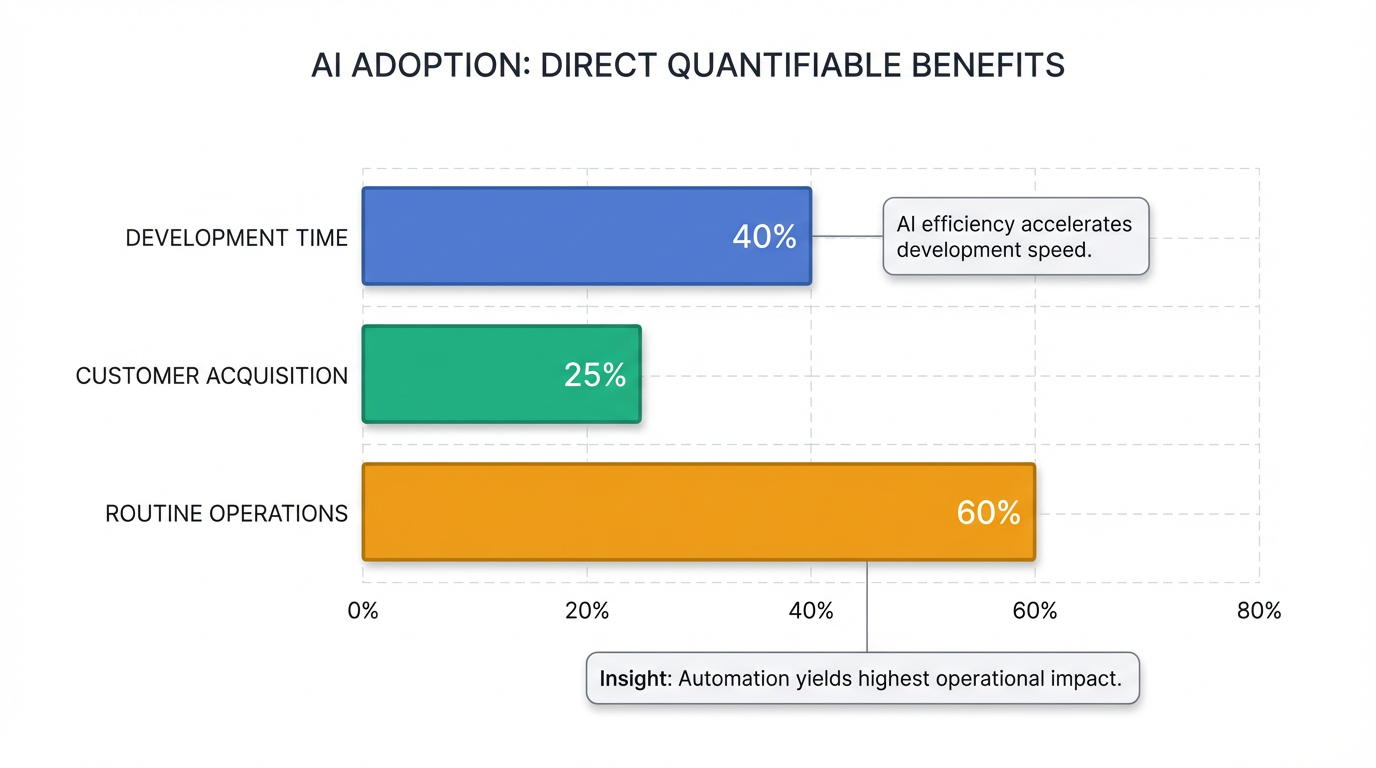
The quantifiable impacts are compelling and speak volumes about the transformative power of this technology. AI adoption can lead to a 40% reduction in development time and a 60% automation of routine operations within SaaS companies 5. Furthermore, AI-powered customer service chatbots alone can save companies around $300,000 annually by efficiently handling a large percentage of routine inquiries 9. The following figure illustrates the powerful efficiencies and strategic advantages gained by integrating artificial intelligence into SaaS products and their development.
Core Strategy: Navigating AI-Powered SaaS Development
For founders building in the dynamic SaaS landscape, mastering the integration of AI is no longer a luxury but a strategic imperative. This pivotal shift is redefining how software is built, delivered, and managed, pushing the boundaries of what's possible for SaaS products and their underlying development workflows 5. By embracing AI as a core component of their operational DNA, startups can unlock unprecedented levels of efficiency, foster innovation, and deliver hyper-personalized experiences that captivate users and drive growth. The future of SaaS belongs to those who strategically leverage AI across the entire product lifecycle, from ideation to deployment and beyond.
One fundamental strategy involves harnessing AI for hyper-efficient code generation and the automation of repetitive tasks, significantly accelerating the development pipeline. AI-powered coding assistants like GitHub Copilot, Cursor IDE, and Replit are transforming developers into superheroes by suggesting entire code blocks, functions, and even multi-file patterns 4. This automation of boilerplate code alone dramatically speeds up creation, with over 82% of developers now using AI to write code, often doubling their development speed 1. Furthermore, AI tools such as Lovable can generate complete full-stack web applications from simple prompts, pushing the boundaries of rapid prototyping and enabling indie hackers to launch products faster than ever before 11.
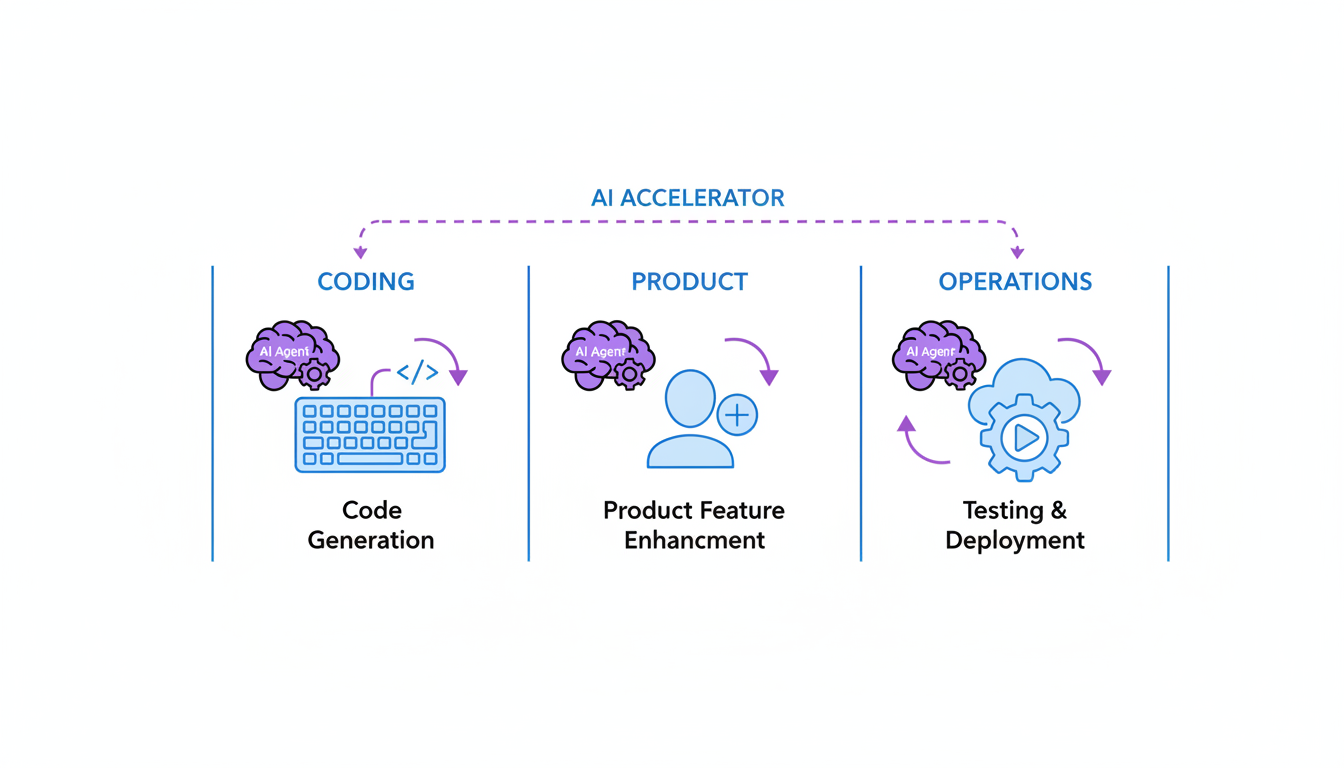
Beyond code, AI is also driving profound insights for product feature development and personalization, directly enhancing the user experience. Startups like PIMMS leverage AI to create intelligent deep links for seamless user journeys and provide real-time conversion analytics, solving critical marketing attribution challenges 5. For enterprises, Writerly AI generates brand-consistent marketing content at scale, while LegalMind AI automates legal drafting and compliance, demonstrating AI's power to tackle specialized business problems 3. Even in complex fields like customer service, AI-powered chatbots from Yellow.ai handle a significant volume of routine inquiries in over 135 languages, showing the potential for enhanced customer engagement and operational savings 9. These integrations enable SaaS products to be more intelligent, responsive, and tailored to individual user needs, creating a significant competitive advantage.
Finally, AI-enhanced testing, deployment, and operational efficiencies are revolutionizing how SaaS products maintain quality and perform at scale. Tools like CodeMate use generative AI to automatically review code, suggest optimizations, and even write unit tests, streamlining the deployment process and improving code quality 3. AI-powered testing solutions, such as those that generate unit and integration tests, learn user paths to perform comprehensive testing and detect vulnerabilities, which has led to startups like Leap CRM reducing their QA cycles by 43% 12. Moreover, AI observability platforms like Datadog AI Ops automate anomaly detection and root cause analysis in production, ensuring robust performance and stability 12. This strategic application of AI across the development lifecycle, from pre-commit to post-deploy, allows startups to move faster, deliver higher quality, and achieve substantial operational savings.
Real Example: The AI-Driven Edge in SaaS
When we talk about the tangible impact of AI on SaaS development, few examples are as compelling as Cursor, an AI-assisted Integrated Development Environment (IDE) from Anysphere. This startup has not only demonstrated how AI can dramatically accelerate coding but has also carved out an incredible growth trajectory by focusing on product-led adoption. It serves as a blueprint for indie hackers and entrepreneurs looking to leverage AI in their own ventures.
Cursor’s core functionality revolves around deeply integrating advanced AI models like GPT-4 and Claude directly into the developer's workflow. This isn't just about syntax highlighting or simple autocompletion; Cursor enables code editing, generation of entire functions, and sophisticated refactoring, significantly reducing manual effort 11. Its innovative "YOLO mode" even allows for autonomous iteration, pushing the boundaries of what a coding assistant can achieve and helping developers operate at an unprecedented speed 11.
The business impact of Cursor is nothing short of remarkable. The company achieved an astonishing $200 million in Annual Recurring Revenue (ARR) without building out a traditional enterprise sales team 7. This explosive growth was primarily driven by a robust product-led growth (PLG) strategy, where the product's intrinsic value and ease of use allowed it to sell itself, leading to rapid organic adoption within development teams 7. Anysphere, Cursor's parent company, further validated this demand by securing $100 million in contracts within just one year, signaling a clear shift in how software development is perceived and executed 13.
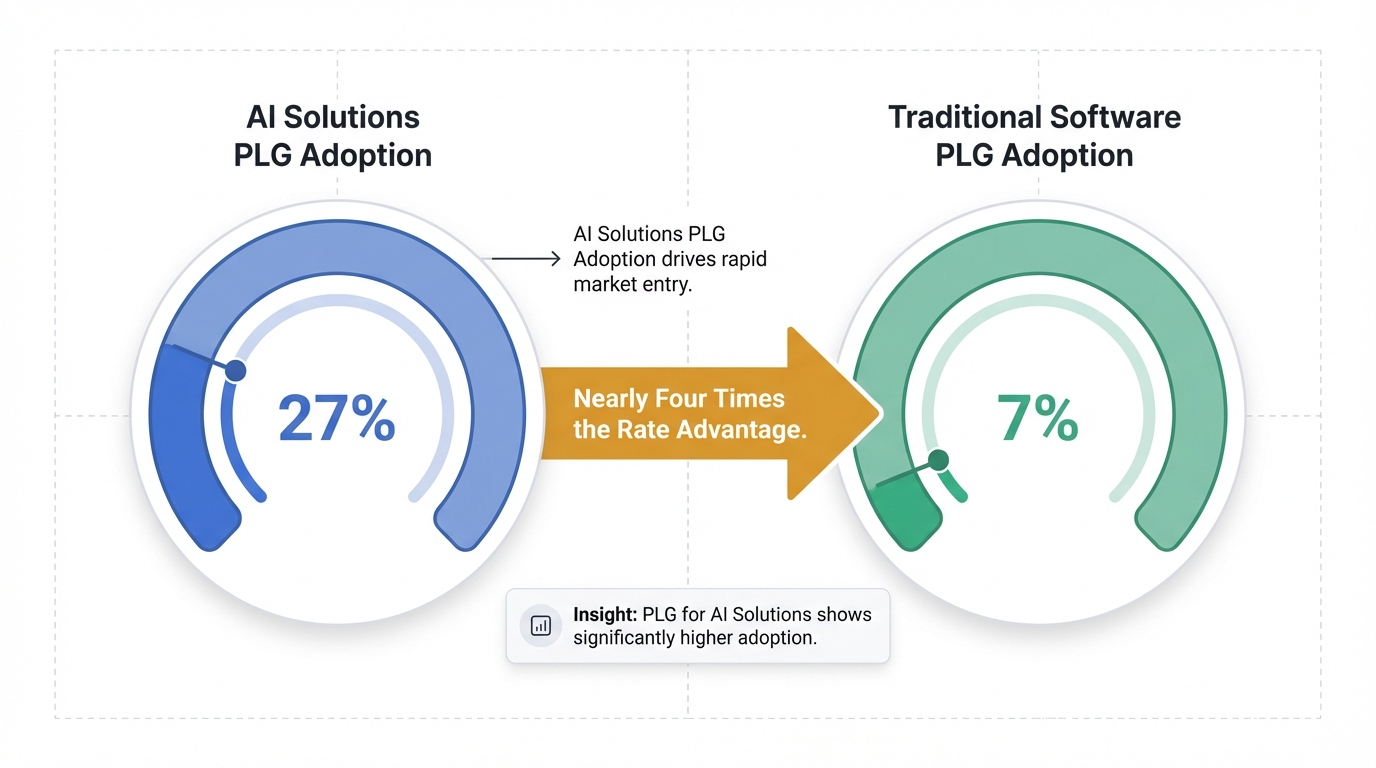
This success story underscores a broader trend: product-led growth for AI solutions is proving to be a powerhouse for market penetration. AI-driven products exhibit adoption rates nearly four times higher than traditional software offerings—27% compared to 7% 7. By building a tool so indispensable that developers naturally integrate it into their daily routines, Cursor navigated the typical hurdles of software adoption, proving that truly innovative AI can generate immense value and achieve rapid, widespread usage.
Build It Yourself: Practical AI Tools for Indie Hackers
Indie hackers today face the perennial challenge of maximizing output with minimal resources. AI development tools are now serving as force multipliers, empowering solo founders to accelerate their product development cycles significantly. These tools streamline everything from initial UI design to crucial user testing, transforming how lean startups operate and enabling them to compete effectively in a crowded market.
At the forefront of AI-powered UI generation is Vercel's v0, a platform that translates natural language prompts into fully responsive UI components using React and Tailwind CSS 14. This generative AI engine is adept at producing high-quality React UIs, often leveraging shadcn/ui components, and can even integrate with popular libraries like Material UI or framer-motion for complex animations 15. The workflow is straightforward: describe your desired UI, and v0 generates multiple options for you to refine through iterative prompts . This capability dramatically shortens the design-to-code loop, allowing indie hackers to quickly generate production-ready code and rapidly prototype ideas without extensive manual coding 14. While v0 excels at frontend, it traditionally requires separate tools for backend logic, authentication, or databases, though its output is clean and readable for integration into existing codebases 14.
Beyond generating interfaces, understanding user interaction is paramount, and this is where AI-first UX research tools like Maze become indispensable. Maze offers a comprehensive platform for validating designs and uncovering user insights quickly, integrating AI throughout the testing process 16. It supports both moderated and unmoderated studies, providing critical data through first-click tests, path flows, and heatmaps that highlight user behavior within a UI 16. Maze's AI moderator can even assist with interviews, suggest bias-aware questions, automate thematic analysis, and summarize findings, enabling small teams to conduct professional-grade UX research efficiently 16. This rapid feedback loop allows indie hackers to test AI-generated prototypes, such as those from v0 or design tools like Lovable, ensuring that product decisions are user-centric and data-driven from the outset 16. Lovable itself, a complementary AI-powered design tool, provides a visual builder with full-stack generation capabilities and the unique ability to edit generated code directly in the browser, perfect for designers wanting more control over their AI-assisted creations .
The synergy between these tools creates a powerful pipeline: ideate and generate UI with v0, visually refine and add backend logic with tools like Lovable if needed, then immediately validate the user experience using Maze . This iterative process, highlighted in the following diagram, dramatically accelerates development and validation, allowing for quicker product launches and more confident iterations.
The core benefit for indie hackers is unmatched iteration speed and cost-effectiveness, as many AI tools offer affordable plans or free tiers . However, effective prompt engineering demands a learning curve, and while powerful, AI-generated outputs might sometimes lack the nuanced control required for highly complex, bespoke interactions . Nonetheless, mastering these AI tools equips indie hackers with the leverage to ship products faster and with greater confidence.
Next Steps: Your AI-Powered SaaS Blueprint
The narrative is clear: AI isn't just optimizing existing SaaS; it's fundamentally reshaping product capabilities and development paradigms for indie hackers and entrepreneurs. We've seen how AI integration either as a core feature or a workflow enhancer drives unprecedented efficiency, automation, and superior user experiences 5. Startups are leading this charge, outpacing incumbents by leveraging agility and product-led growth to capture a significant market share 7. The measurable impacts, from reduced development times to increased productivity, underscore AI's pivotal role in achieving competitive differentiation and rapid growth 5.
For indie hackers and AI entrepreneurs ready to seize this opportunity, a strategic approach is paramount. First, focus on solving specific, high-friction problems within a niche, similar to how PIMMS tackles marketing attribution or LegalMind AI streamlines legal drafting 5. Instead of broad solutions, concentrate on an area where AI can deliver a 10x improvement, creating undeniable value for early adopters. Second, deeply embed AI within your product or development stack rather than treating it as an add-on. Whether it's using AI coding assistants like Cursor to accelerate development or leveraging generative AI for core content creation, true competitive advantage comes from making AI intrinsic to your offering 11.
Third, embrace product-led growth (PLG) by building solutions that demonstrate immediate, tangible value without heavy sales intervention. The success of Cursor, achieving $200 million ARR primarily through PLG, illustrates how a superior user experience driven by AI can drive rapid adoption 7. This approach allows users to experience the "magic" of your AI, fostering organic growth and strong retention. Fourth, prioritize experimentation and continuous learning within this rapidly evolving landscape. The speed at which new models and applications emerge demands constant adaptation and a willingness to iterate, ensuring your solutions remain cutting-edge and relevant to market needs.
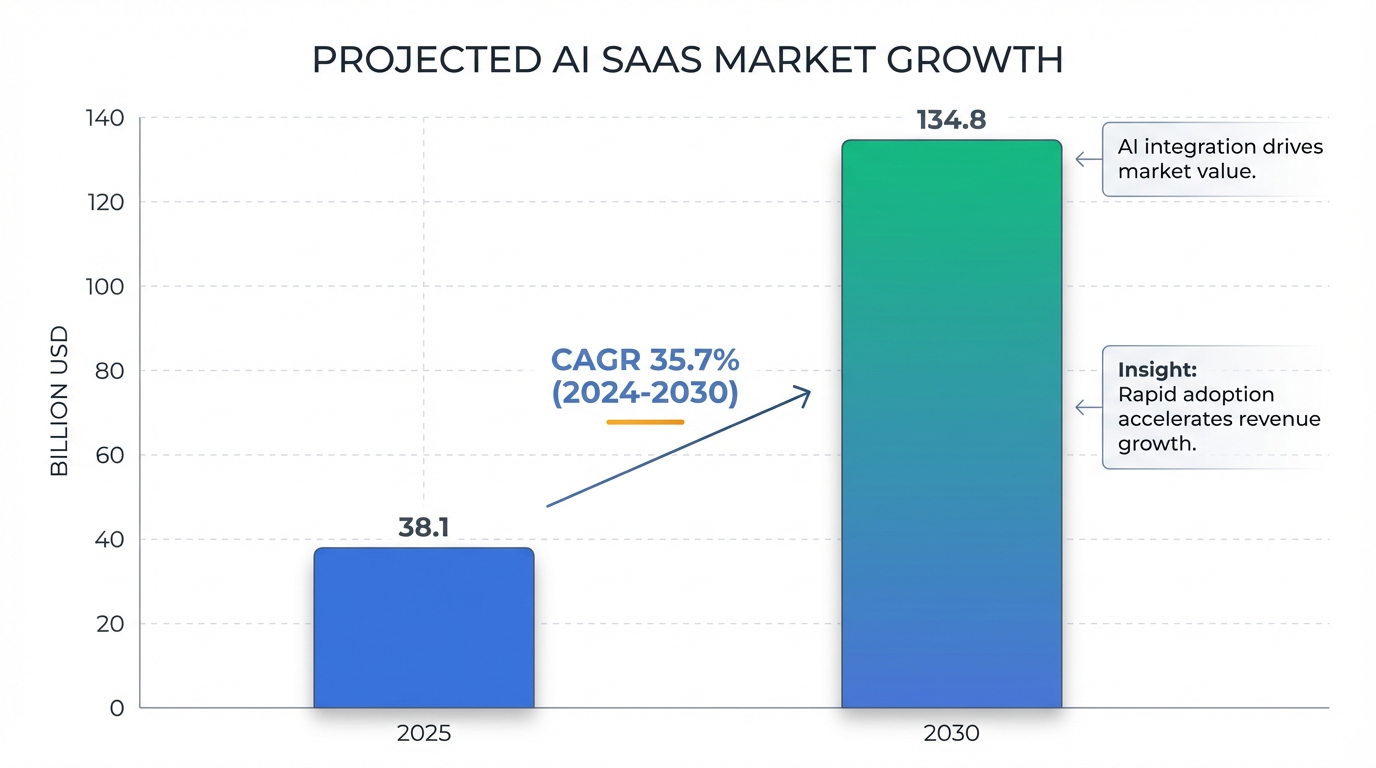
The future outlook for AI in SaaS is nothing short of transformative, with the market projected to reach $134.8 billion by 2030, growing at an impressive 35.7% CAGR 17. Startups are expected to further cement their dominance, driving innovation with industry-specific AI tools, multimodal applications, and increasingly autonomous agents capable of "work automation" 3. However, with this power comes responsibility; acknowledging potential challenges like ethical considerations, data privacy, and the critical need for human oversight and "expert-in-the-loop" systems will be essential for sustainable growth 11. Ultimately, those who strategically integrate AI now, fostering a culture of innovation and responsible development, are best positioned to lead this new era of intelligent SaaS.