The Impact of AI on Developer Productivity and Customer Acquisition
Introduction
The landscape of software development is undergoing a dramatic transformation, powered by an explosion of AI tools. Last year, we saw indie hackers go from concept to live product in mere days, leveraging AI assistants to write code, debug issues, and even generate marketing copy. This unprecedented acceleration has redefined what's possible for solo founders and small teams, fundamentally altering the trajectory of AI on developer productivity and customer acquisition for entrepreneurs.
The promise of AI to supercharge developer output has certainly materialized. Modern AI development tools, such as code generators, real-time code suggestion assistants, automated testing platforms, and advanced context engineering agents, have become integral to many developers' workflows . By 2025, an estimated 90% of software professionals are integrating AI into their workflows, with 80% reporting higher productivity and 59% noting better code quality 1. For the indie hacker, this should theoretically accelerate product development, allowing for faster iterations and quicker market entry.
However, despite these impressive gains in developer productivity, a puzzling paradox has emerged in the world of independent entrepreneurs and AI startups: enhanced development speed often does not directly translate into customer acquisition or market success. Many indie hackers find themselves as 10x developers who still struggle to acquire a single customer, encountering a complex challenge in converting technical efficiency into business outcomes . This disconnect between rapid development and market traction is a critical hurdle for many.
For indie hackers and AI entrepreneurs, navigating this disconnect is not just an academic exercise—it's critical for survival in an increasingly competitive and AI-saturated market. Building faster only matters if you're building the right thing for the right people, and if you can effectively reach them. This report will investigate how AI tools enhance developer productivity and then delve into the reasons why these technical gains do not always convert into customer growth. More importantly, it will outline actionable strategies to bridge this gap, helping indie hackers and AI entrepreneurs translate their AI-powered efficiency into tangible business success.
Core Strategy: Bridging the Productivity-Acquisition Gap
For indie hackers and AI entrepreneurs, the challenge isn't merely to build faster, but to ensure that speed translates into sustainable customer growth and market traction. The productivity gains from AI tools, while impressive, often fall short of delivering business success if not channeled through a deliberate strategy. Bridging this disconnect requires moving beyond a purely technical mindset to embrace market realities, community engagement, and strategic business models. It’s about leveraging efficiency to unlock true value for users.
Focus on Niche Problem Solving and Community Engagement
The first step in converting rapid development into customer acquisition is to keenly focus on solving specific, painful problems for a well-defined niche audience. Rather than chasing broad markets, indie hackers can use their AI-accelerated development cycle to quickly prototype and test solutions within targeted communities. Platforms like Reddit, developer forums, and specialized Slack or Discord groups offer fertile ground for identifying needs, gathering early feedback, and finding initial users . An indie hacker successfully grew "Evercopy," an AI marketing tool, by 30% month-over-month, largely through targeted engagement on Reddit, developer forums, and local events, directly addressing a pain point they themselves experienced 2. This approach ensures that rapid development is guided by genuine market demand, minimizing the risk of building features no one needs.
Embrace Product-Led Growth (PLG) and Transparency
In a competitive market, a product's inherent value and ease of adoption are paramount for customer acquisition. Product-Led Growth (PLG) strategies, which prioritize immediate user value and seamless onboarding, can be highly effective for AI-driven tools. Offering a quick "5-minute test" or benchmarking tools allows developers to instantly grasp the product's benefits, fostering organic adoption 3. Furthermore, transparency about an AI tool's capabilities and limitations builds crucial trust, especially among skeptical developers. Being open about performance benchmarks or even open-sourcing parts of the product can differentiate offerings and establish credibility in a landscape where AI "confabulation" and brittleness are real concerns . This authenticity, combined with a product that delivers tangible results, encourages long-term engagement and word-of-mouth growth.
Adopt Strategic Business Models (Micro-SaaS & Flipping)
Sometimes, the most direct path to financial success isn't through traditional, long-term customer acquisition, but through strategic, shorter-cycle business models. The rise of AI tools has lowered the barrier to entry for building niche Micro-SaaS applications, which can then be sold or "flipped." Indie hackers like Santiago Poli have found success by rapidly developing and selling multiple AI micro-SaaS products, leveraging no-code tools and platforms like Acquire.com 4. This model allows founders to quickly validate ideas, build functional products to fill specific needs, and realize value through an exit, demonstrating that rapid development can lead to financial outcomes even without sustained, traditional customer growth 4. This approach transforms the productivity gains into a tangible asset for acquisition by other businesses, offering a viable alternative to scaling a product for individual customers indefinitely.
Real Example: The ClarifyPDF Journey
Moving from theoretical strategies to a tangible example, the journey of ClarifyPDF, an AI-powered SaaS application by indie hacker Farez Rahman, perfectly illustrates the complex interplay between AI-driven productivity and real-world customer acquisition challenges. Rahman, a seasoned web developer with two decades of experience, launched ClarifyPDF in early 2025, driven by a desire to upskill in AI and capitalize on the burgeoning AI market, confessing a touch of FOMO (fear of missing out) 5. His story highlights how AI tools dramatically amplified his development capabilities but didn't automatically translate into market success.
Despite having no prior practical AI development experience, Rahman leveraged various AI tools to bring ClarifyPDF, designed to allow users to "chat with your PDF," to life rapidly 5. The OpenAI API formed the core of the application's AI chat functionality, while he extensively learned and applied prompt engineering techniques 5. Embeddings were crucial for enabling the AI to understand and process document content for conversational queries, showcasing how powerful APIs can democratize advanced AI capabilities for solo developers 5. Rahman focused on speed to market, utilizing familiar technologies like Laravel, PHP, and Tailwind, proving that existing skill sets combined with AI tools can achieve significant functionality without a large team 5.
However, this impressive development velocity didn't shield ClarifyPDF from significant customer acquisition hurdles. Rahman openly admits launching "without a problem to solve, without a customer segment to serve, and without even a need for it myself," revealing a critical lack of market validation 5. The initial pricing strategy was also deeply flawed; at $4.99 per PDF, it was deemed "insanely expensive" compared to competitors offering similar services for free 5. Further compounding these issues were insufficient marketing efforts, a "side project" mentality that limited dedicated growth focus, and a loss of momentum from discontinuing "building in public" after the initial launch 5. Technical glitches, like integration issues with the payment processor, also consumed valuable time 5. These challenges underscore that even with a 10x development speed granted by AI, market alignment and engagement remain paramount.
To bridge this disconnect, Rahman implemented several critical strategies. He adopted an iterative pricing approach, reducing the initial $4.99 per PDF to $1.99, and then further to $0.99 5. This adjustment proved impactful: when the price was halved from $1.99 to $0.99, the number of purchases doubled, maintaining total revenue while significantly expanding the customer base and, crucially, gathering more feedback 5. He also pursued a multi-channel launch, posting on his Twitter, Hacker News, and Indie Hackers, which helped ClarifyPDF gain visibility on larger listing sites like "There's An AI For That," becoming the biggest traffic source 5. Integrating a Crisp.io chatbox from day one also ensured a direct customer feedback loop 5.
These efforts, while yielding valuable lessons, demonstrated a gradual but challenging climb in early traction.
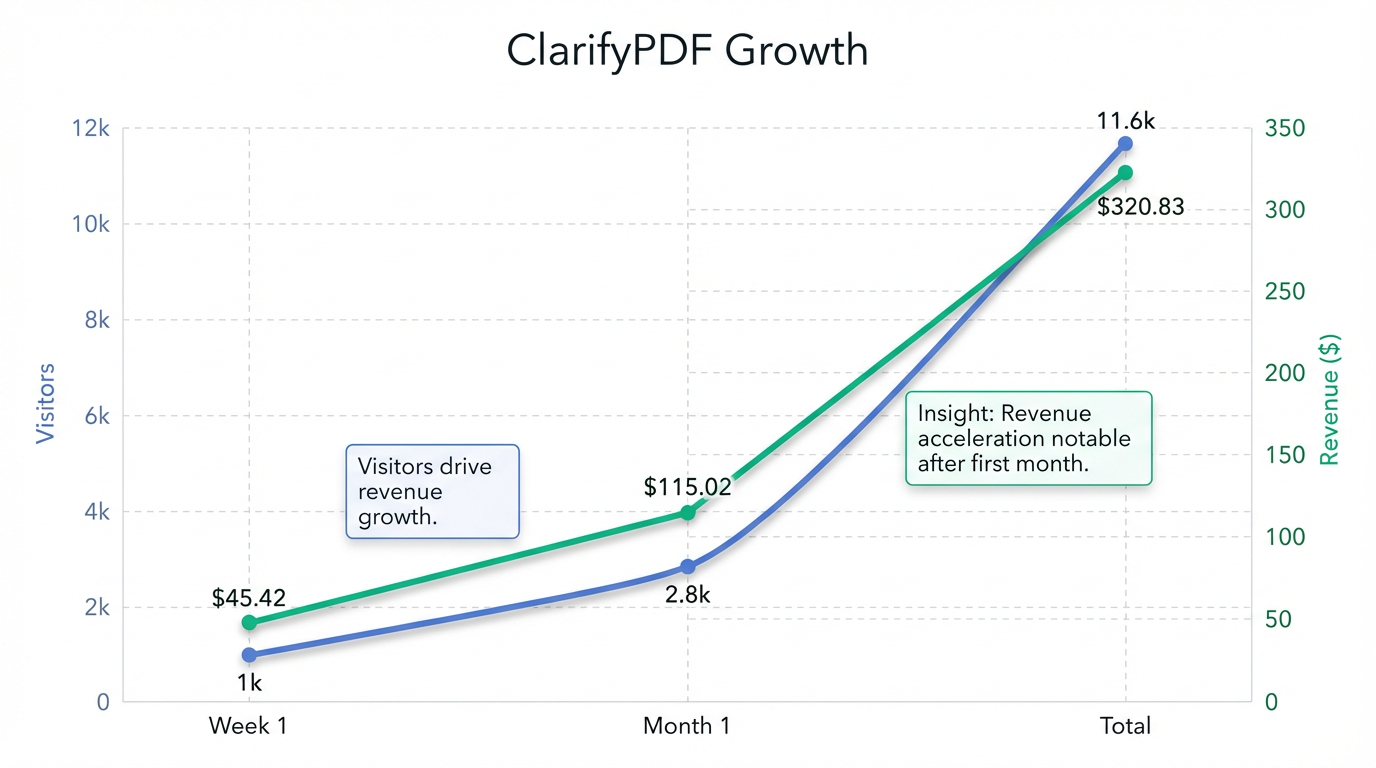
In its first week, ClarifyPDF attracted 1,000 visitors and generated $45.42 in revenue 5. By the end of the first month, these numbers grew to 2,800 visitors and $115.02 in revenue 5. Approximately three months post-launch, the cumulative totals stood at 11,600 visitors and $320.83 in revenue 5. While these figures might not represent a "big" indie AI app success, Rahman emphasized the invaluable learning experiences gained, from the importance of early market entry and continuous learning to the necessity of strong marketing and engaging with users from day one 5. His journey exemplifies that AI amplifies capability, but success still hinges on understanding and serving the market effectively.
Build It Yourself: Leveraging AI Beyond Code
AI tools empower indie hackers and AI entrepreneurs to build smarter, moving beyond just faster coding. They offer strategic advantages in market research, customer feedback, and rapid UI/UX prototyping, directly addressing the crucial challenge of bridging developer productivity with customer acquisition. This shift allows founders to validate market fit and accelerate growth more effectively.
Before writing a single line of production code, founders can leverage Lovable to gauge user sentiment and validate ideas. This "product love engine" embeds lightweight feedback widgets into apps or prototypes to collect real-time reactions and visualize insights through sentiment dashboards and trend graphs 6. Such tools identify trending user wishes and emotional responses, significantly reducing feature build waste. For instance, an indie hacker successfully validated market demand for his product using Lovable before coding, launching and earning revenue in just four days 7.
Once an idea gains early traction, v0, developed by Vercel, becomes invaluable for rapid UI generation. It transforms natural language prompts or visual inputs into high-quality, production-ready frontend code, generating functional UIs in hours . This empowers product teams and non-engineers to quickly generate custom marketing pages, landing pages, or entire application structures, allowing for rapid iteration and stakeholder alignment without extensive engineering resources .
The v0-generated code can then be brought into Cursor for refinement and the integration of complex functionality. As an AI-powered code editor, Cursor facilitates "Vibe Coding," blurring the lines between design and development. Its visual editor allows direct manipulation of components, with an AI agent updating the underlying code, and tools like the Fusion extension provide visual editing of AI-generated elements . This continuous feedback loop ensures a deeper understanding of design constraints and faster iteration on dynamic prototypes .
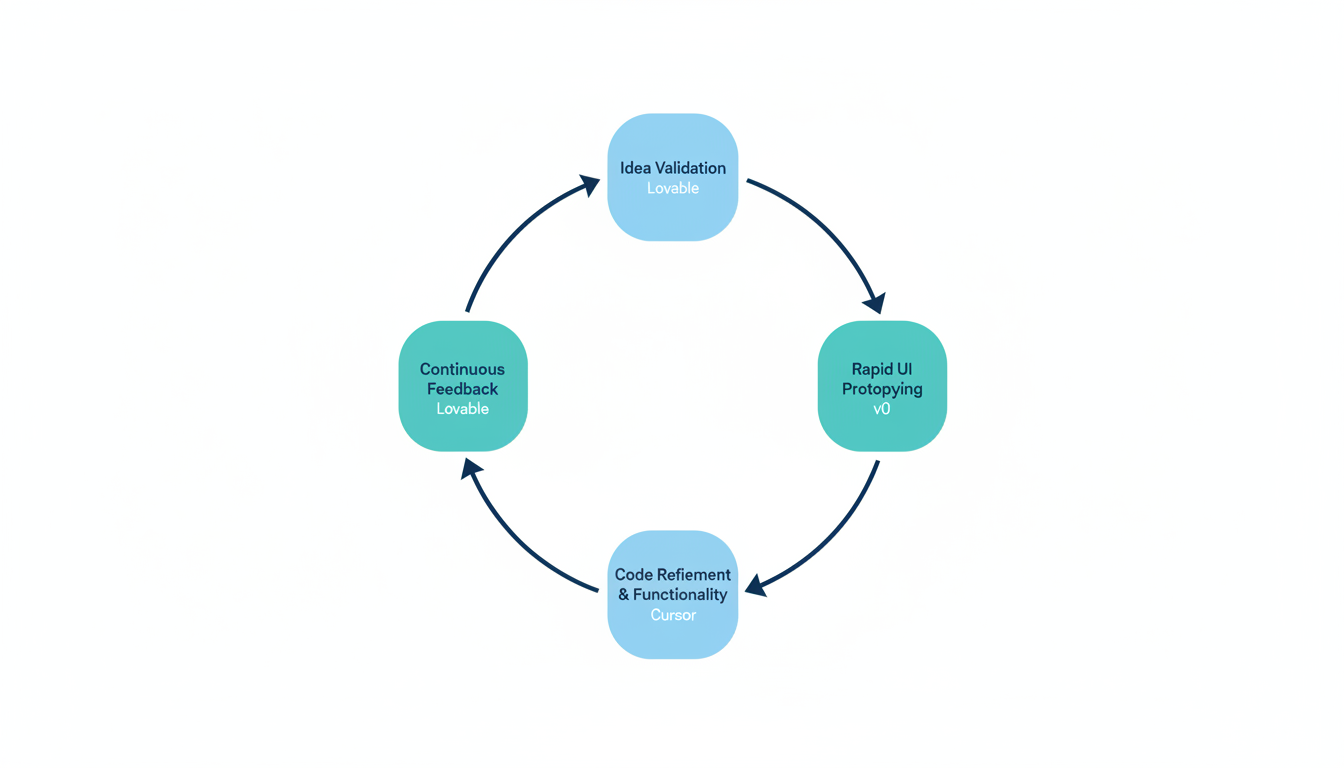
The true power emerges from integrating these tools into a seamless workflow. Indie hackers can start with Lovable for initial idea validation and feedback , then use v0 to quickly spin up an initial UI for a landing page or MVP . This code is then refined in Cursor, where complex functionality is added and quality improved with AI assistance . Finally, Lovable is continuously employed to gather ongoing user feedback, enabling continuous refinement, accelerated customer acquisition, and critical market fit . This holistic approach ensures every development effort is rooted in real user data.
Next Steps: Converting AI Productivity into Business Growth
The journey from enhanced developer productivity to tangible customer acquisition for indie hackers is not a straight line, but a complex interplay of technology, strategy, and market understanding. While AI tools offer unprecedented speed and efficiency in development, true success lies in converting these technical gains into business growth by strategically addressing market needs and user trust. For indie hackers and AI entrepreneurs looking to bridge this gap, a multi-faceted approach focusing on validation, agile iteration, quality control, and business acumen is essential.
First, prioritize market validation with AI-powered insights before extensive development. Instead of falling into the "build a feature, not a company" trap, leverage tools like Lovable to collect early user feedback and validate demand for your ideas. This approach, exemplified by MP who launched a product in just four days after validating demand, drastically reduces the risk of building something nobody wants 7. Rapid prototyping tools like v0 allow you to quickly create functional UIs from natural language, enabling you to test market ideas and gather real user feedback faster, improving market fit before a significant time investment .
Second, embrace rapid, AI-driven prototyping and continuous iteration to refine your product. The integrated workflow described earlier—using Lovable for initial feedback, v0 for rapid UI generation, and Cursor for refinement and functionality—creates a powerful loop for moving from concept to validated product quickly . This iterative process, continuously informed by real user data, ensures that your product evolves in direct response to market demands, accelerating customer acquisition. By accelerating the prototyping phase, Cursor enables indie hackers to rapidly build and test different UI/UX flows based on early market feedback, directly contributing to validating market fit by getting functional prototypes in front of users faster .
Third, implement strategic AI oversight to maintain quality and resilience. While AI significantly speeds up code generation, it can introduce bugs, security vulnerabilities, and technical debt . The "brittleness" of AI agents and their tendency to "confabulate" necessitate human intervention and validation, particularly for high-stakes tasks 8. For small teams, this means integrating quality control mechanisms, whether through manual review, automated testing, or using AI to "write tests first, then the code" as suggested for Cursor workflows 9. This vigilance builds trust, prevents rework, and safeguards your product's reputation, which is critical for long-term customer retention.
Finally, focus on comprehensive distribution and fundamental business strategies beyond just coding. Indie hackers often excel technically but struggle with marketing, sales, and understanding customer needs 2. Rapid development, while impressive, does not guarantee that a product will cut through a "crowded and noisy" market 10. Leverage niche platforms, content marketing, and affiliate programs as acquisition channels . Furthermore, be wary of the "wrapper startup" trap, where reliance on a larger AI model can lead to vulnerability if the underlying provider updates its features 11. Building a unique value proposition and a robust, stand-alone product foundation is paramount for sustainable customer growth and avoiding feature obsolescence.