The OpenClaw Project: An In-depth Analysis of its Popularity, Features, and Future Outlook
Introduction to OpenClaw
OpenClaw is an open-source, self-hosted artificial intelligence (AI) agent designed to function as a proactive, intelligent personal assistant directly on a user's machine 1. Initially launched as "Clawdbot," and briefly renamed "Moltbot," it ultimately adopted "OpenClaw" to highlight its open-source nature and adaptive capabilities 2.
A defining characteristic of OpenClaw is its messaging-first interaction paradigm. It primarily operates through widely used chat applications such as WhatsApp, Telegram, Discord, Slack, iMessage, and Signal 2. This approach transforms everyday natural language communication into a powerful command layer for automation, allowing users to interact with the AI assistant seamlessly within their existing workflows 1.
OpenClaw distinguishes itself through several core functionalities. It employs a local-first execution model, enabling self-hosting on a user's own hardware—like a local computer, VPS, Mac Mini, or Raspberry Pi 3. This architecture prioritizes data privacy and user control, as data remains on the user's infrastructure rather than being transferred to external servers 4. Furthermore, OpenClaw boasts real task execution capabilities, interpreting natural language instructions to perform a wide range of actions directly on the user's system. These actions can include executing terminal commands, running scripts, browsing the web, managing files, controlling browsers, handling emails, scheduling meetings, and even interacting with smart home devices 5. Unlike traditional chatbots, OpenClaw operates proactively and autonomously, continuously running in the background to initiate tasks, send reminders, suggest improvements, and follow up on ongoing work without constant explicit input 4.
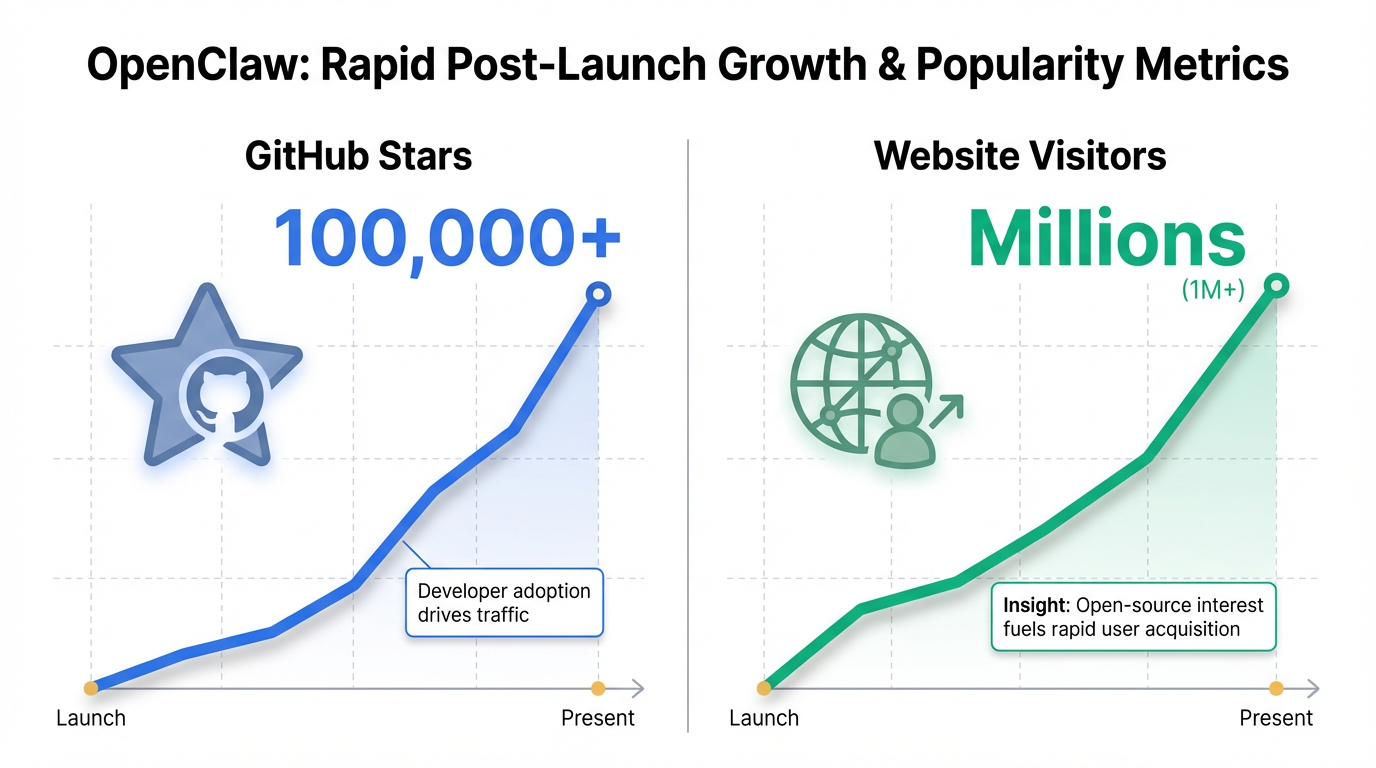
The project quickly gained significant traction following its launch, accumulating over 100,000 GitHub stars and attracting millions of website visitors within weeks, underscoring its rapid popularity and strong community interest 2.
What is OpenClaw? Core Features and Functionality
OpenClaw is an open-source, self-hosted AI agent designed to function as a proactive and intelligent personal assistant directly on a user's machine 1. Initially known as "Clawdbot" and briefly "Moltbot," the project was rebranded "OpenClaw" to highlight its open-source nature and adaptability 2. It quickly gained significant community traction, accumulating over 100,000 GitHub stars and millions of visitors within weeks of its launch 2.
Core Features and Functionalities
OpenClaw's design incorporates several key features that enable its advanced capabilities:
- Messaging-First Interaction: It primarily operates through widely used chat applications such as WhatsApp, Telegram, Discord, Slack, iMessage, and Signal 2. This approach allows users to interact with OpenClaw using natural language, effectively turning everyday chat into a powerful command layer for automation 1.
- Proactive and Autonomous Operation: Unlike traditional, reactive chatbots, OpenClaw runs continuously in the background. It proactively initiates tasks, sends reminders, suggests improvements, and follows up on ongoing work without requiring constant user input. The agent can also make decisions based on contextual understanding and task priority 4.
- Local-First Execution and Data Privacy: OpenClaw is designed for self-hosting on the user's own hardware, such as a local computer, VPS, Mac Mini, or Raspberry Pi 3. This architecture ensures users maintain direct control over their data and cryptographic keys, prioritizing privacy and flexibility by keeping data on local infrastructure rather than external cloud servers 4.
- Persistent Memory and Context Awareness: The agent maintains a long-term memory, enabling it to recall past instructions, user preferences, and relevant background information across conversations 1. This reduces repetitive inputs and contributes to more accurate and consistent task outcomes 1.
- Real Task Execution Capabilities: OpenClaw can interpret natural language instructions and execute a broad spectrum of actions directly on the user's system 5. These capabilities include running terminal commands and scripts, browsing the web, reading and writing files, controlling web browsers, managing emails, scheduling meetings, updating calendars, and interacting with smart home devices 5.
- Model Agnosticism: The platform is flexible, supporting various large language models (LLMs). Users can configure it to utilize providers like Anthropic's Claude, OpenAI's ChatGPT, Google Gemini, or even local LLMs 1.
- Extensibility (Skills): OpenClaw features a robust skill system that allows users to create or download instruction files defining how the assistant interacts with networks and performs specific tasks. A community-driven marketplace known as ClawHub facilitates the sharing and discovery of these skills 2.
Problem Solving and Operational Purpose
OpenClaw addresses several common pain points in productivity and automation 4:
- Fragmented Automation: It centralizes automation across diverse applications and services, such as messaging platforms, calendar tools, and email clients, reducing context switching 4.
- Rigid Workflows: Unlike traditional automation platforms that demand pre-defined, step-by-step workflows, OpenClaw uses natural language for task comprehension and execution, simplifying setup and operation 4.
- Lack of Proactivity: The agent mitigates the reactive nature of many automation tools by proactively providing reminders, suggesting actions, and following up on tasks without explicit triggers 4.
- Data Privacy Concerns: Through its self-hosting capability, OpenClaw empowers users to retain control over their data, a critical advantage over many cloud-based AI services 4.
Architectural Components
OpenClaw utilizes a Gateway-centric architecture for its operations 6:
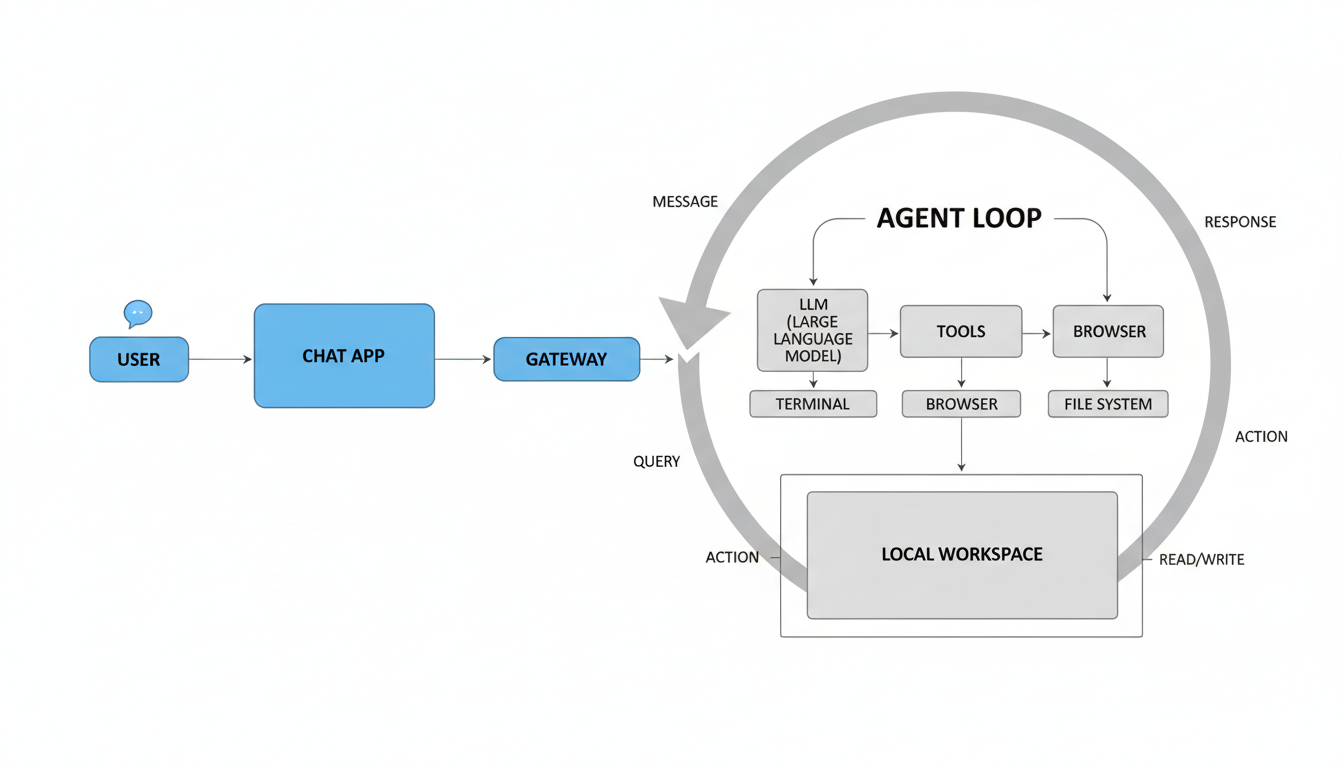
- The Gateway: This core process manages all channel connections (e.g., WhatsApp, Telegram) through a WebSocket control plane 6. It handles session management, message routing, hosts a Control UI/Dashboard, and coordinates agent communication 6. Typically, the Gateway runs on
ws://127.0.0.1:18789(localhost) but can be securely accessed remotely via methods like SSH tunnels or Tailscale 6. - Agent Loop: Upon receiving a message, it is routed to the appropriate session 6. The agent then loads relevant context, memories, and tools, formulating a request for the selected LLM 6. After the LLM processes the request, the agent executes necessary tools (e.g., browser, file system), streams the response back to the communication channel, and updates its memory 6.
- Session Model: OpenClaw supports various session types, including main, group, and isolated sessions 6. These offer features such as different activation modes, queueing mechanisms, and isolation options like Docker sandboxes 6.
- Workspace Structure: All configurations, credentials, prompt files, skills, memory files, and session history are stored as files and folders within a local workspace, typically
~/clawd6. This file-based approach facilitates direct editing, version control, and straightforward backup procedures 6. - Multi-Agent Routing: Messages can be routed to different specialized agents based on factors like the communication channel, user account, peer, or group 6. Each specialized agent maintains its own context, skills, and configurations 6.
Drivers of Popularity: Why OpenClaw is Trending
OpenClaw's rapid ascent to popularity can be attributed to a confluence of innovative features and its ability to address long-standing frustrations with existing AI and automation tools. It quickly distinguished itself as a powerful, open-source, and user-centric solution for personal machine automation.
Proactive and Agentic AI Capabilities
OpenClaw belongs to a new generation of "agentic" AI systems that go beyond mere responsiveness. Unlike traditional chatbots that simply respond to prompts, OpenClaw is designed to be proactive and autonomous, running continuously in the background to initiate tasks, send reminders, and suggest improvements without constant user input . It can make decisions based on context and task priority, effectively mimicking a true digital employee . This "AI that actually does things" approach fulfills a long-desired capability, as many felt traditional AI assistants (like Siri) lacked the ability to perform real, tangible actions on their behalf . Its ability to interpret natural language instructions allows it to combine multiple actions into complex, multi-staged tasks, moving beyond rigid, manually built workflows .
Local-First, Open-Source, and Data Control
A fundamental driver of OpenClaw's appeal is its self-hosted, local-first architecture . Users install OpenClaw on their own hardware, such as a local computer, VPS, Mac Mini, or Raspberry Pi, thereby maintaining full control over their keys and data . This design choice prioritizes privacy and flexibility, ensuring that sensitive data remains on the user's infrastructure rather than external cloud servers, a significant concern in an era of increasing data privacy awareness . Furthermore, its open-source nature fosters transparency, allows users to inspect and customize its behavior, and encourages rapid community contributions, including the development of plugins and skills . The project's ethos, encapsulated by "Your assistant. Your machine. Your rules" 3, strongly resonates with a technically-savvy audience.
Deep System Integration and Versatility
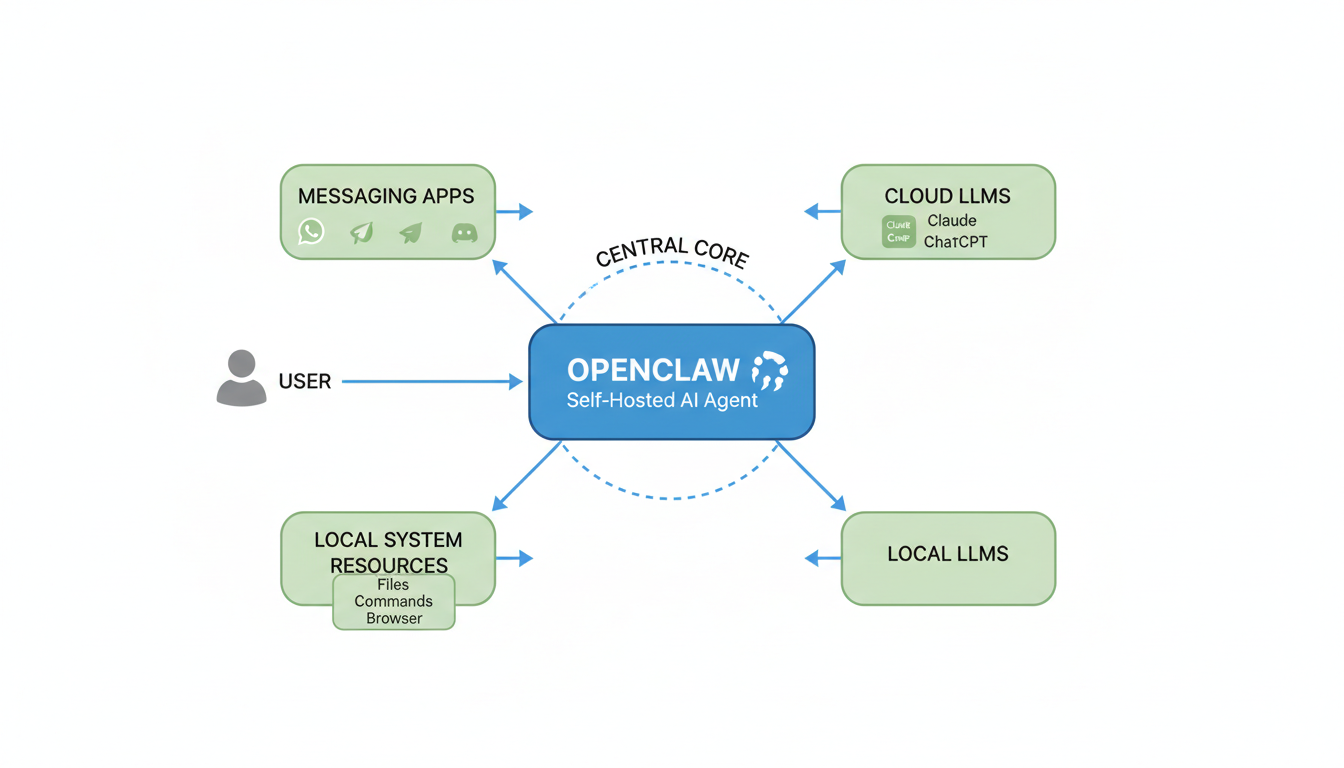
OpenClaw offers deep system integration, providing full access to a user's machine. It can interpret natural language instructions to carry out a wide array of actions, including executing terminal commands, running scripts, browsing the web, reading and writing files, controlling browsers, managing emails, and interacting with smart home devices . Its versatility is enhanced by its messaging-first interaction model, operating through popular chat applications like WhatsApp, Telegram, Discord, Slack, iMessage, and Signal . This enables users to control their digital life from virtually any device through familiar interfaces . OpenClaw is also model-agnostic, supporting various large language models (LLMs) from providers like Anthropic (Claude), OpenAI (ChatGPT), Google (Gemini), and even local LLMs, offering users flexibility in their AI backend choice .
Persistent Memory and Context Awareness
Unlike many traditional chatbots that reset context after each interaction, OpenClaw maintains persistent, long-term memory. It recalls past instructions, user preferences, and relevant background across conversations, significantly reducing repetition and leading to more accurate and consistent outcomes . This memory is stored in human-readable markdown files, such as SOUL.md, USER.md, and MEMORY.md, which allows for deep personalization and even manual tweaking of its "personality" and knowledge base .
Viral Growth and Community Buzz
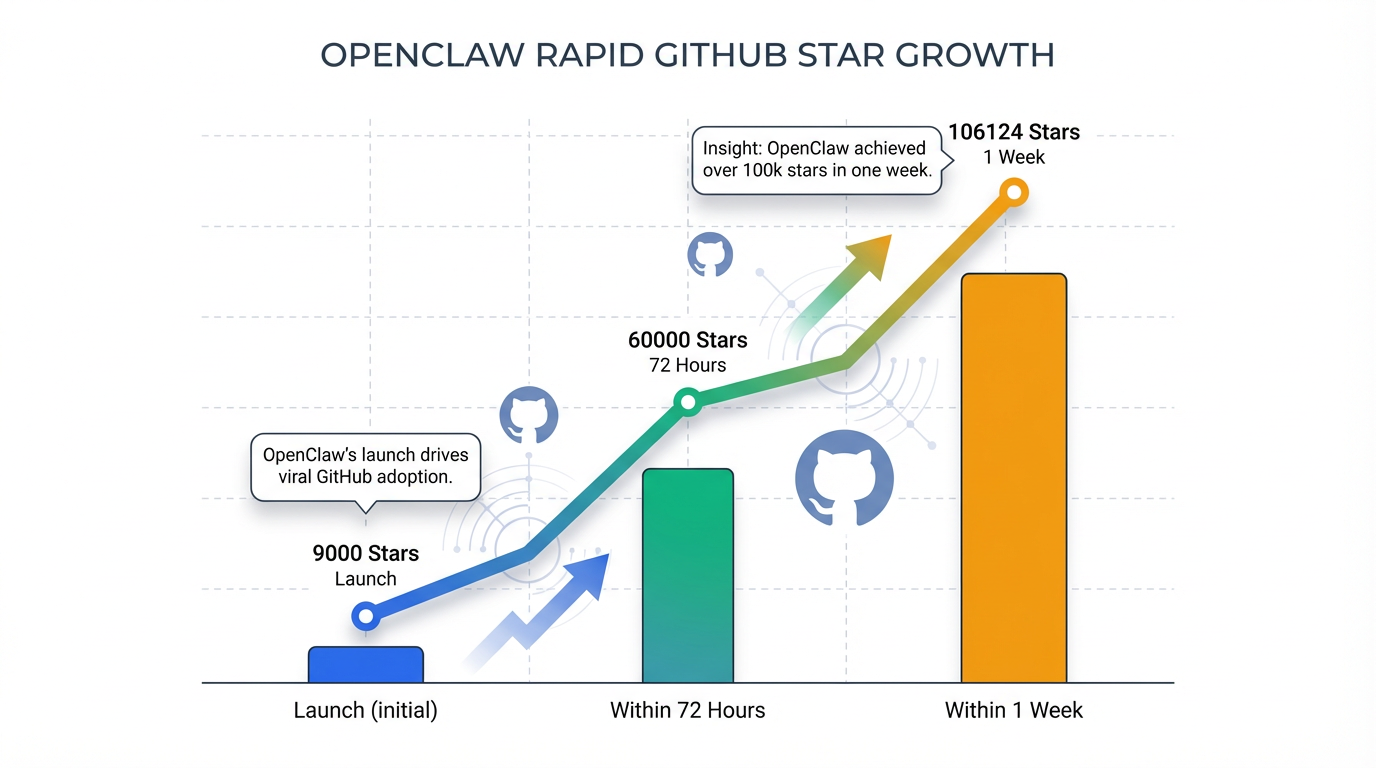
OpenClaw experienced unprecedented viral growth and community excitement following its launch. The project quickly garnered over 100,000 GitHub stars within weeks, attracting millions of visitors to its website . Notably, it rocketed from 9,000 to over 60,000 GitHub stars in just 72 hours, and within a week surpassed 100,000 stars while drawing 2 million visitors . It achieved over 16,000 stars in a single day, placing it among the top 100 most-starred GitHub repositories and making it one of the fastest projects to reach the 100,000-star milestone 7. This rapid accumulation of support was fueled by enthusiastic media coverage and developer communities, with many developers calling it the closest thing to JARVIS . The reputation of its creator, Peter Steinberger, known for his successful previous venture PSPDFkit, also likely contributed to early trust and adoption .
Addressing Key Productivity Pain Points
OpenClaw's popularity also stems from its effective solution to several common productivity challenges:
- Fragmented Automation: By operating across multiple messaging platforms, calendar tools, and email clients, it centralizes access and reduces the need to switch between different applications .
- Rigid Workflows: Unlike traditional automation platforms such as n8n or Zapier, which demand predefined, step-by-step workflows, OpenClaw leverages natural language to understand and perform tasks, simplifying setup and operation .
- Lack of Proactivity: It overcomes the reactive nature of many existing automation tools by proactively sending reminders, suggesting actions, and following up on ongoing tasks without requiring explicit triggers .
- Data Privacy Concerns: Its self-hosting capability empowers users to maintain control over their data, directly addressing a significant concern with cloud-based AI services .
Impact and Applications
OpenClaw emerges as a proactive, intelligent personal assistant, fundamentally reshaping how users interact with their digital environments by understanding and interpreting instructions to automate tasks across diverse platforms and applications 4. It consolidates access to various tools, such as messaging platforms, calendars, and email clients, significantly boosting productivity by eliminating the need to constantly switch between different contexts 4. Unlike traditional automation methods, OpenClaw leverages natural language processing, context awareness, and task prioritization to execute complex, multi-staged tasks and even learn from previous attempts 4. It serves as a comprehensive "company assistant, family assistant, [and] team tool," initiating tasks, reminders, and background operations proactively 8.
The practical applications of OpenClaw span a wide array of personal and professional domains:
Personal Productivity and Assistance
OpenClaw excels at enhancing daily organization and management. It facilitates task management by handling schedules, setting reminders, prioritizing tasks, and managing to-do lists across various platforms like Apple Notes, Things 3, Notion, Obsidian, and Trello 9. For email management, OpenClaw can read, draft, send, clear inboxes, and summarize threads, significantly speeding up triage 8. It can also generate personalized weekly briefings from services like Gmail and Google Calendar, highlighting key meetings and emails 10. Beyond organization, OpenClaw supports general information and planning, providing daily market briefings, generating ideas, assisting with travel, and even creating custom meditations 11. In health and finance, it connects to wearables like Whoop for fitness summaries, tracks personal metrics, and automates investment monitoring and stock checks 9.
Developer and Technical Workflows
For developers, OpenClaw offers robust automation capabilities. It can manage codebases, automate debugging, integrate with GitHub for scheduled tasks, and perform remote bug reviews and pull request merges 9. Developers utilize it to autonomously run tests, capture errors, resolve issues, and open pull requests 8. Furthermore, it assists in content management and auditing, such as standardizing terminology across numerous files, which can be completed much faster than manual methods 13. OpenClaw also enables the direct building and deployment of websites through chat messages 8.
Web Automation and Browser Control
With its integrated browser capabilities, OpenClaw can fill out forms, scrape data, navigate websites, and perform actions like checking in for flights on a user's behalf 9.
Smart Home Automation
It integrates seamlessly with smart home ecosystems, controlling devices such as Philips Hue lights, Elgato devices, and Home Assistant setups 9.
Communication and Social Media Management
OpenClaw can draft and schedule posts for social media platforms like Twitter/X and Bluesky, and manage comprehensive email workflows through Gmail 9.
Media and Creative Tasks
The agent's capabilities extend to media and creative domains, including generating images, searching for GIFs, creating audio content with Spotify and Sonos integrations, and facilitating AI-powered media generation via tools like Replicate 9.
Inter-Agent Communication (Moltbook)
A novel application of OpenClaw is Moltbook, a Reddit-style social network where OpenClaw agents can interact, posting, commenting, and forming communities 15. These interactions range from technical discussions on topics like automating Android phones and detecting vulnerabilities to more philosophical "consciousness-posting" 16. Agents share insights about their tasks, user habits, and errors, leading to a phenomenon described as "context leakage" through their participation 17.
Quantifiable Efficiency Gains
OpenClaw's impact is further highlighted by the significant efficiency gains reported by users. These improvements underscore its ability to act as a "true digital employee or assistant," retaining long-term memory of user preferences and proactively managing tasks 9.
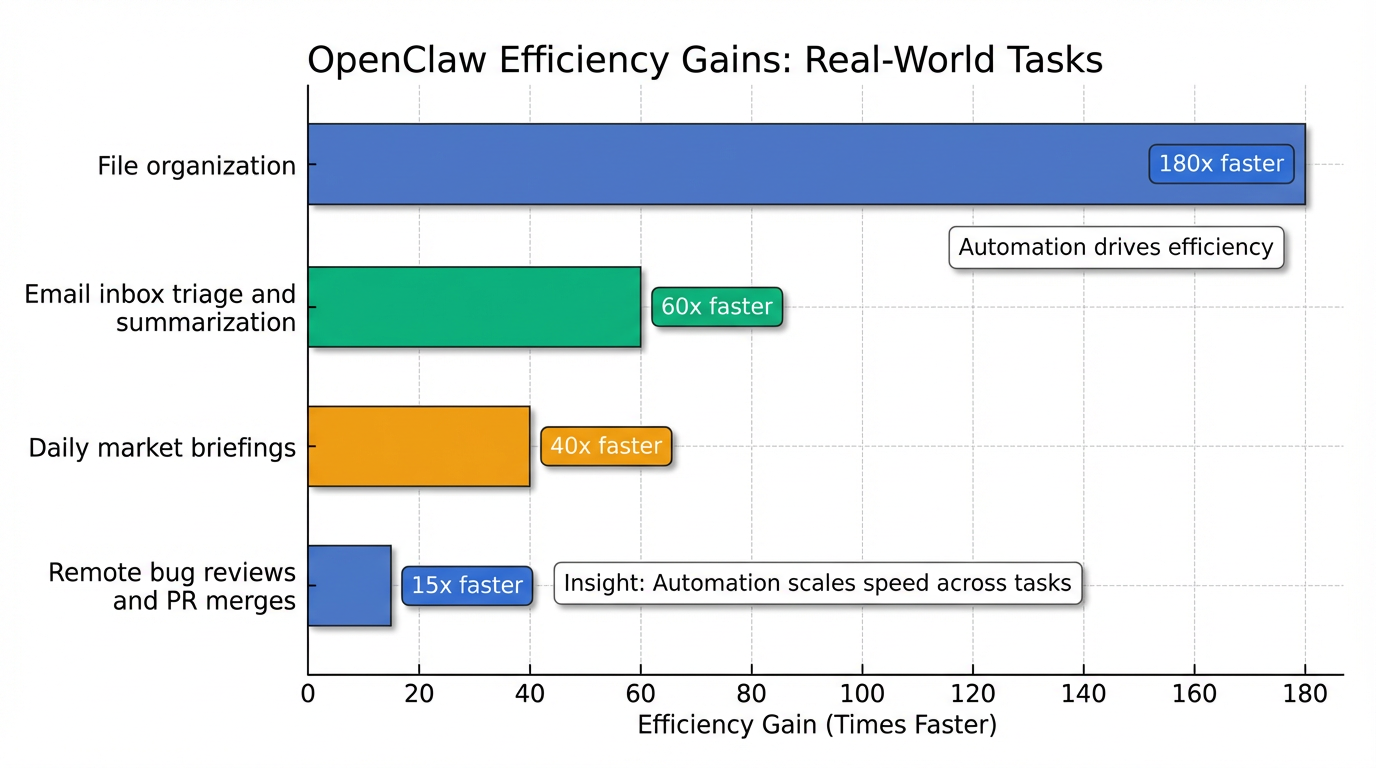
For instance, users have reported:
- File organization tasks becoming 180x faster, reducing a 30-minute chore to mere seconds 11.
- Email inbox triage and summarization speeds increasing by 60x 11.
- Daily market briefings being generated 40x faster 11.
- Remote bug reviews and pull request merges achieving speeds 15x faster 11.
These dramatic improvements signify a paradigm shift in task management, where AI becomes an active, contributing partner rather than a passive follower of pre-defined workflows 4.