The Rise of Micro-SaaS: How to Build and Scale Tiny Products
Introduction: The Quiet Revolution of Micro-SaaS
The tech world is witnessing a quiet revolution, as a new breed of entrepreneur—the indie hacker—discovers that true innovation doesn't always require venture capital or sprawling teams. This shift has propelled Micro-SaaS into the spotlight as a compelling, low-risk, and often high-reward alternative to the traditional startup grind. Today, solo founders and small teams are proving that focused ingenuity can yield substantial success, leveraging agility and niche expertise to build impactful products.
The relevance of Micro-SaaS is particularly acute now, driven by technological advancements and a growing desire for independence. Defined by a narrow market focus and the ability to achieve profitability swiftly, Micro-SaaS businesses are typically run by one to five people . This lean model means that 95% of micro-SaaS ventures achieved profitability within 12 months in 2024, a pace significantly faster than their traditional SaaS counterparts 1. These businesses are not just profitable; they are remarkably efficient, boasting average profit margins of 41% in 2024 2.
The rapid ascent of Micro-SaaS is fueled by several factors, chief among them the proliferation of powerful AI tools and lower entry barriers to software development. AI, in particular, has leveled the playing field, allowing solo founders to craft sophisticated products that once demanded larger teams 3. Indeed, AI-integrated solutions are growing twice as fast as traditional offerings 1, and a significant 40% of successful micro-SaaS launched in 2024 were built using no-code methods 4. This confluence of accessibility and powerful tools empowers individuals to become AI entrepreneurs, creating and scaling lean SaaS products with unprecedented efficiency. This article aims to guide aspiring indie hackers through the proven strategies for building and scaling their own Micro-SaaS success stories.
Core Strategy: Building for Impact and Profit
Success in the Micro-SaaS space hinges on a set of deliberate, often counter-intuitive strategies that prioritize focus and efficiency over broad market appeal. These core principles empower solo founders and small teams to not only launch quickly but also to build sustainable, profitable businesses.
First and foremost is the imperative of Niche Focus. Rather than attempting to serve a wide audience, successful Micro-SaaS products target razor-thin niches and commit to solving one specific problem exceptionally well . This laser focus reduces competition, simplifies marketing, and allows founders to become the undisputed experts in their chosen domain. Such specialized solutions often attract a loyal customer base willing to pay a premium for a tool perfectly tailored to their unique needs.
Another significant advantage comes from Founder Expertise. Technical founders, especially those with domain-specific knowledge, tend to ship products three to five times faster and exhibit twice the success rate compared to their non-technical counterparts 1. The most compelling products frequently emerge from founders solving their own "hair-on-fire" problems, understanding intimately the pain points they aim to alleviate . This intimate understanding ensures that the product truly addresses a market need rather than a perceived one.
Before a single line of code is written, Validate Before Building becomes a critical step. Resist the urge to dive into development; instead, test the idea's viability with potential users. Employ "shadow offers" such as landing pages for pre-orders, collect email sign-ups, or actively engage in niche communities to listen to complaints and gather feedback . This early validation saves immense time and resources by confirming market demand before significant investment.
Once validated, the strategy shifts to Launch Fast & Iterate. The goal is to build a Minimal Viable Product (MVP) quickly and get it into the hands of users, then refine it continuously based on their feedback . The modern toolkit, including no-code, low-code platforms, and AI-powered development assistants, significantly accelerates this process, allowing even solo founders to build sophisticated applications rapidly .
For Smart Acquisition, many successful Micro-SaaS rely on mastering a single organic channel. Content Marketing and SEO stand out as a long-term, sustainable strategy that continues to drive organic traffic for years, long after initial effort . Building in Public, by transparently sharing the development journey on platforms like X, generates anticipation and fosters a loyal audience even before launch 5. For initial traction, leveraging Community Platforms such as Product Hunt and Reddit can provide critical early adopters and valuable feedback . Additionally, Engineering as Marketing—creating free tools related to the core product—can attract significant organic traffic and convert leads effectively 6.
Finally, Monetization strategies require careful consideration. Hybrid pricing models, which combine subscription and usage-based components, lead to higher growth rates, with a median of 21% 1. For reducing churn by 30% and increasing customer lifetime value by 27%, implementing annual billing is highly effective 1. Furthermore, don't shy away from offering high-tier pricing options, as these often contribute significantly to the overall revenue of scaling Micro-SaaS 7.
Real Example: Photo AI by Pieter Levels
To illustrate the immense potential within the Micro-SaaS landscape, few examples shine as brightly as Photo AI by Pieter Levels. This case study perfectly encapsulates the rapid growth and high profitability achievable with a focused, AI-driven product spearheaded by a solo founder. While many other inspiring stories exist—such as Rob Hallam's SuperX, Angus Cheng's Bank Statement Converter, and Bhanu Teja P's SiteGPT—Photo AI offers a singularly clear demonstration of a lean, high-impact model.
Photo AI is an innovative AI photoshoot generator that creates photorealistic images, launched in February 2023 by the prolific solo founder Pieter Levels 8. The product ingeniously solves a common and costly problem: the need for professional photoshoots. By offering an AI-powered alternative, Photo AI empowers users to "fire their photographer," providing high-quality visual assets at a fraction of the cost and effort 8. This direct, compelling value proposition resonated immediately with its target audience.
The product's revenue and growth trajectory has been nothing short of meteoric and fully verified. Starting with an impressive ~$5.4K MRR in its first week (February 2023), Photo AI swiftly scaled to $28.7K MRR by April 2023, and then to $61.8K MRR by July 2023 8. Its momentum continued, reaching $77K MRR by February 2024 and exceeding $100K MRR by September 2024 8. As of November 2025, the product sustains an MRR of $132-138K, translating to an annual run rate of $1.6-1.65M and an estimated total revenue to date exceeding $2M 8.
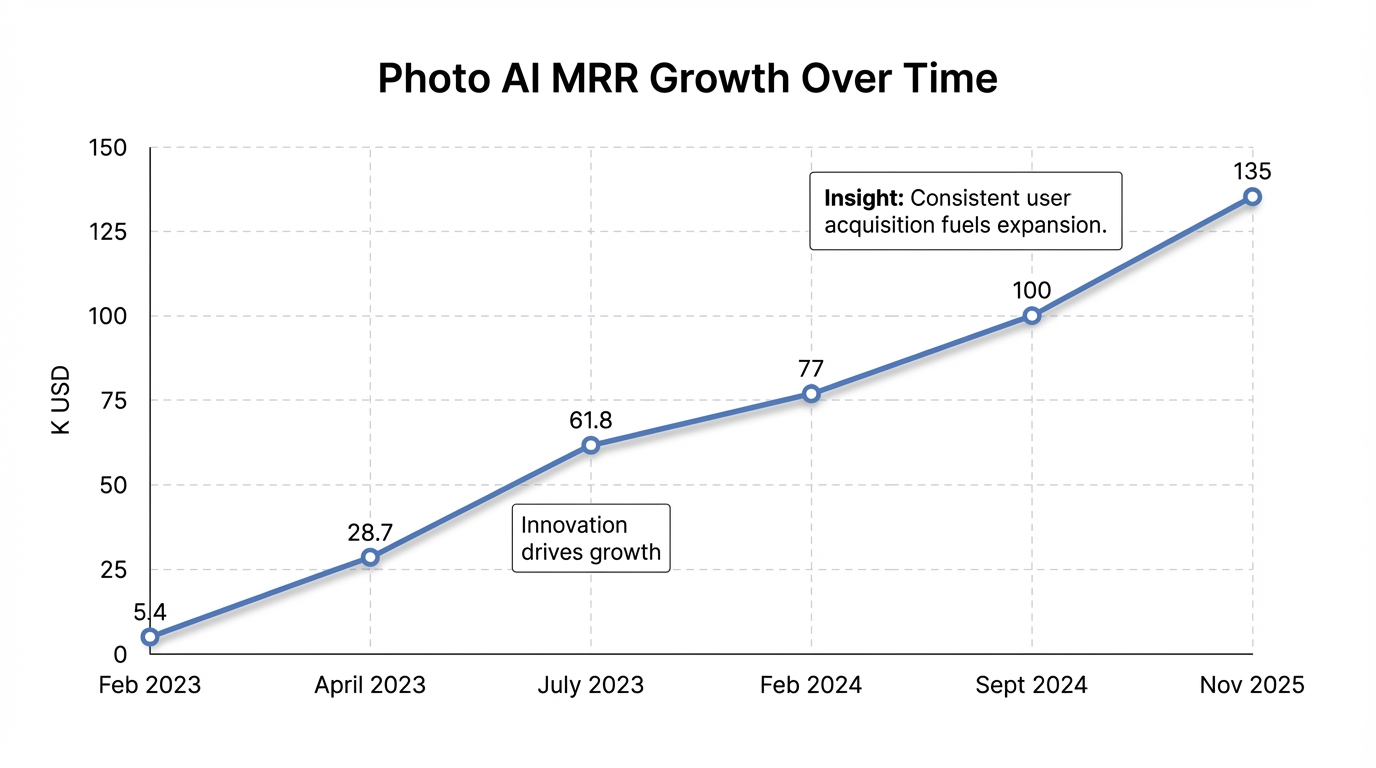
Among Pieter's portfolio of over 40 products, Photo AI stands out as his fastest-growing venture. It hit the $10K MRR milestone in approximately three weeks, a testament to its market fit and execution speed 8. Crucially, the business operates with an exceptional 87%+ profit margin, even accounting for GPU costs of around $13K per month, and remains 100% bootstrapped 8. Its tech stack, notably, utilizes vanilla HTML, CSS with no frameworks, and inline styles for the frontend, demonstrating that complex tools aren't always necessary for rapid, effective development 8. The primary insight from Photo AI's success is the profound rapid growth potential inherent in AI-driven products, particularly when launched by founders with an established presence and a clear understanding of user needs. This case solidifies the idea that a niche focus, combined with timely technological leverage, can lead to remarkable financial success for the lean operator.
Build It Yourself: Leveraging AI and No-Code for Rapid Development
The exciting promise of Micro-SaaS is not just in identifying a niche, but in the practical ability to build and launch quickly, often without a traditional development team. The current technological landscape makes this more accessible than ever, primarily through the strategic leveraging of AI and no-code/low-code tools. These powerful accelerators are fundamentally transforming how products are conceived and brought to market, drastically reducing the barrier to entry for aspiring AI entrepreneurs.
AI, in particular, has become a great equalizer, allowing solo founders to craft and build products that previously required larger teams and extensive resources 3. The sheer power of AI to automate complex tasks, generate code, and assist in design means that a single individual can now accomplish what once took an entire department. This democratization of development is evident in statistics: over 40% of successful micro-SaaS ventures launched in 2024 were built entirely without writing a single line of code 4. Platforms like Webflow, Bubble, or even advanced AI-powered builders like v0, combined with other AI tools, enable rapid prototyping and deployment, turning ideas into functional products in days or weeks, not months.
For those with coding experience, AI coding assistants are a game-changer. Tools such as GitHub Copilot, Cursor, or specialized AI-powered IDEs empower developers to write code significantly faster, debug more efficiently, and explore new architectural patterns. Bhanu Teja P, the founder of SiteGPT, demonstrated this by using AI coding assistants to create over 50 free tools for his "Engineering as Marketing" strategy, often building new tools in under five minutes using existing templates 6. This remarkable speed-to-market allows for extensive experimentation and the rapid generation of lead magnets, proving that even a small team can produce a vast array of valuable content.
The core principle here is to focus on the MVP, launch quickly, and iterate based on user feedback 9. Instead of striving for perfection upfront, the emphasis is on delivering the essential value proposition to early users and letting their input guide subsequent development. This agile approach minimizes wasted effort and ensures the product evolves in direct response to market needs. Leveraging AI not only speeds up the initial build but also supports this iterative cycle by automating feedback analysis and suggesting improvements, making it possible for indie hackers to maintain momentum. Ultimately, the "Build It Yourself" ethos, supercharged by AI and no-code, transforms product development from a significant hurdle into an accessible, repeatable process for ambitious creators.
Next Steps: Your Action Plan for Micro-SaaS Success
Embarking on the journey of building a Micro-SaaS product can feel daunting, but the success stories, empowered by AI and lean methodologies, provide a clear roadmap. For aspiring indie hackers and AI entrepreneurs, the path forward can be distilled into a few actionable principles designed for sustained growth and profitability.
First, anchor your efforts in Niche Focus and Problem Solving. Identify a specific, underserved problem for a well-defined audience and commit to solving it exceptionally well . The narrower the focus, the easier it becomes to become the best solution in that space. Do not build a generalist tool; instead, create a specialist solution that provides undeniable value to its target users.
Second, embrace Validation and Rapid Iteration. Before investing heavily in development, rigorously validate your idea with potential customers through landing pages, surveys, or direct conversations . Once validated, build a Minimum Viable Product (MVP) quickly, launch it, and then iterate continuously based on direct user feedback . This agile approach minimizes risk and ensures your product evolves in lockstep with user needs.
Third, prioritize Sustainable Acquisition Strategies. While paid ads can offer quick bursts of traffic, the long-term success of Micro-SaaS often stems from mastering organic channels. Invest in content marketing and SEO to generate passive, compounding traffic , engage in "building in public" to cultivate an audience 5, and leverage community platforms for early traction . Even "Engineering as Marketing" by creating free tools can be a powerful, AI-accelerated strategy 6.
Fourth, integrate Automation to Minimize Overhead. As a solo founder or small team, efficiency is paramount. Automate as many operational tasks as possible—from customer support and billing to monitoring—to prevent burnout and free up time for product development and growth 9. Leverage AI for repetitive tasks, allowing you to scale without linearly increasing your workload.
Finally, maintain an unwavering Continuous Customer Focus. Regularly engage with your users, understand their evolving needs, and refine your product to enhance their daily experience 10. Ensuring the product integrates into their daily workflow is crucial for retention and long-term stickiness 11. Happy customers are your best marketing tool and provide invaluable insights for future development.
The Micro-SaaS market is not merely a trend; it's an exploding opportunity. The global SaaS market itself is projected to reach an astounding $1.23-1.25 trillion by 2032-2034, with the micro-SaaS sector alone forecast to surge towards $300 billion by 2026 . This massive growth trajectory signals that there has never been a better time for nimble, innovative entrepreneurs to enter the market. By following these principles, you can carve out your own profitable niche and contribute to the vibrant future of lean SaaS.