On this page
Traditional websites were designed for two audiences: people and search engines. A third visitor is now arriving—the AI browser agent.
A person can infer that a green label means “in stock,” that a crossed-out price is stale, or that a button labeled “Continue” probably advances checkout. Googlebot mainly needs crawlable content, links, and indexable meaning. A browser agent has a harder job. It must determine:
- What is this page and what does it contain?
- What is the current state of the product, account, or transaction?
- Which actions are available and permitted?
- What will happen if it takes an action?
- How can it verify that the action succeeded?
That is the practical meaning of an agent-ready website. It is not a separate website for robots, and it is not a replacement for SEO. It is the next layer of web architecture: making the same site legible and operable for humans, search crawlers, and AI agents.
A July 2026 paper, Designing Agent-Ready Websites for AI Web Agents, offers unusually concrete evidence. In a controlled e-commerce experiment, the researchers compared a baseline human-centered storefront with an agent-ready version. Across 300 browser-agent runs, strict task success rose from 49.3% to 89.3%. PASS outcomes increased from 74 of 150 to 134 of 150, PARTIAL outcomes fell from 43 to 3, and average steps decreased from 9.31 to 6.49.
The result is preliminary and comes from a prototype shopping environment—not the whole web. But it suggests that website design can materially change agent performance even when the agent model stays the same.
From SEO to a three-audience website
SEO made websites easier for search engines to discover, crawl, interpret, and rank. An agent-ready website extends that discipline from retrieval to execution.
| Visitor | Primary need | Typical failure |
|---|---|---|
| Human | Understand and complete a task visually | Confusing layout or unclear copy |
| Search crawler | Discover and index canonical information | Blocked rendering, duplicate content, weak semantics |
| AI agent | Understand, decide, act, and verify | Ambiguous state, hidden controls, uncertain outcomes |
The third audience changes the question from:
Can a machine find and summarize this page?
To:
Can a machine reliably complete the user’s permitted task on this page?
That task might be comparing products, checking availability, filling a booking form, changing a subscription, or submitting an order for human approval.
The agent journey: understand, decide, act, verify
An agent-friendly website should support a predictable cycle:
Understand
The agent identifies the page purpose, entities, relationships, current state, and relevant constraints.
Decide
It compares options using current prices, inventory, eligibility rules, dates, evidence, and user preferences.
Act
It finds a deterministic control, understands the expected effect, supplies valid inputs, and respects authentication or approval boundaries.
Verify
It receives an explicit success or failure state, confirms the resulting data, and can report what changed.
Many current websites break this cycle. A button may have an icon but no accessible name. A price may be visible but lack currency or validity information. A form may fail without associating the error with a field. A successful action may trigger a toast that disappears before the agent can observe it.
The three dimensions of an agent-ready website
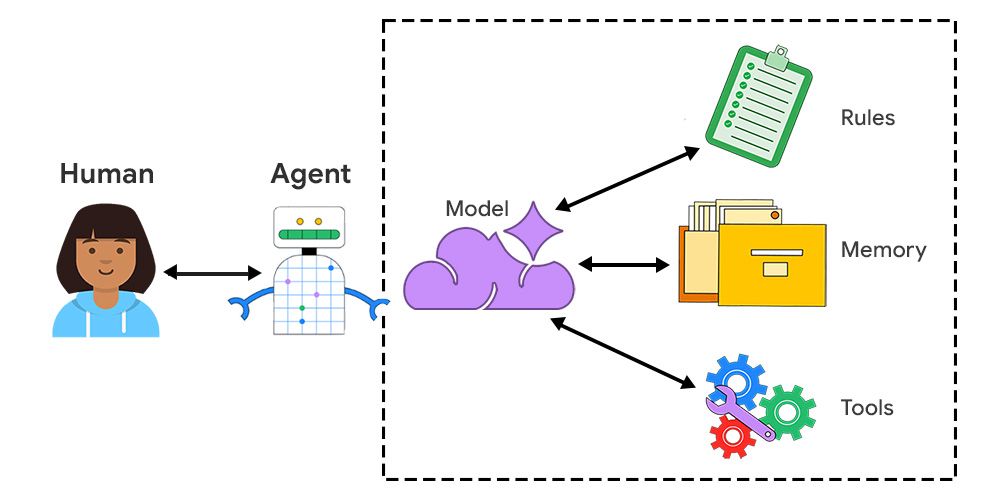
Google web.dev illustrates an agent architecture in which a human interacts with an agent connected to a model, rules, memory, and tools. This conceptual diagram is not a measurement of website or agent traffic. — Source
The paper proposes three connected dimensions.
1. Agent interpretability: can the agent understand the page?
Agent interpretability is the degree to which an agent can accurately parse content, structure, roles, and relationships.
A visually polished page may still be difficult for an agent if meaning is encoded only through color, position, animation, or JavaScript state.
Use semantic HTML
Prefer elements that communicate purpose:
Use real headings, lists, tables, links, buttons, labels, and form controls rather than generic <div> elements with click handlers.
Bad:
Better:
The second control exposes role, action, and target without depending on visual position.
Make the page purpose explicit
A page should state what it is near the top:
- Product detail
- Pricing comparison
- Appointment booking
- Account cancellation
- Order confirmation
Use one descriptive H1, a direct answer, and a clear content hierarchy. Avoid forcing an agent to infer the page purpose from branding and decorative copy.
Use structured data without confusing it with agent readiness
Schema.org and JSON-LD can identify products, offers, organizations, events, software applications, and breadcrumbs. This helps machines interpret entities and relationships.
But structured data is only one layer. BrightEdge reports that 61% of the sites in its study had implemented schema, while still arguing that most were not ready to serve agents efficiently. A site can describe a product perfectly in JSON-LD while offering an ambiguous, inaccessible purchase flow.
Keep important content machine-readable
Put decisive information in readable HTML or an equivalent stable data source:
- product name and variant;
- current price and currency;
- stock state;
- delivery estimate;
- cancellation policy;
- form requirements;
- eligibility constraints;
- last-updated date.
Do not hide critical content exclusively inside canvas elements, images, hover states, videos, or client-only components that appear after fragile interactions.
2. Agent executability: can the agent take the right action?
Agent executability concerns whether controls, paths, APIs, and feedback make an intended task callable and deterministic.
Give every action an explicit name
Weak labels include:
- Continue
- Submit
- Proceed
- Confirm
- Click here
They make sense only when the surrounding visual context is interpreted correctly.
Prefer labels that include the result:
- Continue to payment
- Submit booking request
- Confirm subscription cancellation
- Add size M to cart
- Save shipping address
Expose current state and allowed transitions
An agent should be able to distinguish:
- available vs unavailable;
- selected vs unselected;
- saved vs unsaved;
- draft vs published;
- authenticated vs signed out;
- reversible vs irreversible.
For a product variant:
This is more reliable than communicating selection through a blue border alone.
Make forms deterministic
Every field needs:
- a persistent label;
- expected format;
- required/optional state;
- associated validation errors;
- disabled and loading states;
- a stable success response.
Preserve authentication and approval boundaries
Agent-ready does not mean agent-unrestricted.
Authentication, step-up verification, confirmation screens, spending limits, and human approval should remain explicit. The improvement is clarity:
- state why authentication is required;
- preserve the user’s task after login;
- identify actions that create financial or legal commitments;
- show a review screen before irreversible submission;
- return a stable receipt after completion.
A hidden login redirect or a CAPTCHA with no alternative path may stop an agent. Removing security is not the answer. Design an understandable handoff to the user.
Offer stable data and action interfaces where appropriate
For advanced workflows, documented APIs, feeds, or machine-facing procedures can reduce brittle UI automation. But do not add an agent protocol only for marketing. Start by making the human interface semantic, accessible, and deterministic.
3. Decision reliability: can the agent trust the choice?
An agent can understand and execute a website yet still make a bad decision if the evidence is stale, incomplete, or misaligned with the user.
Agent decision reliability is the quality of signals that support current, verifiable, user-aligned choices.
Timestamp volatile facts
Price, stock, delivery, availability, and policy can change quickly. Include the time and conditions under which a claim is valid.
Do not rely on “today,” “limited time,” or “almost gone” without a machine-readable date, timezone, quantity, or expiry condition.
Separate facts from persuasion
An agent should be able to distinguish:
- current price from crossed-out reference price;
- verified specification from marketing claim;
- provider benchmark from independent test;
- included feature from paid add-on;
- available inventory from preorder;
- guaranteed delivery from estimate.
Clear attribution and conditions improve decisions for both agents and people.
Publish evidence and category signals
Help the agent answer “is this appropriate for the user?” Include:
- intended audience;
- best-fit and unsuitable use cases;
- compatibility requirements;
- version and release date;
- warranty or return conditions;
- evidence source;
- geographic limitations;
- accessibility and safety constraints.
A recommendation is only as reliable as the current context behind it.
Normal website vs agent-ready website
| Ordinary implementation | Agent-ready implementation |
|---|---|
| Visual card implies product identity | Product name, variant, ID, and relationship are explicit |
| Color indicates stock | Text and machine-readable stock state |
| “Continue” button | “Continue to payment” button |
| Price without timestamp | Price, currency, conditions, and validity time |
| Placeholder-only form | Persistent labels, constraints, and linked errors |
| Login redirect loses context | Authentication handoff preserves the task |
| Toast says “Done” and disappears | Stable confirmation with resulting state and receipt ID |
| Critical content rendered only in canvas | Important facts also exist in readable HTML/data |
| Marketing claim appears as fact | Claim, source, methodology, and limitation are separated |
| Irreversible action occurs immediately | Review, confirmation, and explicit commitment boundary |
The objective is not to flatten every website into machine-first markup. It is to remove ambiguity from meaning, state, action, and outcome.
What the 49.3% to 89.3% experiment actually shows
The paper tested three browser agents across five task types on two versions of a prototype e-commerce site, with 300 runs in total.
The reported outcomes were:
| Metric | Baseline site | Agent-ready site |
|---|---|---|
| Strict task success | 49.3% | 89.3% |
| PASS runs | 74 / 150 | 134 / 150 |
| PARTIAL outcomes | 43 | 3 |
| Average steps | 9.31 | 6.49 |
The largest gains appeared in product-detail extraction, comparison, and multi-constraint selection.
This does not prove that every production website will gain 40 percentage points. The site was a research prototype, the tasks were e-commerce focused, and the selected agents and evaluation protocol constrain the result. The important finding is causal direction: clearer structural signals, action cues, evidence, and temporal validity were associated with substantially better agent outcomes in a controlled comparison.

Anthropic’s computer-use illustration shows an AI system operating a graphical interface. It illustrates the interaction concept, not a benchmark result or proof that a website is agent-ready. — Source
Agent Edge shows the category is becoming a product market
BrightEdge launched Agent Edge on August 26, 2026, positioning it as a way for enterprises to optimize interactions between AI agents and websites across search, AI answers, and agent-led discovery.
BrightEdge says its research found that 97% of the top 20,000 websites were not serving AI agents in optimized formats such as Markdown. That number is a BrightEdge company claim based on its own research—not an independent industry census or settled definition of readiness.
The more durable signal is the product category itself. An established SEO platform is now selling:
- monitoring of AI agent activity;
- content delivery tailored to agent consumption;
- optimization for agent-led recommendations and actions;
- integration of traditional search, AI answers, and agent traffic.
This is the same transition SEO experienced before it became a mature discipline: first a technical problem, then a measurement framework, then a software category.
How to make a website AI agent friendly
An AI agent friendly website, agent-readable website, and website optimized for AI agents describe the same practical direction. Do not create three different versions of the site. Build one accessible, semantic, current, and deterministic experience.
Information layer
- Use semantic HTML and a logical heading hierarchy.
- Render critical facts in crawlable, readable HTML.
- Add accurate structured data for visible entities.
- Define canonical URLs and stable entity identifiers.
- Provide current prices, stock, dates, and policy conditions.
- Keep alternative text and accessible names meaningful.
Interaction layer
- Use native buttons, links, inputs, and form semantics.
- Name actions by their result.
- Expose selected, disabled, loading, and completion states.
- Associate errors with the affected input.
- Preserve task context through authentication.
- Add review and approval gates for consequential actions.
Reliability layer
- Timestamp volatile data with a timezone.
- Show evidence and source provenance.
- Separate current facts from promotional claims.
- Identify version, region, eligibility, and compatibility.
- Return stable confirmation states and transaction IDs.
- Provide recovery paths for timeout, failure, and partial completion.
Security layer
- Apply least privilege.
- Require re-authentication for sensitive actions.
- Make financial or legal commitments explicit.
- Log agent actions without leaking private data.
- Rate-limit automation and detect abuse.
- Provide human override and rollback where possible.
An agent-readiness audit checklist
Use this checklist before calling a website agent-ready.
Understand
- [ ] Is the page purpose explicit?
- [ ] Are entities, variants, and relationships identifiable?
- [ ] Is important information readable without visual inference?
- [ ] Does structured data match visible content?
- [ ] Are IDs and canonical URLs stable?
Decide
- [ ] Are price, stock, eligibility, and dates current?
- [ ] Are timestamps and timezones present for volatile facts?
- [ ] Are evidence, source, and limitations visible?
- [ ] Can an agent distinguish facts from marketing?
- [ ] Are best-fit and unsuitable use cases stated?
Act
- [ ] Does each control have a descriptive accessible name?
- [ ] Are form constraints and errors associated with fields?
- [ ] Are loading, disabled, selected, and completion states exposed?
- [ ] Does authentication preserve the original task?
- [ ] Are irreversible actions reviewed and confirmed?
Verify
- [ ] Does completion create a stable confirmation?
- [ ] Can the agent inspect the resulting state?
- [ ] Is there a receipt, reference, order, or booking ID?
- [ ] Are failures explicit and recoverable?
- [ ] Can a user review, override, or undo the action where appropriate?
What agent readiness is not
Agent readiness is not:
- publishing an
llms.txtfile and declaring the job finished; - adding more schema than the visible page supports;
- serving hidden claims only to bots;
- removing authentication or confirmation;
- exposing private APIs without permission controls;
- building a second, stale copy of the website;
- optimizing for one vendor’s crawler at the expense of users.
A genuinely agent-ready website improves clarity for people, accessibility tools, search engines, and browser agents at the same time.
How this connects to AI website building
The fastest way to improve agent readiness is at design and implementation time—not after the site has accumulated years of ambiguous components and client-side patches.
When building with an AI website builder, specify:
- semantic page regions;
- explicit actions and state transitions;
- persistent form labels and validation;
- structured product or service facts;
- dated prices and availability;
- accessible confirmation and error states;
- authentication and approval boundaries;
- machine-readable receipts and outcomes.
Atoms can help build and iterate the website workflow, but this article does not claim that Atoms currently provides an automated agent-readiness checker, WebMCP endpoint, or Agent Edge equivalent. Validate the deployed result with real browser-agent tasks.
WebMCP and agent-ready websites
WebMCP is one interface layer within the broader agent-ready website model. It can help a compatible client discover and call declared actions, but it does not replace semantic HTML, current state, authentication, authorization, confirmation, or outcome verification. A useful mental model is: agent readiness covers understand → decide → act → verify; WebMCP primarily strengthens the act interface.
OpenAI’s WebMCP Challenge and the WebMCP Community Group Report show that this interface is moving from an isolated browser experiment into active platform and developer discussion. The proposal remains evolving, so do not claim that Atoms automatically provides a WebMCP endpoint or that WebMCP improves Google rankings or ChatGPT citations.
For a deeper implementation guide, see WebMCP for Websites: How to Make Your Site Usable by ChatGPT and AI Agents.
The next web visitor is already here
SEO taught websites to communicate with crawlers. Agent readiness teaches them to cooperate with software that can make decisions and take actions for users.
The winning site will not be the one with the most machine-only files. It will be the one that makes four things unambiguous:
What this is. What is true now. What can be done. What happened afterward.
That is useful for humans. It is necessary for agents.
Sources
- Said Elnaffar and Farzad Rashidi, Designing Agent-Ready Websites for AI Web Agents: A Framework for Machine Readability, Actionability, and Decision Reliability, July 13, 2026.
- Replication repository: AIAgentReadWebSites.
- BrightEdge, 97% of Sites Aren’t Ready for AI Agents, August 26, 2026.
- BrightEdge, Agent Edge product page.
