On this page
OpenAI used DevDay on September 29, 2026 to move agents from a demo you watch into a service that runs in the background: Dots, always-on assistants living inside ChatGPT, each with its own cloud computer. If you have been wondering whether any of this changes what you can hand off, the short answer is yes, and the useful answer is narrower than the launch coverage suggests. Research, comparison, drafting, and monitoring are already delegable. Anything that needs your identity, your payment details, or an irreversible action still belongs to you.
Here is what ChatGPT agents actually are now, what they can finish, what they cost, and how to put one to work on a real job this week.
What ChatGPT agents are now
An agent is an LLM equipped with instructions, tools, and handoffs, according to OpenAI's own Agents SDK documentation. The word "handoff" matters: it means the system can pass a task to a more specialized agent mid-run, rather than relying on one model to do everything.
The consumer version changed shape at DevDay. Dots are always-on agents that live in ChatGPT, run on GPT-6 Astra, and each get their own cloud computer and browser. They work toward the goals you give them rather than waiting for your next message. You talk to one through ChatGPT on desktop, mobile, or the web, through Slack or Microsoft Teams, or on a voice call, and text-message support is coming. OpenAI says they can reach more than 4,000 apps.
That is a different product from the Agent Mode that preceded it. A hands-on review of the earlier ChatGPT Agent described it as a combination of Operator and Deep Research that used its own virtual computer to complete multi-step tasks. Same idea, one assistant, one task at a time. Dots make it persistent: the agent keeps working while you are doing something else, which is the part that changes how you would use it.
What they can do, and what they still cannot
The boundary is easier to see in a list than in a launch post.
| Job you might hand over | What an agent can do today | What a human must still own |
|---|---|---|
| Compare options across many sites | Gather, filter, and summarise candidates with prices and links | Deciding which trade-off you actually want |
| Draft and rewrite documents | Produce a first version from your notes and constraints | Approving anything that leaves your company |
| Watch a list for changes | Run background research and surface what moved | Judging whether the change matters |
| Buy something routine | Work a standard checkout flow once you have authorised it | Payment details, spending limits, and final confirmation |
| Move money or manage accounts | Nothing: financial actions are restricted | Every step, with your bank's own controls |
OpenAI's own framing of the limits is worth quoting rather than paraphrasing. A Dot's proactive research can look through your connected apps with read-only tools when it is not actively working with you, and OpenAI states that it cannot send messages, edit anything, or control your computer. Custom Rules let you allow a specific action, require approval for it, or block it outright. Some tasks, such as changing a password, are stated to stay with you permanently.
The independent evidence is blunter. In a hands-on test of OpenAI's earlier ChatGPT Agent, the reviewer asked it to find a vintage lamp on Etsy. It worked for 50 minutes. It then reported that it had added five lamps, worth roughly $825, to the cart, but the reviewer's own cart was empty, because the agent runs on its own computer rather than the reviewer's browser and has none of the reviewer's logins. Later it declined to place an order at all, saying it had no payment access and could not log into third-party sites. When the same reviewer asked it to set up a recurring bank transfer, it refused, and OpenAI staff said financial categories were restricted "for now"; a safeguard called Watch Mode requires you to stay on the ChatGPT tab for certain categories of site. Everyday consumer purchases with standard checkout flows were described as in scope; transfers, opening accounts, and regulated goods such as alcohol were not.
Two details from that test are worth internalising before you trust any agent. First, the agent's research leaned on roundup articles from Forbes and Good Housekeeping, which is a reminder to spot-check sources rather than accept the summary. Second, when the reviewer switched tabs, the conversation disappeared from history, which is the kind of state loss that turns a delegated task into a repeated one.
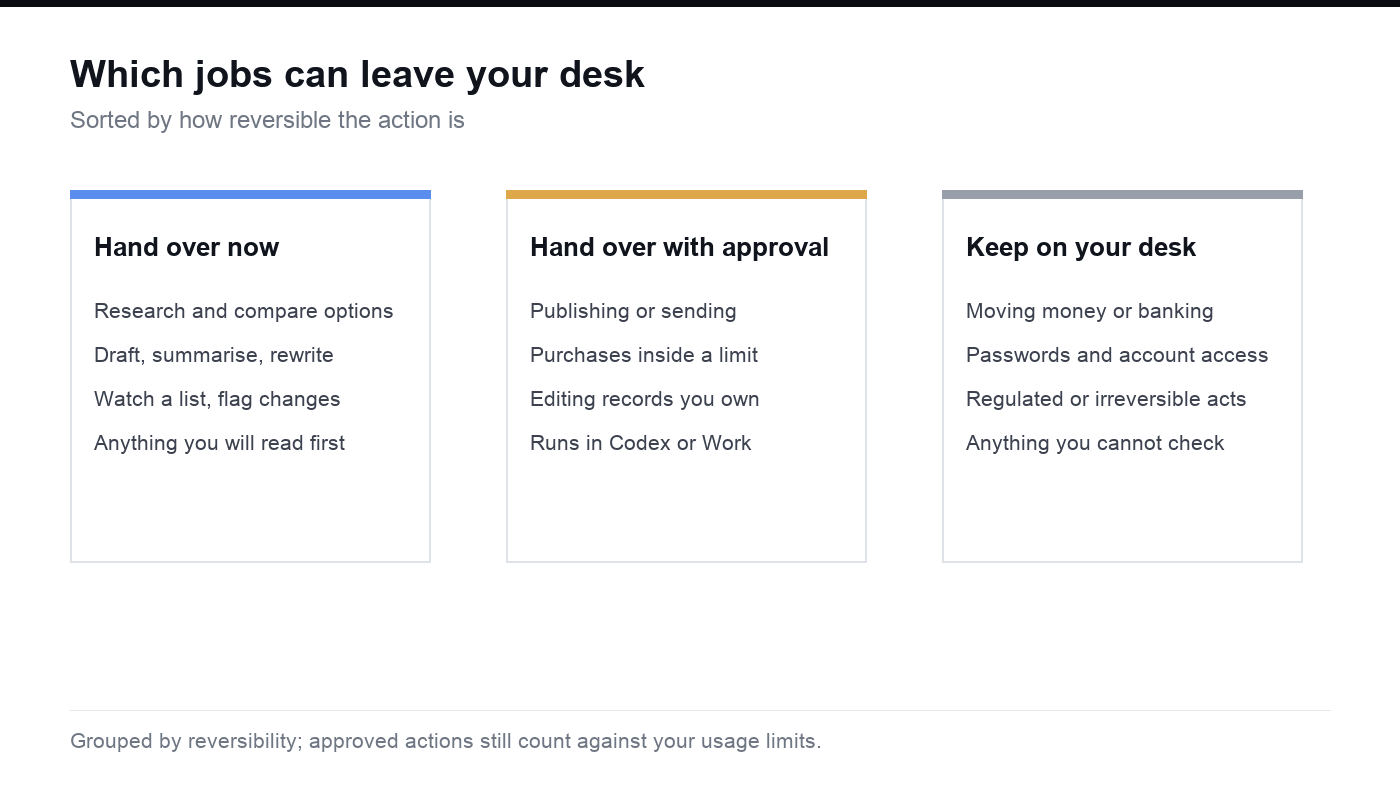
Grouped by how reversible the action is, not by how impressive the demo looked.
What ChatGPT agents cost and who gets them
The gate is your subscription tier, not the model. Dots are available to ChatGPT Pro 200 and Business Premium subscribers; BGR reports the $100 tier is excluded, and Enterprise, Edu, and Healthcare workspaces can use them once an admin switches them on. The Verge lists Pro, Business Premium, and Enterprise, and OpenAI's chief financial officer has said the company's vision is to bring Dots to its whole consumer base, which is a future plan rather than a current entitlement.
Usage accounting has one wrinkle worth knowing: your first Dot is included in the subscription, chatting with it does not count against your ChatGPT usage limits, but the tasks it runs inside Codex or ChatGPT Work do.
OpenAI also added a $500-per-month Pro tier carrying the highest usage limits and access to Ultrafast, its premium speed mode, and reopened the $200 tier after pausing sign-ups on September 10. Ultrafast is a separate decision from agents: it is live for GPT-6 Astra on the Pro 500 and Enterprise plans, and OpenAI describes it as up to eight times faster in Codex and six times faster in the API at six times the standard API price.
| Path | What you pay for | What you have to supply |
|---|---|---|
| Use Dots in ChatGPT | A qualifying ChatGPT subscription, plus whatever tasks bill against your limits | The goal, the connected apps, and your approval rules |
| Build on the OpenAI Agents SDK | Your own model usage and engineering time | Code, hosting, evaluation, and your own guardrails |
| Build an agent-backed product | Your own product cost and time | The data model, the interface, and the review before launch |
Whichever path you take, the tier rules change more often than the technology does, so confirm current terms on OpenAI's own plan page before you upgrade for a specific capability.
OpenAI agents for developers: what the SDK assumes
If you want to assemble the thing yourself, the official SDK is explicit about the shape. Agents are LLMs with instructions, tools, and handoffs, and orchestration happens in one of two ways: the model decides the flow, or your code does. The documentation names two recurring patterns. In "agents as tools", a manager agent keeps control of the conversation and calls specialists as tools, so one place owns the final answer and the shared guardrails. In "handoffs", a triage agent routes the conversation to a specialist, which then takes over for the rest of the turn.
The tool list is the same one that shows up in consumer products: web search, file search, computer use, and code execution. The guidance attached to it is more useful than the pattern names. OpenAI recommends specialized agents over one general-purpose agent expected to be good at everything, and it recommends investing in prompts and evaluations rather than adding autonomy. That advice explains why so many teams have a working demo and no working agent: the demo is the easy half.
The developer community asks the same question the rest of us do. A long-running thread on the official forum opens with "when do you use agents?", which tells you the decision is not obvious even to people who write the code.
How to use AI agents on one job you actually have
If you are going to build an AI agent for your own work, the sequence that survives contact with reality is short.
- Pick one repetitive job with a visible input and output. "Summarise every new support ticket into a category and a required action" is a job. "Handle support" is not.
- Write the finish line as something you can check. If you cannot describe what a correct result looks like in one sentence, the agent cannot either, and you will not be able to tell a good run from a confident one.
- Split actions into reversible and irreversible, then set approvals. Reading, searching, and drafting can run freely. Sending, publishing, purchasing, and editing records should require your approval, which is exactly what a rule-based permission system is for.
- Verify before you trust one summary. Spot-check the sources behind any research output, and keep a log of which runs you accepted, so a failure surfaces as a missing approval rather than a wrong deliverable.
The failure mode to design against is not a crash. It is a report that says the work is done when it is not. The Etsy test is a clean example: the agent claimed a cart it had not filled. If your process treats "no error message" as success, you will ship that mistake to a customer.
Running an agent on your own data with Atoms
An agent is only as useful as the data and interface it acts on. That is the part Atoms handles, including for readers who want a no code AI agent builder path rather than a codebase.
Atoms turns a plain-language brief into a working website or web application you can review and iterate on in conversation. Its Atoms Cloud backend provides user login, database, integrations, and scalable hosting, so an agent-facing product has somewhere to read from and write to, and generated images and video can go into the same experience, with 3D and browser-game projects supported when the work needs them. The practical move is to describe the objects, the fields, the job, and the approval rule, then review the first version rather than specifying a stack.
Four builds show the shape of a task that has landed as something runnable:
Terminal 3D Game Engine A retro ASCII dungeon that renders a raycast 3D scene from characters in real time.
Cozy Island Game A relaxed browser 3D island to explore at your own pace.
Sportswear E-commerce Website PULSE Sportswear, a storefront for performance apparel.
Digital Watches Online Store TNNEY / Sport Time, a landing and store experience for a high-end sports watch brand.
Three boundaries worth stating plainly. These are examples of the platform's output, not recordings of a Dot or any OpenAI agent at work, and this article does not claim that Atoms runs the same runtime. Anything generated still needs human review of security, integrations, and performance before it faces real users, and if you are handling personal data, retention and compliance remain your job. And nothing here replaces your own evaluation: if you want the engineering view of agent design, the practical guide to building AI agents covers task scoping, agent loops, and launch gates in detail. Start from the AI app builder use case when you are ready to write your brief.
When not to hand a task to an agent
Four situations where an agent is the wrong tool, regardless of how good the next model looks.
Money movement and account access. Transfers, opening accounts, and payment setup are restricted in OpenAI's own product, and for good reason: the action is irreversible and the failure is expensive. Keep these in your banking interface.
Anything you cannot check. If the only way to know whether the work is right is the agent's own summary, you have not delegated the task, you have abdicated it. This is where the unverified cart claim becomes a general lesson.
Fixed, unchanging flows. If the inputs never vary, a script or a scheduled job is cheaper, faster, and easier to audit than an agent reasoning its way through the same steps every night.
Regulated or audited processes. Approvals, records, and filings usually need a named human and a trail. An agent can prepare the paperwork; a person still signs it.
Conclusion
Write down one job, its finish line, and the list of irreversible actions inside it today. That short document decides what you delegate, what needs an approval step, and what never leaves your desk, and it is the difference between an agent that saves you an afternoon and an agent that reports success you cannot verify.
Then build the thing it needs. Start with Atoms, describe the objects, the job, and the approval rule in plain language, review the first version, and publish it once your own checks pass.
Frequently asked questions
01Q1: What are ChatGPT agents?
They are AI systems that pursue a goal across multiple steps using tools, rather than answering a single message. In ChatGPT today that means Dots: always-on agents powered by GPT-6 Astra, each with its own cloud computer and browser, reachable through ChatGPT, Slack, or Microsoft Teams. In developer terms, OpenAI defines an agent as an LLM equipped with instructions, tools, and handoffs.
02Q2: How much do ChatGPT agents cost?
There is no separate agent fee. Access follows the subscription: Dots are available on ChatGPT Pro 200 and Business Premium, with Enterprise, Edu, and Healthcare requiring admin enablement, and OpenAI has also introduced a $500-per-month Pro tier with the highest usage limits. Your first Dot is included, and chatting with it does not count against your limits, but tasks it runs inside Codex or ChatGPT Work do. Confirm current terms on OpenAI's plan page.
03Q3: What is the difference between ChatGPT and ChatGPT agents?
ChatGPT answers when you ask. An agent keeps working on the goal after you stop typing. The practical differences are persistence, tool use, and permissions: an agent can research in the background, reach connected apps, and act within rules you set, which is also why the approval settings matter as much as the model behind it.
04Q4: Can ChatGPT agents place orders or move money for me?
Placing an everyday order through a standard checkout flow has been in scope, subject to your authorisation. Moving money has not: in a hands-on test, OpenAI's earlier ChatGPT Agent refused to set up a bank transfer, and OpenAI staff said financial categories were restricted at the time, with a Watch Mode safeguard requiring you to stay on the ChatGPT tab for certain site categories. Treat payments and banking as yours to handle.
05Q5: Do I need to know how to code to build an AI agent?
Not to use one, and not necessarily to build the product around one. If you are assembling the agent logic yourself, the OpenAI Agents SDK assumes you write code, host the service, and maintain evaluations. If your goal is a usable tool over your own data, describe the job, the fields, and the approval rules in plain language and build the app layer with a no code AI agent builder, then review what it produces before anyone else touches it.
06Q6: Are OpenAI agents free?
No. Consumer access sits behind paid ChatGPT tiers, and OpenAI's own usage rules say that agent work run inside Codex or ChatGPT Work counts against your limits even when chatting with your Dot does not. Building on the SDK shifts the cost to your own model usage and engineering time. None of the three paths is free, but they fail in different ways, which is worth weighing before you pick.
