AI coding agents are converging on the same visible feature set: an LLM, tools, an agent loop, context, skills, subagents, permissions, and a sandbox.
That feature checklist is no longer enough to explain why the systems feel different.
DeepSeek Harness, Claude Code, and Codex are built around different architectural centers. Claude Code is primarily about making one powerful agent more capable. Codex is about letting an agent operate inside a real computer environment with explicit execution boundaries. DeepSeek Harness is about making the runtime itself composable: models, tools, skills, sessions, sandboxes, storage, loops, scheduling, and UI can be treated as replaceable capabilities.
The right comparison is not “which one has more features?” It is:
What problem does each architecture optimize, and where does it place control?
The same agent loop, different system around it
At the lowest level, the three systems share a common shape:
The model provides reasoning and action decisions. The harness determines what the model can see, which tools it can call, what the tools actually do, how state is preserved, which actions require approval, and how completion is verified.
That is why a better formula for coding-agent performance is:
A model can be excellent and still produce a poor result if the harness provides incomplete repository context, weak tool contracts, unsafe permissions, poor recovery, or no acceptance check.
Three architectures in one table
| System | Architectural center | Primary question |
|---|---|---|
| Claude Code | Claude Agent | How do we make one agent stronger and easier to use? |
| Codex | Agent plus execution runtime | How can an agent act autonomously without losing control of the environment? |
| DeepSeek Harness | Composable runtime | How can models, tools, loops, and execution capabilities be replaced or recombined? |
This distinction matters more than a feature-by-feature checklist because all three systems can expose similar primitives while optimizing different constraints.
Claude Code: agent-centric architecture
Claude Code is best understood as an agent-centric system.
The primary agent remains the center. The surrounding capabilities make that agent more effective:
CLAUDE.mdgives it project context;- Skills package reusable knowledge and workflows;
- MCP connects external systems;
- Subagents isolate specialist work;
- Hooks add deterministic lifecycle behavior;
- Permissions control sensitive actions;
- Plugins package capabilities for reuse.
Skills are experience packages
A repeated workflow such as code review can be expressed as a reusable process:
This is knowledge plus workflow plus instruction. It does not always need to become a new software module.
As models become more capable, a meaningful portion of an agent’s advantage may come from how well these experience packages are selected and applied.
Hooks restore deterministic control
Agents are flexible, but production systems also contain rules that should not depend on a model remembering them:
- run tests after a code change;
- block a dangerous command;
- request approval before writing to a protected location;
- record a tool call in an audit log;
- validate output before the agent stops.
Hooks attach deterministic behavior to lifecycle events such as prompt submission, pre-tool use, post-tool use, stop, and subagent transitions.
The architecture becomes:
That is a practical compromise between flexibility and control.
Subagents are valuable because of isolation
A multi-agent workflow is not automatically useful because it contains several personas. The engineering value comes from boundaries:
An isolated subagent can have its own context, tools, permissions, and task boundary. This keeps the primary context focused and makes parallel investigation more practical.
Codex: execution-centric architecture
Codex emphasizes the problem that appears when an agent can actually change a computer.
A coding agent may edit files, run shell commands, install packages, access the network, use Git, read configured credentials, and call external services. The system therefore needs an execution model that answers two separate questions:
| Mechanism | Question |
|---|---|
| Sandbox | What can the agent technically access or modify? |
| Approval | What is the agent currently allowed to do? |
A sandbox can constrain writable paths, network access, and protected resources. Approval policies can pause the agent before actions that create meaningful risk.
The key principle is capability minimization:
Do not give an agent every privilege and ask it to be careful. Start with a constrained environment and widen access deliberately.
Agent-native telemetry
Traditional application monitoring tracks CPU, memory, latency, and error rates. An agent runtime also needs to expose:
- prompts and context decisions;
- tool calls;
- approvals;
- policy checks;
- commands executed;
- files changed;
- subagent transitions;
- token usage;
- execution traces;
- final task outcome.
The operational question is not only “did the process fail?” It is also:
What did the agent do, what did it access, why was the action permitted, and how can the result be recovered?
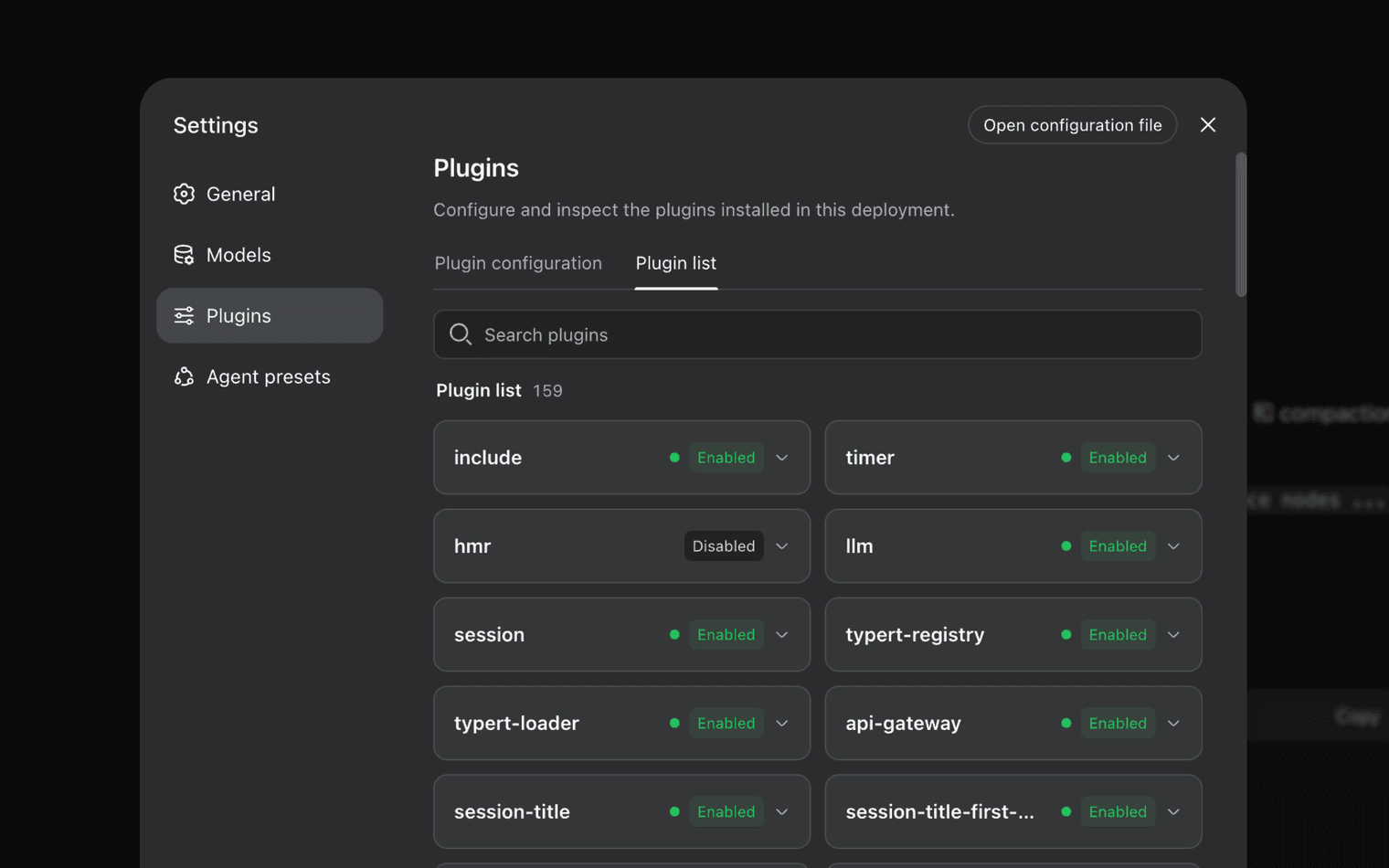
DeepSeek Harness shows a plugin-oriented configuration surface with model, session, gateway, and agent-preset components. This UI illustrates extensibility; it is not a complete architecture diagram. — Source: DeepSeek Harness
DeepSeek Harness: runtime-centric architecture
DeepSeek Harness starts from a platform question:
What if the Agent Loop itself should not be a permanent core?
The public developer preview describes the philosophy as “Everything is a plugin.” The plugin boundary includes models, tools, skills, sessions, sandboxes, storage, loops, scheduling, and UI.
This is different from a conventional plugin system in which a stable core exposes extension points. DeepSeek Harness pushes the boundary inward: the mechanisms that drive the agent can also be replaced or recomposed.
The Cordis composition layer
The runtime is intended to provide a composition layer that resolves and connects capabilities. A capability can be modeled as:
For example:
The tool depends on the filesystem contract, not on one specific implementation. The same approach can apply to:
- local shell vs container shell;
- remote model vs local vLLM;
- one session store vs another;
- a ReAct loop vs a workflow loop;
- a local scheduler vs a background-job provider.
This is the attraction of a capability seam: replace the provider without rewriting every consumer.
Runtime composition
A composable runtime can support several agent shapes:
The design does not assume that today’s coding loop will be the only valid architecture for future enterprise agents.
The cost of composability
Composability creates a real trade-off. Developers may need to understand:
- Plugin;
- Service;
- Provider;
- Consumer;
- Event;
- Effect;
- Scope;
- Session;
- Workflow;
- Bundle;
- Profile.
A platform can be highly flexible and still be difficult to adopt. DeepSeek Harness is therefore most interesting to teams building or extending agent runtimes—not necessarily to every end user who simply wants an agent to edit a repository.
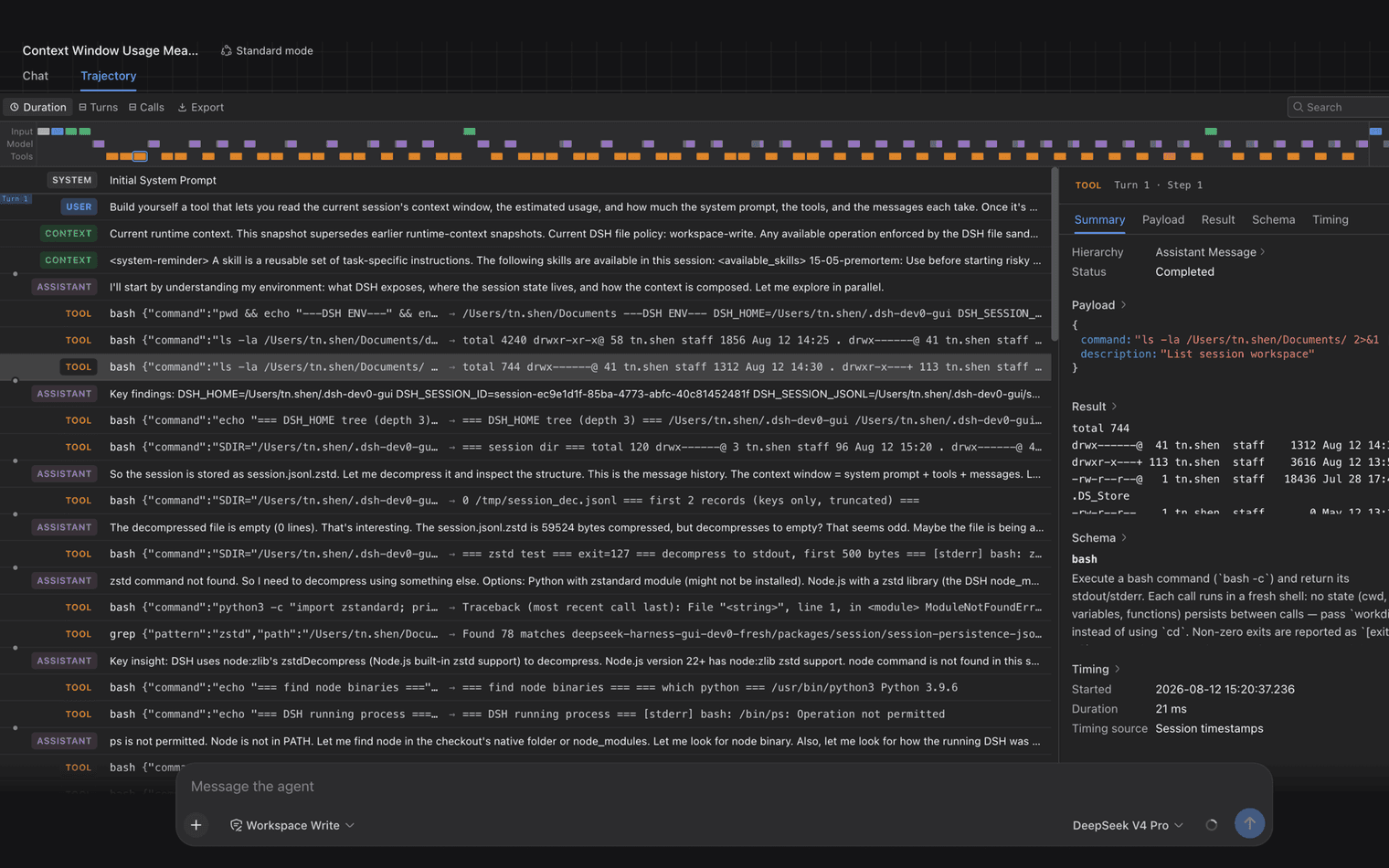
DeepSeek Harness trajectory view showing structured context, assistant decisions, tool calls, results, schemas, timing, and sandbox-related runtime behavior. It is evidence of an observable runtime trace, not standalone proof of every plugin boundary. — Source: DeepSeek Harness
A runtime trace is not the same as an architecture diagram
DeepSeek Harness also highlights the importance of observability. A trajectory view can separate:
- system messages;
- user messages;
- runtime context;
- assistant decisions;
- tool calls;
- tool results;
- schemas;
- timing;
- session state.
That is strong evidence of an inspectable agent runtime. It is not, by itself, proof of the complete plugin architecture.
The distinction is important when reading screenshots and demos:
- a plugin settings panel can show configurable components;
- a trajectory view can show execution events;
- a source repository can show plugin interfaces;
- an architecture document can explain intended composition.
Do not use one category as evidence for another.
Claude Code vs Codex vs DeepSeek Harness
| Dimension | Claude Code | Codex | DeepSeek Harness |
|---|---|---|---|
| Center | Primary Claude Agent | Agent plus execution boundary | Composition runtime |
| Main optimization | Capability and experience | Safe autonomous execution | Replaceability and recomposition |
| Agent loop | Explicit center | Explicit center | Replaceable plugin capability |
| Context | Project and experience oriented | Bounded runtime context | Context as service/plugin |
| Tools | Built-in tools and MCP | Tools, MCP, and Apps | Tool registry and capability seams |
| Skills | Major extension mechanism | Increasingly important extension | Independent capability |
| Subagents | Isolated context and execution | Multi-agent expansion | Composable capability |
| Safety | Hooks and permissions | Sandbox, approval, policy | Runtime policy, effects, and events |
| Session | Persistent conversation | Agent runtime state | Plugin-managed or event-oriented state |
| Best fit | Specialized agent product | Agent operating real systems | Extensible agent platform |
The last row is not a ranking. It describes the product boundary each architecture emphasizes.
Control is the deeper comparison
The most durable way to compare agent systems is to ask who owns each decision.
| Decision | Model | Program / Runtime | Policy | Human |
|---|---|---|---|---|
| Understand the task | ✓ | |||
| Generate a plan | ✓ | ✓ | ||
| Select a tool | ✓ | ✓ | ✓ | |
| Validate parameters | ✓ | ✓ | ||
| Judge permission | ✓ | ✓ | ✓ | |
| Approve high-risk action | ✓ | ✓ | ||
| Execute the tool | ✓ | ✓ | ||
| Terminate the run | ✓ | ✓ | ✓ |
Claude Code gives the main agent broad dynamic capability while adding lifecycle controls. Codex places more emphasis on sandbox and approval boundaries. DeepSeek Harness makes more of the control machinery itself composable.
This map is more useful than counting how many tools or model providers a framework supports.
What Atoms does differently
Atoms is a product workflow for turning ideas into working websites and applications. Its architecture is explicitly multi-agent rather than “one model with a giant prompt.”
Atoms can coordinate specialized AI employees for different parts of the product journey:
- Product Manager;
- Deep Research;
- Architect;
- Engineer;
- SEO Specialist;
- Growth or Ads Specialist;
- Data Analyst.
The workflow looks like:
This is a different application of the same architectural insight. Work should be separated by context, tools, acceptance criteria, and deliverables rather than forced through one undifferentiated loop.
Atoms also supports Race Mode, which runs the same prompt across multiple models in parallel so builders can compare outputs and choose the stronger implementation. That introduces competition and verification into product generation instead of treating the first output as final.
Explore AI Agents for building apps and websites, AI Coding Agents, AI Website Builder, and AI App Builder.
For projects that need a real application layer, see Atoms Backend, Atoms Cloud, and Production-Ready AI App Builder.
Which architecture should you choose?
Choose an agent-centric design when:
- one primary agent owns a clear professional workflow;
- user experience and context quality matter most;
- skills and specialist subagents can extend the core loop;
- deterministic hooks can cover the critical controls.
Choose an execution-centric design when:
- the agent edits code or changes real systems;
- permissions, isolation, approvals, and auditability are central;
- the cost of an incorrect action is high;
- the runtime must make boundaries visible.
Choose a runtime-centric design when:
- multiple models and providers must coexist;
- tools and sandboxes need interchangeable implementations;
- several agent loops or workflow types are expected;
- the product is an extensible platform rather than one fixed agent.
Choose a multi-agent product workflow when:
- the task crosses research, planning, architecture, implementation, SEO, and analytics;
- different stages need different context and tools;
- parallel alternatives improve quality;
- the result is a working product rather than a single answer.
Final takeaway
DeepSeek Harness, Claude Code, and Codex all expose the same broad vocabulary—LLM, tools, loop, context, skills, subagents, permissions, and sandbox.
Their architectural philosophies differ:
- Claude Code: make one agent stronger and more useful.
- Codex: let an agent act safely inside a real computer environment.
- DeepSeek Harness: make the runtime and its capabilities composable.
- Atoms: coordinate specialized AI agents across a product lifecycle and use parallel generation to improve the odds of a strong working result.
The important question is no longer only:
How do we call the model?
It is:
How should intelligence, execution, policy, tools, context, and human control be organized around the model?
That is the architecture question that separates a convincing demo from durable agent software.
