 Ethan Carter
On this page
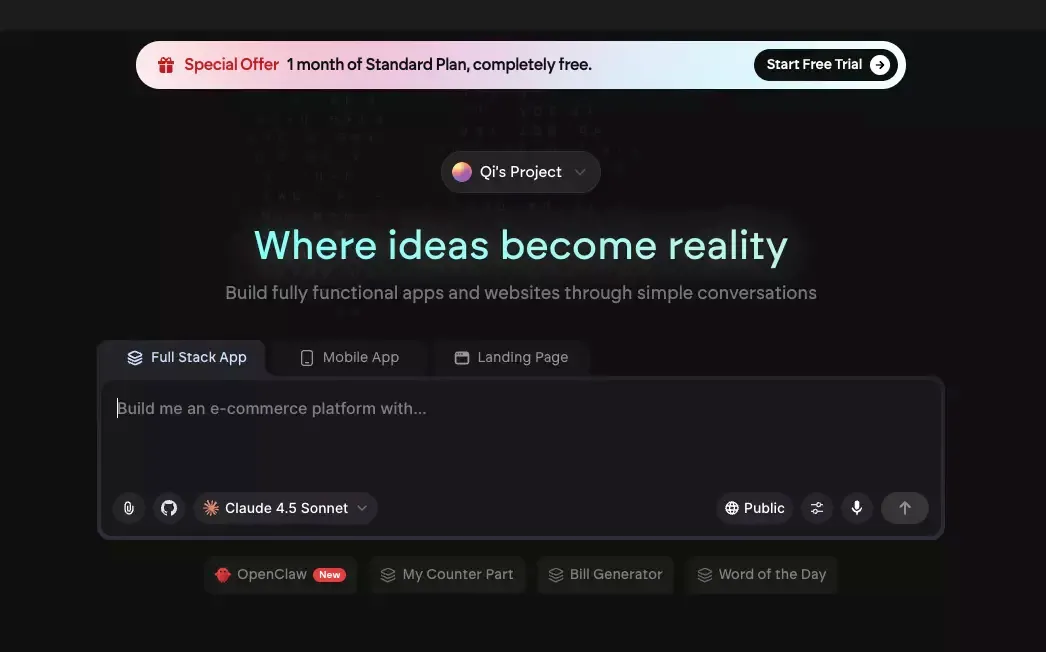 AI app builders are getting better fast. That also makes them harder to evaluate.
Many tools can generate a landing page, a demo app, or a rough AI prototype from a prompt. Fewer can help you move from idea to something that feels like a real product. That is the gap Emergent is trying to close.
In this review, I look at what Emergent does well, where it still falls short, how its pricing works, and how it compares with other AI app builders in 2026.
What Is Emergent?
Emergent is an app and website builder designed to help users create web and mobile apps through conversation. Instead of starting with manual setup, you describe what you want, refine it through prompts, and let the platform handle much of the building process.
What makes Emergent interesting is that it is not positioned as just a mockup tool or a visual toy. It aims to support a broader workflow that includes:
- app generation
- iteration through prompting
- testing
- deployment
- GitHub integration
- AI code generation
That matters because many AI builders look impressive in a demo, then feel limited once real logic, data, or deployment enters the picture.
In simple terms, Emergent is trying to sit between lightweight no-code builders and traditional development workflows. It is meant to help users move faster without reducing everything to static prototypes.
Who Emergent Is Best For
Emergent is not for every type of builder. Its strongest fit is users who already have a reasonably clear idea of what they want to build and want to shorten the path from concept to working product.
Best fit for
-
Founders building MVPs
- Good for validating ideas quickly
- Useful when speed matters more than polish in the early stage
-
Product managers and operators
- Helpful for turning requirements into working prototypes
- Useful when you want to test workflows without coordinating multiple teams first
-
Developers who want to move faster
- Can reduce repetitive setup work
- More attractive if you still want code access, version control, and AI coding assistant style speed
Less ideal for
- users who expect pixel-perfect design immediately
- teams with heavy compliance or highly custom technical requirements
- buyers who want a fully polished product without much iteration or review
That is an important distinction. Emergent may help you get to a functional product faster, but it does not eliminate the need for judgment.
Key Features of Emergent
The easiest way to understand Emergent is to look at the product through the lens of workflow, not novelty.
Core features
-
Prompt-to-app generation
- Start with a natural language brief
- Refine the result through conversation
-
Full-stack project support
- Positioned for more than front-end screen generation
- Better aligned with app-building than simple AI page generators
-
GitHub integration
- Important for users who want visibility and control
- Makes the tool more credible for real product work
-
Deployment support
- Helps compress the distance between building and shipping
- Useful for MVPs and internal tools
-
Iterative editing
- You can revise features, flows, and interfaces through prompts
- Better suited to ongoing improvement than one-shot generation
Why these features matter
A builder becomes far more useful when it reduces context switching.
That is where Emergent has real appeal. It is not just trying to generate code once. It is trying to keep planning, building, revising, and shipping in one loop.
My Practical Take on the Workflow
The strongest thing about Emergent is not that it can generate an app from a prompt. That is no longer unique.
Its real value is that it tries to compress multiple stages of product work into one system. That includes:
- idea translation
- structure and logic generation
- iteration
- testing
- deployment
That sounds simple on paper. In practice, it is meaningful. A lot of product work is slowed down not by hard engineering problems, but by setup friction and handoff friction.
This is also why Emergent seems better suited to users who can write clear prompts and think in systems. The clearer your workflow, users, and app logic are, the better the output is likely to be.
A vague prompt may still generate something quickly. But quick output and useful output are not the same thing.
What Emergent Does Well
Emergent has a few clear strengths that make it worth paying attention to.
1. It aims beyond mockups
Some AI builders are mainly useful for rough concepts or visual starting points. Emergent appears more ambitious than that. It is built around the idea of generating working apps, not just attractive screenshots.
2. It reduces early-stage friction
This is one of the biggest reasons tools like this matter.
Instead of spending days on setup, stack choices, deployment configuration, and scaffolding, users can get to something tangible much faster. That early momentum is often more valuable than people think.
3. It sits in a useful middle ground
Emergent is appealing because it does not force a strict choice between:
- “I want everything visual and simple”
- “I want full control and developer workflow”
It tries to bridge both sides. That alone gives it a stronger use case than many lighter AI builders.
Where Emergent Still Falls Short
No serious review should pretend these tools are frictionless. Emergent has real limitations, and they matter.
1. Pricing can become a real consideration
Emergent uses a credit-based structure. That means experimentation is not truly open-ended.
If you iterate carelessly, costs can climb faster than expected. For disciplined builders, that may be fine. For casual exploration, it can feel restrictive.
2. Design polish is not the main reason to use it
If your highest priority is refined visual taste right away, Emergent may not be the strongest option in the category.
Its appeal seems more tied to product generation and workflow coverage than to perfect front-end aesthetics.
3. Human review still matters
This category is improving, but it still rewards oversight.
You still need to validate:
- business logic
- edge cases
- UX clarity
- security decisions
- final quality before launch
That is not a flaw unique to Emergent. It is the reality of AI app builders in 2026.
Emergent Pricing
Pricing matters here because this kind of product can feel cheap or expensive depending on how intentionally you use it.
Pricing overview
| Plan | Best for | What stands out |
|---|---|---|
| Free | First-time users exploring the product | Good for testing the workflow, but limited for serious building |
| Standard | Solo builders and MVP teams | More realistic starting point for actual project work |
| Pro | Advanced users or teams with heavier usage | Better fit for people using Emergent as part of a real build process |
My take on pricing
- The Free tier is enough to understand the product
- The Standard tier is where serious evaluation likely begins
- The Pro tier only makes sense when the tool is replacing meaningful work
That is the right frame for judging value. Emergent is not cheap because it is fun to try. It becomes cost-effective when it saves real time, removes friction, and accelerates product output.
How Emergent Compares to Other AI App Builders
Emergent is not competing in a vacuum. The more useful question is not whether it is “good,” but where it fits relative to other tools.
Emergent vs Lovable
Lovable tends to feel more approachable at first glance. It is easy to understand, quick to start, and attractive for users who want faster front-end progress or a simpler entry point.
Emergent feels more workflow-oriented.
Lovable may be better for
- faster onboarding
- lighter product exploration
- users who value simplicity first
Emergent may be better for
- broader app-building workflows
- more structured iteration
- users who care about deployment and developer-style control
Emergent vs Base44
Base44 is compelling for users who want to build business apps with a more guided experience. It feels well aligned with internal tools, operational products, and structured app workflows.
Emergent seems more agent-driven in how it frames the build process.
Base44 may be better for
- business-oriented app creation
- structured operational workflows
- users who want a more guided product layer
Emergent may be better for
- users who want a more engineering-shaped process
- people who like the idea of an AI-driven coding agents workflow
- teams that want more flexibility in how the product evolves
Emergent vs Atoms
Atoms enters the conversation from a slightly different angle.
Rather than focusing only on app generation, Atoms is more interesting for teams that want a broader idea-to-launch workflow. It is not just about building screens or features. It is also about moving from concept to usable product assets more efficiently.
That makes Atoms a natural alternative for users who want more than a standalone AI app builder.
Atoms may be a better fit for
- teams that want a broader build-to-publish workflow
- users creating not just apps, but also launch-ready product assets
- founders who care about speed across validation, build, and go-to-market execution
Emergent may be a better fit for
- users focused primarily on the software creation flow itself
- teams that want an AI app builder with a stronger development-process feel
- builders who value the app generation pipeline more than the broader launch stack
Which tool fits different project needs?
| Need | Best-fit direction |
|---|---|
| Fast, simple app exploration | Lovable |
| Structured business app building | Base44 |
| Broader idea-to-launch workflow | Atoms |
| AI-driven full-stack app building workflow | Emergent |
Final Verdict
Emergent is one of the more credible AI app builders in 2026 because it is trying to solve a real product problem.
It is not just selling the fantasy of “type one prompt, get a startup.” It is trying to reduce the friction between idea, app generation, iteration, and deployment. That makes it more substantial than many lighter tools in the space.
Emergent is a strong choice if you want:
- faster MVP development
- a more complete AI app-building workflow
- code access and deployment in the same system
- a tool that feels closer to product building than to pure demo generation
Another tool may be better if you want:
- stronger visual polish from the start
- a more lightweight entry point
- a broader build-to-launch workflow beyond app generation alone
My overall view is simple: Emergent is worth paying attention to, especially for founders, PMs, and developers who want speed without reducing everything to mockups.
It is not magic. It still needs clear thinking, careful prompting, and human review. But for the right user, it can remove a lot of the drag that usually slows software down.
Frequently asked questions
01Is Emergent good for beginners?
Yes, especially for beginners who can clearly describe the product they want to build. The tool is more accessible than traditional development, but better inputs still lead to better outputs.
02Can Emergent build production-ready apps?
It is positioned that way, but the real answer depends on the complexity of the app. For simple or mid-complexity products, it may get you close much faster. For more advanced products, human review is still essential.
03Do you get access to the source code?
Emergent is designed to feel closer to a real development workflow than a closed visual generator, so code access and version control are part of its appeal.
04Is Emergent worth trying for MVP development?
Yes. That is one of the clearest reasons to consider it. If your goal is to move from idea to working prototype quickly, Emergent looks well suited to that job.
