On this page
Elon Musk said on September 2, 2026 that Grok 4.7 would "come out in 10 days," which points to roughly September 12 if the estimate holds. Grok 4.7 has not launched yet.
At the time of this update, xAI has not published a Grok 4.7 launch page, API model ID, price, model card, context window, or benchmark table. The latest documented production model remains Grok 4.6.
Release status: Upcoming. Musk has given a 10-day estimate, but developers should wait for matching xAI release notes, model documentation, pricing, and a callable API identifier before treating Grok 4.7 as available.
Grok 4.7 release status at a glance
| Question | Current answer |
|---|---|
| Has Grok 4.7 launched? | No official launch was found |
| Latest public timing | "10 days" from Musk's September 2 post |
| Implied date | Around September 12, 2026, if the estimate holds |
| Official API model ID | Not published |
| Pricing | Not published |
| Context window | Not published |
| Benchmarks | Not published |
| Model card or safety report | Not published |
| Current documented baseline | grok-4.6 |
The date is an inference from a social post, not a dated release commitment from xAI. Product launches can also roll out across the Grok app, xAI API, Grok Build, Cursor, and partners at different times.
What Elon Musk said
Unverified promotional-style artwork reading "Introducing GROK 4.7." Its source and official status have not been independently confirmed. It does not prove that Grok 4.7 has launched.
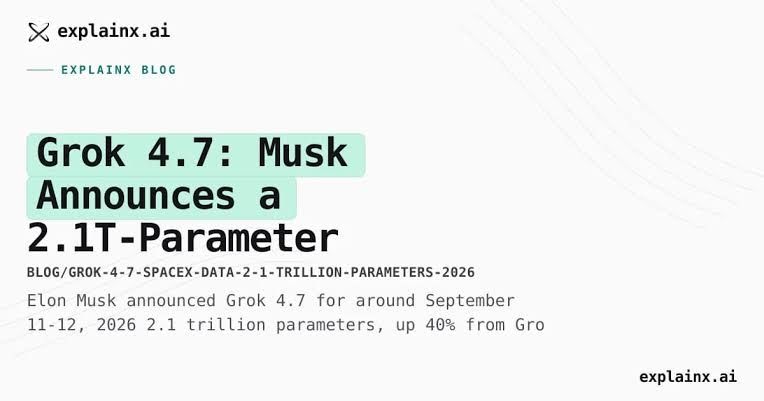
ExplainX’s third-party summary of the reported Grok 4.7 timeline. The graphic is not an official xAI announcement, and its visible summary is truncated.
For the primary timing and capability claims, see Elon Musk’s August 13 X post and his September 2 timing post.
The Grok 4.7 timeline has changed
Musk has discussed Grok 4.7 several times before the latest post:
- In late July, he described Grok 4.6 and Grok 4.7 as successive releases separated by roughly two weeks.
- After Grok 4.6 shipped on August 12, he said Grok 4.7 was about three to four weeks away.
- On September 2, he narrowed the estimate to 10 days.
The schedule has moved enough that September 12 should be treated as a target, not a guaranteed launch date. The model is ready only when xAI publishes a real product surface and developers can verify it.
What is reported about Grok 4.7
Several specifications circulating in coverage trace back to Musk's posts rather than xAI documentation.
A reported 2.1 trillion parameter foundation
Musk has described Grok 4.7 as using a 2.1 trillion parameter foundation, compared with the 1.5 trillion figure he associated with Grok 4.6. xAI has not published architecture details that explain active parameters, routing, memory requirements, or inference cost.
Parameter count alone does not establish model quality. It also does not tell developers how much the model will cost per accepted coding task.
More SpaceX company data
Musk said supplemental training was adding a large amount of SpaceX company data. He later argued that this corpus could make Grok 4.7 especially strong at real-world engineering.
That is a founder claim. xAI has not disclosed the dataset composition, evaluation protocol, safeguards, or whether the training data covers software engineering, aerospace documents, operational telemetry, or some other mix. More specific descriptions should not be repeated as fact without a first-party source.
Better token efficiency but slower serving
Musk has said Grok 4.7 should be better than Grok 4.6 while serving slightly more slowly and using tokens more efficiently. No public tokens-per-second figure, task-level cost comparison, or reproducible benchmark currently supports that claim.
For coding agents, token efficiency can matter more than raw output speed. A slower model may still finish a repository task faster or more cheaply if it takes fewer wrong turns. That needs testing under a real harness, not a parameter estimate.
What Grok 4.6 proves today
Grok 4.6 is the useful baseline because it has official documentation and a callable API ID.
xAI documents Grok 4.6 with:
- the API model ID
grok-4.6; - a 500,000-token context window;
- text and image input with text output;
- configurable
low,medium,high, andxhighreasoning effort; - Responses API and Chat Completions support;
- function calling, web search, X search, and code execution;
- standard pricing starting at $2 per million input tokens, $0.50 per million cached input tokens, and $6 per million output tokens below the long-context threshold.
The detailed pricing and benchmark boundaries are covered in Grok 4.6: What Changed for Long-Running Coding Agents?.
Do not copy those specifications onto Grok 4.7. A successor may keep some values, change them, or launch with different limits across channels.
Need to evaluate a model on a real product task? Use the Atoms AI Coding Assistant to build and test a working application, then compare the accepted result rather than the first response.
What developers should verify at launch
A real Grok 4.7 launch should produce several matching artifacts:
- A dated xAI announcement or release-note entry.
- A documented API model identifier such as
grok-4.7. - Published token pricing, cached-input pricing, and any long-context threshold.
- Context length, modalities, output limits, and knowledge cutoff.
- Supported APIs, tools, regions, and rate limits.
- A model card or safety and access documentation.
- Benchmark results with exact effort settings and harness versions.
- A visible rollout path in the Grok app, API console, Grok Build, or named partners.
A model picker screenshot without working requests is not enough. Neither is an SDK enum added before the backend becomes available.
How to test Grok 4.7 when it ships
The first evaluation should compare Grok 4.7 against Grok 4.6 on fixed tasks. Keep the repository, prompt, tools, permissions, time budget, and acceptance tests the same.
For coding-agent work, measure:
- completion rate against executable tests;
- total input, cached input, and output tokens;
- tool calls and failed tool calls;
- wall-clock time to an accepted result;
- regressions introduced during repair;
- human review time;
- total cost per accepted task.
This separates a real improvement from a longer, more confident answer. It also tests the reported token-efficiency claim in the unit that matters: finished work.
You can use Atoms AI App Builder for a product-level test that includes interface work, code, backend logic, and verification. Atoms does not currently list Grok 4.7 in its public model selector, so this is a workflow recommendation rather than a claim of Grok 4.7 availability.
Should you wait for Grok 4.7?
Wait if your goal is specifically to compare xAI's newest model and your project can tolerate an uncertain date.
Do not wait if work must start now. Grok 4.6 has documented access, pricing, and limits. Build a repeatable evaluation on 4.6, then replay it on 4.7 after the API, price, and release documentation agree.
The latest signal is meaningful: Musk has shortened the public estimate to 10 days. It is not a launch. Until xAI publishes the missing product artifacts, Grok 4.7 remains an upcoming model with founder-reported specifications.
Sources
- Elon Musk: "Grok 4.7 comes out in 10 days"
- xAI Grok 4.6 announcement
- xAI developer release notes
- xAI models documentation
- Grok 4.6 model page on Atoms
Research cutoff: September 3, 2026, 06:09 UTC. This article will need an update when xAI publishes Grok 4.7 documentation or changes the release timeline.
