On this page
Official MiniMax H3 launch artwork, centered for a 16:9 editorial cover — Source
MiniMax H3 is one of the most consequential video-model releases of 2026—not simply because it can generate polished clips, but because MiniMax has published downloadable model checkpoints for a 33-billion-parameter, omni-modal audio-video system.
That does not make the entire H3 pipeline open source in the conventional sense.
The release uses a custom MiniMax H3 Community License. Several important components remain hosted or unreleased. The license also excludes open-weight use in the United States, European Union, United Kingdom, and South Korea unless MiniMax grants separate authorization.
This guide separates five questions that headlines often blur together:
- What can H3 do?
- Which weights and code are downloadable?
- Which parts still depend on MiniMax services?
- What does the license allow?
- How does H3 change the open-weight AI video market?
MiniMax H3 at a Glance
MiniMax announced H3 on July 31, 2026 and published its open-weight release on August 3.
The official system specifications list:
| Category | MiniMax H3 specification |
|---|---|
| Parameters | 33B on the Hugging Face model metadata |
| Output duration | 4–15 seconds |
| Output frame rate | 24 FPS |
| Base resolution | Shorter side defaults to 768 pixels |
| High-resolution workflow | Up to 2K through H3-Regenerate-2K |
| Audio | Native 32 kHz stereo |
| Dialogue | Stable support for 11 listed languages |
| Aspect ratios | Includes 21:9, 16:9, 4:3, 1:1, 3:4, and 9:16 |
| Reference inputs | Text, images, video, and audio |
| Maximum mixed references | 12 files in Ref2VA mode |
| License | MiniMax H3 Community License Agreement |
The 11 languages MiniMax lists as stably supported are Arabic, Chinese, English, French, German, Italian, Japanese, Korean, Portuguese, Russian, and Spanish. Other languages may work to varying degrees.
What “Omni-Modal” Means Here
H3 accepts a context that can combine text, images, video clips, and audio clips. The model is designed to understand relationships among those sources rather than treating each as an isolated mode.
A request can ask the system to:
- borrow camera motion from one video;
- preserve a subject from an image;
- follow rhythm, speech, or sound from an audio reference;
- render the result as a new video with synchronized stereo audio;
- modify an existing clip while preserving selected elements.
This makes H3 relevant to more than text-to-video. Its official and hands-on examples cover:
- first- and last-frame generation;
- subject replacement;
- video-to-video motion transfer;
- visual effects transfer;
- background replacement;
- text and brand rendering;
- animated posters and websites;
- film titles, MV graphics, advertising, e-commerce, UI/UX, and games.
The supplied Chinese tests are especially positive about visual packaging: typography integrated into scenes, logo animation, motion graphics, game UI, stylized advertising, and effects applied to an existing subject without spreading across the whole frame.
Those are selected observations, not universal success rates. One article also reports occasional incorrect numbers and weaknesses in very dramatic cinematic shots compared with Seedance.
H3 Has Two Public Generation Modes
The official release describes two H3-Base variants.
H3-Base-FL2VA
First-and-last-frame audio-video generation supports:
- no image: text-to-video;
- one image: first-frame-to-video or last-frame-to-video;
- two images: first-and-last-frame-to-video.
H3-Base-Ref2VA
Omni-reference audio-video generation supports:
- up to nine images;
- up to three video clips;
- up to three audio clips;
- no more than 12 files in total.
Each video reference must be 2–15 seconds, with no more than 15 seconds of reference video in total. Audio references must accompany an image or video rather than being used alone, and their total duration is also limited to 15 seconds.
These are the open-release specifications. A web product or future API revision may expose different limits, so production code should bind itself to the documentation for the exact route being called.
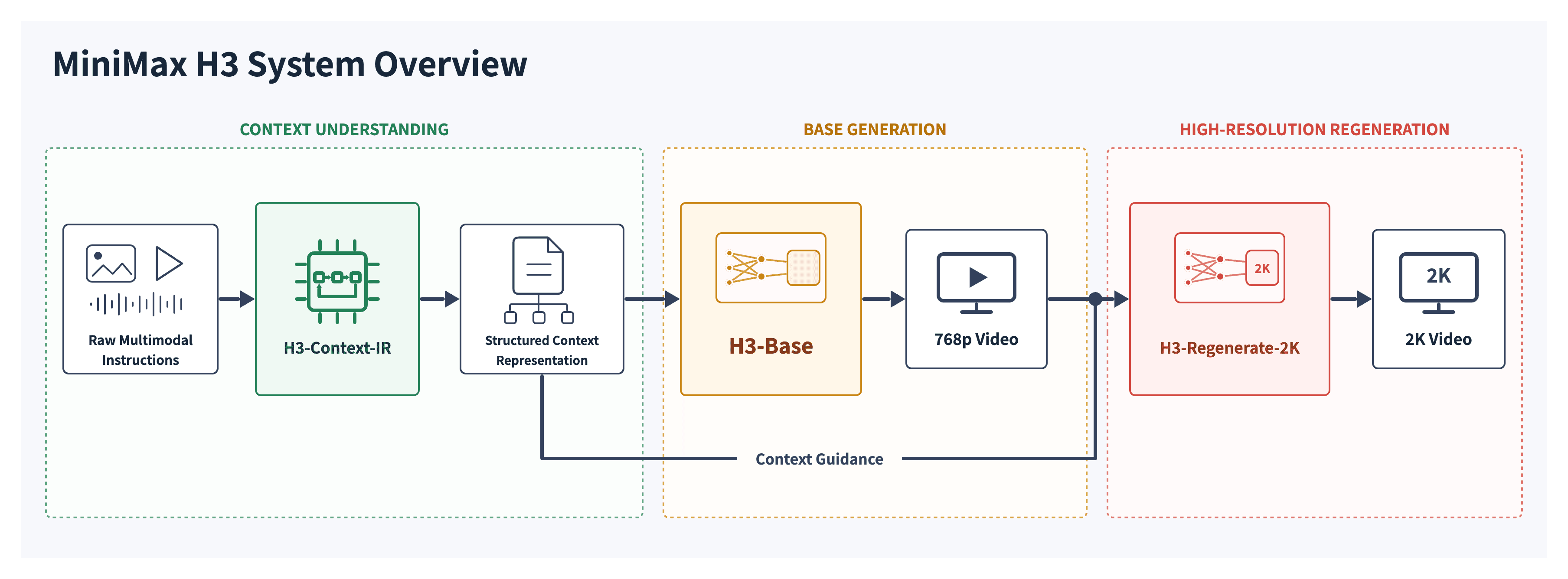
MiniMax presents H3 as a three-module system: hosted context interpretation, 768p base generation, and a separate 2K regeneration stage — Source
The Three-Part H3 System
MiniMax describes the complete workflow as three modules.
H3-Context-IR
H3-Context-IR is a preprocessing and orchestration system for free-form multimodal inputs. It parses instructions, associates information across modalities, reasons about temporal relationships, fills some underspecified details, and serializes the request into a Context Intermediate Representation that H3-Base can use.
This layer matters because “use this movement, keep this character, follow this audio, and change this object” is not one simple prompt. It is a relationship graph across several assets.
H3-Base
H3-Base generates synchronized audio and 768p-class video from the prepared context. The two released checkpoints target first/last-frame and omni-reference workflows.
H3-Regenerate-2K
H3-Regenerate-2K takes the 768p result plus the original context and generates a new high-resolution output. This is regeneration, not a conventional deterministic upscale. The second pass can rebuild details using both the draft and the source context.
That distinction matters for quality control: a 2K result can differ from the approved 768p draft. Teams should compare identity, text, product geometry, timing, and brand elements again after regeneration.
Why MiniMax Rebuilt the Architecture
The supplied hands-on report says MiniMax moved away from the Hailuo-02 architecture and built a new tokenizer. MiniMax's official technical explanation supports the broader architectural shift.
H3 uses:
- a new high-efficiency visual tokenizer;
- an audio VAE for compact acoustic representation;
- an H3 Omni Transformer for synchronized audio-video denoising;
- Contextual Omni Representation for mixed-modal context;
- In-Context Regeneration for the 2K workflow.
The design objective is task generalization. Earlier systems frequently used separate models or pipelines for text-to-video, image-to-video, motion reference, subject reference, voice reference, editing, and first/last frames. H3 attempts to learn these as related context-conditioned tasks within one system.
MiniMax argues that language acts as a scalable connective layer between modalities. The practical benefit is not that every task becomes identical. It is that a common model can interpret a wider range of requests without one specialist checkpoint for every editing operation.
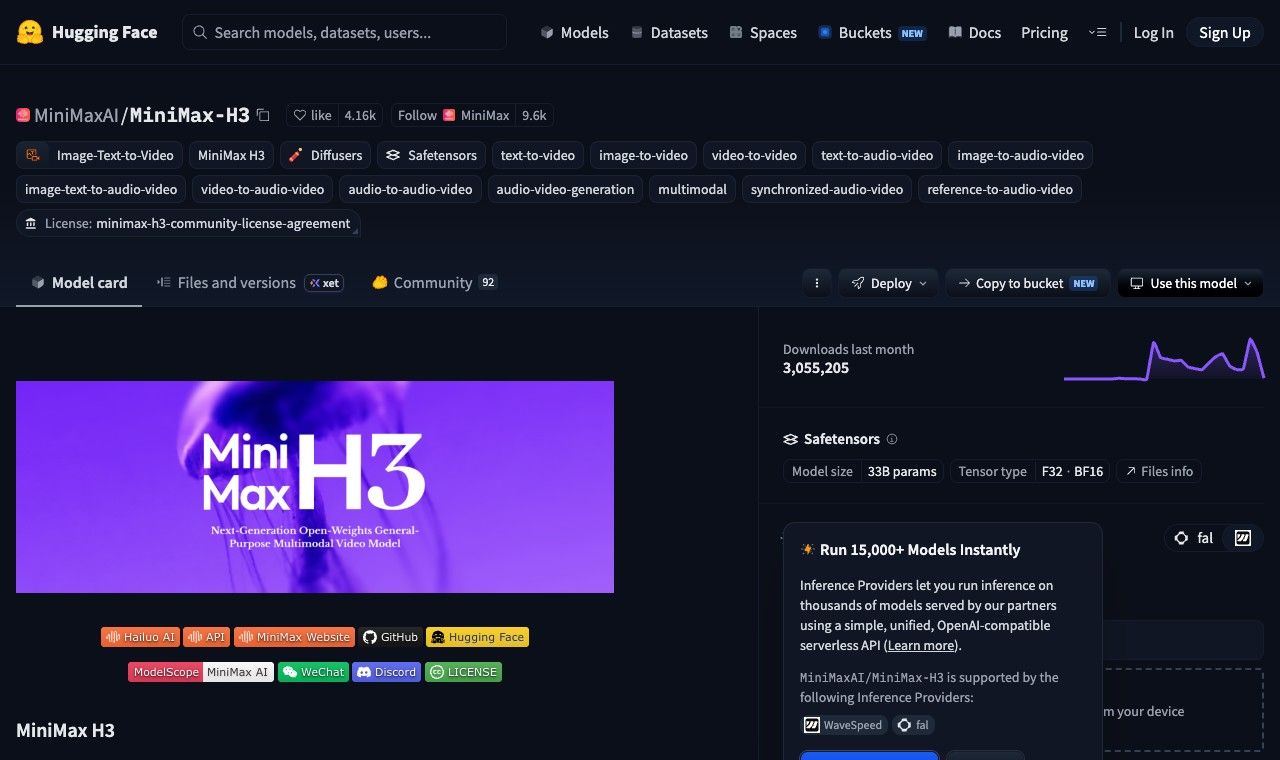
The MiniMaxAI Hugging Face repository labels H3 open weights under the custom MiniMax H3 Community License; some end-to-end components remain hosted — Source
What Is Actually Open?
The MiniMaxAI/MiniMax-H3 Hugging Face repository provides model checkpoints, code, configuration, examples, and local-deployment instructions under the custom community license.
The model card identifies the release as open weights and provides:
- Safetensors files;
- two H3-Base checkpoints;
- Diffusers integration;
- SGLang and vLLM serving guidance;
- ComfyUI references;
- text-to-video, image-to-video, and reference-to-video examples;
- 768p and hybrid 2K workflows.
The narrow, defensible statement is:
MiniMax publishes H3-Base model checkpoints and supporting code under the MiniMax H3 Community License Agreement.
That is materially different from saying the entire end-to-end product is fully open source.
What Is Not Included in the Open Release?
Three caveats are important.
H3-Context-IR remains hosted
The official model card describes Context-IR as a hosted preprocessing and orchestration system. It is critical to translating complex free-form inputs into the representation used by H3-Base, but it is not included as a fully local component.
MiniMax provides prompting guidance so developers can build their own context-processing layer, but that is not necessarily equivalent to the hosted service.
H3-Regenerate-2K is not fully open
The base release produces 768p-class output. The official 2K workflow calls the hosted regeneration service after local base generation.
Therefore, “H3 is an open 2K model” needs qualification. Open H3-Base can produce the draft; the official high-resolution regeneration component is still a hosted dependency at the research cutoff.
Some optimization components were not initially published
The model card also notes that parts such as the sparse-attention implementation were not included in the initial release. Local hardware requirements and performance may therefore differ substantially from MiniMax's managed service.
Open Weights Is Not the Same as an OSI Open-Source License
Hugging Face labels the repository with minimax-h3-community-license-agreement, not Apache-2.0, MIT, or another standard permissive license.
The agreement grants rights only within its defined Applicable Territory and imposes additional use and commercial conditions. It is more accurate to call H3 an open-weight model with source-available code under a custom license.
Developers should not infer that “downloadable” means unrestricted.
The Territory Restriction
The Community License defines its Applicable Territory as worldwide except:
- the European Union;
- the United Kingdom;
- the Republic of Korea;
- the United States of America.
The agreement says use, reproduction, modification, distribution, display, and even use of outputs outside the Applicable Territory are not authorized under that license.
MiniMax's license Q&A says this is a temporary compliance decision related to evolving likeness, copyright, content-safety, and generative-video regulation. Organizations in excluded regions can apply for a formal license.
This is not legal advice. Any team planning deployment, distribution, fine-tuning, output use, or a hosted H3 service should review the current agreement and obtain qualified advice for its jurisdiction.
API Access Is Different From Open-Weight Access
MiniMax says its API remains globally available because MiniMax operates the serving infrastructure and can enforce safeguards for copyright, minors, misuse, and content safety.
That creates two separate routes:
| Route | Control | Geographic model |
|---|---|---|
| MiniMax API / Hailuo | MiniMax operates the service and safety controls | Described by MiniMax as globally available |
| Downloaded H3 weights | User deploys or modifies the model | Custom license excludes four major territories without authorization |
Do not assume that API availability grants the right to download and deploy the weights locally—or that the open-weight license controls every API output. Check the terms for the route actually used.
Commercial Terms and Attribution
The license includes additional commercial conditions. Among them:
- products or services generating more than $20 million in yearly revenue require prior written authorization from MiniMax;
- a commercial product or service using H3 must prominently display “MiniMax H3” in its interface;
- users must pass enforceable restrictions to recipients of products or hosted services incorporating the model;
- H3 works or outputs may not be used to improve another AI model, except H3 or its derivatives.
These terms make licensing part of architecture planning—not a footer task after deployment.
Is the 33B Model Easy to Run Locally?
No.
A 33B diffusion-transformer audio-video system is far heavier than a typical image model. The repository's existence does not imply desktop-friendly inference at 2K.
Actual requirements depend on:
- FL2VA or Ref2VA mode;
- duration and aspect ratio;
- number and duration of references;
- BF16 versus quantized weights;
- offloading and attention implementation;
- base generation versus regeneration;
- the serving stack and GPU interconnect.
Community quantizations and LoRA work can lower the barrier, but they may change quality, speed, compatibility, or licensing obligations. Use a short, low-resolution acceptance test before committing to local infrastructure.
What the Benchmarks Do—and Do Not—Show
MiniMax cites leading performance and price-performance. Third-party Artificial Analysis results support a narrower claim: H3 is a strong open-weight video model.
At the August 19 research cutoff:
- Artificial Analysis showed H3 leading open-weight text-to-video without audio at 1,305 Elo;
- it showed H3 leading open-weight image-to-video without audio at 1,352 Elo;
- on the global with-audio video-editing table, H3 was second, in a statistical range tied with Gemini Omni Flash, behind Wan 3.0;
- H3's editing row showed 1,132 Elo from 12,565 samples and an API-pricing estimate of $7.80 per minute at the leaderboard's normalized settings.
Leaderboards are dynamic. Filters, audio mode, resolution, provider, sample count, and date all matter. These results do not establish that H3 is the best choice for every cinematic, advertising, game, or product workflow.
Where H3 Looks Most Differentiated
The three supplied hands-on articles converge on one strength: H3 is unusually capable at visual packaging and controlled post-production-style work.
Promising tasks include:
- integrating large, legible typography into a shot;
- turning posters into animated campaign assets;
- lyric videos and VJ graphics;
- logo reveals and event openers;
- UI and game-menu animation;
- transferring a visual effect from a reference clip;
- replacing characters, products, vehicles, colors, or backgrounds;
- producing several campaign variants from one source asset;
- adding sound and dialogue while preserving the edit.
That makes H3 interesting to design, advertising, e-commerce, games, and motion-graphics teams—not just filmmakers.
The usual caveats remain: small text can fail, exact product geometry can drift, a local edit can alter more than intended, and the best published examples do not reveal retry cost.
A Production Evaluation Checklist
Before choosing H3, build a fixed test package with:
- a product with exact geometry and readable labels;
- two characters with distinct voices;
- one motion-reference clip;
- one style or effect-reference clip;
- three pieces of required on-screen text;
- one background replacement;
- one color or product variant;
- one 768p-to-2K regeneration.
Measure:
- total generations and cost;
- accepted seconds;
- text accuracy by frame;
- identity and geometry drift;
- unintended changes outside edited regions;
- stereo, dialogue, and lip-sync failures;
- time spent building Context-IR or prompts;
- local GPU time and peak memory;
- differences between base and regenerated output.
The useful metric is total workflow cost per accepted finished second—not the price of the best single attempt.
Can You Use MiniMax H3 on Atoms?
No dedicated MiniMax H3 model page was found on Atoms at the research cutoff. This article does not imply that H3 is currently integrated.
You can explore available video and multimodal models in the Atoms Models catalog, including Seedance 2.0 on Atoms. Atoms can also support the surrounding workflow: turn a creative brief into a shot list, create prompt and reference manifests, generate QA checklists, and build internal review tools with frontier GPT, Claude, Qwen, GLM, and other models.
For a direct workflow decision, continue with MiniMax H3 vs Seedance 2.5.
The Bottom Line
MiniMax H3 matters because it brings competitive multimodal audio-video generation to an open-weight release and targets tasks that conventional video generators often handle poorly: typography, motion graphics, UI, brand packaging, effect transfer, and natural-language editing.
But four qualifications belong in every serious evaluation:
- H3-Base checkpoints are open; the full H3 workflow is not fully local.
- The official 2K path uses a hosted regeneration component.
- The custom license restricts geography, commercial use, attribution, and downstream behavior.
- Open weights do not make a 33B audio-video model cheap or simple to deploy.
H3 expands the choices available to video teams. It does not remove the need for infrastructure planning, rights review, benchmark discipline, and human quality control.
Frequently asked questions
01Is MiniMax H3 open source?
MiniMax calls H3 open source, but the precise description is open weights and supporting code under the custom MiniMax H3 Community License. Important workflow components remain hosted or unreleased.
02How large is MiniMax H3?
The Hugging Face model metadata lists 33 billion parameters.
03Can H3 generate 2K video locally?
The open H3-Base checkpoints generate 768p-class output. MiniMax's official 2K workflow uses H3-Regenerate-2K, which was still a hosted component at the research cutoff.
04How long are H3 clips?
The official open-release specification is 4–15 seconds at 24 FPS.
05Does H3 generate audio?
Yes. It generates native 32 kHz stereo audio and lists stable dialogue support for 11 languages.
06Can H3 edit video?
Yes. H3 supports reference-to-video workflows, element replacement, motion and effect transfer, background changes, text rendering, and other instruction-driven editing tasks.
07Can developers in the US or EU run the weights?
Not under the standard Community License. The US, EU, UK, and South Korea are excluded territories; organizations can apply to MiniMax for a formal license.
08Is MiniMax H3 on Atoms?
No dedicated H3 model page was found at the research cutoff. Use the broader Atoms Models catalog to see currently available models.
Sources
Research cutoff: August 19, 2026.
- MiniMax: H3 launch article
- MiniMax: H3 open-source announcement
- MiniMaxAI/MiniMax-H3 on Hugging Face
- MiniMax-AI/MiniMax-H3 on GitHub
- MiniMax H3 Community License
- MiniMax H3 license Q&A
- MiniMax API video-generation guide
- Artificial Analysis: MiniMax H3
- Artificial Analysis: Video Editing Leaderboard
- Crossing: MiniMax H3 hands-on test
- Digital Life Khazix: H3 visual-packaging test
- Maoli Zhiyuan: H3 commercial-use tests
