On this page
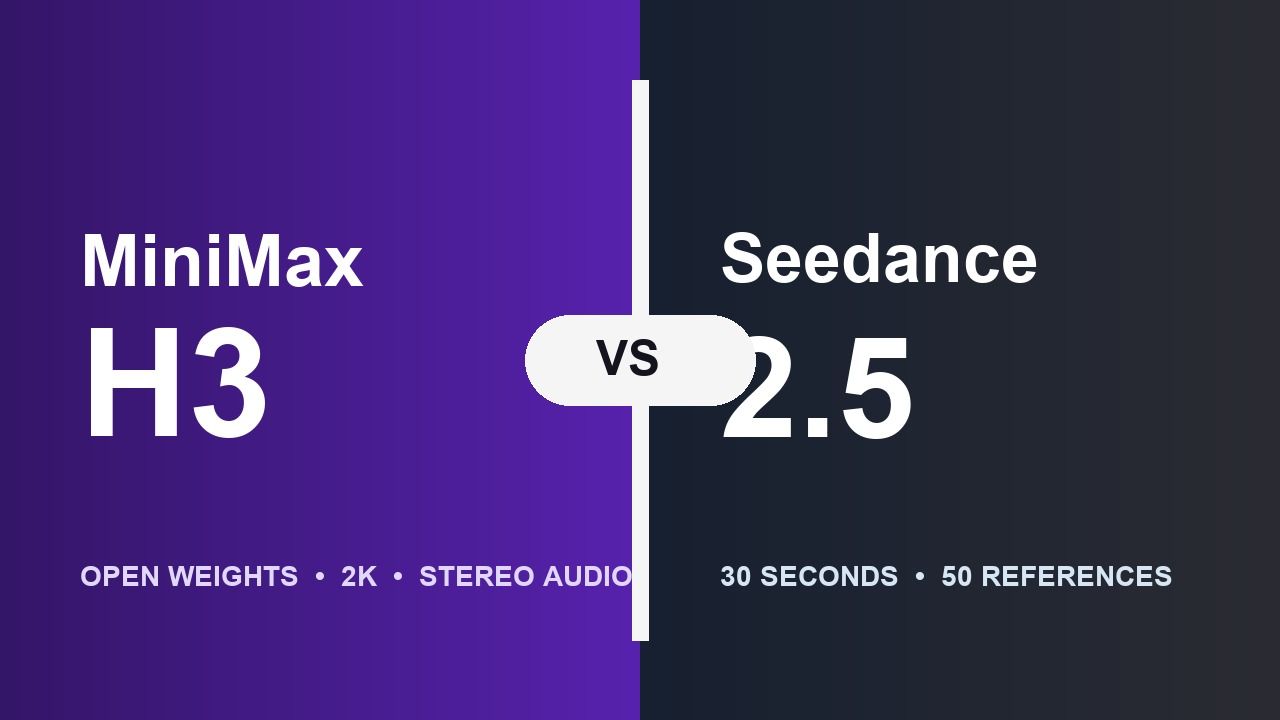
Independent editorial comparison graphic; the layout does not imply vendor affiliation or endorsement
MiniMax H3 and Seedance 2.5 launched on the same day, but they are not trying to win in exactly the same way.
MiniMax H3 emphasizes open weights, 2K regeneration, native stereo audio, multimodal editing, typography, UI, motion graphics, effects, and commercial visual packaging.
Seedance 2.5 emphasizes 30-second storytelling, up to 50 reference assets, multi-round extension, timestamp control, green-screen editing, clay-render guidance, and a broader hosted production workflow.
Calling them a simple “top two” misses the practical choice.
Choose the model whose constraints match your delivery pipeline—not the one with the best isolated demo.
This comparison separates official specifications, third-party leaderboard evidence, and selected hands-on observations from the supplied Chinese tests.
Quick Verdict
Choose MiniMax H3 first when you need:
- downloadable base checkpoints in a permitted territory;
- native stereo audio;
- up to 2K through regeneration;
- visual packaging, typography, motion graphics, logo animation, UI, MV, or ad work;
- video-to-video effect or motion transfer;
- a custom deployment or fine-tuning path;
- shorter 4–15 second assets.
Choose Seedance 2.5 first when you need:
- up to 30 seconds in one pass;
- as many as 50 reference assets;
- longer narrative structure and multi-round extension;
- green-screen and clay-render workflows;
- timestamp-level changes and camera instructions;
- a managed product workflow rather than operating a 33B model;
- film, commercial, game-cinematic, and previsualization workflows that benefit from more narrative room.
Neither model is a guaranteed replacement for editing, compositing, 3D, asset management, or human direction.
MiniMax H3 vs Seedance 2.5 Specs
| Category | MiniMax H3 | Seedance 2.5 |
|---|---|---|
| Launch | July 31, 2026 | July 31, 2026 |
| Open-weight release | August 3, 2026 | No official open-weight release found |
| Native duration | 4–15 seconds | Up to 30 seconds |
| Longer output | 15-second maximum per base output; workflows can assemble or continue externally | Multi-round extension for longer videos |
| Base resolution | Shorter side defaults to 768 pixels | Product/interface dependent |
| High resolution | Up to 2K through H3-Regenerate-2K | Official launch focuses on generation and workflow; verify route-specific resolution |
| Frame rate | 24 FPS | Not specified on the official launch page reviewed |
| Native audio | 32 kHz stereo | Joint audio-video generation |
| Reference inputs | Up to 9 images, 3 videos, 3 audio clips; 12 files total | Up to 30 images, 10 videos, 10 audio clips |
| Editing | Reference-to-video, replacement, motion/effect transfer, text/brand rendering | Timestamp, green screen, camera perspective, reference-based editing |
| 3D/previs control | Reference workflows; less emphasis in official launch | Clay-render/white-model control is a headline capability |
| License/deployment | Custom community license with territorial and commercial restrictions | Hosted product/API terms |
| Strongest positioning | Open-weight multimodal video and visual packaging | Longer hosted storytelling and production control |
The table does not establish quality. It defines the operating envelope.
Duration: 15 Seconds vs 30 Seconds
Seedance 2.5 has the clear official advantage in single-pass duration: up to 30 seconds, compared with H3's 4–15 seconds.
That matters for:
- dialogue with setup and response;
- action that crosses several shots;
- short narrative arcs;
- product demonstrations;
- music and performance sequences;
- sequences where cutting and restarting would cause identity drift.
ByteDance says Seedance can organize setup, development, turn, and resolution within one 30-second result, then extend it through multiple rounds.
H3's shorter window is not necessarily a weakness for motion graphics, campaign cutdowns, product variants, title sequences, social ads, game UI, and VFX-style inserts. Many of those assets naturally live in the 5–15 second range.
The useful question is not “Which clip is longer?” It is “How long must one continuity-safe unit be before my editor can assemble it reliably?”
Resolution: H3's 2K Claim Needs Context
MiniMax describes H3 as generating video up to 2K, but the open workflow is two-stage:
- H3-Base generates a 768p-class audio-video result.
- H3-Regenerate-2K uses the base result plus the original context to create a new 2K output.
At the research cutoff, the official regeneration component remained hosted rather than fully included with the open base release.
This is not merely a pixel upscale. Regeneration can improve detail, but it can also change approved elements. Product labels, faces, text, timing, and geometry should be checked again.
Seedance 2.5 resolution varies by product and route. The official launch materials reviewed here focus more on 30-second generation, reference capacity, and editing than on one universal global output resolution. Do not copy a “native 4K” claim across every Seedance interface without checking the exact product.
References: Seedance Supports a Larger Production Brief
Seedance 2.5 accepts up to:
- 30 images;
- 10 videos;
- 10 audio clips.
H3 Ref2VA accepts up to:
- 9 images;
- 3 videos;
- 3 audio clips;
- 12 mixed files total.
Seedance therefore supports a much larger formal reference package. This can matter for a commercial with several products, multiple characters, location references, wardrobe, motion, music, and style frames.
More references are not automatically better. They create a reference-governance problem:
- Which source owns identity?
- Which defines camera motion?
- What happens when two style references conflict?
- Does one audio clip control rhythm while another controls voice?
- Can the team reproduce the exact package six weeks later?
H3's smaller limit may be enough for a more focused edit. Seedance's larger context is more useful when a project genuinely needs many authoritative assets.
Editing: H3 Is Strong at Visual Packaging
All three supplied H3 articles converge on the same observation: H3 is unusually effective at graphic and post-production-style tasks.
Tests include:
- adding large words such as “Origin,” “Fire,” and “Beyond” into a continuous shot;
- turning static posters into animated layouts;
- creating lyric and VJ graphics;
- replacing actors with a reference character while preserving motion and lighting;
- transferring a pixel-rainbow effect to a monster without spreading it to the background;
- logo reveals, event openers, fashion campaigns, e-commerce ads, and game UI;
- changing a vehicle's color or model while retaining camera and lighting.
H3's instruction-following can be a major advantage when the job is “make this exact piece of visual communication move.”
The same reviewer notes a trade-off: strict semantic execution may produce less cinematic tension than Seedance in some dramatic shots. H3 can also generate incorrect small text or numbers.
Editing: Seedance Is Strong at Timeline and Production Control
Seedance 2.5's official workflow emphasizes:
- edits assigned to specific time ranges;
- character, action, or plot changes inside selected clips;
- camera-only revisions;
- green-screen replacement;
- preservation of the main subject in a new environment;
- clay-render structure for blocking, trajectory, and camera movement;
- multi-round extension while maintaining character, environment, and pacing.
This makes Seedance attractive when the production starts with a shot plan or 3D previs rather than a finished clip that needs visual packaging.
The distinction is not absolute. Both models generate and edit. But their product stories differ:
- H3 feels like a multimodal generator-editor with a strong motion-design and packaging bias.
- Seedance feels like a hosted creation workflow trying to move from brief and reference package toward a longer sequence.
Audio
H3's open-release specification is unusually explicit: 32 kHz stereo, with stable dialogue support for 11 languages.
Seedance 2.5 also uses joint audio-video generation and official examples combine dialogue, music, effects, and synchronized visuals. The launch page does not provide the same concise audio specification table.
For either model, test:
- voice identity across multiple speakers;
- lip sync;
- pronunciation of brand and product names;
- music rights;
- unwanted lyrics or background speech;
- stereo placement;
- whether a visual edit changes unaffected audio.
A GitHub issue on H3 reports speaker-routing bleed in some multi-character dialogue scenarios. That is a community report, not a measured failure rate, but it belongs in a multi-speaker QA plan.
Open Weights: H3 Wins Access but Carries a License Catch
Seedance 2.5 is a hosted ByteDance product. H3 publishes downloadable H3-Base checkpoints and code.
That gives H3 potential advantages:
- controlled deployment;
- deeper integration;
- custom optimization;
- fine-tuning and LoRA development;
- reduced dependency on one hosted API;
- private asset processing where the license permits it.
But H3's custom license excludes standard open-weight use in the US, EU, UK, and South Korea without separate authorization. The full workflow is also not completely open: H3-Context-IR and H3-Regenerate-2K remain hosted or unavailable locally in the official release.
“Open weights” is therefore a real advantage, but not a universal deployment permission.
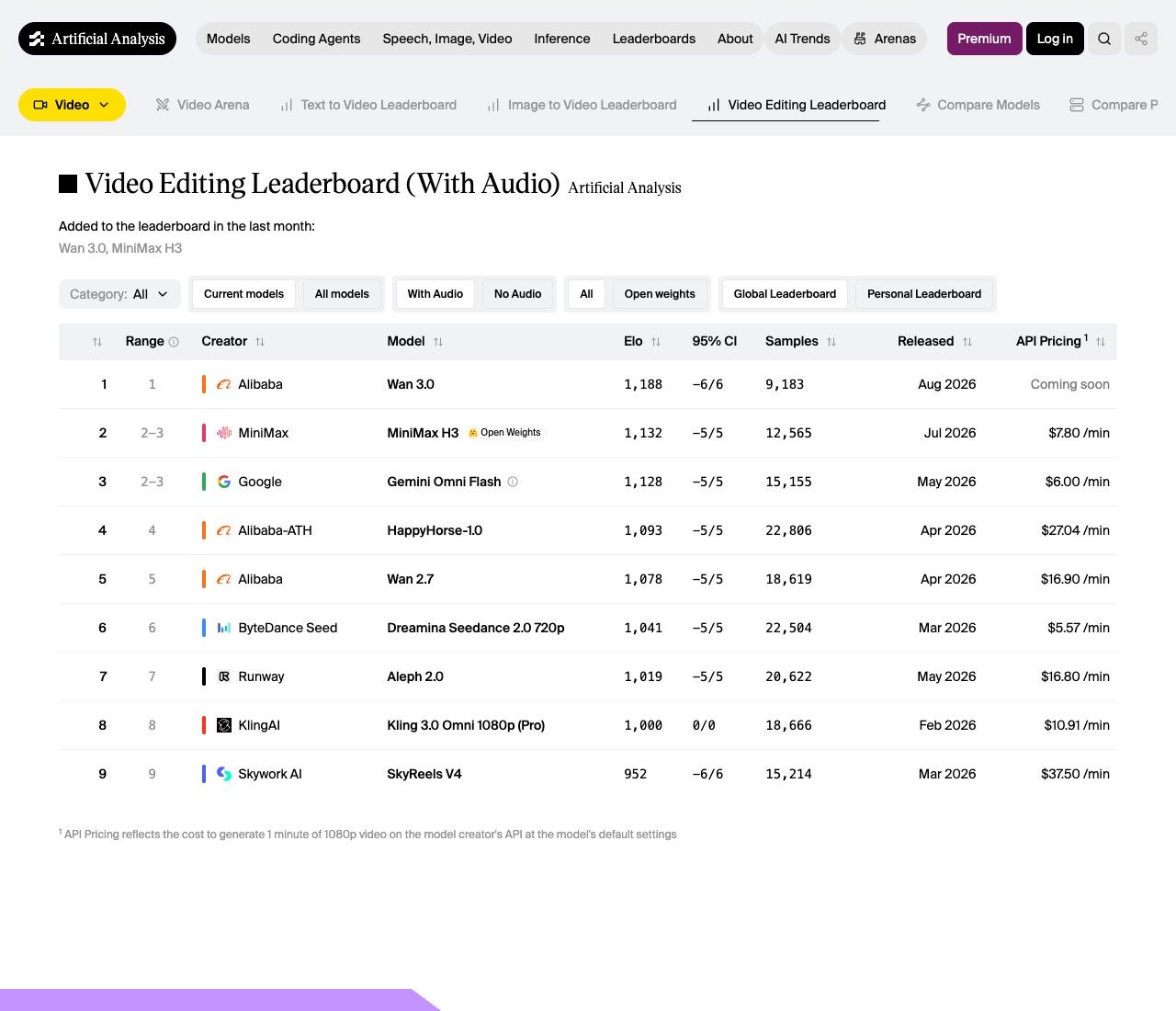
Artificial Analysis global current-model Video Editing leaderboard with audio, captured August 19, 2026. It includes Seedance 2.0—not Seedance 2.5—so it cannot prove H3 beats Seedance 2.5 — Source
What the Third-Party Editing Leaderboard Shows
Artificial Analysis provides one useful, time-stamped comparison—but not a complete H3-vs-Seedance-2.5 result.
On August 19, 2026, with these filters:
- Video Editing;
- With Audio;
- Current models;
- All models;
- Global Leaderboard;
MiniMax H3 ranked second with:
- 1,132 Elo;
- a ±5 confidence interval;
- 12,565 samples;
- $7.80 per minute in the site's normalized API-pricing column.
Wan 3.0 ranked first at 1,188. Gemini Omni Flash was statistically tied in the 2–3 range at 1,128.
The table included Dreamina Seedance 2.0 720p, not Seedance 2.5. Seedance 2.0 ranked sixth at 1,041. Therefore, the leaderboard cannot be used to claim that H3 beats Seedance 2.5.
This corrects a common category error in the supplied articles: “same class as Seedance” may be a useful editorial impression, but the available editing leaderboard is not a controlled H3-vs-Seedance-2.5 benchmark.
Cost: Compare Accepted Output, Not Sticker Price
One supplied H3 test quotes a low per-second price, and MiniMax says its 2K pricing is less than one-third of mainstream alternatives. Prices vary by Hailuo plan, API route, resolution, provider, discounts, and region.
Seedance pricing also varies by Jimeng, Doubao, Dreamina, BytePlus, resolution, and provider.
A fair comparison requires the same delivery brief and these metrics:
- generation price;
- retries;
- queue and latency;
- local GPU cost for H3;
- prompt and Context-IR preparation time;
- failed text or logo renders;
- continuity repair;
- post-production labor;
- high-resolution rechecks;
- final accepted seconds.
Use:
total model + infrastructure + human repair cost ÷ accepted finished seconds
A cheaper model can be more expensive if it requires five retries. A longer model can be more expensive if only eight of 30 seconds are usable.
Advertising and E-Commerce
Prefer H3 when
- the deliverable is a 6–15 second campaign unit;
- typography and brand packaging are central;
- one product asset must produce many variants;
- you need logo animation, UI, title cards, or effect transfer;
- local or customized deployment is valuable and permitted.
Prefer Seedance when
- the ad has several narrative beats;
- the brief includes many product, talent, location, and audio references;
- green-screen footage must be re-environmented;
- the team needs explicit timestamp and camera edits;
- the campaign depends on a managed creative workflow.
For exact products, neither model should be trusted without geometry and label checks.
Film, Short Drama, and Music Video
Prefer H3 when
- you are producing titles, lyric graphics, VJ loops, logo packages, effects, or short inserts;
- stereo audio and multilingual speech are important;
- the team wants to customize the base model.
Prefer Seedance when
- a scene needs up to 30 seconds of connected storytelling;
- character and environment continuity must survive several shots;
- clay render or previs controls camera and blocking;
- multiple extension rounds are part of the plan.
For long-form film, both remain components rather than complete autonomous studios. Story, continuity, asset tracking, editorial judgment, rights, and finishing still sit outside the model.
Games and UI
H3's selected tests show a strong fit for:
- game menus;
- animated character promos;
- cyberpunk UI;
- high-contrast effects;
- product-site motion;
- promotional packaging.
Seedance's white-model and clay-render workflow fits:
- environment previs;
- camera-path visualization;
- blocking;
- cinematic concepts from early 3D assets;
- converting scene structure into a styled preview.
A hybrid workflow is plausible: use Seedance to explore the scene and camera, then use H3 for title, UI, logo, effects, or short campaign variants. This is a workflow hypothesis, not a verified interoperability feature.
Self-Hosting and Data Control
H3 can be the better architectural choice for teams that need to control where assets are processed—but only if:
- their territory is licensed;
- they can operate the infrastructure;
- required components are actually local;
- the custom license fits the product;
- the quality difference from the managed Hailuo service is acceptable.
Seedance is easier operationally because the provider handles inference and product integration. That also means uploading valuable references to a hosted service and accepting its terms, regional availability, safety controls, and retention policies.
Review the current data and product terms for both routes before using confidential unreleased media.
Which Model Should You Choose?
| Workload | First model to test | Why |
|---|---|---|
| 30-second narrative scene | Seedance 2.5 | Longer native window |
| Motion graphics and title design | MiniMax H3 | Strong packaging and text-oriented examples |
| Many-reference brand production | Seedance 2.5 | Up to 50 reference assets |
| Open-weight experimentation | MiniMax H3 | Downloadable H3-Base checkpoints |
| Green-screen advertising | Seedance 2.5 | Explicit official workflow |
| Logo animation and campaign cutdowns | MiniMax H3 | Short-form packaging fit |
| Clay-render game previs | Seedance 2.5 | Explicit spatial/camera control |
| Game UI promotional clip | MiniMax H3 | UI and typography strengths |
| Multi-minute assembly | Seedance 2.5 | Multi-round extension, still requires QA |
| Restricted-region local deployment | Neither by default | H3 license blocks standard use; Seedance is hosted |
This is a starting order, not a universal ranking.
Run a Controlled Head-to-Head Test
Use the same reference package and delivery rubric.
Brief A: commercial
- one product with exact labels;
- one human subject;
- one color change;
- one logo reveal;
- required text at a fixed time;
- stereo sound and one spoken line.
Brief B: cinematic
- two recurring characters;
- three connected shots;
- one camera path;
- one complex physical interaction;
- one extension or continuation;
- fixed wardrobe and prop state.
Brief C: game/UI
- one character sheet;
- one clay or graybox scene;
- one UI menu;
- one stylized effect;
- two readable labels;
- one camera transition.
Record generations, cost, latency, accepted seconds, text errors, identity drift, product changes, audio failures, human repair, and delivery time.
Using Atoms Around the Workflow
No dedicated MiniMax H3 or Seedance 2.5 model page was found on Atoms at the research cutoff. Do not assume either latest model is integrated.
Seedance 2.0 is available on Atoms, and the broader Atoms Models catalog includes frontier models that can help with the work around video generation:
- turn treatments into shot lists;
- generate structured H3 or Seedance prompts;
- create reference manifests and rights checklists;
- build asset-review and approval tools;
- compare outputs with a shared rubric;
- generate subtitles, metadata, and campaign variants.
For the open-weight and licensing details behind H3, read MiniMax H3 Explained.
The Bottom Line
MiniMax H3 and Seedance 2.5 represent two important directions in AI video.
H3 pushes toward an open-weight, customizable multimodal generator-editor with native stereo audio and unusually strong visual packaging.
Seedance pushes toward a hosted production system with longer shots, more references, timeline control, green screen, clay render, and extension.
H3 is not universally “better at post,” and Seedance is not universally “better at film.” Those descriptions are useful hypotheses from launch materials and early tests. The winner depends on the exact artifact, reference package, rights model, infrastructure, retry rate, and human repair burden.
Choose by accepted output—not by launch-day spectacle.
Frequently asked questions
01Is MiniMax H3 better than Seedance 2.5?
Not across every task. H3 has stronger open-weight access, explicit stereo specifications, 2K regeneration, and promising visual-packaging tests. Seedance provides a longer native window, many more references, and deeper hosted production controls.
02Which model is better for AI video editing?
H3 is compelling for typography, UI, effect transfer, replacement, and motion-design work. Seedance is compelling for timestamp edits, green screen, camera changes, clay-render control, and longer continuity.
03Which model is open source?
H3 publishes base checkpoints under a custom community license. The entire H3 workflow is not fully open, and the license excludes open-weight use in several major territories. Seedance 2.5 is hosted and not open weight.
04Which model makes longer clips?
Seedance 2.5 supports up to 30 seconds in one pass. H3 supports 4–15 seconds.
05Which model supports more references?
Seedance supports up to 50 reference assets. H3 Ref2VA supports up to 12 mixed files.
06Does H3 beat Seedance on Artificial Analysis?
The August 19 video-editing leaderboard included H3 and Seedance 2.0, not Seedance 2.5. It cannot prove that H3 beats Seedance 2.5.
07Can I use H3 or Seedance 2.5 on Atoms?
No dedicated page for either latest model was found at the research cutoff. Seedance 2.0 is available on Atoms.
Sources
Research cutoff: August 19, 2026.
- MiniMax H3 launch article
- MiniMax H3 open-weight announcement
- MiniMax H3 on Hugging Face
- MiniMax H3 Community License
- ByteDance Seedance 2.5 model page
- ByteDance Seedance 2.5 launch article
- Artificial Analysis Video Editing Leaderboard
- Crossing H3 hands-on test
- Digital Life Khazix H3 packaging test
- Maoli Zhiyuan H3 commercial tests
- Atoms Seedance 2.5 production-workflow review
