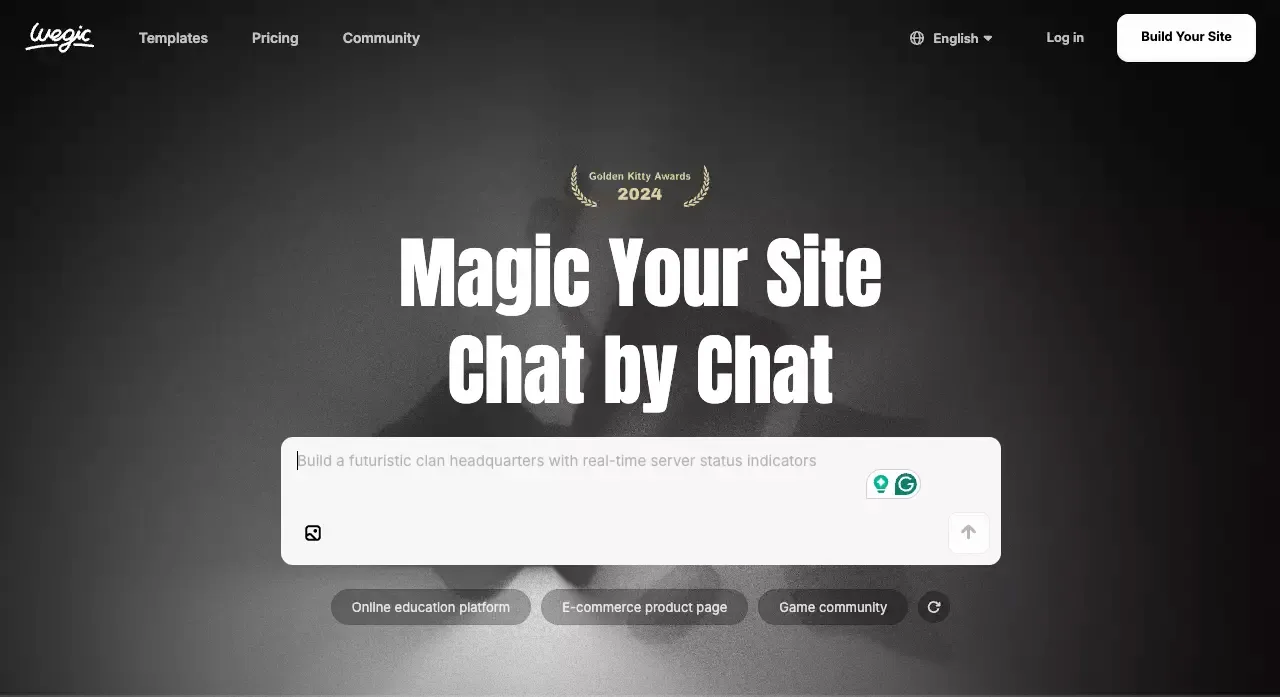
 If you are looking for a Wegic alternative, you are probably not just asking, “What else exists?” You are really asking a more practical question: what should I use if Wegic feels a bit too limited, too simple, or just not quite right for the kind of site I want to launch?
A lot of “Wegic alternatives” pages online are noisy. Some software directories mix in tools that are not true substitutes for an AI website builder. That makes comparison harder than it should be. So in this article, I am focusing on the options that make sense in the real world, not just the ones that happen to appear on broad competitor lists.
Wegic is easy to understand. Its appeal is speed. You describe the site you want in chat, AI generates it, and you publish without much setup. That is exactly why many beginners find it appealing, especially if they like a text-to-website workflow.
But that same simplicity can become the reason people start looking elsewhere. In my experience, the first AI-generated draft is rarely the hard part. The harder part comes later: refining the design, improving SEO, adding structure, connecting business workflows, and growing the site into something that still works a month later. That is where alternatives start to matter.
Why People Look for a Wegic Alternative
What Wegic gets right is speed. It is clearly designed for users who want a conversational, low-friction path from idea to live site. That works well for basic business pages, quick launches, and users who do not want to deal with layout systems or technical setup.
Where some users outgrow it is not necessarily in the first hour, but in the next few weeks. Once you care more about fine design control, SEO structure, content workflows, app-like functionality, or long-term flexibility, the question changes from “Can AI make me a site?” to “Can I keep shaping this thing without fighting the platform?”
That is the lens I used for this comparison.
How I Evaluated the Best Wegic Alternatives
I looked at each alternative through five practical filters:
- Speed to first draft: how fast it gets you to something usable
- Editing flexibility: how much room you have to refine the site after AI generates it
- SEO and publishing control: whether the platform gives you real control over structure and search visibility
- Use-case fit: whether it works for small business sites, marketing sites, landing pages, or product-style builds
- Long-term ceiling: whether the tool still makes sense once your needs get more serious
A fast homepage draft is nice. But for most users, the real question is whether the platform still works once the project grows up a little.
Quick Comparison Table
| Tool | Best For | Main Strength | Main Trade-Off |
|---|---|---|---|
| Atoms | Projects that may grow beyond a simple website | More room to expand into product workflows | Broader scope may be more than some users need |
| Framer | Design-led marketing websites | Strong visual polish and modern site feel | Slightly higher learning curve |
| Durable | Fast small business launches | Very quick setup | Less depth for customization |
| Webflow | Advanced customization | High ceiling and strong control | More complex than beginner-first tools |
| Wix | Beginner-friendly all-around use | Balanced and practical | Less specialized |
| Dorik | Lightweight no-code websites | Good structure without too much complexity | Not as powerful as higher-end platforms |
| 10Web | AI website creation with WordPress flavor | Familiar path for WordPress-minded users | More moving parts than closed builders |
| Hostinger Horizons | All-in-one AI build and launch workflow | Simple bundled setup | More opinionated environment |
The Best Wegic Alternatives in 2026
1. Atoms
If Wegic feels too light once your project starts becoming more than a simple marketing site, Atoms is one of the strongest alternatives. It feels broader from the start. Instead of acting only as a website generator, it is better suited to people who may need something larger over time.
What I like here is the direction of travel. Wegic is attractive because it removes complexity. Atoms is interesting because it removes some complexity without trapping you in a tiny box. If your site may later need sign-in, dashboards, content workflows, payments, or a broader product layer, Atoms makes more sense than a pure brochure-site builder. That is especially true if you want an AI app builder mindset instead of only a page generator, or if you expect to add an AI dashboard builder layer later.
It is also a better fit for people who think in terms of launch and iteration, not just page generation.
Best for:
- Founders building something beyond a simple site
- Small teams that care about growth and flexibility
- Users who may later need product-like functionality
2. Framer
Framer is one of the clearest picks if your main issue with Wegic is design quality. It helps you move quickly, but it also gives you more visual control once the first draft is done.
My view is simple: Framer is not the easiest builder in the world, but that is part of why it produces stronger-looking sites. It asks a little more from you, and in return it gives you more visual range. If Wegic feels convenient but visually generic, Framer is the upgrade path I would look at first, and a detailed Framer review helps explain why.
Best for:
- Startups that want polished marketing sites
- Designers and marketers who care about visual detail
- Teams that want modern layouts and interactions
3. Durable
Durable is built around one promise that many small business owners love: speed. It is one of the few tools here that competes with Wegic on the same emotional promise. Less setup. Less friction. Faster launch.
I think Durable is strongest when you do not want a web design project at all. You just want to get online, look credible, and move on to running the business. That makes it a very practical option for solo operators and service businesses, especially for use cases close to an AI local business website builder.
The trade-off is clear. You usually choose Durable for momentum, not for deep customization.
Best for:
- Solo operators
- Local service businesses
- Users who care more about speed than precision
4. Webflow
Webflow sits in a different class from Wegic. It is a stronger fit for users who start with convenience in mind but later realize they need real control.
I would not call it the easiest switch for a total beginner. I would call it the most logical switch for someone who has already learned that “easy” is not always enough. If your frustration with Wegic is not speed but ceiling, Webflow deserves serious attention.
This is the option I would look at if the site matters strategically and you know you will keep refining it over time, whether that means a polished SaaS landing page or even your startup's first landing page.
Best for:
- Teams that want strong customization
- Users who care about long-term flexibility
- Companies with more serious content and design needs
5. Wix
Wix is a solid middle-ground choice. It stays beginner-friendly while giving you more breadth than narrower AI-first builders.
It is not the most specialized option on this list, and it is not the most design-forward either. But that is exactly why it works for many users. Wix feels practical. It is often the safer choice for someone who wants something easy, flexible, and mature enough to cover a wide range of needs.
If Wegic feels a bit too narrow, Wix is one of the easiest places to look next.
Best for:
- Beginners
- Small businesses
- Users who want an easy all-around builder
6. Dorik
Dorik is one of the more underrated options in this space. It sits in a useful middle zone. It is simpler and lighter than Webflow, but it still gives you more visible structure than a heavily chat-driven builder.
That matters more than it sounds. Some users like AI speed, but still want to clearly see the building blocks they are working with. Dorik does a better job of balancing generation with structure.
If you like the idea of fast site creation but still want a more tangible editing experience, Dorik is worth considering.
Best for:
- Landing pages
- Lightweight websites
- Users who want no-code simplicity with clearer structure
7. 10Web
10Web is a good choice for users who want AI website generation but prefer a WordPress-oriented path. That makes it especially appealing to people who like the flexibility or familiarity of the WordPress ecosystem.
This is not the simplest route on the list, but it can be the more strategic one for the right person. If your issue with Wegic is that it feels too self-contained, 10Web gives you a path that feels more open and more extensible.
In other words, it is better for users who do not just want a builder. They want a workflow they can keep shaping.
Best for:
- Users comfortable with WordPress logic
- Teams that want more flexibility
- People who want AI speed without a closed ecosystem
8. Hostinger Horizons
Hostinger Horizons is one of the more interesting newer options because it goes beyond simple page generation. It is better thought of as an all-in-one AI build-and-launch setup.
I would not choose it just because it is new. I would choose it if I wanted hosting, AI tooling, and launch infrastructure to sit closer together. For the right user, that simplicity is valuable. For others, it may feel a bit too opinionated.
Still, it is relevant because it speaks to the same desire that makes Wegic appealing in the first place: getting from idea to live output fast.
Best for:
- Users who want an all-in-one environment
- Fast launch workflows
- People who prefer fewer moving parts
Best Wegic Alternatives by Use Case
Best if you may need more than a website
Atoms
This is my pick for users who suspect their site may later become something bigger, such as a product, dashboard, workflow tool, or more ambitious business asset.
Best for polished design
Framer
If visual quality is your top priority, Framer stands out.
Best for fastest launch
Durable
If you mainly want to get online quickly and keep things simple, Durable is hard to ignore.
Best for advanced control
Webflow
If you are willing to trade some ease for customization, Webflow gives you much more room to work.
Best beginner-friendly all-around option
Wix
Wix is the practical, low-risk choice for many mainstream users.
Best lightweight middle-ground option
Dorik
Dorik is a good fit if you want more structure than chat-only builders, without stepping into a more complex tool.
Best for WordPress-oriented users
10Web
This is the better fit if you want AI help but still like the WordPress direction.
Best all-in-one launch setup
Hostinger Horizons
A strong option if bundled simplicity matters more than deep customization.
How to Choose the Right Wegic Alternative
The easiest way to choose is to stop asking which tool is “best” in general and start asking what kind of problem you are really trying to solve.
Choose Atoms if:
- You may need product features later
- You want more room to grow
- You think beyond a single marketing site
Choose Framer if:
- You want a better-looking website
- Brand presentation matters a lot
- You care about design quality more than raw simplicity
Choose Durable if:
- You need to launch quickly
- You run a small business
- You do not want to spend time learning a builder
Choose Webflow if:
- You want stronger customization
- Your website is a strategic asset
- You are willing to accept a steeper learning curve
Choose Wix if:
- You want balance
- You are a beginner
- You want an established platform with broad functionality
Choose Dorik if:
- You want a lightweight tool
- You still want visible structure and editing blocks
- You want something simpler than Webflow
Choose 10Web if:
- You prefer a WordPress-style path
- Flexibility matters more than simplicity
- You want more control than closed builders usually offer
Choose Hostinger Horizons if:
- You want AI plus hosting in one setup
- You prefer an all-in-one workflow
- You want fewer platform decisions to make
FAQ About Wegic Alternatives
What is the best Wegic alternative overall?
There is no single best option for everyone, but Atoms, Framer, Durable, Webflow, and Wix are the strongest overall choices depending on your needs. Atoms is strongest for growth potential, Framer for design, Durable for speed, Webflow for control, and Wix for ease of use.
Which Wegic alternative is best for SEO?
Webflow, Atoms, and 10Web are the most interesting options if SEO control matters to you. They make more sense for users who care about structure, flexibility, and long-term content performance, especially in content models closer to an AI blog website builder.
Which Wegic alternative is easiest for beginners?
Wix and Durable are usually the easiest for beginners. Both reduce friction and make it easy to get something live quickly. If you want more context around entry-level tools, a guide to the best AI website builder for beginners is a useful comparison point.
Which Wegic alternative is best for designers?
Framer is the strongest choice if design quality is your top concern. If you are actively comparing adjacent options, it is also worth reviewing broader Framer alternatives.
Which Wegic alternative is best if I may build more than just a website?
Atoms is the best fit if you think your project may grow beyond a standard website, especially toward product flows, dashboards, or even an AI store builder.
Final Thoughts
Wegic makes sense if your priority is simple, conversational website creation with as little friction as possible. That is a real strength, and it explains why the product gets attention. If you want more background on where it fits, a detailed Wegic review adds useful context.
But if I were choosing based on what happens after the first draft, I would not stop at the easiest option. I would ask a harder question: which platform still helps when the site needs better design, better structure, better SEO, or a broader product path?
That is why my shortlist would look like this:
- Best overall if you want room to grow: Atoms
- Best for design-led sites: Framer
- Best for fastest small-business launch: Durable
- Best for advanced control: Webflow
- Best easy all-around option: Wix
That is the real takeaway. The best Wegic alternative is not the one that looks most similar on a directory page. It is the one that matches what you will need next, not just what feels easy today.
