AI Drives Business Model Change
Opening Paragraph
Block cut 40% of its workforce, 4,000 jobs, to lean into AI . This signals a major shift in corporate structures towards leaner, AI-focused teams.
AI's New Corporate Blueprint
Block’s CEO Jack Dorsey cut 40% of staff, 1,100 jobs, to focus on AI and leaner teams. This signals a rising trend in corporate restructuring. Companies worldwide are adjusting their workforces to integrate AI. This impacts thousands of roles across diverse industries.
Artificial intelligence and automation are reshaping corporate structures. Businesses aim for leaner operations and enhanced efficiency 1. This often leads to significant workforce reductions and resource re-allocations 1. While some firms cite AI directly, others use terms like "efficiency improvements" 1. Over 100,000 employees faced AI-driven layoffs in 2025 2. Another 22,000 were impacted in 2026 2.
Major Workforce Adjustments
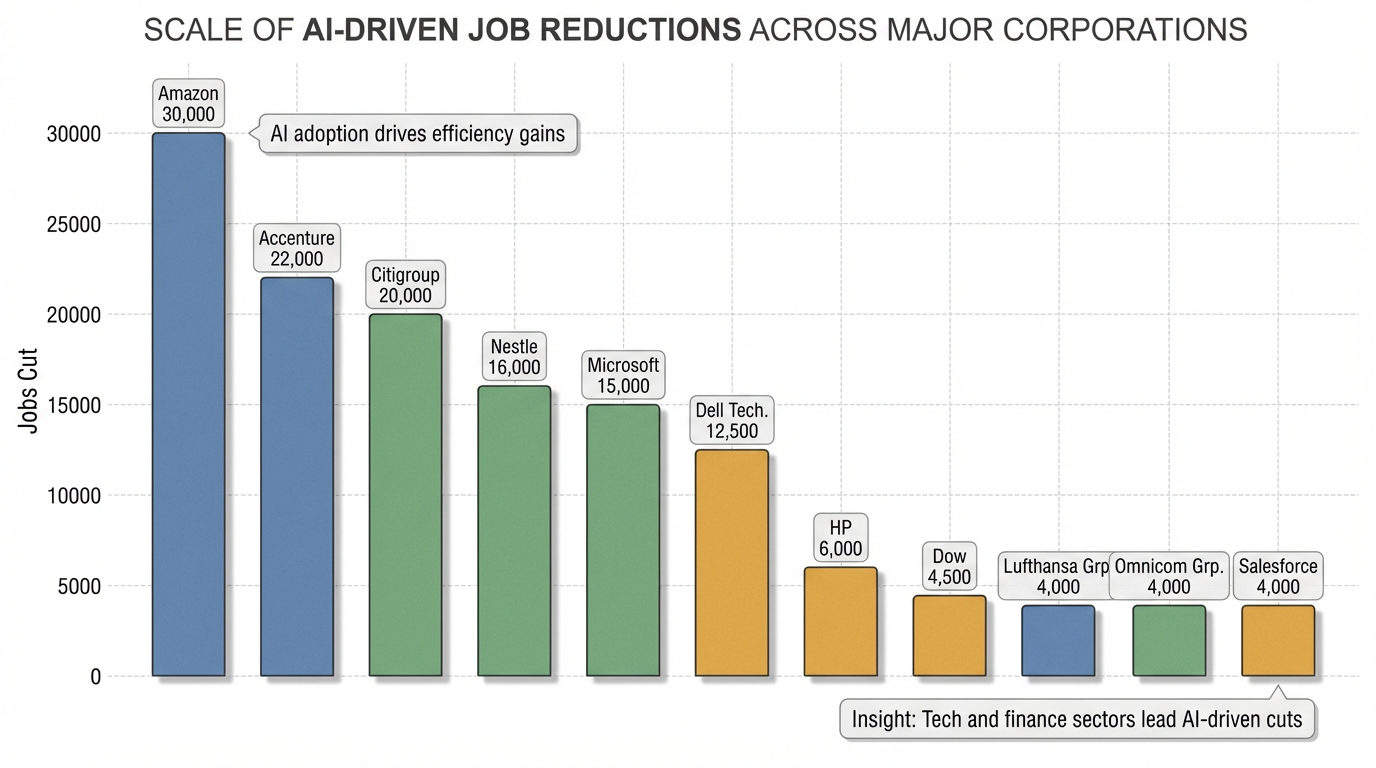
Several major companies have announced substantial job cuts linked to AI integration. Accenture cut between 11,000 and 22,000 jobs in 2025 . Their goal was to save $1.2 billion by fiscal year 2026 3. Accenture also plans to add 8,000 AI-focused positions, leading to a net reduction of 3,000 employees 3. They trained over 550,000 employees in generative AI 3.
Amazon eliminated approximately 30,000 corporate jobs 2. They flattened management layers to increase individual contributor ratios . Amazon credits AI investments for allowing more efficient operations with fewer people . Salesforce cut 4,000 customer service positions 4. Their CEO noted "I need less heads with AI" 4.
Broad Industry Restructuring
This trend extends beyond the tech sector. Nestle announced 16,000 job cuts over two years . They plan to simplify their organization and automate processes . Dow eliminated 4,500 jobs, 13% of its workforce . They leverage AI for greater productivity across operations .
Professional services are also impacted. Baker McKenzie announced cuts of 600-1,000 employees 2. This represents up to 10% of their global workforce 2. The firm is shifting towards AI, affecting support staff roles like research and marketing 2. Citigroup plans a 20,000 headcount reduction 2. They will use automation and AI-enabled systems for middle-office functions 2.
The Reskilling Imperative
Many companies are not just cutting jobs but also reskilling their remaining workforce. Meta cut over 1,000 jobs in Reality Labs 4. They also eliminated about 600 roles in Superintelligence Labs . Meta pivoted resources towards AI technologies, away from VR projects . Microsoft laid off over 15,000 jobs across its general workforce 1. The company is reshaping for AI innovation, shifting capital to AI infrastructure . Some displaced employees received reskilling or reallocation options 5.
WiseTech Global plans to cut approximately 2,000 positions . This is 29-33% of their workforce . They are strategically shifting to AI-driven operations to enhance efficiency . The company aims for a leaner, high-performance culture 6. These examples highlight a clear directive: companies must adapt their teams for an AI-first future.
Balancing Automation and Human Talent
AI's rise forces companies to rethink workforce strategy. It presents both challenges and opportunities for jobs worldwide. This shift demands careful balancing of automation and human skills.
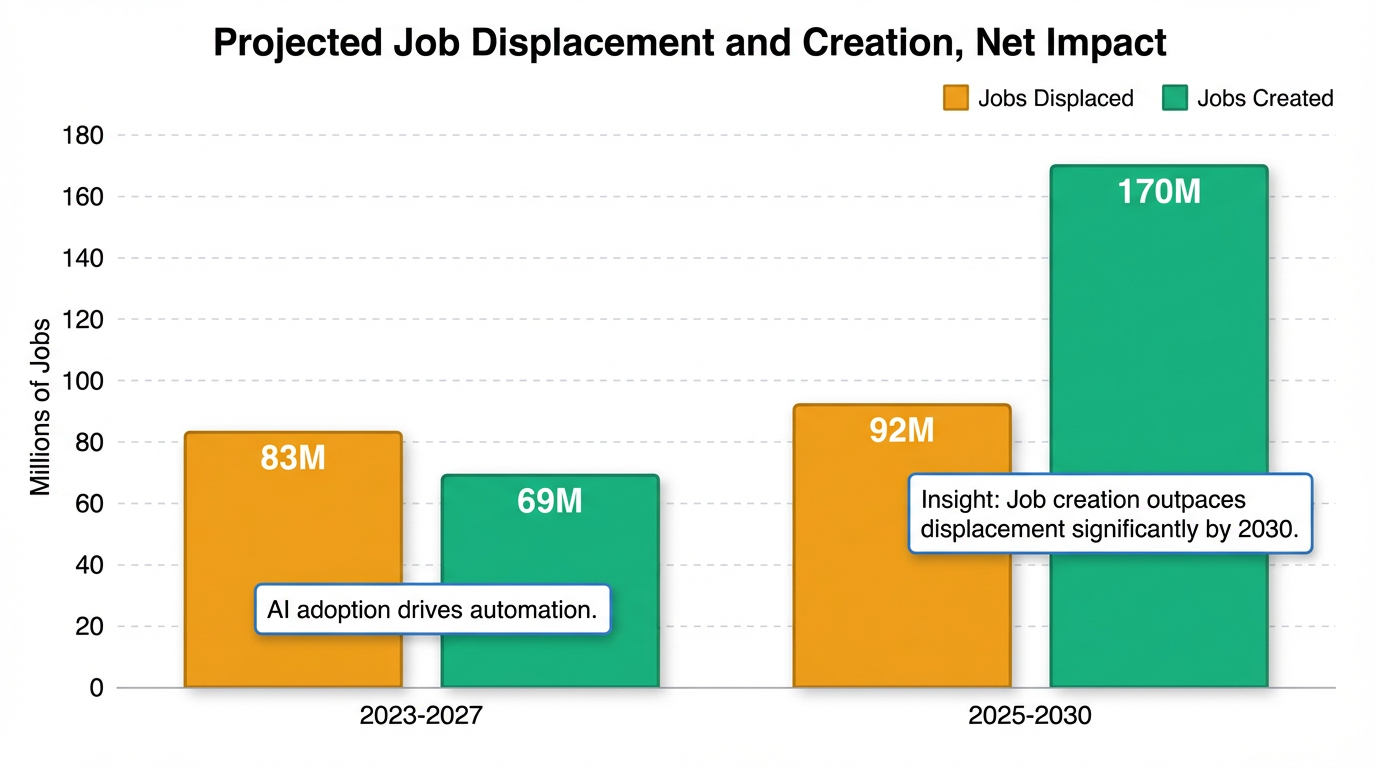
AI is causing significant job displacement. The World Economic Forum (WEF) projected 83 million existing jobs would be displaced globally by 2027 7. A later WEF report predicts 92 million roles displaced by 2030 due to global macro trends 9. The International Monetary Fund (IMF) indicated almost 40% of global employment is exposed to AI 10. This figure rises to 60% in advanced economies 10. A WEF survey found 40% of employers expect to reduce their workforce where AI can automate tasks 11. McKinsey suggests up to 30% of current work hours could be automated by 2030, accelerated by generative AI 12. Globally, 54% of business executives expect AI to displace existing jobs 13.
Vulnerable roles include financial analysts, customer service agents, and software coders 14. Bank tellers, postal service workers, and cashiers are also highly affected 8. McKinsey projects declining demand for office workers and customer service representatives by 2030 12. Entry-level jobs are especially at risk. AI could replace over 50% of tasks for market research analysts (53%) and sales representatives (67%) 11. It can now perform many "first-rung" tasks for junior professionals 15. In Canada, job postings for AI-exposed occupations grew slower after 2020 16.
| Vulnerable Roles/Sectors | Growth Roles/Sectors |
|---|---|
| Financial analysts | AI and machine learning specialists |
| Customer service agents | Sustainability specialists |
| Software coders | Business intelligence analysts |
| Bank tellers | STEM-related fields (occupations in) |
| Office workers | Healthcare (occupations in) |
| Entry-level jobs (e.g., junior analysts, assistants) | Software developers |
Despite displacement, AI also creates new jobs. The WEF's Future of Jobs Report 2023 anticipated 69 million new roles globally by 2027 7. The 2025 report projects 170 million new jobs created by 2030 9. Around 24% of business executives expect AI to create new jobs 13. AI specialist jobs grew 3.5 times faster than all jobs since 2016 14. There were seven times more postings for these roles in 2023-2024 compared to 2012 14. PwC's 2025 report notes job numbers and wages are growing in virtually every AI-exposed occupation 16. In Canada, AI-related job postings increased from 33,000 in 2023 to 57,000 in 2024 16.
Sectors like professional services, information & communication, and financial services show accelerating AI penetration 14. They also have higher demand for AI skills 14. Fastest-growing jobs include AI and machine learning specialists, sustainability specialists, and business intelligence analysts 8. McKinsey anticipates rising demand for STEM fields and healthcare professionals 12. The WEF's 2025 report highlights growth in roles like farmworkers, software developers, and nursing professionals 9. New roles like "agent orchestrators" will emerge with "Agentic AI" 13.
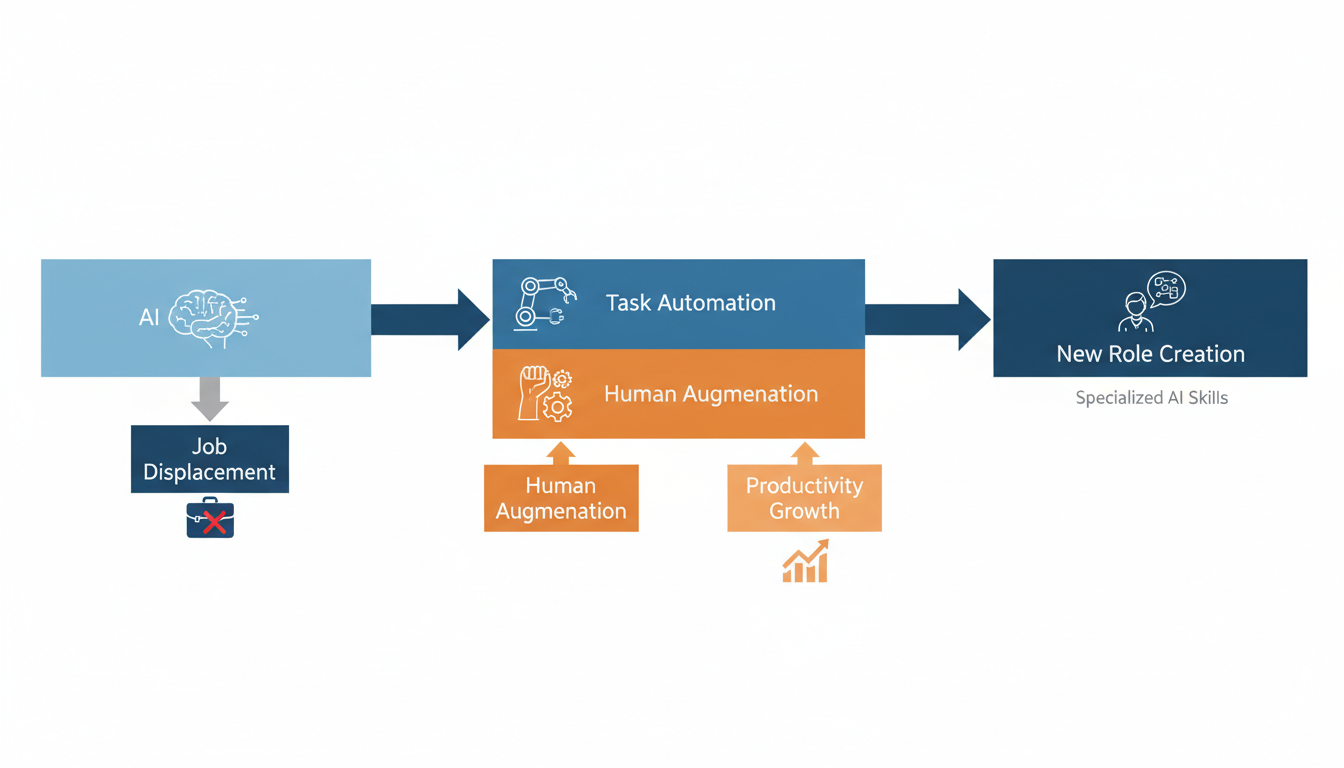
AI impacts the workforce through distinct mechanisms. Displacement happens when AI automates routine, codified tasks 15. This includes drafting, summarizing, and initial compliance checks 15. AI creates roles requiring specialized skills, like machine learning experts 14. It also augments human capabilities. Workers can offload lower-value tasks and focus on complex problem-solving 16. This makes workers more productive and valuable 16. High AI penetration leads to 4.8 times greater labor productivity growth 14. Industries using AI show three times higher revenue growth per employee 16.
Projections for AI's net impact vary. The WEF's Future of Jobs Report 2023 projected a net loss of 14 million jobs by 2027 7. This came from 83 million displaced jobs and 69 million created ones 7. However, the Future of Jobs Report 2025 forecasts a net employment increase of 78 million jobs by 2030 9. This is driven by broader macro trends including technology 9. PwC suggests AI generally leads to gentler job growth, potentially creating more jobs than it displaces if new economic activities emerge 17.
The skills employers seek are changing rapidly. In AI-exposed occupations, skill demands change 25% faster in 2024, rising to 66% faster in 2025 14. Workers with specialist AI skills, such as prompt engineering, command a significant wage premium 14. This premium increased from up to 25% in 2024 to 56% in 2025 in some markets 14. Key skills gaining importance include technical expertise in AI and cybersecurity 9. Creative thinking, resilience, flexibility, and lifelong learning are also crucial 9. McKinsey emphasizes technological, social, and emotional skills 12. They also note a shortage in critical thinking and creativity 12.
Continuous learning and reskilling are now imperative 14. Workers risk being outcompeted if they don't adapt 11. Demand for formal degrees is declining, especially for AI-exposed jobs 16. AI can help democratize opportunity 16. This means focusing on upskilling and reskilling strategies is vital for individuals and organizations alike. These strategies help bridge skill gaps and prepare the workforce for AI's evolution.
Industries Navigating the AI Shift
AI integration is rapidly reshaping corporate structures across many industries . This trend leads to significant workforce and operational model shifts . Companies use AI to boost efficiency, drive innovation, and gain a competitive edge . This often comes with workforce reductions and strategic resource reallocations .
Technology Sector Leads AI Restructuring
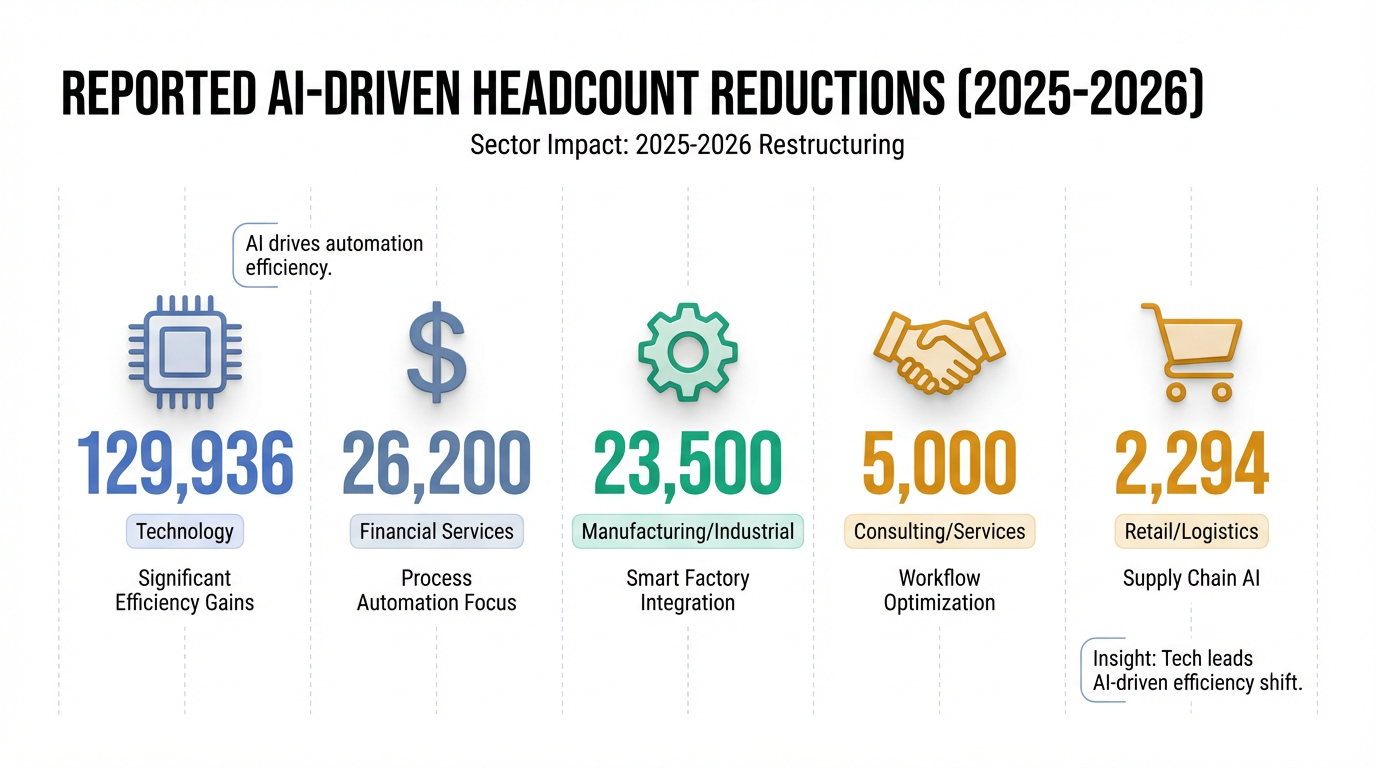
The technology sector is undergoing extensive restructuring. Companies are seeing significant headcount reductions as resources shift towards AI development . The goal is embedding AI into core offerings and automating internal workflows .
- Block reduced its workforce by 40% (from over 10,000 to under 6,000 employees) in February 2026 . CEO Jack Dorsey cited internal "intelligence tools" like "Goose" for automating workflows 19. This allowed a "significantly smaller team" to achieve more 19.
- SAP plans to affect up to 10,000 jobs through restructuring to integrate AI . They invest €2 billion annually in AI and aim for €10 billion in free cash flow by 2026 20.
- Microsoft executed two waves of layoffs in 2025, impacting 6,000 then 9,000 employees 21. This coincided with heavy AI spending and reallocating headcount to AI growth areas 21.
- Salesforce cut 700 employees in January 2024 to focus on high-growth areas like AI 22. The CEO stated, "I need less heads with AI" 4. The company eliminated 4,000 customer service positions in September 2025 4.
- Dell Technologies cut 12,500 jobs and reduced sales roles . This reallocated resources to AI teams and its "AI-as-a-Service" offerings 22.
Other tech companies like Accenture cut 11,000 to 22,000 jobs in 2025 . Amazon cut around 30,000 corporate jobs, flattening management layers 2. HP expects to reduce 4,000 to 6,000 employees by 2028 through AI-enabled operational streamlining .
Financial Services Transforms with AI
The financial sector integrates AI to enhance efficiency and automate processes 22. This improves risk assessment and personalizes offerings 22. It leads to significant headcount reductions in certain functions 22.
- Klarna plans to reduce its workforce by about 47%, from 3,800 to 2,000 employees 22. Its AI virtual assistant handles two-thirds of customer service inquiries, doing the work of 700 employees 22. It also improved customer satisfaction by 22% 22.
- Citigroup targets a headcount reduction of around 20,000 2. This is part of a broad overhaul using automation and AI-enabled systems 2. These systems will run middle-office and operational functions with fewer employees 2.
- BlackRock cut approximately 300 employees as it shifted resources towards technology and data-driven systems 2. Expanding AI use reduced the need for some traditional support roles 2.
- Commonwealth Bank cut 300 roles, particularly impacting teams handling high volumes of standard inquiries 23. This reshapes its workforce around AI 23.
- Allianz eliminated up to 1,800 jobs in its travel insurance division 24. This occurred as AI replaced manual processes 24.
Fintech, software, and banking have the highest concentrations of AI leaders 25. AI enables new services like robo-advisors and advanced fraud detection 26.
Biopharma and Life Sciences Embrace AI Discovery
This sector heavily invests in AI for drug discovery and operational efficiency 22. Despite this, traditional roles sometimes see workforce reductions 22.
- Exscientia reduced its workforce by 20-25% in May 2024 22. This conserved cash while maintaining a focus on AI-driven drug discovery 22.
- Xaira Therapeutics launched in April 2024 with over $1 billion in capital 22. It aims to develop drugs using AI, focusing on advanced machine learning 22.
- Ginkgo Bioworks cut hundreds of employees in 2024 22. However, it announced a strategic partnership with Google Cloud worth over $250 million 22.
AI-driven drug discovery platforms can identify new compounds much faster . This suggests a future business model with dramatically higher R&D productivity .
Education Technology Reacts to Generative AI
The EdTech industry is adapting to the disruptive impact of generative AI 22. Companies are developing proprietary AI tools and automating content creation 22.
- Chegg laid off 21% of its workforce (319 employees) in 2024 22. This was due to competition from AI platforms like ChatGPT, which caused a 40% drop in subscriptions 22. Chegg responded by launching its own AI-powered study assistant, CheggMate 22.
- Udemy cut 280 employees, adapting to AI-driven market demands 22. The company focuses on automated content creation and AI-powered course recommendations 22.
Legal Services Adopts AI for Productivity
Law firms are adopting AI to enhance productivity and streamline legal processes 27. This prompts discussions about traditional business models, such as the billable hour 27.
- AI tools significantly increase lawyer productivity 27. A complaint response system reduced associate time from 16 hours to 3-4 minutes 27. This indicates over 100 times gains in efficiency 27.
- Legal work shifts from information collection to more strategic analysis 27. Firms are collaborating with clients and AI vendors to test AI use cases 27.
- No reductions in practicing attorneys are anticipated 27. However, new roles for data scientists and AI engineers are being added 27.
AI acts as a catalyst for re-evaluating business models and firm scale 27. The industry is exploring alternative pricing beyond the billable hour 27.
Competitive Landscapes Reshaped by AI
AI is a "game-changer" that redefines how companies compete 25. It creates new avenues for value creation and operational efficiency 25.
- Disruption: AI acts as a strategic catalyst for restructuring, moving beyond cost-saving to become a strategic differentiator . It enables new business models and products .
- Efficiency: Generative AI can automate 60-70% of employee time spent on work 25. This boosts labor productivity and leads to significant cost savings 25. Over half of C-suite executives expect AI to deliver more than 10% in cost savings 28.
- Personalization: AI enables data-driven personalization at scale 25. This enhances customer satisfaction and loyalty across various sectors 25.
- Strategic Decision-Making: AI is evolving beyond task automation 29. Advanced AI systems analyze vast data to make decisions with greater accuracy by 2025 29. Predictive analytics helps anticipate market shifts 29.
- Investment: The technology sector sees fewer, larger M&A deals 30. Companies make concentrated bets on AI capabilities to strengthen their position 30. Over 85% of executives plan to increase their AI spending in 2024 28.