Brain Cells Master Doom Future of AI
Brain Cells Conquer Doom A Breakthrough Explored
Cortical Labs has trained human brain cells on chips to play Doom, moving bio-computing closer to real-world integration and novel AI applications 1.
This milestone follows previous success with a Pong-like task 1. The research aims to explore the scientific and technical aspects of using biological components for computation 2. This fusion of biology and digital environments opens new doors for AI development.
Experimental Setup Details
The core of this experiment involved approximately 200,000 living human neurons . These cells were sourced from human induced pluripotent stem cells (iPSC) 2. Earlier Pong experiments also used mouse embryonic neurons 2. The neurons grew on a high-density multi-electrode array (HD-MEA) 2. This array in the Pong setup featured over 26,000 platinum electrodes across an 8mm² surface 2. It routed 1,024 electrodes for recording neural activity and 8 for sensory input 2.
The CL1 biological computing platform housed these neurons. This compact desktop enclosure maintained their viability by supplying continuous nutrients and oxygen 3. Micro-scale electrodes served dual purposes: stimulating neurons with electrical signals and reading their responses (spikes) 3. Cortical Labs markets the CL1 as a code-deployable biological computer for research purposes 1. It can keep neurons alive for up to six months .
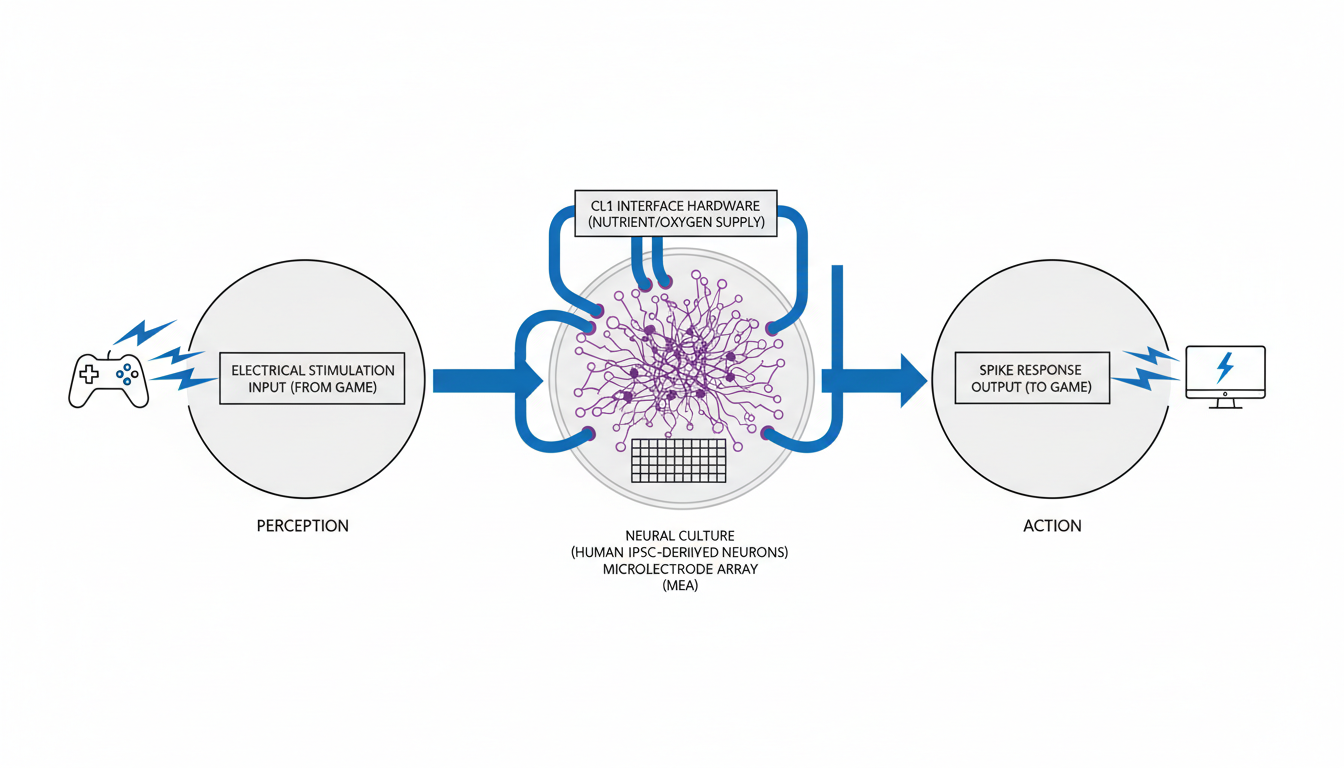
Figure 1: Human neurons cultured on a microelectrode array, forming the biological component of the system.
Cortical Labs provides an open API (Application Programming Interface) . This API connects games like Doom to the neural culture. Sean Cole, an independent developer, used a Python-based interface to teach the chips Doom . The demo's source code is publicly available on GitHub 1. The company also offers Cortical Cloud, a platform for remote access and development .
Training Methodology and Learning
The system translates the game's video feed into electrical stimulation patterns . For example, if a demon appears on the left, specific electrodes stimulate that area of the neural culture . Learning follows the Free Energy Principle. Biological systems minimize prediction error . Neurons learn through continuous, real-time feedback .
When cells make a "good" move, such as hitting an enemy, they get a predictable electrical signal 4. Conversely, a "bad" move, like getting hit, results in chaotic electrical noise or unpredictable stimulation . This feedback causes neurons to reorganize their connections 4. They favor actions that lead to predictable feedback, thus minimizing "surprise" 4.
The neurons' electrical responses (spikes) are then interpreted as motor commands for the game . Different firing patterns correspond to specific actions. For instance, one pattern might trigger the Doomguy to shoot . Another pattern could make him move right . Cortical Labs researchers also used artificial intelligence. AI refined how game information encoded into electrical signals . This improved how cells respond to desired actions .
Key Results and Performance
The neural culture plays at an "absolute beginner" level . Its play is chaotic and inefficient, but self-directed . The neurons are far from "esports ready" and often "die a lot" in-game . However, their performance surpasses a player firing randomly 5.
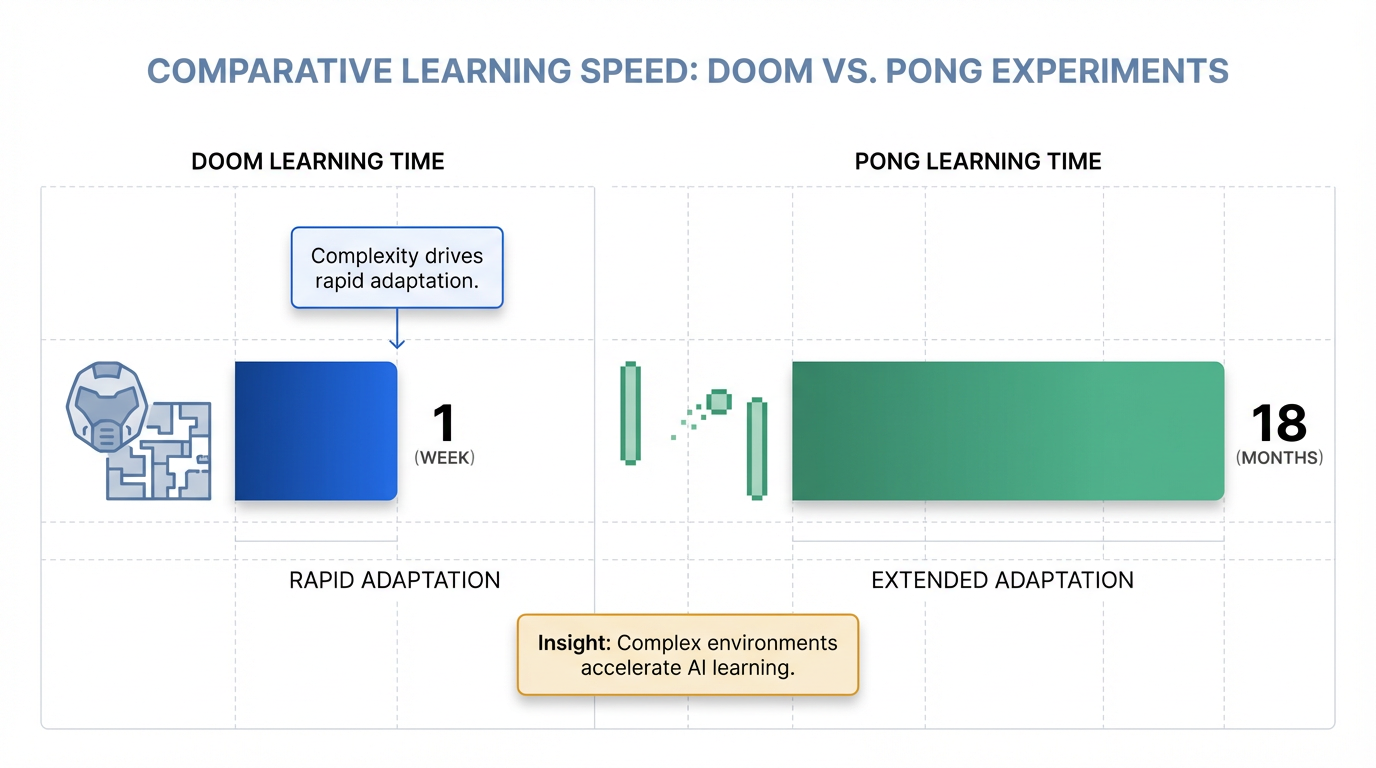
The cells showed basic in-game actions. These included shooting, moving, seeking enemies, and spinning . Researchers observed signs of adaptive behavior and early-stage learning 3. Crucially, the neurons learned to interact with Doom in about one week . This speed contrasts sharply with the 18 months required for earlier Pong experiments . Cortical Labs claims this is much faster than traditional, silicon-based machine learning systems .
Doom represents a significant jump in complexity from Pong . Doom demands 3D navigation, aiming, and combat actions in a rich environment . Pong involved a simpler, direct input-output relationship . Ablation tests confirmed the biological layer's contribution 1. Control conditions with random or zero spikes showed no learning 1.
What "Playing Doom" Truly Means
The neurons are not truly aware or conscious that they are playing Doom . They simply react to electrical signals and produce electrical responses . The experiment uses Freedoom, a version that runs on the Doom engine . This simulated 3D chaos translates into electrical stimulation patterns .
The experiment demonstrates adaptive, real-time, goal-directed learning . The neural network modifies its behavior based on feedback from the simulated environment . This project serves as a crucial stress test for Synthetic Biological Intelligence (SBI) . It shows that the digital-to-biological interface works . This breakthrough paves the way for biological neurocomputing .
Biological and Technical Mechanisms Explained
Learning and adaptation within the neural culture likely occur through "prediction error" minimization 2. This process is described by the Free Energy Principle 2. Neurons self-organize and physically reorganize their synaptic connections . This reduces unpredictable stimulation, vital for real-time adaptation and learning in biological systems .
Technically, the CL1 platform enables neural stimulation via microelectrodes 3. It also acquires signals by recording neuronal spikes 3. A custom software system plays a vital role . It translates game visual data into specific electrical stimulation patterns for the neurons . It then decodes the resulting neural activity back into game control commands . This creates a closed-loop perception-processing-action feedback system between the game environment and the neural culture 3.
Integration, Limitations, and Future Horizons
The system represents a hybrid combination of living human neurons and a silicon interface . Software bridges the gap between Doom's digital world and the neurons' electrical "language" .
Methodological limitations and challenges exist. Researchers still need to understand how these neurons "see" the screen or grasp expectations 5. Some concerns suggest conventional software (the decoder) might do most of the learning, effectively bypassing the neurons 6. Sean Cole's GitHub documentation highlighted this potential confounding factor 6. However, Cortical Labs emphasizes their ablation tests confirm the biological layer's genuine contribution 1. The current scale of 200,000 neurons is also tiny compared to the 86 billion in a human brain .
Future research aims to develop better learning algorithms, encoding, rewards, and feedback mechanisms 6. Practical applications could include controlling robotic arms for precision experiments . Identifying objects for robots and drug testing for neurological diseases like dementia or epilepsy are also possibilities . The technology could even contribute to energy-efficient AI . The field is clearly moving towards biological neurocomputing and hybrid systems . These systems combine biological efficiency with electronic precision .
For innovators looking to build and test novel applications, tools exist to accelerate development. For example, using platforms like Atoms (https://atoms.dev) allows solo founders to quickly build AI apps with features like authentication, databases, and payments. It can even help with projects exploring complex AI or game logic, much like the sophisticated neural interactions needed for a Game Builder. You can see many user-built projects on their Appworld. Such platforms empower rapid prototyping, essential in emerging fields like bio-computing interface development.
This research raises important ethical questions . These include the possibility of consciousness in cultured neurons . Questions about the origin and ownership of human cell lines used in computing also arise .
FAQ Section
Can brain cells actually "play" a video game consciously?
No, the neurons do not possess consciousness or awareness of the game . They interact by reacting to electrical signals and generating responses based on feedback .
How is Doom different from Pong for these neural networks?
Doom is much more complex, requiring 3D navigation, aiming, and combat decisions . Pong involved simpler, direct input-output correlations .
What are the potential applications of this brain cell computing?
Future applications range from controlling robotic systems to drug testing for neurological diseases . It could also lead to more energy-efficient AI .
How quickly did the neurons learn to play Doom?
The neurons learned to interact with Doom in approximately one week . This is significantly faster than the 18 months required for earlier Pong experiments .
Medical Transformations and Assistive Technologies
Brain-Computer Interfaces (BCI) are transforming medicine. They greatly improve neurorehabilitation for stroke and spinal cord injury patients, and enable precise prosthetic control. This technology also restores vital communication abilities, significantly boosting patient quality of life.
BCI technology offers transformative potential in medical fields. It focuses primarily on neurological rehabilitation and assistive technologies 7.
Advanced Neurorehabilitation
BCI interventions significantly improve patient outcomes. They help stroke patients with lower limb motor function and daily living activities 8. Non-invasive brain-machine interaction training is effective. It uses BCI and an exoskeleton robot to show rapid and sustained motor function improvement 9. VR-based rehabilitation tools also enhance functional connectivity in the brain 10. This promotes neuroplasticity and motor recovery for stroke survivors 10.
For Spinal Cord Injury (SCI), VR-mediated BCI training improves sensorimotor neuromodulation 11. It supports rehabilitation through tasks like virtual walking 11. BCIs are explored as rehabilitation adjuncts in SCI patients 12. They can even distinguish neuropathic pain from numbness using EEG 12. Epidural electrical stimulation combined with near-infrared nerve stimulation shows promise 10. It enhances motor function specificity in SCI 10.
BCIs are also valuable for a range of general neurological disorders. These include multiple sclerosis (MS), amyotrophic lateral sclerosis (ALS), Parkinson's disease (PD), and cerebral palsy 12. They aim to restore motor control and assist with communication 12. BCIs provide adaptive neuromodulation, offering an improved quality of life to patients 12.
Prosthetics and Motor Control
BCI technology allows individuals to perceive objects on a bionic hand. It provides realistic tactile sensations through synchronized electrical stimulations 13. This involves electrode arrays implanted in brain areas for hand movement and touch 13. Users can move robotic arms by thought and receive tactile feedback 13. Recent studies have advanced localized tactile sensations 13. They recreated dynamic sensations like object contours or sliding motions 13.
Paralyzed individuals and amputees have regained partial mobility 16. They operate robotic hands or intelligent wheelchairs using BCI 16. Neuroprosthetics enhancement is a growing sector 17. It includes non-invasive interfaces with haptic feedback 17.
Communication and Sensory Restoration
For patients with severe conditions, BCIs restore expressive capabilities. This includes locked-in syndrome or advanced ALS 17. Researchers achieved speech decoding at 97% accuracy 17. Text communication reached nearly 80 words per minute through neural signals 17. A Neuralink speech-restoration implant received breakthrough device designation 18.
Future applications include implants that activate the visual or auditory cortex 18. This could enable individuals to see or hear again 18. Neuralink's Blindsight project is an example 18. The Bionic Breast Project also aims to restore the sense of touch after mastectomy 15.
Mental Health and Home Assistance
Less invasive neuromodulation is being explored for mental health conditions. These include depression and anxiety 19. Closed-loop personalization techniques are under investigation 19.
BCI can automate home appliances for disabled individuals 20. This includes lights and fans. Such systems improve their independence within their living spaces 20.
Ethical Crossroads of Living Tech
Integrating brain cells into technology creates profound ethical questions about consciousness, data ownership, and human identity. This convergence demands careful consideration for the future of bio-cybernetic systems.
Defining Personhood and Identity
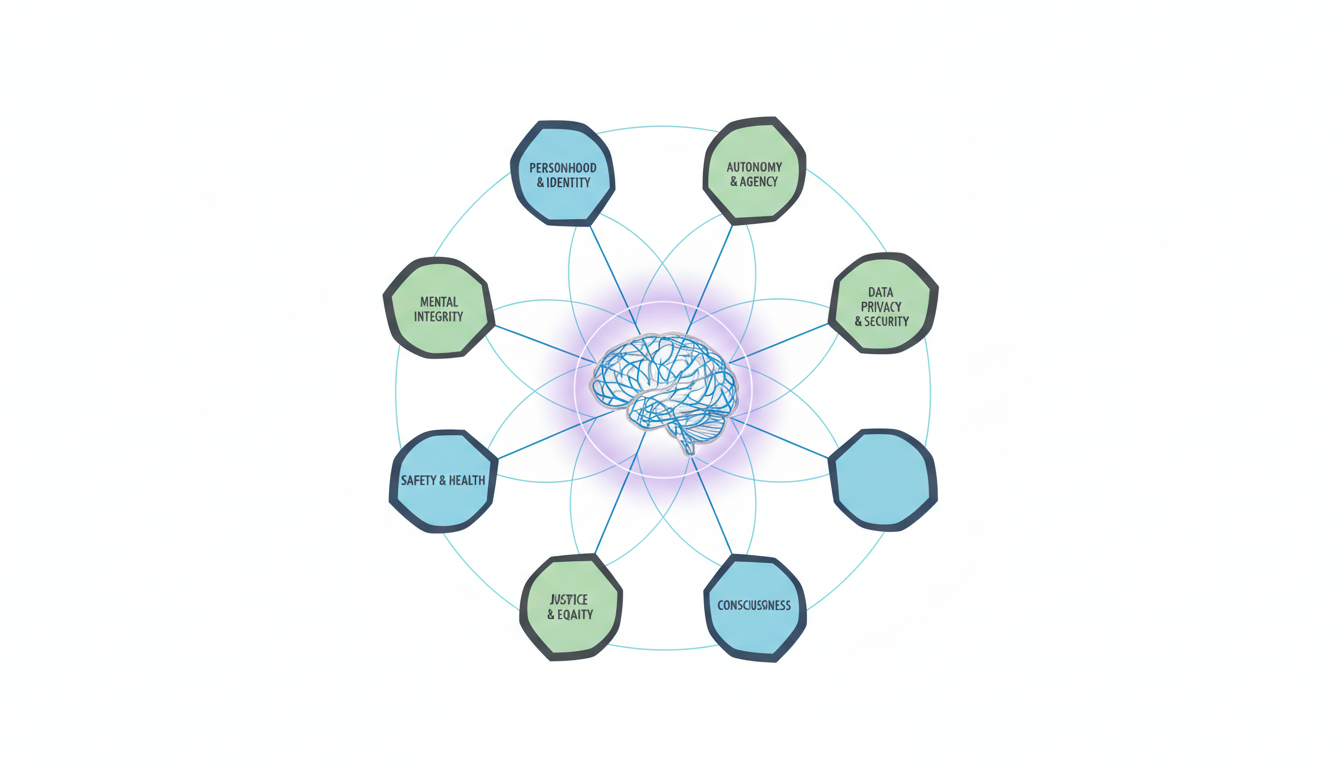
Brain-Computer Interfaces (BCIs) raise fundamental questions about being a person . They also challenge what it means to be recognized as such . The impact on personal identity is a significant concern, especially regarding "bio-cybernetic continuity" 21. This refers to identity persisting despite augmentation 21. Ethical dilemmas regarding "identity integrity" are emerging with these technologies 22. Removing BCIs can even cause a "trauma of losing your own identity again" 23.
Autonomy and Agency in Shared Control
Human-machine adaptation in BCIs shapes issues of autonomy and responsibility 24. Shared control systems also play a distinct role here 24. Concerns exist about "disembodied agency" when interacting with BCIs 25. Protecting participant autonomy is vital 26. This includes ensuring informed consent and preventing coercion, especially for those with impaired consent capacity 26.
Neural Data Privacy and Security
BCIs directly connect the brain to external devices 27. This generates vast amounts of sensitive neural data 27. Key ethical challenges include neural data commodification 28. Cybersecurity vulnerabilities in wireless BCIs are also a concern 29. Unauthorized manipulation of brain activity is a potential risk 26. Uncertainty in data ownership and control poses significant challenges 30. Agreements between developers and users are often unclear 30. Data collected by manufacturers could offer invasive insights into users' thoughts 31. Protecting brain signal data is a major policy option 30.
Consciousness and Bio-Integrated Minds
Speculative models of bio-integrated consciousness represent a frontier in post-human biotechnologies 21. The idea of "human-machine symbiosis and the hybrid mind" has profound implications 25. These implications extend to ethics and human rights 25.
Safety and Health Risks
Implantable BCIs carry inherent risks . Surgical complications are a concern . Biological reactions, such as glial scarring, also pose dangers . The foreign body reaction (FBR) can lead to inflammation and fibrous scar tissue . It can also cause electrode damage and reduced device performance . There is risk of harm if users lose access to their BCI 30. This applies, for instance, after clinical trials or if a company ceases operations 30.
Justice, Equity, and Mental Integrity
The high cost of BCI development could restrict access . This might lead to a "bifurcated cognitive landscape" . It could also exacerbate the wealth gap . A global infrastructure deficit further limits universal adoption 32. Billions could remain "biologically baseline" 32. Policies must address potential inequality 21. They must also ensure ethical access and distribution 21. Neurotechnologies bring forth concerns about the right to mental integrity 25. This relates to the extended mind thesis 25.
Bio-Hybrid Systems and Living Components
Biohybrid neural interfaces combine artificial components with living biological materials . These include living muscles or neurons . They face specific engineering, regulatory, and neuroethical challenges . These systems aim to use living components' adaptability for enhanced functionality . However, they must contend with biological integration issues . Synthetic biology in "post-human biotechnologies" raises further ethical questions 21. These include issues of autonomy, consent, and potential inequality 21.
Current Regulatory Frameworks and Their Limitations
The current regulatory environment for BCIs is fragmented 31. It does not fit neatly into existing schemes 31. This leads to potential governance problems 31.
The United States has several regulatory bodies. The Food and Drug Administration (FDA) regulates investigational medical devices 26. This includes implantable BCIs under the Investigational Device Exemption (IDE) program 26. They review safety, efficacy, design, and protocols 26. The FDA has issued guidance for iBCI devices for paralysis or amputation 26. However, FDA authority limits devices making health-related claims 31. This leaves many BCI applications outside direct jurisdiction 31. Neuralink has received IDE approval 29.
The Federal Trade Commission (FTC) can address nonmedical claims 31. This applies if claims are unfair or deceptive 31. The FTC has been less active due to the technology's novelty 31. Institutional Review Boards (IRBs) safeguard participant rights 26. They ensure ethical informed consent 26. Medicare and Medicaid Services (CMS) coverage decisions can be challenging 30. This hinders BCI adoption 30.
| Regulatory Body | Primary Scope/Role regarding BCIs | Key Limitations/Challenges |
|---|---|---|
| Food and Drug Administration (FDA) | Regulates investigational medical devices (e.g., implantable BCIs) under IDE program; reviews safety, efficacy, design, protocols; issues guidance for iBCI devices. | Authority limited to devices making health-related claims; many potential BCI applications (e.g., consumer entertainment) outside its direct jurisdiction. |
| Federal Trade Commission (FTC) | Addresses nonmedical claims made by BCI manufacturers, particularly if unfair or deceptive. | Has been less active in this area due to the technology's novelty. |
| Institutional Review Boards (IRBs) | Safeguards participant rights and welfare in human subjects research; ensures ethical informed consent and clear communication of risks. | Specific limitations for IRBs themselves are not explicitly detailed in the provided text. |
| Medicare and Medicaid Services (CMS) | Manages the coverage decision process for BCIs. | Coverage decision process for BCIs can be challenging, hindering adoption. |
Existing governance is often insufficient 28. It fails to address vulnerabilities in consent, privacy, and long-term safety 28. The rapid commercialization of BCIs risks outpacing neuroscientific understanding 28. Ethical frameworks also lag behind 28. While ethical issues are numerous, practical solutions are lacking 27. A coordinated, adaptive regulatory model is crucial 33. This model needs early dialogue, data transparency, and shared learning 33.
Expert Insights on Future Governance
Experts emphasize the need for interdisciplinary deliberations 34. These discussions should understand personhood in BCI contexts 34. Future research should collect empirical data 27. This data should come from the public, BCI users, and researchers 27. Policymakers should consider options to increase consumer control over data 30. Protecting brain signal data is also important 30. Device maintenance should be prioritized 30. Coordination between BCI developers and regulators like CMS needs improvement 30. Human-machine symbiosis prompts questions about human rights 25. Mental integrity also comes into play 25. This suggests rethinking neuroethics with the extended mind thesis 25. Responsible innovation requires proactive measures 28. Robust public engagement is needed to align BCI development with societal values 28. Recommendations include a risk-based regulatory approach 22. Best practices and clear guidelines ensure ethical development and oversight of BCIs 22.
Engineering the Future Technical Challenges and Milestones
Advanced BCI technology faces significant hurdles in integrating living cells with electronics for consumer use. Long-term stability and power efficiency are key challenges for future widespread adoption.
Overcoming Bio-Integration Obstacles
Interfacing living cells, especially neural tissue, with electronics presents unique engineering obstacles. Achieving long-term stability and functionality remains a primary challenge 35. Biological responses to implanted foreign materials largely hinder progress.
-
Biocompatibility and Immune Response The human body's reaction to implants is a major barrier 36. Implantation causes tissue damage and triggers acute inflammatory reactions 37. Microglia and astrocytes activate, forming dense glial scars around electrodes 37. This scar tissue insulates, increasing electrical impedance and reducing signal quality 36. Poor biocompatibility is a critical failure mode for neural electrodes 39.
-
Mechanical Mismatch Traditional neural interfaces use rigid materials like silicon 35. Brain tissue is soft, creating a mechanical disparity with rigid electrodes 35. This mismatch causes tissue damage, chronic inflammation, and shear strain 35. Glial scarring and signal degradation follow 35.
-
Signal Resolution and Longevity Achieving high signal-to-noise ratios and stable transmission for months or years remains difficult 41. Scar tissue increases the distance between neurons and electrodes, weakening signals 37. This compromises the electrode's ability to record and stimulate neurons 37. Material degradation, like corrosion, also affects signal quality 35.
-
Miniaturization and Power Consumption Miniaturized BCI hardware often increases impedance, needing more power for stimulation 40. This higher power draw can affect biological tissues 40. Power management limitations restrict BCI operation in remote or mobile scenarios 43. These issues are crucial for consumer devices.
-
Environmental Resilience BCIs in harsh conditions face extreme temperatures, electromagnetic interference, and moisture 43. Mechanical vibrations and corrosive atmospheres also pose threats 43. These factors accelerate degradation, compromise signal integrity, and reduce reliability 43.
Hardware Breakthroughs
Significant advancements in materials science, microelectronics, and fabrication address these challenges.
-
Biomaterials and Flexible Electrodes The industry is shifting to flexible materials to improve compatibility 36. These include conducting polymers, carbon-based substances, and hydrogels 36. Flexible electrodes better mimic brain tissue's mechanical properties 38. Hydrogel interfaces offer tissue-like mechanics and customizable conductivity, providing stable alternatives 40.
-
Surface Functionalization and Coatings Anti-inflammatory coatings and bioactive compounds are under development 36. These modulate neuroinflammatory responses and enhance tissue regeneration 36. Coating electrodes with materials like PEDOT:PSS improves charge injection and lowers impedance 40.
-
Advanced Manufacturing Microfabrication, nanotechnology, and 3D printing create complex micro- and nanoscale geometries 36. This improves neuron interaction, leading to higher resolution and specificity 36.
-
Bio-hybrid and Living Electrodes Integrating living biomaterials, like cells or organoids, is a transformative approach 44. These "living electrodes" aim to couple with host neural networks and dampen immune activation 44. They can potentially aid tissue regeneration 44. Examples include Neuralink's flexible arrays and Synchron's Stentrode system 45.
Software Innovations
AI and machine learning advances are revolutionizing neural signal interpretation and control.
-
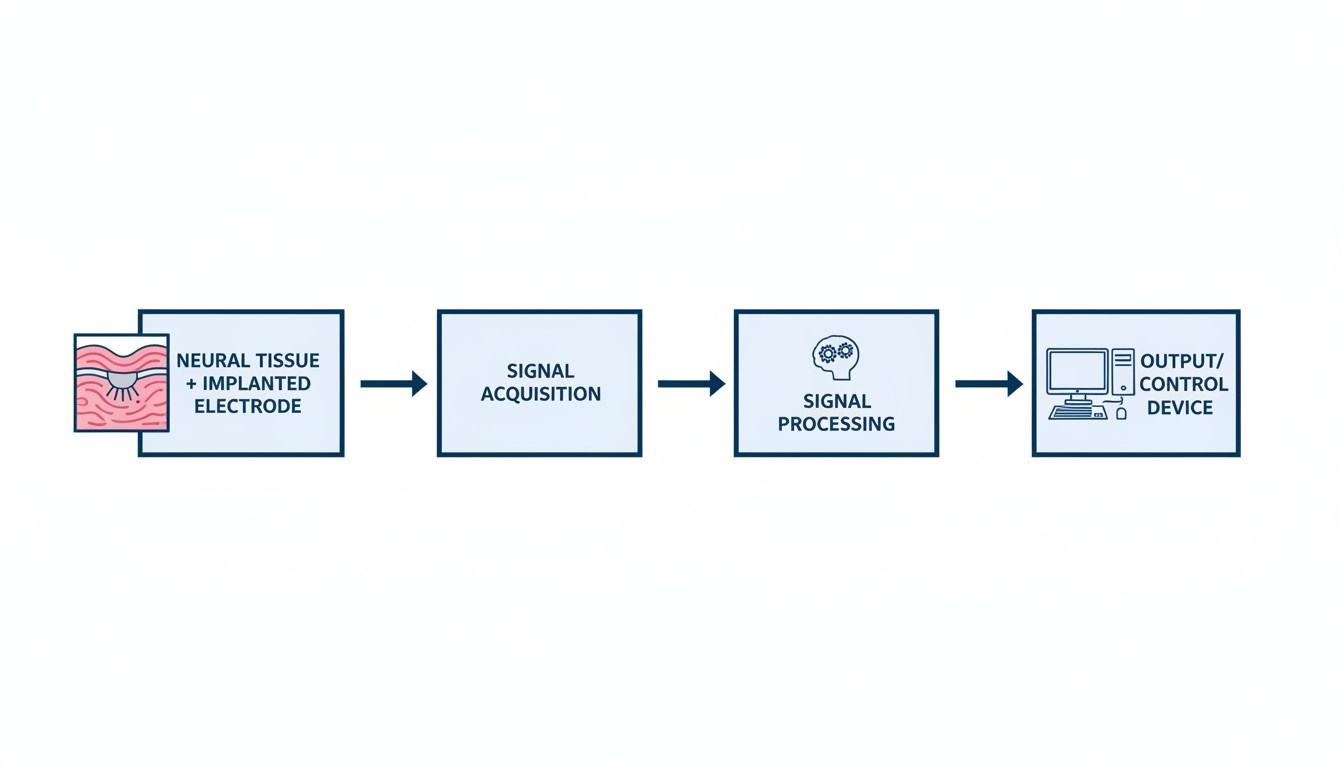
Signal Processing and Feature Extraction Raw neural signals undergo preprocessing to remove noise and artifacts 45. Techniques like filtering and artifact removal enhance signal quality 46. Feature extraction transforms high-dimensional EEG signals into concise representations 47. This improves classification efficiency and accuracy 47.
-
Machine Learning and Deep Learning AI, especially deep learning, is central to BCI development 45. Neural decoding algorithms analyze signals to classify neural patterns into commands 45. Deep neural networks excel at finding patterns in noisy neural recordings 48.
- Specific Algorithms: CNNs and LSTMs show superior efficacy over traditional methods like SVM and LDA 45. CNNs extract features from raw EEG data, reducing preprocessing needs 49. RNNs and LSTMs learn neural data dynamics and nonlinear mappings 50.
- Generative AI: GANs and VAEs create synthetic neural data, enriching training sets 45. This improves decoding robustness and accuracy, allowing simulation of various neural conditions 45.
- Adaptive and Hybrid Models: These models combine multiple signal sources or cognitive paradigms 49. This improves decoding accuracy, robustness, and user adaptability 49.
-
Real-time Processing The goal is to shift from offline analysis to fast, online brain data classification 53. This requires optimizing algorithms for real-time function and rapid processing capabilities 49.
Miniaturization for Consumer Devices
Current BCI systems are limited by power consumption, a major constraint for portable applications 43. The consumer market demands non-invasive BCI interfaces with stable performance for thousands of hours 35. Devices need to be small, lightweight, robust, and energy-efficient. Research focuses on minimizing impedance in miniaturized electrodes without excessive power 40. The aim is for devices to operate reliably for decades, not just months 35.
Projected Milestones and Future Outlook
While specific timelines for broad consumer adoption vary, a focus on long-term viability is clear.
-
Long-term Stability Target A critical goal is over ten years of operational lifespan for BCIs 35. This is crucial for medical applications needing continuous function 35. Current flexible electrodes often fall short of multi-year detection periods 37.
-
Current Progress The BCI market is growing due to an aging global population and increasing neurological disorders 35. Medical device manufacturers are developing implantable BCIs that maintain signal quality for years 35.
-
Expert Predictions Figure 1 from reference 70 projects BMI applications extending until 2030. This suggests continued development and integration are on the horizon.
-
Future Directions Future research focuses on personalized, multimodal BCI systems with adaptive autonomy 54. Interpretable machine learning and cognitive context awareness are key areas 54. The goal is to move from static, single-user BCIs to adaptive, context-aware, multi-agent systems for everyday use 54. Overcoming challenges like cross-subject generalization and environmental adaptability is vital for real-world deployment 55.
-
Toward Ubiquitous Consumer Products Developing new BCI applications or tools often requires rapid prototyping. For solo founders aiming to build innovative applications, even those leveraging advanced AI or data processing, tools like Atoms.dev can accelerate development. Atoms.dev is an AI app builder for solo founders. You can describe your idea and get a working app with authentication, database, and payments. This helps innovators quickly iterate on concepts for neural signal processing or bio-integrated computing applications. You can explore various user-built projects or dive into use case templates to kickstart your own BCI-adjacent software project. Widespread consumer BCI use will generate the huge training datasets needed for deep neural networks 53. This widespread adoption is still a future goal.