Evaluating Payroll Platforms: A Comprehensive Checklist
Navigating the Payroll Platform Maze
In today's fast-evolving business landscape, managing payroll has grown far beyond simply cutting checks. For Small to Medium-sized Businesses (SMBs) and their dedicated HR professionals, navigating the intricate world of payroll platforms has become a critical strategic challenge 1. The stakes are higher than ever, with increasingly complex compliance risks looming large, administrative burdens straining lean resources, and the potential for employee dissatisfaction arising from payment inaccuracies or lack of transparency . It's no longer about finding a solution, but about discovering the right one that seamlessly balances essential features, strategically leverages emerging trends, and flawlessly handles complex, ever-changing compliance requirements through 2026 .
The rapid pace of technological advancements, from AI-powered automation to real-time payroll processing, alongside a constantly shifting legislative landscape, often leaves business owners feeling overwhelmed and unsure how to differentiate between platforms . Deciding among options that offer automated tax filings , multi-state compliance , seamless integrations , or innovative features like earned wage access demands careful consideration. Without a clear, expert-guided roadmap, the decision can lead to costly errors, significant administrative headaches, and missed opportunities for operational efficiency and enhanced employee satisfaction .
This report aims to demystify this complex selection process. We provide a comprehensive, expert-driven checklist designed to empower HR professionals and small business owners to make informed decisions when evaluating payroll platforms for the 2024-2026 timeframe . By shedding light on core functionalities, understanding transformative emerging trends, and detailing critical compliance considerations, we equip you with the knowledge to select a platform that not only meets current operational needs but also scales with future growth and anticipates evolving regulatory demands .
Core Strategies for Smart Payroll Platform Selection
Navigating the crowded marketplace of payroll platforms can feel overwhelming for SMBs and HR professionals. Choosing the right system isn't just about processing paychecks; it's a strategic decision that impacts financial health, compliance, and employee satisfaction. Effective platform selection hinges on a few core strategies, each demanding careful consideration to ensure long-term value.
Strategy 1: Feature Alignment and Compliance Focus
The foundation of any robust payroll system lies in its essential features. For SMBs operating between 2024 and 2026, automated payroll processing is non-negotiable, handling everything from wage calculations to deductions without manual intervention 1. This efficiency extends to comprehensive tax calculations and filings, covering federal, state, and local requirements to minimize compliance risks . Employees expect reliable direct deposit options, including increasingly common next-day processing, which also reduces administrative burdens associated with paper checks .
Beyond these basics, advanced capabilities distinguish leading platforms. An employee self-service portal, accessible via mobile, empowers staff to view pay stubs, W-2s, and update personal information, significantly cutting down on HR inquiries . Seamless integration with time and attendance systems is crucial for accurate wage and overtime calculations, preventing errors and ensuring compliance with labor laws 2. Furthermore, platforms must offer robust reporting and analytics, transforming payroll data into strategic insights for labor costs, tax liabilities, and workforce planning . Critically, given the rise of remote work, multi-state payroll capabilities are vital for correctly managing taxes for employees across different U.S. states . Platforms that can also integrate with benefits administration and workers' compensation streamline complex HR functions, offering a more unified approach .
Compliance is no longer just a checkbox; it's a dynamic and continuous requirement. Modern payroll platforms must proactively adapt to a constantly evolving regulatory landscape. This includes navigating federal tax regulations like the "One Big Beautiful Bill Act" (OBBBA) which introduced new deductions for tips and overtime, demanding specific tracking and W-2 reporting . State-specific mandates, such as varying minimum wage rates, Paid Family and Medical Leave (PFML) taxability, and evolving pay transparency laws, add layers of complexity that platforms must manage automatically . Data privacy laws, including the FTC Safeguards Rule and state-specific regulations like CCPA, require stringent protection of client and employee data, pushing platforms to implement robust security measures and real-time risk monitoring 3. Proactive compliance features that auto-update for legislative changes, monitor regulatory guidelines, and detect potential errors are essential to avoid costly penalties and legal entanglements .
Strategy 2: Understanding Pricing Structures and Total Cost of Ownership
Focusing solely on the advertised monthly fee can be a costly mistake when selecting a payroll platform. The real financial impact is captured by the Total Cost of Ownership (TCO), which extends far beyond basic subscription charges 4. SMBs must thoroughly understand the predominant pricing models and anticipate potential hidden fees to avoid budget surprises.
Many platforms adopt a Per Employee, Per Month (PEPM) model, featuring a base fee plus a fixed amount per active employee 5. This approach scales with growth and offers predictable budgeting for expanding teams 5. Alternatively, a Flat Monthly Fee provides a single set price, often covering a defined number of employees or features, which is ideal for businesses with stable headcounts 5. For seasonal businesses or those with infrequent payrolls, a Per Payroll Run model charges each time payroll is processed, offering flexibility but potentially higher costs for frequent runs 5. Many vendors also employ Tiered/Feature-Tiered Pricing, bundling different sets of features into progressively more expensive plans, allowing businesses to upgrade as their needs grow 6. Hybrid and add-on models combine these, allowing customization but requiring careful scrutiny of extra service costs 6.
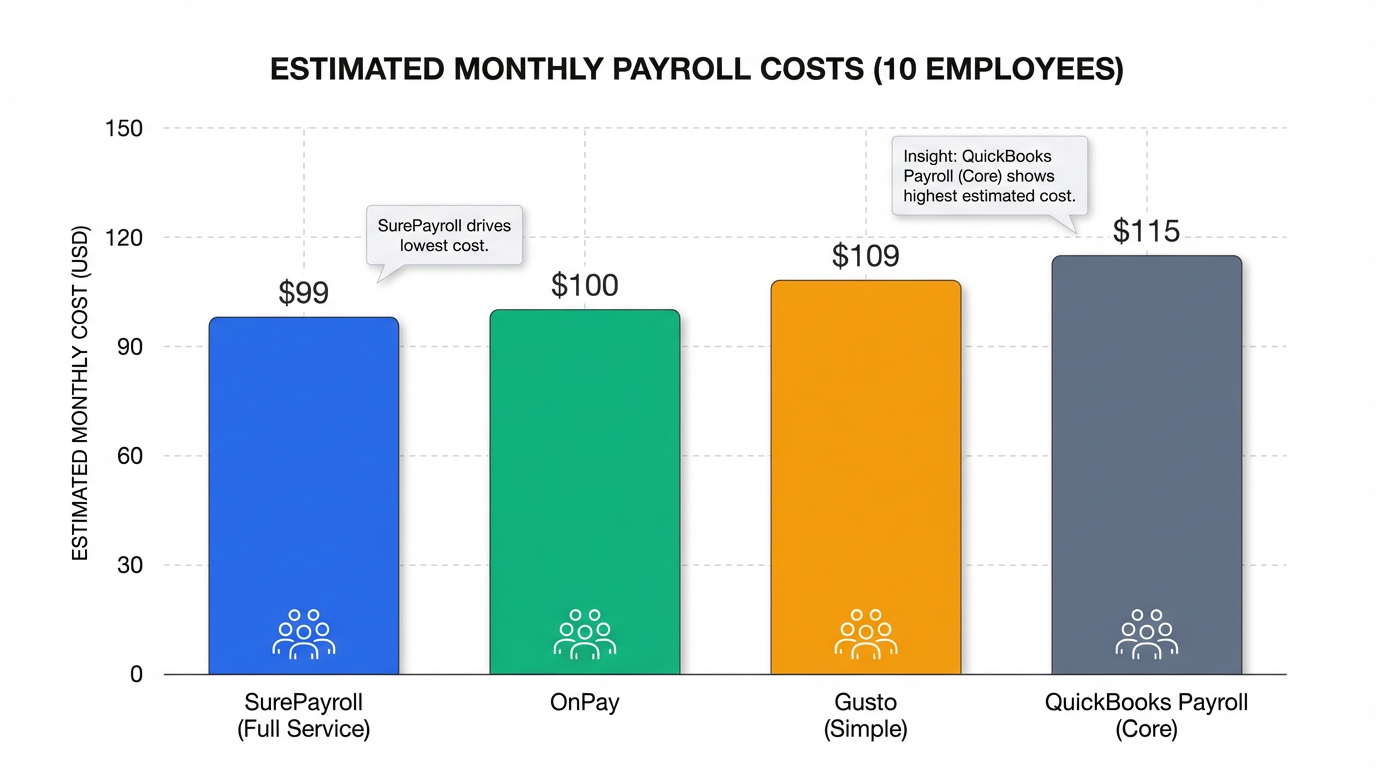
The table below illustrates typical cost ranges for SMBs based on their size, providing a clear comparison across different business scales and example providers.
| Business Size | Typical Monthly Base Fee | Typical Per-Employee Fee | Example Providers & Costs |
|---|---|---|---|
| Small Business (1-20 Employees) | $20 - $50 7 | $3 - $7 8 | Gusto (Simple): $49/month + $6/person 9 |
| QuickBooks Payroll (Core): $50/month + $6.50/employee 10 | |||
| OnPay: $40/month + $6/employee 7 | |||
| SurePayroll (Full Service): $29/month + $7/employee 11 | |||
| Mid-Sized Businesses (21-200 Employees) | $25 - $100 8 | $4 - $9 8 | Gusto (Plus): $60/month + $9/employee 7 |
| QuickBooks Payroll (Premium): $88/month + $10/employee 10 | |||
| Example for 20 employees PEPM: $170-$320/month 12 | |||
| Larger SMBs (200-500 Employees) | $100 - $1,000+ 7 | $10 - $30+ 7 | Papaya Global (Scale Global): Starts at $20/employee/month for 501-1000 employees 9 |
| QuickBooks Payroll (Elite): $134/month + $12/employee 10 |
However, the "sticker price" often obscures a litany of hidden fees. Implementation and setup fees, ranging from hundreds to over a thousand dollars, are common one-time charges that cover data migration and system configuration 13. Tax-related fees can include separate charges for federal, state, and local filings, as well as significant year-end processing fees for W-2s and 1099s 13. Unexpected costs can also arise from off-cycle payroll runs, pay corrections, premium customer support, or integration fees for connecting with accounting or HRIS systems 5. Even seemingly small per-transaction fees for direct deposits or paper checks can accumulate rapidly 13. Businesses must demand a complete fee schedule upfront and evaluate the "all-in" costs to make an informed decision 5. A comprehensive TCO analysis, considering a three-year horizon and factoring in internal labor, training, and integration expenses, is crucial for an accurate financial projection 4.
Strategy 3: Scalability and Integration Ecosystem
Choosing a payroll platform is an investment in your business's future, so scalability and a robust integration ecosystem are paramount. A platform must possess the modular design and flexible user management to gracefully accommodate growth, whether that means adding new employees, departments, or even entirely new HR processes . Without this inherent scalability, businesses risk outgrowing their payroll solution, leading to disruptive and costly migrations down the line.
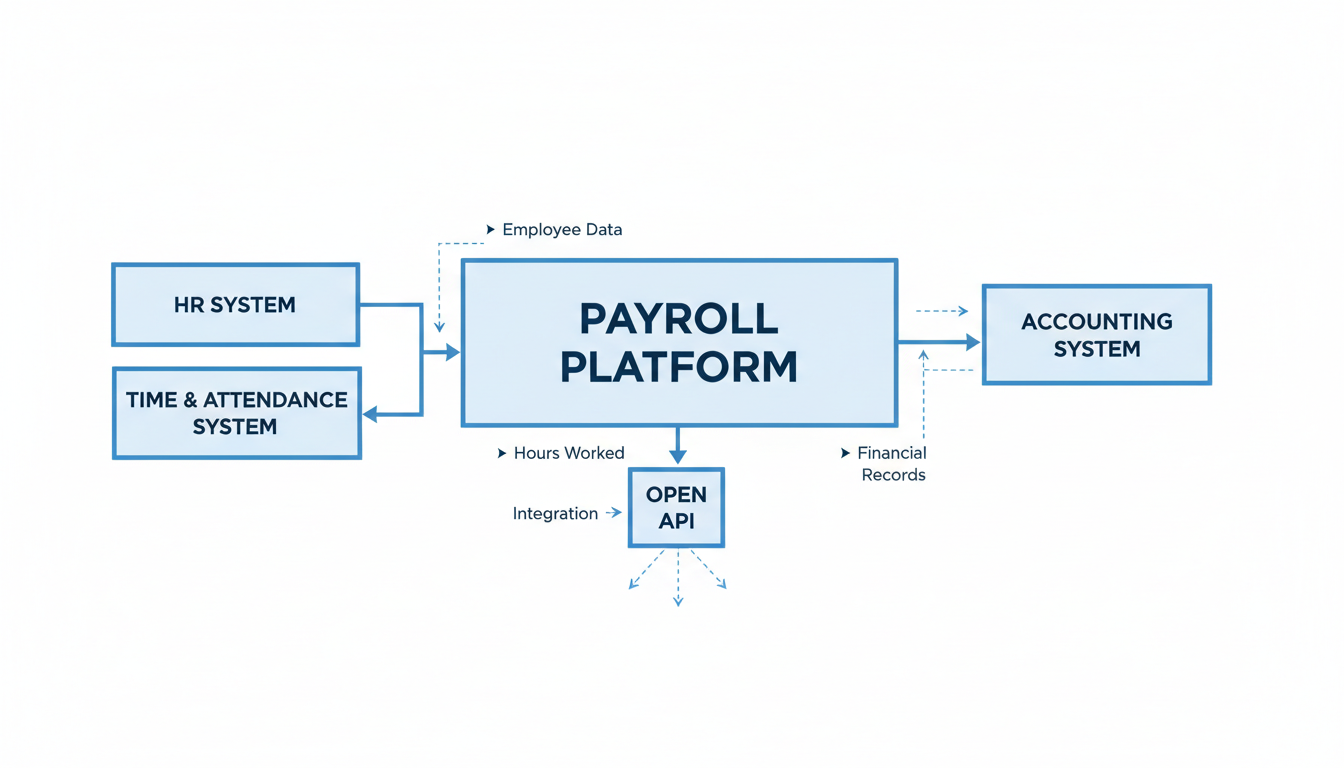
The ability for a payroll system to seamlessly integrate with other business-critical software is equally vital. Real-time data sharing with accounting software like QuickBooks or Xero, Human Resource Information Systems (HRIS), time tracking applications, and other productivity tools eliminates the painstaking and error-prone process of double data entry . Such integrations ensure data consistency across the organization and provide a unified view of employee information, transforming payroll from a standalone function into a central hub of operational efficiency . Platforms offering open APIs are particularly valuable, as they provide flexibility for custom integrations and future-proofing against evolving technological needs 14. While some integrations might incur initial setup or ongoing fees, the long-term benefits in efficiency and data accuracy typically far outweigh these costs, especially when compared to the hidden costs of manual workarounds and data discrepancies 15. Ultimately, a well-integrated payroll platform reduces administrative burden, improves decision-making, and supports a more agile and responsive business operation.
Real-World Check: Common User Experiences and Pitfalls
Navigating the landscape of payroll platforms often reveals a significant gap between advertised promises and the realities of daily use. For HR professionals and small business owners, the allure of streamlined operations and guaranteed compliance can quickly dissipate when confronted with common pitfalls. This section explores prevalent user complaints, from frustrating customer service to hidden complexities, contrasting them with advertised ease of use.
A persistent pain point arises from inadequate customer support, frequently characterized by impersonal ticket systems, long hold times, and the repeated need to re-explain issues to various agents . This contrasts sharply with the expectation of personalized problem resolution for such a critical business function. Furthermore, the fear and effort associated with data migration are major deterrents, with businesses often concerned about potential errors during transfer that could lead to compliance issues 16. Many payroll problems, in fact, originate from fundamental setup errors, outdated configurations, or incorrect employee classifications rather than software malfunction itself .
Software reliability frequently falls short, with common miscalculations in pay rates, overtime, and deductions leading to significant correction efforts . Incorrect federal, state, and local tax calculations are cited as the biggest challenge, risking non-compliance and substantial fines due to complex and ever-changing regulations . Moreover, the inflexibility of many systems to handle intricate arrangements forces manual workarounds, increasing administrative burden and risk 17. These issues are often compounded by unexpected hidden costs for additional runs or specific services, making the total operational cost much higher than initially advertised 18.
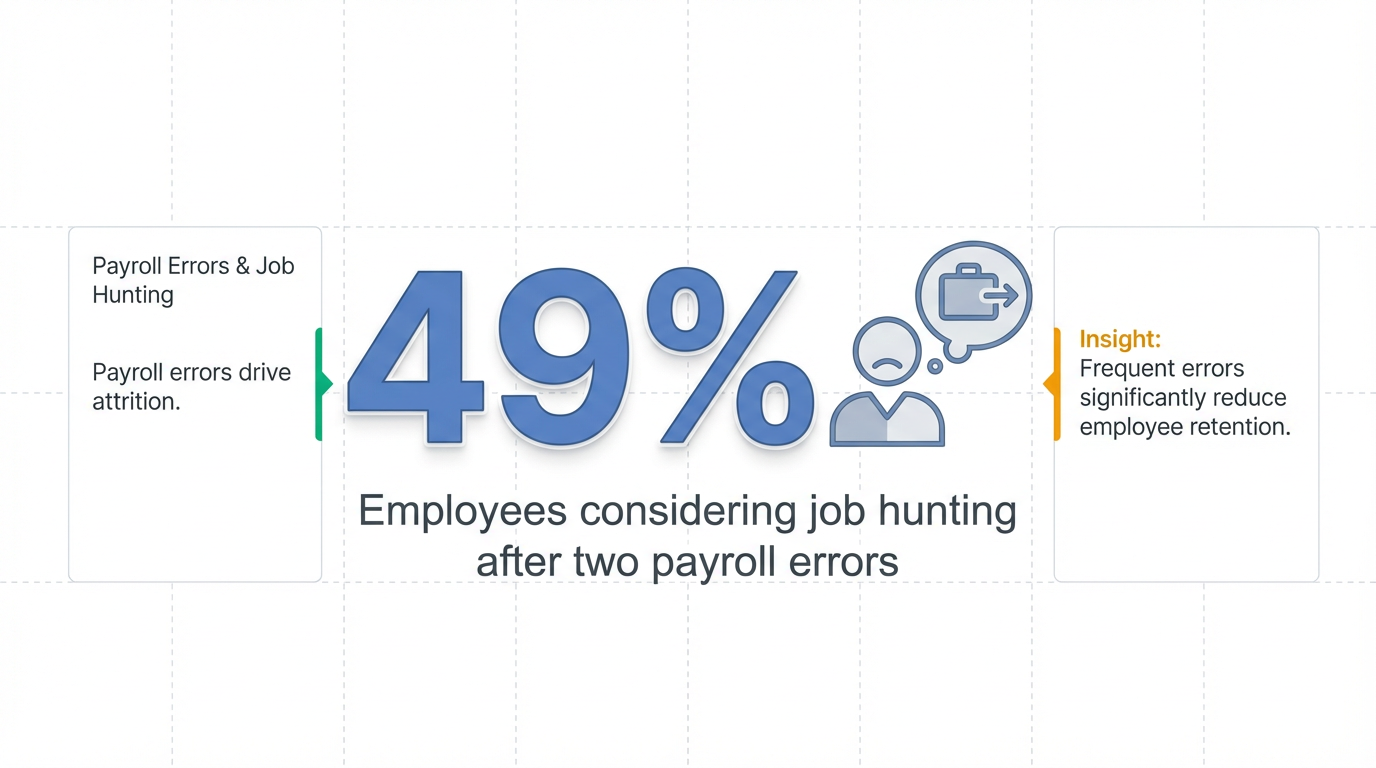
Disconnected HR, timekeeping, and payroll systems force manual data entry, escalating error rates and compromising data integrity across departments . Ultimately, payroll errors deeply impact employee well-being, causing increased stress, money concerns, and reduced productivity . Critically, such mistakes erode trust and can lead to high turnover, with 49% of employees considering job hunting after just two payroll errors .
The contrast between advertised "service" and actual "tech support" is notable, where comprehensive support becomes impersonal ticket systems 17. While platforms are marketed as "future-ready," the reality is that the costs of not upgrading—through inefficiencies and compliance risks—are often far greater and silently erode profitability over time compared to the initial investment . True positive user experiences, conversely, stem from genuine automation, seamless integration, and proactive compliance tools that directly address these pain points.
Optimizing Payroll: Leveraging Integrations and Automation
Moving beyond merely managing payroll, modern platforms empower businesses to architect highly efficient and tailored payroll operations. For the tech-savvy owner or HR professional, this means leveraging a suite of advanced features and robust integration capabilities to transform a once-manual chore into a strategic advantage. It’s about building a bespoke system that serves your specific needs, rather than adapting to a rigid, off-the-shelf solution.
The cornerstone of this optimization lies in seamless integration, driven by open APIs and real-time data sharing 14. This capability allows payroll platforms to connect effortlessly with existing HR systems, accounting software like QuickBooks or Xero, and time-tracking tools, eliminating the tedious and error-prone task of manual data entry . Such interoperability ensures data consistency across all business functions, providing a unified and accurate view of workforce costs and performance. Think of it as a central nervous system for your operational data, where payroll isn't an island but a fully integrated organ.
Artificial Intelligence (AI) and Machine Learning (ML) are rapidly advancing, moving payroll from a transactional necessity to a strategic intelligence hub . By 2026, AI is expected to function as autonomous payroll "agents," capable of processing payroll end-to-end, validating accuracy, and finalizing runs automatically . These intelligent systems can detect anomalies and errors before they escalate, offer predictive analytics for forecasting expenses, and even automatically interpret and apply new regulatory guidelines across diverse geographies, ensuring continuous compliance . This level of automation frees up HR teams to focus on strategic initiatives rather than administrative burdens.
Furthermore, cloud-based solutions provide the foundational agility and scalability necessary for future-proofing your payroll environment 19. These platforms offer inherent flexibility to manage complex pay structures, support multi-currency transactions, and adapt quickly to regulatory shifts through automatic updates . For those looking to configure robust and customized payroll ecosystems, cloud infrastructure is indispensable, offering enhanced security and access from anywhere, crucial for today's distributed workforces . The power to configure and control these dynamic elements empowers businesses to stay ahead of the curve, crafting payroll systems that evolve with their growth and the ever-changing landscape of work.
Your Action Plan: Next Steps to Payroll Peace of Mind
Navigating the complex landscape of payroll platforms for Small to Medium-sized Businesses (SMBs) in the 2024-2026 timeframe demands a strategic approach. We've explored the essential features that drive efficiency, the emerging trends that promise transformation, and the critical compliance considerations that shield your business from risk. Understanding the varied pricing models and common user experiences reveals that the right choice is less about the flashiest features and more about a perfect fit for your operational realities and growth trajectory. The goal is to move beyond simply paying employees to leveraging payroll as a strategic asset.
To achieve this, HR professionals and small business owners must adopt a meticulous, proactive stance when evaluating platforms.
Firstly, begin with a thorough internal needs assessment. Don't get swayed by extensive feature lists before understanding what your business truly requires, both now and in the near future. Document your specific payroll complexities, such as multi-state employees, a blend of W-2 and 1099 workers, or unique benefits administration needs . Identify pain points with your current system, whether they stem from manual processes, integration gaps, or poor reporting . This clear understanding of your requirements will serve as your non-negotiable checklist when reviewing potential platforms.
Secondly, always perform a comprehensive Total Cost of Ownership (TCO) analysis, looking well beyond the advertised base prices. Many providers entice with attractive upfront fees but hide significant costs in add-ons and various transaction charges . Demand a complete fee schedule that details all potential expenses: implementation, tax filings, year-end forms, off-cycle payroll runs, premium support, and integration fees . Crucially, factor in the "hidden" internal costs of staff time spent on administration, reporting, and corrections over a three-year horizon 4. A seemingly cheaper platform might be far more expensive in the long run if it demands extensive manual work or leads to frequent corrections.
Thirdly, prioritize seamless integration and robust data security. A payroll platform should not be a standalone silo; it must integrate effortlessly with your existing accounting, HRIS, and time-tracking systems to prevent manual data entry, reduce errors, and create a single source of truth for employee data . Beyond integration, scrutinize the platform’s security protocols and adherence to data privacy laws like the FTC Safeguards Rule and various state-specific regulations . Ensure it provides real-time risk monitoring and robust protection for sensitive employee information to mitigate the ever-growing cyber threats .
Finally, verify compliance guarantees and customer support efficacy. The regulatory landscape is constantly shifting, with new federal and state mandates emerging frequently . A modern payroll platform must offer automated compliance updates and error detection to protect your business from costly penalties . Beyond automated features, assess the quality of customer support. The real-world experience often deviates from advertised "service," with users frequently encountering impersonal "tech support" 17. Seek platforms with responsive, knowledgeable support that can help with complex queries and configuration issues, ensuring a partner, not just a vendor, in your payroll operations.