MiniMax-M2.5: Unveiling the Next Generation of Agentic AI
Introduction: The Buzz Around MiniMax-M2.5
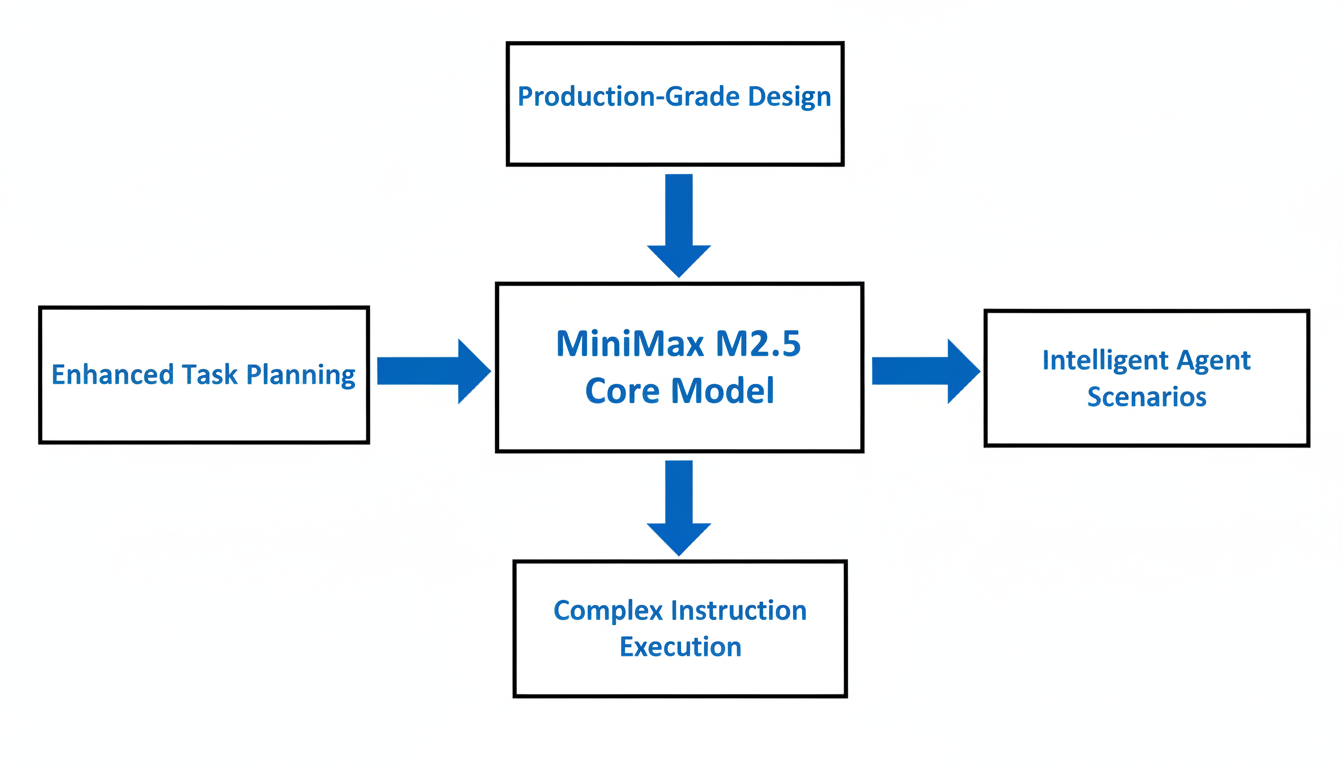
On February 12, 2026, MiniMax officially unveiled its flagship programming model, MiniMax M2.5, marking a significant milestone in the AI landscape 1. This highly anticipated release positioned M2.5 as a production-grade model, meticulously engineered for intelligent agent scenarios 1. The company proudly declared that its programming and intelligent agent performance are on par with international top-tier models, such as Claude Opus 4.6 1.
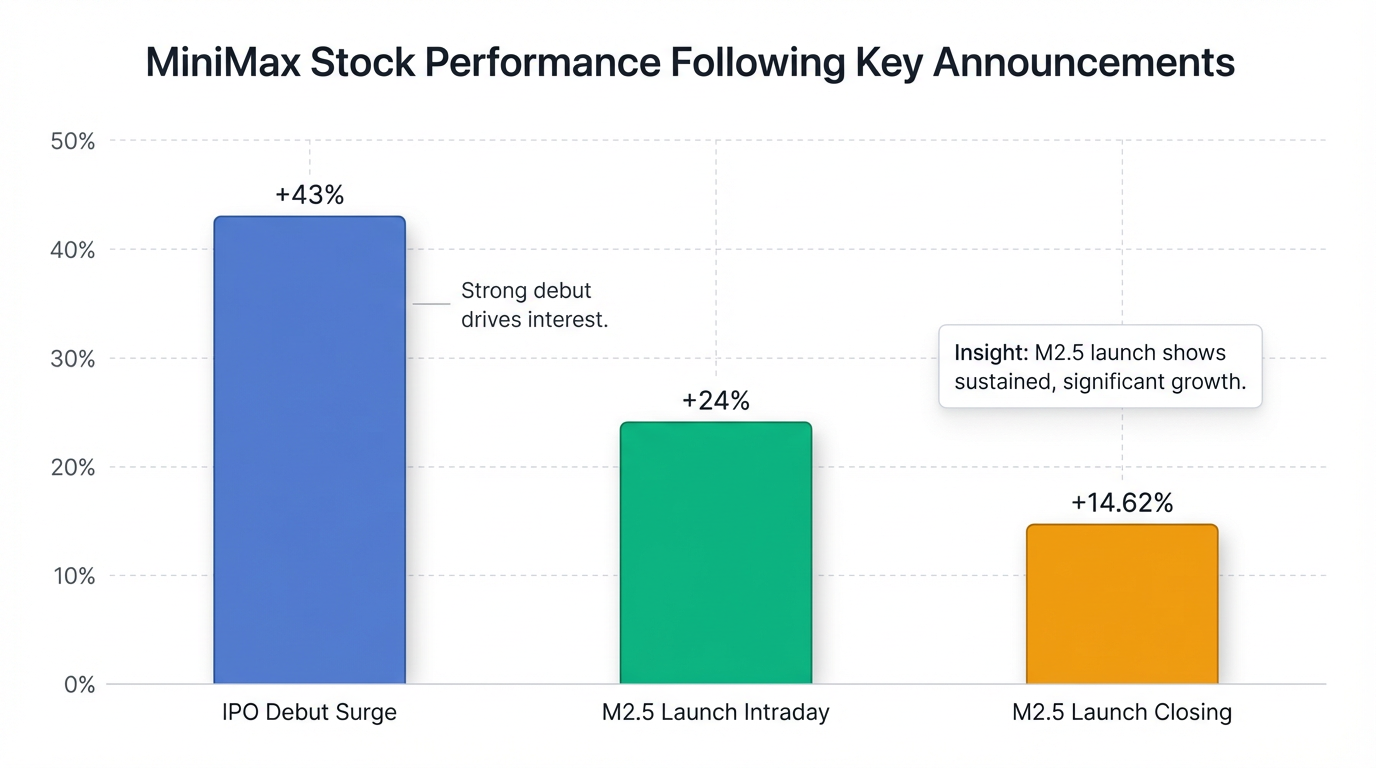
The launch of MiniMax M2.5 immediately generated considerable buzz, intensifying competition within the domestic large model field 2. Its unveiling sent ripples through the financial market, with MiniMax's stock (MINIMAX-WP (00100)) experiencing a substantial 24% surge during intraday trading, reaching new highs and ultimately closing up 14.62% 1. This strategic move earned praise from analysts; CITIC Securities highlighted MiniMax's "anti-consensus" focus on advancing model intelligence, while JPMorgan initiated coverage with an "Overweight" rating, recognizing MiniMax as a top pick for global AI value creation 3.
What is MiniMax-M2.5? A Deep Dive
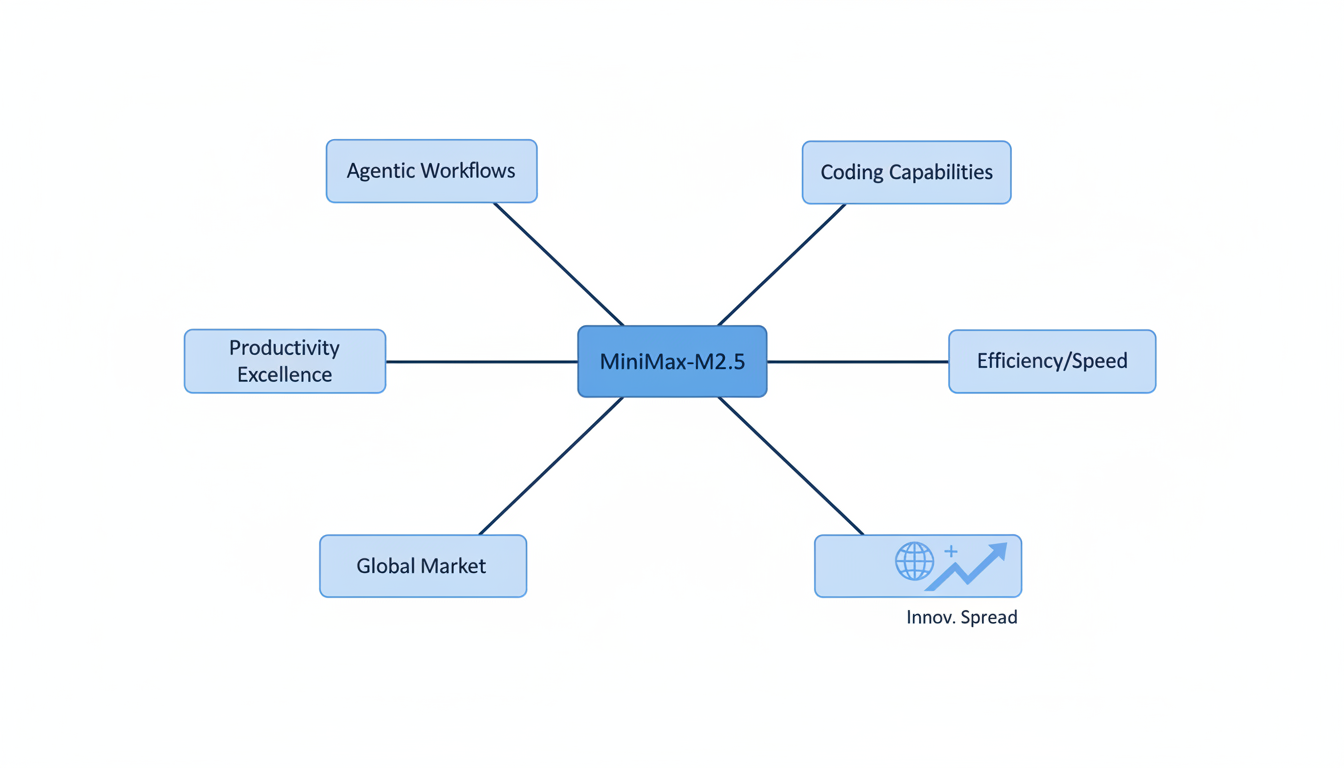
MiniMax-M2.5 is the flagship programming model officially launched by MiniMax on February 12, 2026 . It is positioned as a production-grade model specifically engineered for intelligent agent scenarios and is recognized as the world's first production-level model natively designed for such applications . This model represents an evolution from its predecessors, MiniMax-M2 (released November 2025) and MiniMax-M2.1 (released December 22, 2025) 4, emphasizing efficiency, speed, and advanced capabilities for complex tasks, particularly in coding and agentic workflows. MiniMax's strategic focus included internal testing within the overseas version of its Agent product, signaling a commitment to global expansion .
Core Features and Capabilities
MiniMax-M2.5's design prioritizes robust performance in practical applications, distinguishing it in the competitive AI landscape:
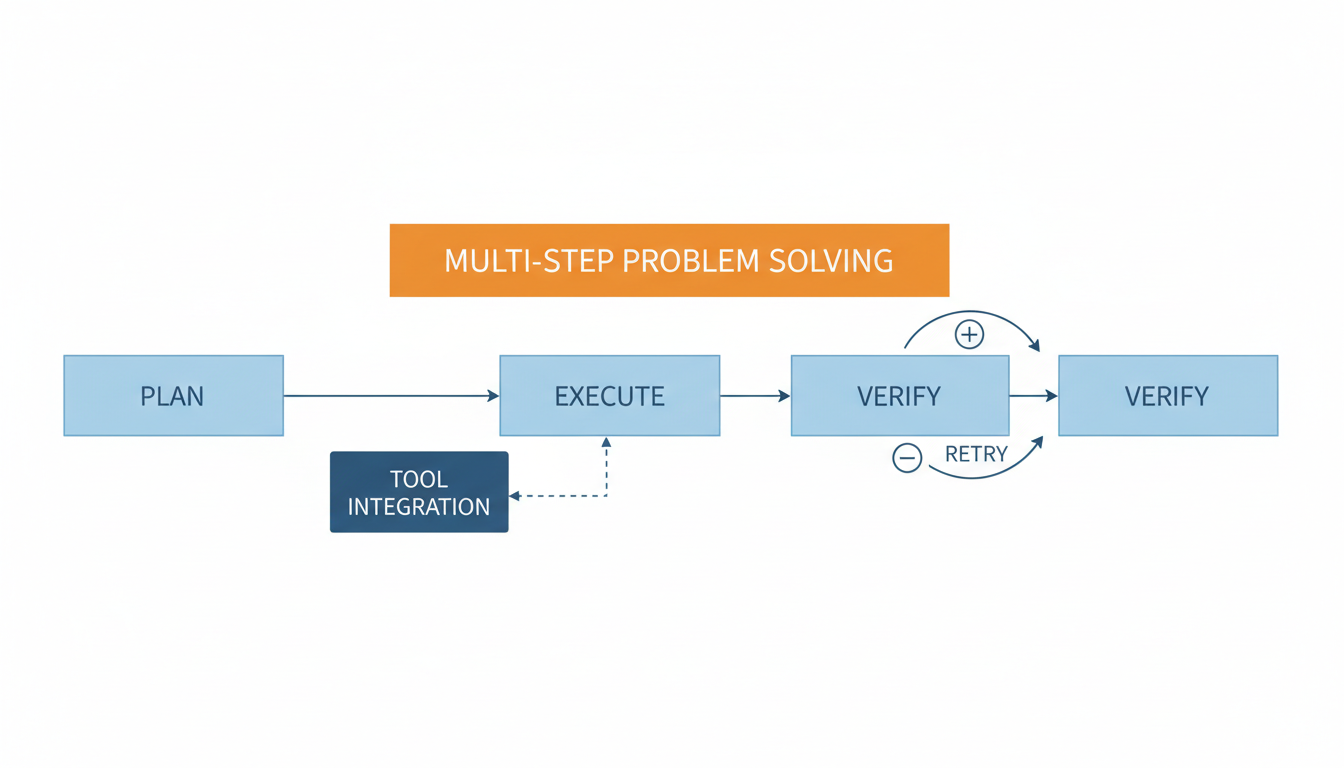
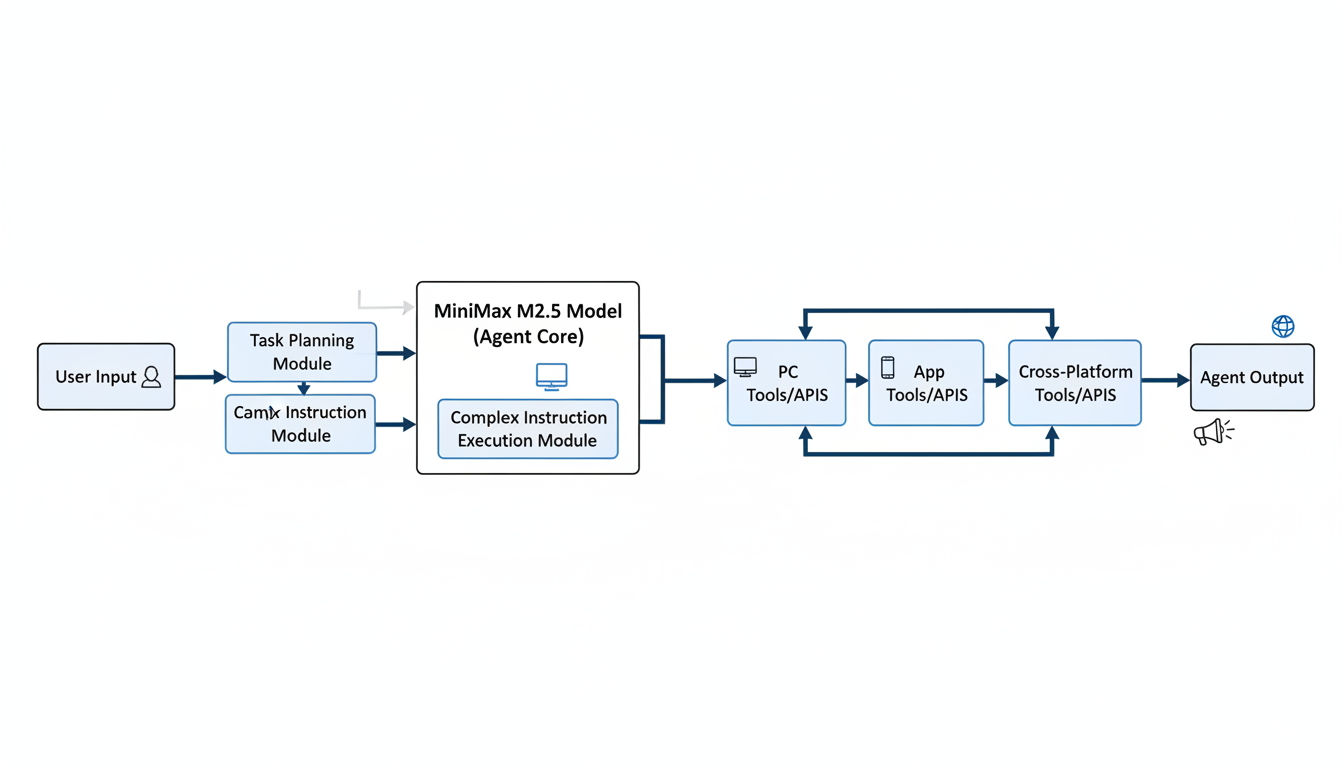
- Intelligent Agent Design & Agentic Workflows: Natively designed for agent scenarios, M2.5 supports complex tool integrations and multi-step problem-solving . This includes the ability to plan, execute, verify, and retry tasks, making it suitable for autonomous agents and workflow orchestration . Its availability on agent.minimax.io further underscores its agent-focused application 5.
- Programming Prowess: The model's programming and intelligent agent performance is described as matching leading international models like Claude Opus 4.6 1. It supports full-stack development across PC, App, and cross-platform applications . M2.5 excels in code generation, debugging, multi-file editing, and test-driven development, capable of reading multi-file repositories, executing multi-step repair loops, and validating its own modifications .
- Interleaved Thinking: A distinctive aspect is its "interleaved thinking" format, where the model outputs its chain-of-thought within specific
...tags . Preserving these thinking tokens in the conversation history is critical for maintaining coherence and performance in multi-step solutions and agentic reasoning . Incorrect implementation can significantly reduce performance, with improvements seen in benchmarks like Tau²-Bench (87% vs. 64%) when thinking state is preserved 6. - Productivity Excellence: MiniMax-M2.5 excels in specific productivity-related tasks including advanced Excel processing, in-depth research, and PPT creation, achieving industry-leading (SOTA) levels .
Technical Specifications
The technical foundation of MiniMax-M2.5, evolved from M2 and M2.1, focuses on a balance between parameter scale and inference efficiency:
- Architecture: It employs a Sparse Mixture-of-Experts (MoE) architecture . For MiniMax-M2.5, it features an activated parameter count of 10 billion (10B) per task . Its immediate predecessor, M2.1, utilized 230 billion total parameters with 10 billion active parameters per token, representing a 23:1 sparsity ratio 4.
- Attention Mechanism: MiniMax-M2.1 reintroduced Lightning Attention, a hybrid design incorporating 7 layers of linear attention and 1 layer of standard softmax attention, to address quadratic scaling with sequence length while maintaining precision 4. This approach allows for a standard 200,000-token context window with theoretical extension to 1 million tokens 4. Earlier, MiniMax-M2 had reverted to full attention for quality and stability .
- Efficiency and Speed: MiniMax-M2.5 boasts an impressive 100 TPS (tokens per second) throughput, with inference speed surpassing that of some top international models . The earlier version, MiniMax-M2, achieved 93 tokens/second inference speed and 100-200ms first-token latency . The sparse MoE design ensures extremely parameter-efficient operation, enabling high throughput and low deployment costs, capable of running efficiently on setups with limited GPU memory .
- Context Window: MiniMax-M2 supports an ultra-large context window of 204K input tokens and 131K output tokens . MiniMax-M2.1 maintained a 200K standard context window with potential for 1 million tokens 4.
- Open-Source & Deployment: The weights for MiniMax-M2 were open-source under an Apache 2.0 or MIT license . It integrates with inference frameworks such as vLLM, SGLang, and MLX-LM for efficient cloud or local deployment . It also supports OpenAI and Anthropic API standards, making integration straightforward .
Unique Selling Points & Comparative Advantages
MiniMax-M2.5's primary advantages stem from its specialized design for agentic and coding tasks, coupled with impressive efficiency:
- Cost-Effectiveness: The M2 model offered top-tier results at up to 8% of the cost of comparable models . Its API cost was only 15% of rivals like Kimi K2 Thinking, with rates such as $0.08/M input tokens and $0.40/M output tokens for M2 . This "radical unit economics" is a key feature for reducing latency, cost, and increasing throughput 7.
- Performance in Agentic & Coding Benchmarks: MiniMax-M2.5's comprehensive performance directly competes with top international models like Claude Opus 4.6 in programming and agent performance 8. MiniMax-M2 achieved a 69.4% score on SWE-bench Verified and 77.2% on Tau²-bench for agent tasks, often outperforming or closely rivaling proprietary systems like GPT-5 (thinking) and Claude Sonnet 4.5 in these areas .
- Speed and Low Latency: Its efficient design and 10B active parameters contribute to rapid inference, which is critical for real-time applications and rapid feedback loops in coding and agentic tasks .
- Accessibility: As an open-source model (M2), it allows developers to self-host, fine-tune, or integrate it into workflows without significant financial barriers, promoting wider adoption .
Problems Solved & Target Applications
MiniMax-M2.5 is designed to address several critical challenges in AI development and enterprise applications:
- Enhanced Developer Workflows: It enables multi-file code edits, automated testing, and regression repair directly within integrated development environments (IDEs) or CI/CD pipelines . Its ability to diagnose, edit, and validate code in real-time makes it an effective AI pair programmer and autonomous PR fixer .
- Enterprise Automation: MiniMax-M2's (and thus M2.5's) agentic capabilities are highly valuable for organizations seeking to automate complex workflows that involve web search, command execution, and API calls . This extends to applications in customer support, R&D, data analysis, and scalable compliance audits .
- Financial and Legal Workflows: MiniMax-M2 (and by extension M2.5) can automate document-heavy tasks in finance (e.g., generating audit reports, investment summaries, portfolio analyses) and legal (e.g., case law research, summarizing statutes and precedents), improving accuracy and reducing manual effort 9.
- Cost-Effective AI Deployment: By offering frontier-level reasoning and coding capabilities with a manageable activation footprint and efficient inference, MiniMax-M2.5 allows enterprises and startups to operate advanced AI workloads on fewer GPUs, significantly reducing infrastructure costs and making advanced AI more accessible .
Comparison with Previous Versions and Competitors
MiniMax-M2.5 represents the ongoing evolution of MiniMax's models, showing clear advancements and strong competition:
- MiniMax-M2.5 vs. Claude Opus 4.6: MiniMax-M2.5 is officially stated to directly compete with Claude Opus 4.6 in comprehensive programming and agent performance 8.
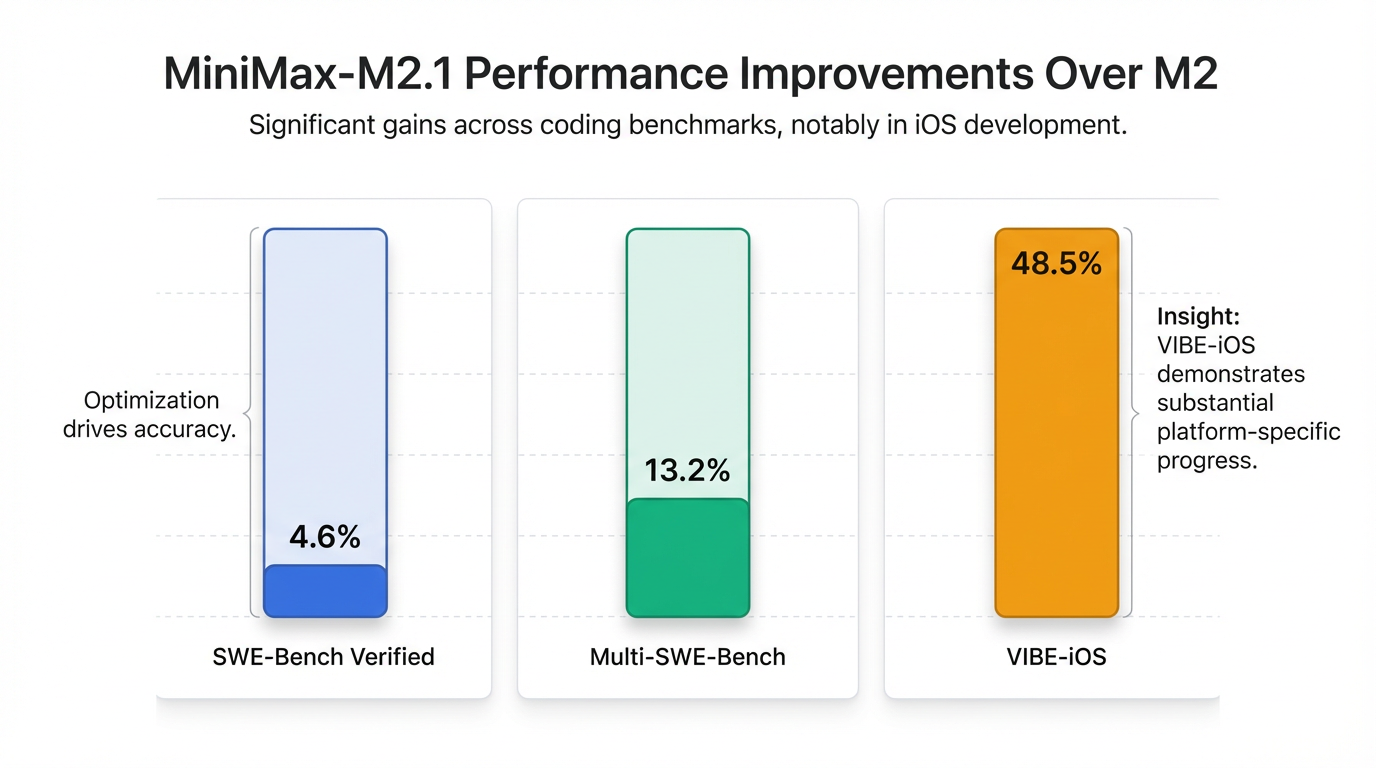
- Improvements from MiniMax-M2 to M2.1: M2.1, released two months before M2.5, significantly improved performance over M2 in coding and agentic tasks. For instance, SWE-Bench Verified saw a +4.6% increase, Multi-SWE-Bench a +13.2% increase, and VIBE-iOS a dramatic +48.5% improvement 4. M2.1 also reinstated Lightning Attention, an architectural choice that diverged from M2's full attention approach .
- MiniMax-M2 vs. Kimi K2 Thinking: MiniMax-M2 is considerably faster (93 tok/s vs. Kimi's 34 tok/s) and more cost-effective (85% cheaper API) . M2 excels in long-chain agent task planning (77.2% on Tau²-bench vs. Kimi's 66.1%) and system-level operations . Kimi K2 Thinking, however, demonstrates stronger mathematical and scientific reasoning, and ultra-complex multi-step reasoning .
- MiniMax-M2 vs. GPT-5 and Claude Sonnet 4.5: MiniMax-M2 is highly competitive in reasoning and coding tasks, often matching or surpassing these proprietary models in specific benchmarks. For example, M2's LiveCodeBench score is ~83%, nearing GPT-5's ~85% . M2 has shown stronger performance than Claude Sonnet 4.5 in BrowseComp (44.0 vs 19.6) and Terminal-Bench (46.3 vs 50.0 for Claude, 43.8 for GPT-5) . The Artificial Analysis Intelligence Index for M2 was 61 points, ranking it as the highest open-weight model globally 10.
- Architectural Evolution: M2.5's immediate predecessor, M2.1, showcased a more aggressive sparsity ratio (23:1) compared to competitors like DeepSeek V3.2 (~1.5:1) and GLM-4.7 (~3.5:1), maximizing inference efficiency 4. M2's parameter sparsity was also twice that of Qwen3 (4.37% active parameters vs. 9.36%) 11.
| Model | Inference Speed (tok/s) | API Cost (vs Kimi) | Tau²-bench (%) | LiveCodeBench (%) | Terminal-Bench (%) |
|---|---|---|---|---|---|
| MiniMax-M2 | 93 | 15% | 77.2 | ~83 | 46.3 |
| Kimi K2 Thinking | 34 | 100% | 66.1 | - | - |
| Claude Sonnet 4.5 | - | - | - | - | 50.0 |
| GPT-5 (thinking) | - | - | - | ~85 | 43.8 |
In conclusion, MiniMax-M2.5 emerges as a highly competitive and specialized model, particularly strong in agentic and coding applications, offering exceptional efficiency and performance that rivals leading proprietary models while aiming to make frontier AI capabilities more accessible and cost-effective.
Key Announcements and Milestones
MiniMax has demonstrated remarkable progress in its AI model development and market expansion, marked by a series of pivotal announcements and milestones leading up to and including the launch of its flagship M2.5 model.
MiniMax M2 Goes Open-Source, Redefining Agentic AI
On November 3, 2025, MiniMax officially open-sourced MiniMax-M2, a groundbreaking "Agent & Code Native" model designed to streamline end-to-end developer workflows 12. This release quickly garnered significant attention, achieving the #1 rank among open-source models, #5 in intelligence, and becoming the #3 token usage model on OpenRouter, alongside its #1 trending status on Hugging Face 12. M2 boasts an impressive 200K context window, approximately 100 TPS throughput, and robust support for long-horizon toolchains, including MCP, shell, browser, retrieval, and code 12. Notably, it offers superior efficiency, operating approximately twice as fast and priced at about 8% of Claude Sonnet 12. Concurrently, MiniMax published an article detailing "Interleaved Thinking," a crucial methodology for enhancing MiniMax-M2's agentic capabilities across various API interfaces 13.
M2.1 Unleashes Polyglot Programming and Massive Context Windows
Just over a month later, on December 23, 2025, MiniMax launched MiniMax-M2.1, introducing "polyglot programming mastery" and "precision code refactoring" 14. This iteration provides a text generation API with buildable tool calls, accessible through HTTP, Anthropic SDK, or OpenAI SDK 14. M2.1 supports an ultra-large context window of up to 204,800 tokens and is specifically designed for advanced code understanding and interleaved tool use 14. The release also brought enhancements to polyglot video generation with new models like MiniMax-Hailuo-2.3 and MiniMax-Hailuo-2.3-Fast, offering improved realism and speed, alongside MiniMax-Hailuo-02 for higher resolution 14.
MiniMax Makes Historic IPO Debut, Valuations Soar
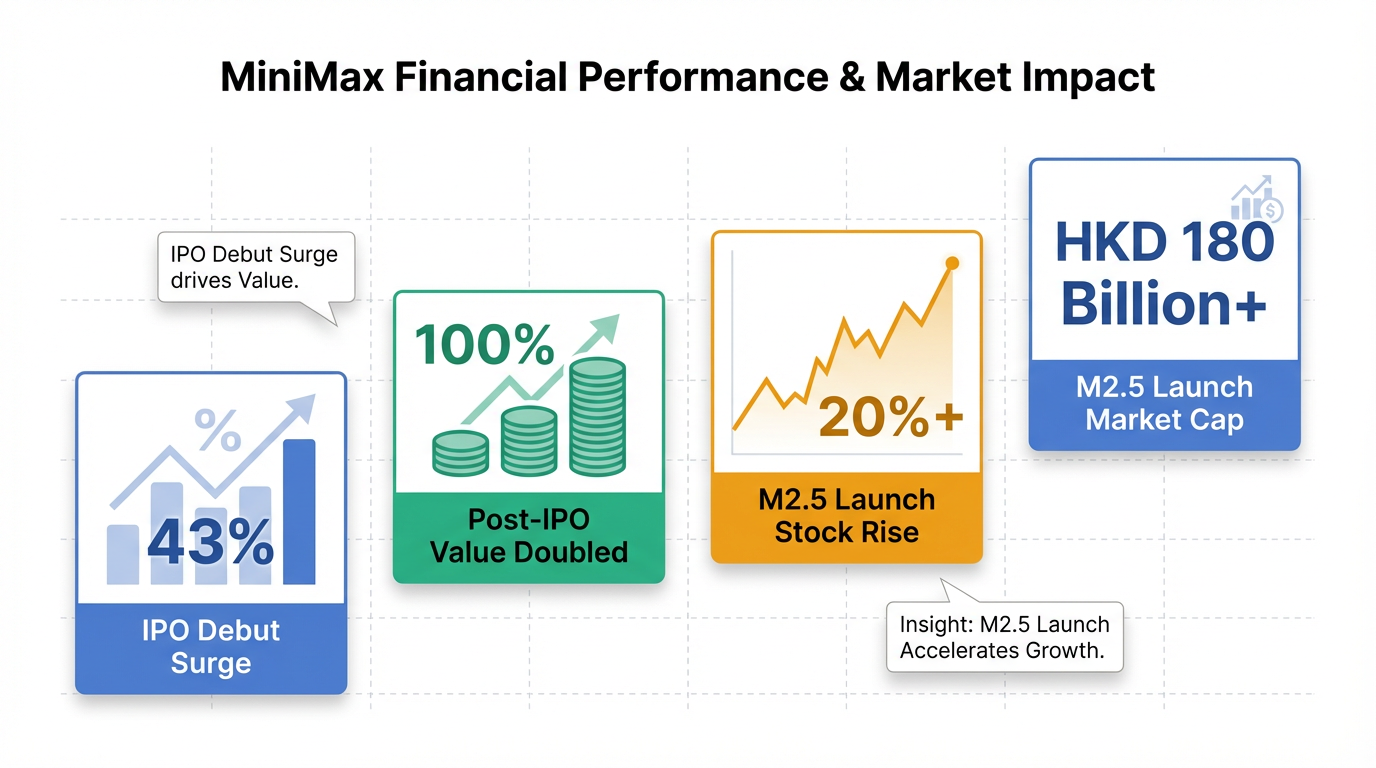
A landmark event for the AI industry, MiniMax Group Inc. filed for its Initial Public Offering (IPO) on December 31, 2025 15. This made MiniMax the first pure Large Language Model (LLM) company to go public globally 17. The IPO prospectus revealed substantial investments, including over $150 million spent on cloud computing in 2025, with R&D expenditures reaching approximately $250 million, 90% of which was dedicated to hardware 17. Despite reporting $53 million in revenue through September 2025 and $211 million in losses during the same period, the company's market debut was a resounding success 17. MiniMax commenced trading on the Hong Kong Stock Exchange on January 8, 2026, with an offer price of HK$165.00 per share, raising HK$4.8 billion ($620 million) and witnessing a 43% surge in its trading debut 15. By January 9, its value had doubled, and an additional HK$697 million was raised through the full exercise of its overallotment option by January 11 15.
Agora Partnership Elevates Real-Time Conversational AI with MiniMax
On January 20, 2026, Agora (NASDAQ: API), a leading real-time engagement infrastructure provider, announced a deepened strategic collaboration with MiniMax following the latter's successful IPO 20. This partnership integrates MiniMax's advanced text-to-speech (TTS) and multimodal foundation models with Agora's Conversational AI Engine and global real-time delivery network 20. The initiative aims to empower developers to deploy conversational AI systems capable of human-like, responsive, and real-time interactions, particularly benefiting applications in call centers, AGI, and robotics 20. A key focus is to overcome the challenge of delivering expressive AI voices consistently and naturally worldwide, enabling sophisticated real-time voice agents, AI-native devices, and multimodal conversational experiences 20.
M2.2 Looms as M2 Continues to Impress in Agentic Performance
Leading up to its next major release, reports on February 3, 2026, indicated MiniMax's plan to launch its M2.2 version before the Spring Festival, with an emphasis on enhancing programming capabilities 23. A review of the MiniMax M2 model, published concurrently, lauded its competitive performance against top models like GPT-5 in agentic workflows 24. The M2 model's efficient design, utilizing only 10 billion active parameters out of 230 billion total parameters, was highlighted for enabling lower latency, reduced cost, and higher throughput 24. It demonstrated robust performance in coding and agentic benchmarks, achieving 69.4% on SWE-bench Verified, 46.3% on Terminal-Bench, and 44.0% on BrowseComp 24. Furthermore, its API pricing was noted as significantly more cost-effective—85% cheaper—with an inference speed 2.7 times faster than Kimi K2 Thinking 24.
MiniMax M2.5 Unveiled: A New Era for Agentic AI
The highly anticipated official launch of MiniMax M2.5 occurred on February 12, 2026 26, following Reuters' report on February 11, 2026, about its release on MiniMax's overseas agent website 15. Positioned as the company's latest flagship programming large model, M2.5 is described as "the world's first production-level model designed natively for Agent scenarios" 26. MiniMax claims M2.5 directly rivals international top-tier models like Claude Opus 4.6 in both programming and intelligent agent performance 1. This advanced model supports full-stack programming development across PC, app, and cross-platform applications 1. It excels in core office productivity tasks, including advanced Excel processing, in-depth research, and PPT creation 1. Featuring only 10 billion activation parameters, M2.5 achieves high energy efficiency and an impressive 100 TPS throughput, enabling its inference speed to surpass some international leading models 1. The launch had an immediate and significant market impact, causing MiniMax's share price to rise by over 20% 8, with its stock surging 24% during intraday trading and ultimately closing up 14.62% 1. Its market capitalization exceeded HKD 180 billion 8, approaching HKD 200 billion 1. This release solidifies MiniMax's strategic focus on the agent field and its ambition for global competitiveness 26. The model is available for selection and invocation on its model interface and via MiniMax Agent apps and partner surfaces 30.
Industry Reaction and Future Outlook
The launch of MiniMax M2.5 on February 12, 2026, sparked significant market and industry reactions, positioning MiniMax as a key player in the evolving AI landscape. The financial market responded positively, with MiniMax's stock (MINIMAX-WP (00100)) surging by 24% in intraday trading, reaching a new high since its listing and nearing a market capitalization of HKD 200 billion, ultimately closing up 14.62% 1. This strong market performance was further underscored by JPMorgan initiating coverage with an "Overweight" rating and a HKD 700 price target, identifying MiniMax as a top pick for global AI value creation 3. Analysts from CITIC Securities highlighted MiniMax's "anti-consensus" strategic focus on advancing model intelligence as a standout in the generative AI wave 3.
MiniMax M2.5's release contributed to "intensifying competition" within the domestic large model field 2. Its strategic focus on global expansion and competitiveness in the international AI application market was evident from prior internal testing within the overseas version of the MiniMax Agent product 3. M2.5 is positioned to directly compete with international top-tier models like Claude Opus 4.6 in programming and intelligent agent performance 1. This competitive stance signals MiniMax's ambition to lead in the global AI market.
The model's unique design for agentic and coding tasks, coupled with its impressive efficiency and cost-effectiveness, positions it as a key enabler for advanced AI deployment. M2.5 is natively designed as a production-grade model for intelligent agent scenarios, with capabilities for enhanced task planning and complex instruction execution 1. It supports full-stack programming development across PC, App, and cross-platform applications 1 and excels in code generation, debugging, multi-file editing, and test-driven development 9. Its architectural efficiency, featuring only 10 billion activated parameters, offers advantages in GPU memory usage and inference efficiency 1. With a throughput of 100 TPS, its inference speed surpasses that of some international leading models 8. Earlier versions, like M2, demonstrated significant cost-effectiveness, offering top-tier results at up to 8% of the cost of comparable models and an API cost 15% of rivals like Kimi K2 Thinking 9. These attributes make M2.5 a powerful tool for enhanced developer workflows, enterprise automation, and cost-effective AI deployment, enabling multi-file code edits, automated testing 10, and complex workflow automation across various sectors 10.
MiniMax's commitment to rapid iteration speed, with M2.5's release coming just over a month after its 2.2 version 2, and continuous architectural advancements, such as the reintroduction of Lightning Attention in M2.1 to optimize sequence length handling 4, signals its dedication to ongoing development and leadership in AI innovation. The company's strategy balances shipping new versions with increasing computational investment 30.
Looking ahead, M2.5 is poised to significantly increase the accessibility of frontier AI capabilities. Its efficient inference and manageable activation footprint allow enterprises and startups to operate advanced AI workloads on fewer GPUs, thereby reducing infrastructure costs and making advanced AI more attainable 9. This democratized access to high-performance AI is expected to foster innovation and accelerate AI adoption across various industries.
Conclusion: MiniMax-M2.5's Place in the Landscape
The official launch of MiniMax M2.5 on February 12, 2026, marks a pivotal moment in the evolution of artificial intelligence, firmly positioning MiniMax as a frontrunner in the global AI landscape 1. As a flagship, production-grade programming model natively engineered for intelligent agent scenarios, M2.5 sets a new benchmark for advanced AI capabilities 1. Its ability to match international top-tier models like Claude Opus 4.6 in programming and agent performance underscores its significant competitive advantage 1.
MiniMax-M2.5 differentiates itself not only through its robust performance in complex tasks, including full-stack development and productivity applications 1, but also through its remarkable efficiency and cost-effectiveness. Featuring an activated parameter count of 10 billion, the model boasts superior GPU memory usage, inference efficiency, and a rapid throughput of 100 tokens per second, surpassing many leading international models in speed 1. This efficiency, inherited from its predecessors, translates into substantially lower operational costs, with earlier versions achieving top-tier results at a fraction of the expense of comparable models 9. This "radical unit economics" is a game-changer for businesses and developers alike, making advanced AI more accessible 7. The rapid iteration speed, with M2.5 releasing just over a month after its 2.2 version, further demonstrates MiniMax's agility and commitment to continuous innovation 2.
The market's enthusiastic reception, including a significant surge in MiniMax's stock price and positive analyst ratings, highlights the strategic importance of M2.5 1. MiniMax's "anti-consensus" focus on advancing model intelligence is gaining recognition as a key differentiator in the generative AI wave 3. M2.5's native design for intelligent agent scenarios, coupled with its advanced capabilities, signals a strategic drive towards global expansion and competitiveness in the international AI application market 3.
Moving forward, MiniMax-M2.5 is poised to reshape the future of AI development and adoption. By enabling enhanced developer workflows, streamlining enterprise automation, and addressing complex challenges in fields such as finance and legal research, it empowers a wide array of users to leverage frontier AI capabilities 10. Its efficient architecture and cost-effectiveness will allow enterprises and startups to deploy advanced AI workloads on fewer GPUs, significantly reducing infrastructure costs and democratizing access to powerful AI tools 9.
MiniMax-M2.5 stands as a testament to MiniMax's vision, offering a powerful, efficient, and accessible AI solution designed to drive innovation across industries and solidify its position as a global leader in the intelligent agent era.