The Indie Hacker's Playbook for Subscription Retention: Onboarding, Personalization, and AI-Driven Engagement
The Retention Imperative in Subscription Models
In today's dynamic digital economy, especially within a conservative venture capital market, the emphasis for SaaS founders and subscription business owners has critically shifted towards sustainable growth. Retention of existing customers has never been more vital, evolving from a best practice into an urgent business imperative 1. The harsh reality is that acquiring new customers is an increasingly costly endeavor, with estimates suggesting it's 5 to 25 times more expensive than simply retaining those you already have 2. With the average Customer Acquisition Cost (CAC) for SaaS companies hitting approximately $702 in 2024—a staggering 222% increase over the past eight years—the financial strain of constant acquisition is undeniable 3.
This escalating cost trajectory underscores a fundamental truth: even a modest improvement in retention rates can yield profound financial benefits. Boosting retention by just 5% can translate into a substantial increase in profits, ranging from 25% to an astonishing 95% 2. Companies excelling at retention inherently grow faster, with those boasting a Net Revenue Retention (NRR) above 100% demonstrating nearly double the growth rate of their peers 4. The industry's shift from "growth at any cost" to a focus on efficiency and sustainable scaling means that maximizing the lifetime value of every customer is paramount 6.
This report delves into the core challenges faced by subscription models, from the varied churn rates across different business types to the silent drain of involuntary cancellations. We propose that success in this environment hinges on adopting sophisticated, customer-centric strategies. Specifically, we will explore how proactive onboarding and intelligent personalization serve as cornerstones for not only mitigating churn but also fostering deeper, more valuable customer relationships. By strategically investing in these areas, businesses can transform their retention efforts from a defensive measure into a powerful engine for predictable growth and enhanced profitability.
Core Strategy: Engineering Lasting Engagement
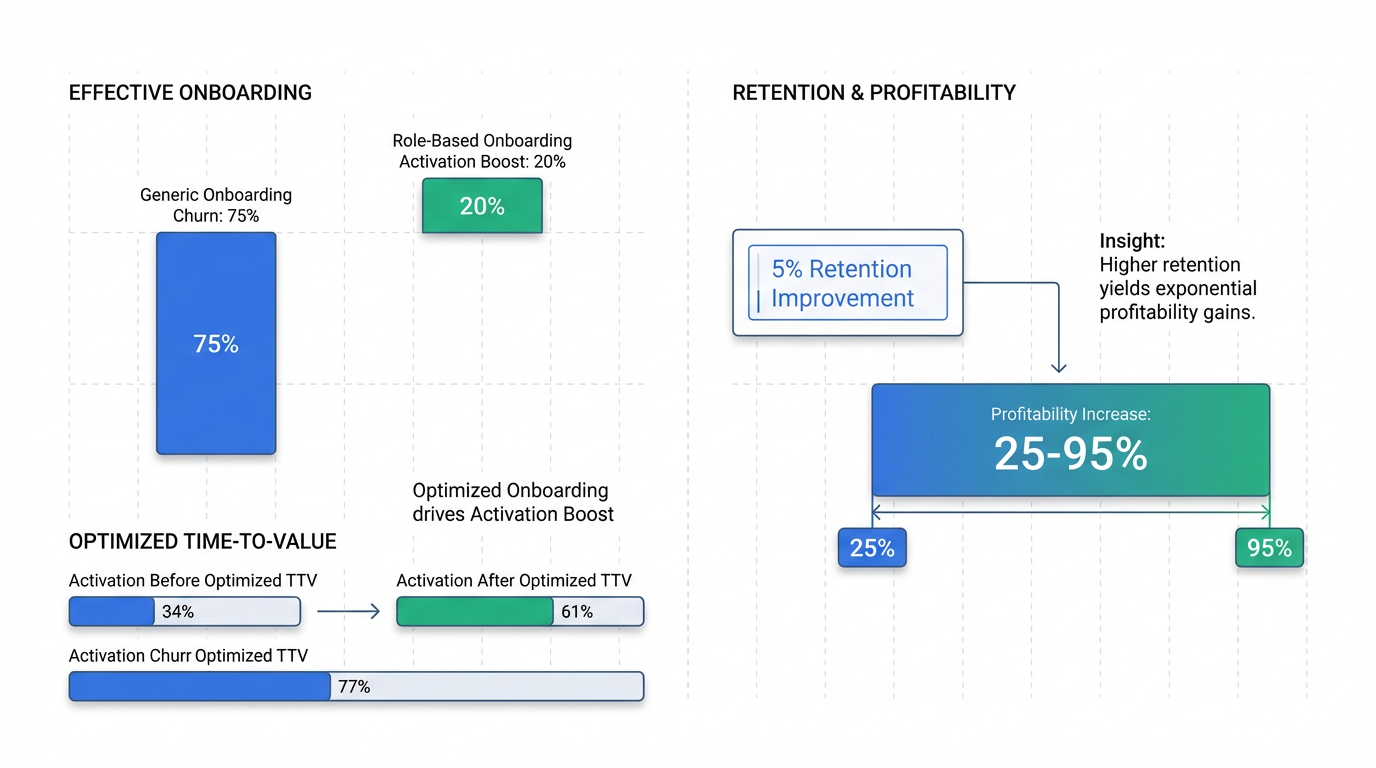
For indie hackers and SaaS founders, securing a foothold in a competitive market is only half the battle; the true determinant of long-term success lies in retaining customers. Rather than a reactive response to churn, effective retention requires a proactive, strategic approach woven into the very fabric of the product and customer experience. This paradigm shift, prioritizing ongoing engagement over one-time acquisition, is essential for sustainable growth in subscription-based models. Studies show that even a modest 5% improvement in retention can boost profitability by 25-95%, underscoring its profound impact 8.
To truly move the needle on retention, SaaS businesses must meticulously craft experiences that resonate deeply with users from their first interaction and continue to evolve. This involves a three-pronged approach: optimizing the onboarding journey, leveraging data for hyper-personalization, and fostering vibrant user communities that build a strong sense of belonging and shared value.
1. Proactive Onboarding to Achieve the "Aha Moment"
The initial moments a user spends with your product are disproportionately critical. A generic onboarding experience can see up to 75% of new users churn within the first week, making it a pivotal area for intervention 10. Proactive onboarding focuses on guiding users to their "aha moment"—the point where they truly grasp the product's core value—as swiftly as possible. This means reducing the "Time-to-Value" (TTV) to under 15 minutes, using smart defaults and streamlined paths to minimize friction 10.
Personalized onboarding flows, segmented by user roles or specific use cases (e.g., a marketing manager versus a technical lead), can significantly increase activation rates, sometimes by as much as 20% 10. Techniques like progressive disclosure, where features are introduced gradually, prevent information overload and allow users to achieve quick wins, building proficiency step-by-step 10. Companies like Canva excel at this, using templates to reduce cognitive load 12. Integrating psychological triggers, such as progress bars that leverage the Zeigarnik Effect, along with small motivational messages, can provide those crucial "dopamine hits" that reinforce engagement and guide users through the initial learning curve 11.
2. Data-Driven Personalization & AI-Powered Segmentation
Moving beyond generic approaches, effective personalization tailors experiences based on specific customer characteristics, behaviors, and evolving needs 13. This is where AI truly shines, enabling advanced customer segmentation that traditional methods simply cannot match. AI sifts through vast datasets in real-time, uncovering hidden patterns and correlations in customer behavior, preferences, and pain points, providing insights that drive genuinely meaningful interactions 15.
The benefits of AI-driven segmentation are profound: it scales personalization to millions of customers with nuanced, behavior-based groupings and provides predictive insights into future actions like churn risk, allowing for proactive interventions 16. This capability significantly enhances Customer Lifetime Value (CLV) by identifying prime opportunities for upselling and cross-selling, and facilitates micro-segmentation, pushing towards individualized marketing rather than broad cohorts 16. The foundation of this strategy relies on high-quality behavioral data—a "goldmine" of user interactions—combined with demographic, preference, and contextual data, all unified into a 360-degree customer view, often facilitated by Customer Data Platforms (CDPs) 18.
3. Building Customer Communities & Value Ecosystems
Beyond individual product experiences, fostering a sense of community can significantly strengthen customer retention by creating belonging and mutual support, while also increasing the switching costs for users 21. An engaged community acts as a self-sustaining ecosystem, becoming a valuable source of product ideas, early feedback, and powerful word-of-mouth referrals 21.
Building these communities involves creating dedicated spaces, whether through Slack channels, forums, or integrated in-app features, where users can connect and share insights 21. Empowering advocates—power users who passionately champion your product—with perks like early access to features or direct feedback channels can transform them into valuable partners 21. Regularly hosting engaging events, such as Ask Me Anything (AMA) sessions, workshops, or user conferences, deepens engagement and facilitates knowledge sharing 21. Showcasing user-generated content, including real-world use cases and success stories, inspires others and tangibly demonstrates the product's value 21. Furthermore, AI can play a role in scaling these efforts through AI-moderated forums and automated feedback loops, efficiently managing and growing community engagement 22.
Real Example: The Netflix Blueprint for Enduring Engagement
For subscription-based services, keeping users hooked is the ultimate challenge. Netflix, a global leader in entertainment streaming, has mastered this art by employing a sophisticated, AI-driven personalization strategy to drastically reduce subscriber churn, saving hundreds of millions annually through this approach alone 23. This isn't just about suggesting shows; it's a meticulously engineered system that deeply integrates with the user experience.
Netflix's strategy centers on AI-driven UI personalization, dynamically tailoring every aspect of a user's interface 23. This includes custom title rankings, unique thumbnail displays, and personalized recommendation rows, all meticulously adjusted based on a user's watch history, device, and viewing context 23. They utilize a powerful combination of collaborative filtering, content-based filtering, and contextual bandit algorithms to achieve this level of bespoke content delivery 23.
The impact of this approach is staggering: over 80% of the hours streamed on Netflix are a direct result of these personalized recommendations 23. To maintain this edge, the company runs thousands of A/B tests each year, iterating on elements like layout, artwork, and row organization 23. This continuous optimization ensures that their personalization engine remains highly effective, consistently engaging users and reinforcing their connection to the platform, making the cost of switching feel incrementally higher with every tailored interaction. This robust, data-driven methodology exemplifies the pinnacle of the "Data-Driven Personalization & AI-Driven Segmentation" core strategy, proving its profound effect on enduring customer relationships.
Build It Yourself: AI Tools for Indie Hackers
For indie hackers and founders operating with lean teams and tight budgets, the promise of advanced retention strategies might seem daunting. However, modern AI tools are rapidly democratizing these sophisticated techniques, enabling swift implementation and continuous enhancement of retention efforts. These tools act as force multipliers, accelerating development cycles and reducing the inherent complexity of building highly personalized and engaging user experiences.
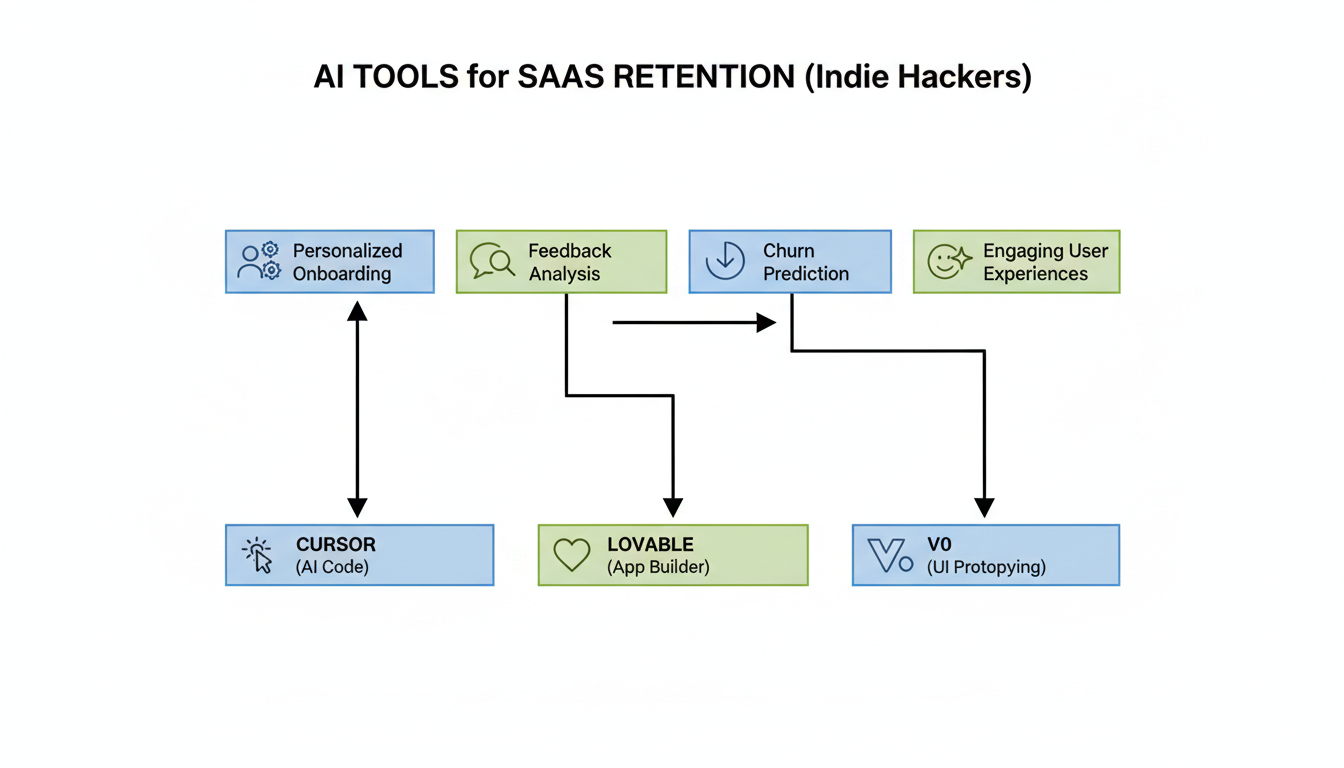
Cursor, an AI-first code editor built upon VS Code, empowers developers with inline AI completions, refactoring capabilities, and context-aware code generation directly from their repository . This makes it invaluable for rapidly developing personalized onboarding flows. For instance, indie hackers can prompt Cursor to generate React components for multi-step onboarding wizards that adapt content based on user roles, or produce conditional logic in a Next.js application to display different feature introductions linked to user preferences 24. Furthermore, Cursor can assist in crafting Python scripts for parsing structured user feedback or developing basic SQL queries to analyze user activity logs, laying the groundwork for rudimentary churn prediction models .
Lovable simplifies the creation of entire full-stack applications from simple language prompts, transforming ideas into deployed apps within minutes . This power translates directly to retention by allowing non-technical founders to quickly build the infrastructure for personalized experiences. Imagine describing a complex onboarding flow with different paths for individual and team users; Lovable can generate the complete application structure, including user management and database models to track progress and segment users . Its ability to quickly establish PostgreSQL databases also facilitates robust data collection for user behavior, which is crucial for identifying churn risks and segmenting users effectively 25.
Finally, v0 by Vercel excels at translating natural language prompts into polished React/Next.js UI components, often leveraging Shadcn . This tool is a game-changer for rapid UI prototyping, allowing indie hackers to design and iterate on engaging user experiences crucial for retention. From generating interactive welcome screens with progress bars to creating layouts for community forums or even "We miss you!" re-engagement pop-ups, v0 dramatically shortens the design and development cycle for user-facing features 26. This allows for quick A/B testing of visual approaches and messaging within the onboarding flow, ensuring optimal user engagement.
By strategically combining these AI tools, indie hackers gain an unprecedented ability to develop, test, and implement robust retention strategies. This synergistic approach enables them to compete effectively in crowded markets and build sustainable SaaS businesses, transforming complex tasks into achievable projects with remarkable speed.
Next Steps
The landscape for SaaS has irrevocably shifted. The era of "growth at any cost" has given way to a sharper focus on efficiency and sustainable scaling, especially with Customer Acquisition Costs (CAC) reaching all-time highs, around $702 in 2024 6. For indie hackers and SaaS founders, this means understanding that retaining existing customers is not just a best practice, but an existential imperative. It’s a foundational truth: retaining a customer is 5 to 25 times more cost-effective than acquiring a new one, and even a modest 5% improvement in retention can boost profits by 25-95% 2. Companies thriving today are those with Net Revenue Retention (NRR) above 100%, growing almost twice as fast as their peers 4.
So, how do you translate these insights into a thriving, resilient SaaS business? Your action plan begins now:
First, master proactive onboarding. Your "aha moment" isn't a happy accident; it's a meticulously engineered experience. Identify the core value your product delivers and guide new users there within 15 minutes, if possible 10. Think about role-based flows and progressive disclosure to prevent overwhelming new users, which often leads to 75% churn in the first week 10. Use interactive tutorials and guided empty states to ensure users not only see value but experience it firsthand . Continuous onboarding, offering value reminders and feature updates, is just as crucial as the initial welcome 27.
Second, embrace data-driven personalization and AI-powered segmentation. Move beyond basic demographics. Leverage AI to analyze behavioral data, purchase patterns, and engagement metrics to create dynamic customer segments 18. Tools like Cursor can help you build and iterate on the code for these personalized experiences, while Lovable can generate entire full-stack applications to track and manage this data. Use Natural Language Processing (NLP) for psychographic segmentation and sentiment analysis from customer feedback to build a comprehensive customer health score 28. This granular understanding allows you to tailor campaigns, features, and support interventions precisely, proactively addressing churn risks with predictive insights 16.
Third, cultivate active customer communities and value ecosystems. Create dedicated spaces, whether Slack channels or in-app forums, where users can connect, share, and support each other 21. Recognize and empower your power users, giving them early access or direct feedback channels. Showcase user-generated content and host engaging events to deepen connections and increase switching costs 21. An engaged community acts as a powerful retention magnet and a wellspring of product ideas and referrals 21.
Finally, make continuous iteration, measurement, and customer feedback your operating rhythm. Retention isn't a static goal; it's a continuous loop of learning, adapting, and optimizing. Track metrics like User Retention Rate (aiming for 92-95% optimally), Activation Rate, Customer Lifetime Value (CLV), and Net Revenue Retention (NRR) vigilantly 16. Integrate customer feedback—both quantitative and qualitative—into every product development cycle, creating a sense of co-creation and ownership that fosters loyalty 11. Ethical considerations around data quality, privacy, and algorithmic bias must be central to your AI implementation 16.
By proactively defining your "aha moment," leveraging AI for hyper-personalization, fostering vibrant communities, and obsessively measuring what matters, you're not just fighting churn; you're building a more valuable, more resilient business destined for sustainable growth.