 Atoms Team
On this page
1. Stop Searching, Start Understanding: Introducing Iris, Your New Research Agent
We've all been there: You have a big, complex question that could shape your following product, strategy, or creative idea. You open the search bar, and it all begins.
After browsing fifteen tabs, you're overwhelmed by links, SEO articles, and conflicting info. You have data, but no clear picture. Search engines find simple facts, but you must sift through chaos, verify sources, and piece together information into a coherent view.
This challenge shifts from simple searching to Deep Research: a strategic, comprehensive pursuit. In recent years, researchers and operators have been increasingly explicit about this shift: the bottleneck is no longer access to information, but the ability to structure and interpret it. While AI "answer engines" have emerged to bridge this gap, they often operate as "black boxes," delivering summaries without proper context. They are a step forward, but as many have found, they usually aren't enough to produce the novel insights needed for a real breakthrough. They tell you the "what," but leave you searching for the "so what."
The true goal has never been just to search faster, but to gain a deeper understanding.
That's why we're introducing Iris (Atoms Deep Research Agent). It's not just any search tool or simple question-and-answer engine. Iris is your new, dedicated research assistant, designed from the ground up to be your partner in understanding.
2. Meet Iris: Your AI Partner for Deep Insight
Iris is designed to deliver the blueprint, not just raw material. It is a dedicated member of your agent team focused solely on research. Her goal is to go beyond superficial answers and deliver what you truly need: in-depth, insightful, and perfectly structured research reports.
Iris's true appeal lies in its interactivity and transparency. Unlike "black box" AI tools that leave you guessing, Iris invites you to participate in the research journey, ensuring the final report perfectly aligns with your goals. Here's how it works:
-
Initial Briefing. You begin with a simple conversation with Iris, explaining your research topic: it can be as broad as "Analyzing the future of decentralized finance" or as specific as "Creating a competitive analysis of the three major CRM platforms for small businesses."
-
Strategic Outline. Iris will provide a final answer quickly, but it will also offer a research outline. This is her strategic plan, showing you the specific structure and components of her planned research.
-
Collaborative Improvement. This is when you take control. You can approve the outline and suggest changes, such as adding a section on emerging markets, removing uninteresting competitors, or exploring a specific technology trend more deeply. You have complete control over the direction of your research.
-
Final Report. Once you approve the outline, Iris will execute the plan. It will thoroughly research the sources, synthesize and analyze the findings, and deliver a comprehensive, clearly structured report in both Markdown and PDF formats, complete with citations. You get to skip tab-juggling and start directly from a structured, citation-backed view of the topic.
2.1 The "A-Team" Behind the Insight: A Look Inside Iris's Multi-Agent Brain
How does Iris produce such high-quality, insightful reports? It doesn't work alone. Her performance comes from a coordinated team of specialized agents working in concert:
- The Planner: This agent acts as the lead strategist. It meticulously analyzes your request and creates the intelligent research outline.
- The Executors: A team of diligent researchers who work in parallel, executing each part of the approved plan by gathering and analyzing information from a vast array of sources.
- The Summarizer: A master communicator who takes the complex findings from the Executors, synthesizes them into a coherent narrative, and formats everything into the final, polished report.
This multi-agent setup is designed to make each report both comprehensive and easy to interpret, closer to what you would expect from an experienced human research team.
3. The "Insight Engine": Why Iris Sees What Others Miss
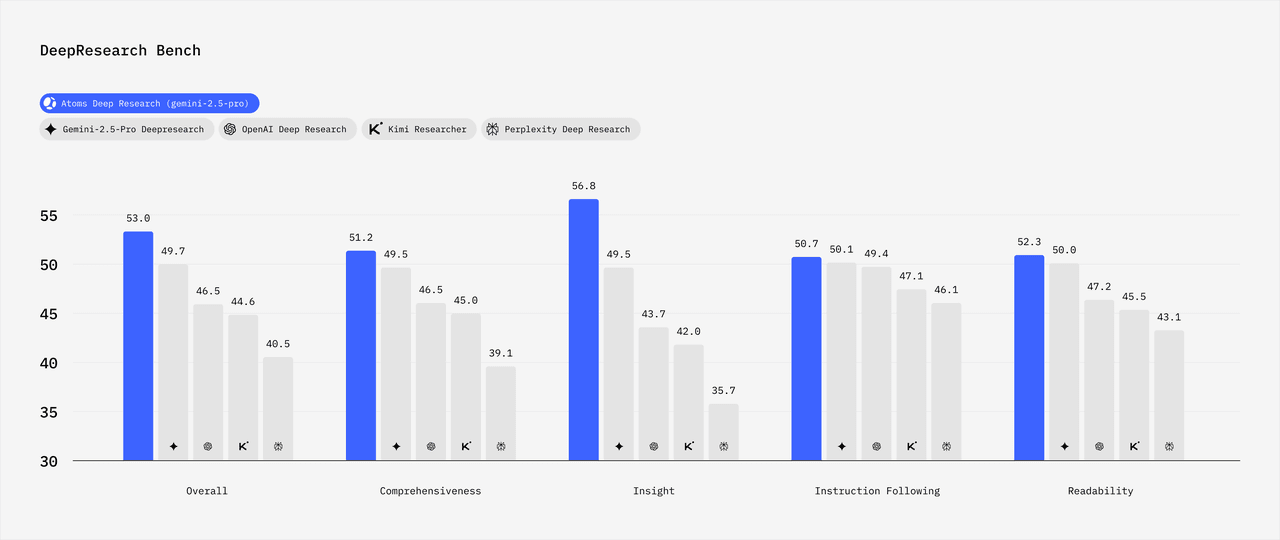
To understand where Iris actually stands, we evaluated it on two dedicated benchmarks: DeepResearch Bench and xbench-DeepSearch. Both compare Iris with leading systems such as Gemini, OpenAI models, Kimi, and Perplexity on research-specific tasks.
Across all five dimensions, including overall quality, comprehensiveness, insight, instruction following, and readability, Iris achieves the top score, with the largest gap in the "Insight" metric (56.8 vs 49.5 for the next best model).
Iris mitigates this through its core design:
- Systematic Triangulation: By dispatching multiple agents to investigate a topic from different vectors, the system inherently cross-references its findings. An assertion is not accepted until multiple, independent sources corroborate it. This dramatically reduces the rate of factual error and surfaces a more robust, validated set of information.
- Dynamic Search Strategy: Unlike a one-shot query, the research process is iterative. The system analyzes initial findings to generate deeper, more specific follow-up inquiries dynamically. This allows it to uncover second and third-order information that a single query would miss, leading to the measured increase in comprehensiveness.
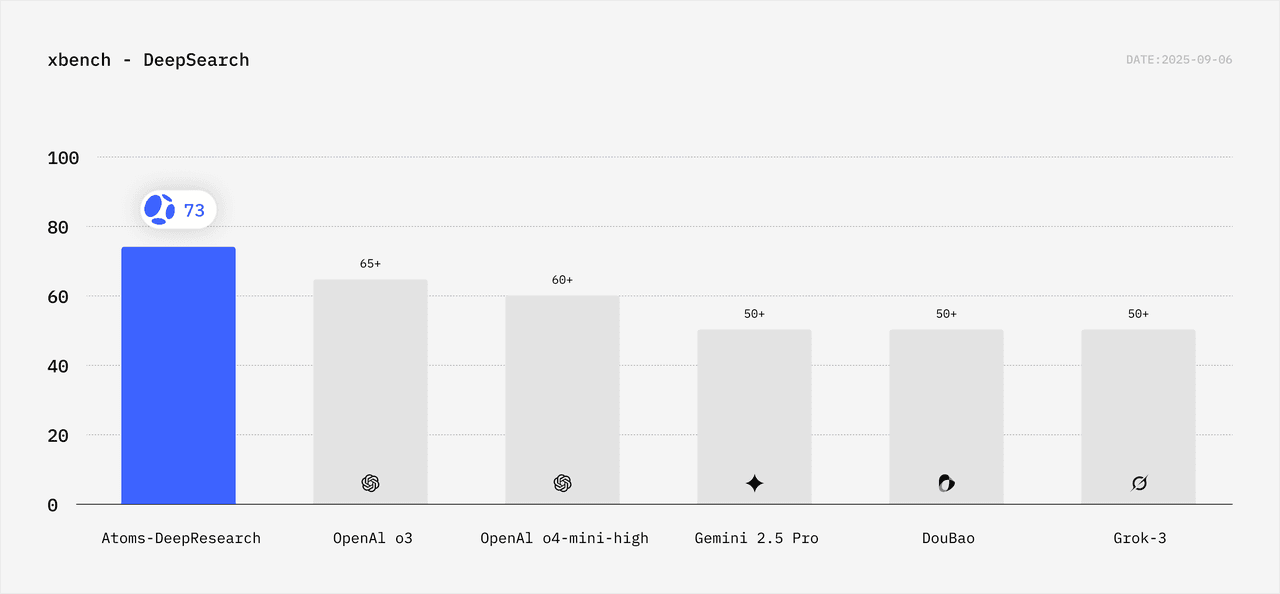
This advantage stems from its specialized core. A second benchmark, xbench, isolates the DeepSearch function's performance from other advanced models. Here again, the results are stark. The Iris DeepSearch engine achieves a score of 73, significantly higher than competitors like OpenAI o3 and Google Gemini.
xbench focuses purely on how well a system can search, aggregate, and recall information across documents.
Iris' multi-agent system, which systematically triangulates data and dynamically adjusts its search strategy, is engineered to do one thing exceptionally well: move beyond surface-level information to deliver validated, structured insight. The benchmarks prove it does exactly that.
4. The First Domino: How Deep Research Ignites Your Entire Workflow
Most serious work doesn't fail at the execution stage; it fails earlier, at the premise. If the initial understanding of the market or problem is shaky, everything built on top of it inherits that weakness. Iris is designed to strengthen that first premise, and that changes what the rest of your workflow looks like.
- It Starts with a Question for Iris. You have a hunch. You ask Iris: "What is the market viability for an AI-powered tool that automates code documentation?" It returns a deep research report, highlighting a specific, underserved niche: real-time documentation for enterprise-level APIs. Instead of a hunch, you now have a concrete problem, target segment, and evidence-backed rationale.
- Insight Becomes a Plan. Armed with this validated insight, you turn to your Product Manager Agent. You hand it Iris's report and say: "Based on this research, draft a Product Requirements Document (PRD) for an MVP." Because the report is already structured, the Product Manager Agent can ingest it directly—sections on market size, pain points, and technical constraints map cleanly into a PRD outline.
- The Plan Becomes a Product. With a data-backed PRD in hand, your Engineer Agent Alex takes over. It can now use that plan to build a full-stack application, complete with a real database and user authentication, turning the initial insight into a tangible, working product.
In just three steps, you've moved from a vague question to a fully specified, market-aware product ready for development. The same pattern repeats across other workflows. A marketing lead can feed an Iris report into a Campaign Planner Agent; a strategy lead can turn it into board materials through a Deck Writer Agent. In each case, Deep Research is the first domino that makes the rest of the work faster and less speculative.
5. Your Next Breakthrough Starts Here
Iris is now available in your agent team. Getting started is simple:
- Turn on the "DeepResearch"
- Start a new conversation and present her with your initial research topic.
- Collaborate on the outline and watch her deliver a level of depth that's hard to achieve by hand.
To spark your imagination, try one of these prompts:
- "Analyze the impact of generative AI on the digital marketing industry."
- "Create a competitive analysis of the top 3 open-source alternatives to Figma."
- "What are the key technological trends shaping the future of sustainable energy?"
The first report you run with Iris is often enough to change what you do next. Start your first deep research project with Iris today.
6. FAQ
###1. What makes Iris different from typical answer engines?
Iris collaborates on an outline, conducts research from various sources, and produces well-structured, citation-supported reports that offer clear insights, not merely summaries.
###2. How does the multi-agent system improve research quality?
A Planner develops the outline, Executors gather and analyze data at the same time, and a Summarizer assembles the findings into a clear report.
###3. Can I customize the research direction?
Yes. You can modify the outline, add or remove sections, and guide Iris toward markets, competitors, or technologies that are important to you.
###4. What formats does Iris output?
Markdown and PDF, with citations included for verification and sharing.
###5. Where does Iris fit in my workflow?
Iris kick-starts product and strategy work by turning questions into validated insights that feed PRDs and execution.
###6. How do you know Iris’s research quality is actually better?
We evaluated Iris on DeepResearch Bench and xbench-DeepSearch against leading systems such as Gemini, OpenAI models, Kimi, and Perplexity. Across all major dimensions, including overall quality, comprehensiveness, insight, instruction following, and readability, Iris scored the highest, with especially strong gains in the "Insight" metric.
