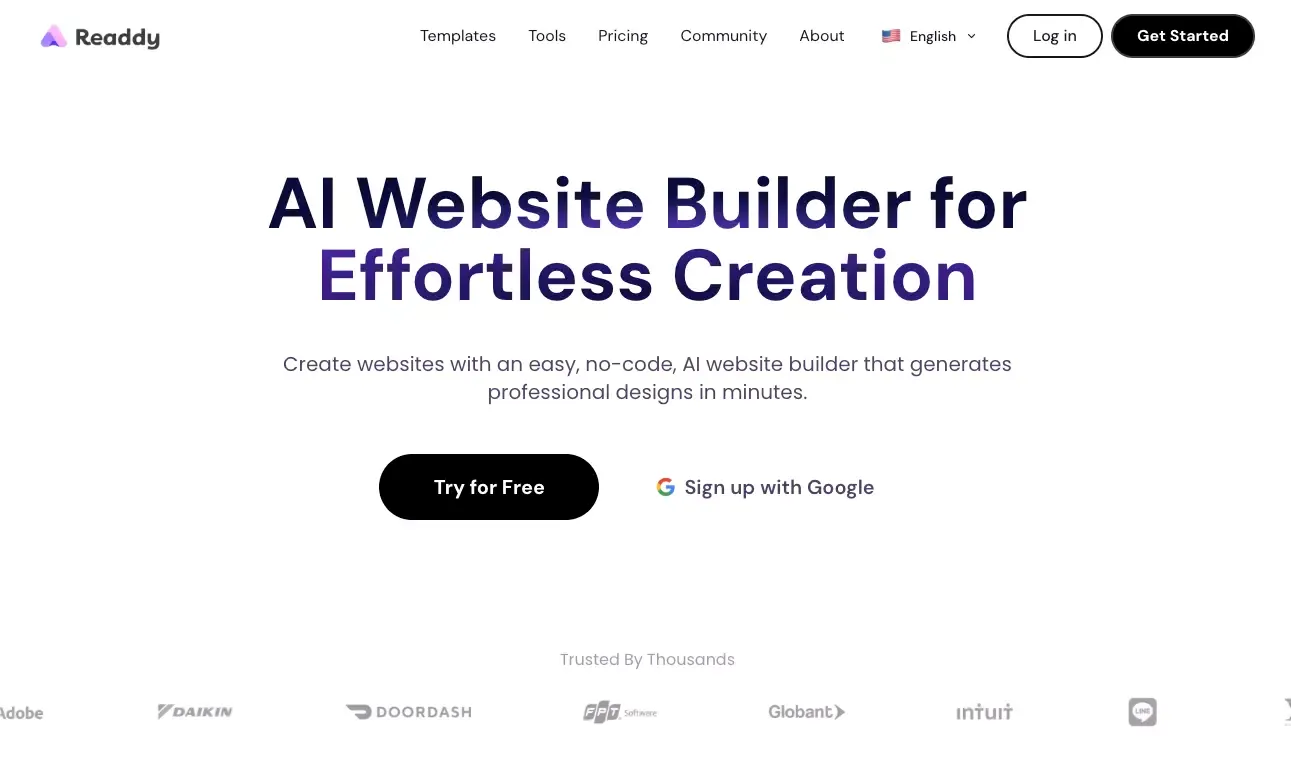
 If you are searching for Readdy alternatives, you probably do not dislike Readdy itself. More often, you have reached the point where fast website generation is no longer the full job.
That is the pattern I see in this category. Readdy is a solid tool for generating websites quickly from prompts and then refining them in a visual editor. For landing pages, portfolios, and simple business sites, that can be enough.
But once the project needs more than a front end, the decision changes. Some users want stronger design control. Others want better planning workflows, cleaner publishing, more code ownership, or a path from website to actual product. That is where the best alternatives start to separate from each other.
My view is simple: the right Readdy alternative depends less on who can generate a homepage fastest, and more on what you need after version one goes live.
Why People Look Beyond Readdy
Readdy gets a lot right. It is fast, approachable, and built for people who want to go from idea to live page with minimal friction. That alone makes it attractive.
Still, many users outgrow tools like this for a few common reasons:
- They need more than a marketing site
- They want deeper customization and layout control
- They care about SEO and AI blog website builder scalability over time
- They need backend logic, integrations, or app-like workflows
- They want more ownership over code and future development with an AI coding assistant
That does not make Readdy weak. It just means it solves a specific problem well, while many users eventually move into a different stage.
The Best Readdy Alternatives at a Glance
| Tool | Best For | Core Strength | Main Tradeoff |
|---|---|---|---|
| Atoms | Founders building beyond a website | Full-stack direction, launch-to-product workflow | Broader scope than a simple site builder |
| Framer | Polished marketing websites | Strong visual quality and design feel | More website-focused than product-focused |
| Relume | Teams planning site structure | Great for sitemaps and wireframes | Not an all-in-one builder |
| STUDIO | Design-led no-code sites | Creative freedom with publishing tools | Better for sites than complex products |
| WebWave | Small business and agency sites | Drag-and-drop flexibility with AI help | More traditional website-builder feel |
| Typedream | Creators and lightweight startup sites | Fast and simple publishing | Lower ceiling for complex builds |
| TeleportHQ | Hybrid visual + code workflows | Visual building with export flexibility | Slightly less beginner-friendly |
| Wix | Broad website platform needs | Large feature surface and mainstream support | Less focused than specialist tools |
1. Atoms
- Best for: Founders, marketers, and small teams that want a website that can grow into a real product
Atoms is the most interesting Readdy alternative when your real problem is not just generating a nice page, but launching something that can keep evolving.
What stands out is that Atoms is positioned more like an AI-powered development platform than a narrow website builder. It is designed for app and website builder workflows, with a broader setup that can cover backend website needs, deployment, code export, and GitHub sync. That makes it feel less like a one-step design tool and more like a platform for shipping something real.
Why I’d pick it over Readdy
It handles the “what happens next?” question better
This is the main reason Atoms ranks first for me. Readdy works well when the site itself is the end goal. Atoms makes more sense when the site is only the start.
If you may later need logins, payments, backend workflows, analytics, or product logic, Atoms feels more aligned with that future. It also has a Growth Dashboard angle, which matters for teams thinking about launch, measurement, and iteration instead of just page generation. If your roadmap points toward an AI app builder instead of a static site, that difference becomes even clearer.
What to watch
It is broader by design
That is the advantage, but also the tradeoff. If all you need is the simplest path to a brochure site, a narrower tool may feel lighter. But if you want something growth-ready, Atoms is one of the strongest alternatives in this category.
2. Framer
- Best for: High-polish marketing websites and visually strong landing pages
Framer is one of the clearest alternatives if what you like about Readdy is speed, but what you want more of is design quality.
It is especially strong for startups, agencies, and designers who care a lot about presentation. Framer sites often feel more refined out of the box, and the overall workflow is built around modern marketing-site execution. It is especially compelling when your main goal is a polished SaaS landing page or a sharper product launch page.
Why I’d pick it over Readdy
It is better when visual polish is the priority
If your homepage, pricing page, and brand presentation matter more than backend depth, Framer is an easy choice. It feels more design-driven and more polished for public-facing marketing sites.
What to watch
It is still mainly a website tool
This is the tradeoff. Framer is excellent when the website is the product surface. It is less compelling when your next step is building something with deeper functionality.
3. Relume
- Best for: Teams that want better structure before they start designing
Relume solves a different problem from many tools in this space. It is not mainly about jumping from prompt to finished site as fast as possible. It is better when the hard part is deciding what pages you need, how those pages connect, and what sections should go where.
That makes it useful for teams that care about site architecture, messaging flow, and wireframing before they move into final design or development. If the bottleneck is figuring out page scope, an AI-assisted page generator mindset is often more useful than rushing straight into polish.
Why I’d pick it over Readdy
It is stronger for planning-heavy workflows
A lot of teams do not need more AI decoration. They need more clarity. Relume works well when structure is the real bottleneck and you want AI to accelerate planning rather than replace the rest of your stack.
What to watch
It is not trying to be everything
That is part of its strength. But if you want an all-in-one builder that goes straight to a live site, Relume may feel more like part of a workflow than the whole answer.
4. STUDIO
- Best for: Design-led teams that want creative freedom without code
STUDIO is a strong choice for teams that want more control than template-first tools usually offer. It sits in a useful middle space: visual and no-code, but still serious enough for real publishing workflows.
It is a good fit for brand sites, editorial sites, and custom website work where layout control matters.
Why I’d pick it over Readdy
It gives more room for creative control
Readdy reduces friction. STUDIO gives you more room to shape the outcome. For teams that care about design craft, that difference matters.
What to watch
It is more site-focused than product-focused
STUDIO covers many serious website needs, but it is still not the obvious answer if your project is likely to grow into a more complex app or software product.
5. WebWave
- Best for: Small businesses, freelancers, and agencies that want AI help plus manual freedom
WebWave makes sense for people who still like a drag-and-drop website-builder mindset, but want AI to make the process faster. It is a practical option for local business website builder use cases, blogs, and lightweight AI store builder needs.
Why I’d pick it over Readdy
It feels more familiar for mainstream website use cases
Some users want AI assistance, but they do not want the product to feel like a black box. WebWave is attractive because it still feels like a website builder first.
What to watch
It is less compelling for product-style builds
WebWave is strongest when the website itself is the deliverable. If the real goal is a more software-like product, other options will usually fit better.
6. Typedream
- Best for: Creators, solo founders, and lightweight startup sites
Typedream is one of the easiest tools to like in this space because the value proposition is simple. It helps users get a site live quickly without a lot of setup or platform complexity.
For creators, simple startup pages, and low-friction publishing, that simplicity is a real advantage. It is especially relevant when all you need is your startup’s first landing page, not a full product stack.
Why I’d pick it over Readdy
It is simple in a way that feels useful, not limited
If your needs are straightforward and you care more about speed and clarity than maximum flexibility, Typedream is a sensible pick.
What to watch
It has a lower ceiling
That simplicity is exactly why many people choose it. But it is not the first option I would pick for a project that may need deeper workflows or more custom logic later.
7. TeleportHQ
- Best for: Teams that want visual building but still care about code export
TeleportHQ stands out because it bridges visual building and developer-oriented output better than many no-code-first tools.
That makes it interesting for hybrid teams. You can move quickly visually, but still keep a stronger connection to code and handoff workflows. For teams that still want an AI code editor or online code editor path after the visual stage, that flexibility matters.
Why I’d pick it over Readdy
It is a better middle ground for technical teams
If Readdy feels a bit too website-first, but a fully code-first workflow feels too heavy, TeleportHQ is a good middle lane.
What to watch
It is not the softest beginner tool on this list
More flexibility usually means a bit more complexity. That is fine for hybrid teams, but not always ideal for users who want the most lightweight experience possible.
8. Wix
- Best for: Mainstream businesses that want a broad platform with AI-assisted setup
Wix remains one of the safest broad-platform options in the market. It covers many website needs in one place, which is why it still deserves a spot in this conversation.
Why I’d pick it over Readdy
It is the safer all-purpose business choice
If you are thinking less like a startup builder and more like a mainstream business owner, Wix is easy to justify. It is broad, established, and familiar.
What to watch
Breadth can come at the cost of focus
Wix does many things. That helps a lot of users. But it can also feel less sharp than more specialized tools built for a clearer workflow or user type.
How I’d Choose Between Them
Here is the simplest way to think about it:
- Choose Atoms if you want a website that can become a real product
- Choose Framer if design polish is your top priority
- Choose Relume if your main challenge is structure, not visual editing
- Choose STUDIO if you want more design freedom in a no-code workflow
- Choose WebWave if you want a more traditional site-builder experience with AI help
- Choose Typedream if you want the easiest path to a clean, simple site
- Choose TeleportHQ if you want visual speed plus stronger code ownership
- Choose Wix if you want a broad, familiar website platform
My Final Take
Readdy is not difficult to recommend. It is fast, approachable, and useful for people who want to go from idea to website with minimal friction.
But “best alternative” is the wrong question unless you define what better means.
If better means more capable after launch, I would put Atoms first. It feels strongest for users building something bigger than a website.
If better means better-looking marketing sites, I would lean Framer.
If better means better structure and planning, I would lean Relume.
If better means more visual freedom, I would look closely at STUDIO.
And if better means a simpler website-first path, then Typedream, WebWave, and Wix are all valid depending on your workflow and comfort level.
The real takeaway is this: do not choose based on who can generate a homepage fastest. In 2026, that is the easy part. Choose based on what happens after version one.
FAQ
What is the best Readdy alternative for startups?
If you expect the project to grow into a real product, Atoms is the strongest fit. It makes more sense than a pure website-first tool when you may later need backend logic, deployment, code ownership, or product workflows.
Which Readdy alternative is best for SEO?
It depends on the type of SEO work you care about. For pure website publishing and on-page control, several tools here are solid. If your SEO plan is tied to broader growth workflows, AI blog website builder content scaling, and Growth Dashboard analytics setup, Atoms stands out more.
Which alternative feels closest to Readdy?
Framer, Typedream, and WebWave are among the closest in spirit because they remain focused on fast website creation. The main difference is where each one leans: Framer toward polish, Typedream toward simplicity, and WebWave toward drag-and-drop flexibility.
Which Readdy alternative is best for designers?
Framer and STUDIO are the strongest design-led choices on this list. Framer is especially strong for sleek marketing sites, while STUDIO is appealing if you want more creative freedom inside a no-code workflow.
