 Ethan Carter
On this page
 Same.new is easy to understand at first glance.
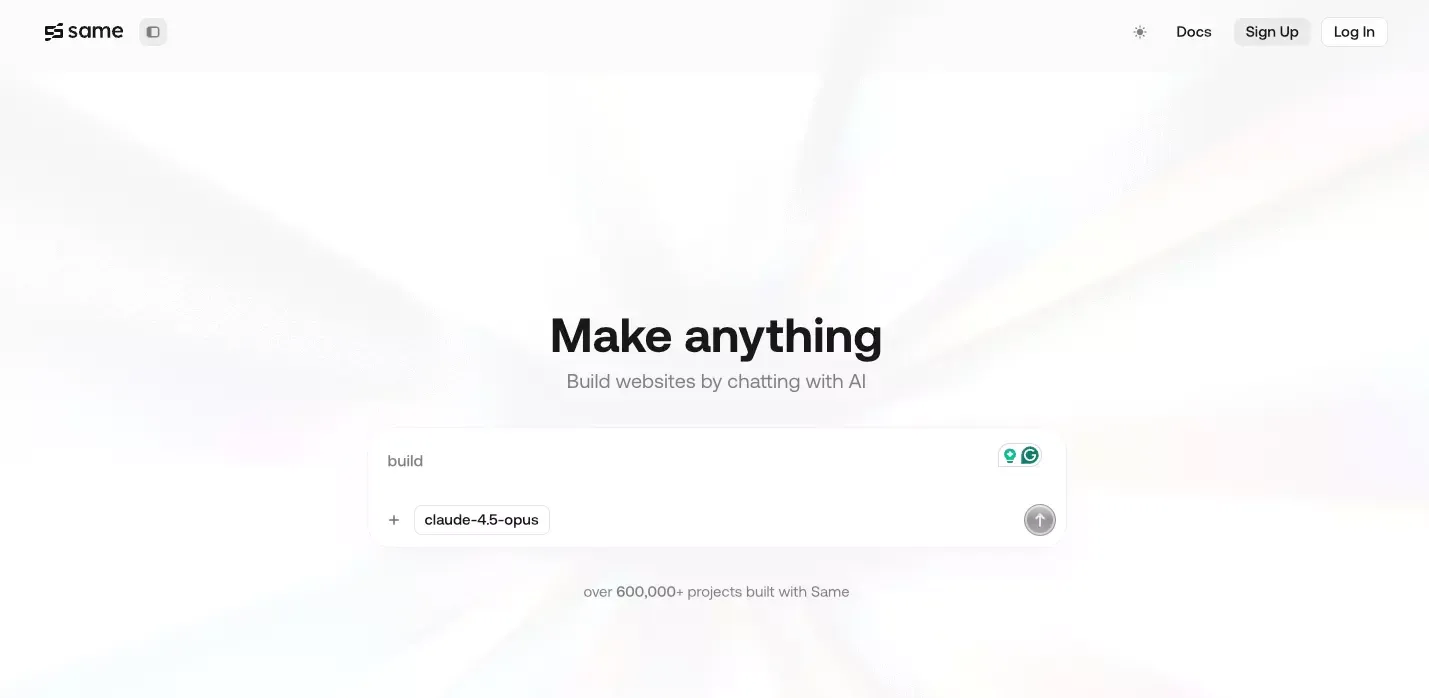
You describe what you want, or paste a URL, or upload a screenshot, and it starts building a web app for you. That pitch is strong because it removes a lot of the usual friction. No setup spiral. No blank canvas panic. No feeling that you need to wire five tools together before you can even test an idea.
But tools like this should not be judged by the first output alone.
The real question is what happens after the first version. Can you keep iterating without losing structure? Can you control cost? Can you move from rough concept to something stable enough to keep building on? That is where Same.new becomes more interesting, and more honest to evaluate.
My view is simple: Same.new looks strongest when speed matters more than control, and when the product you want to build is clearly web-first. It looks less convincing when the project becomes complex, the change requests pile up, or you need a broader workflow that goes beyond generating the app itself.
What Is Same.new?
Same.new is an AI web app builder built around a prompt-first workflow.
Instead of dragging components around manually from the start, you describe what you want and let the system generate a working direction for you. It is designed for websites and web applications, not native mobile apps. It also sits closer to a modern AI website builder than a traditional no-code page editor.
In plain terms, Same.new is best understood as:
- an AI-powered web app builder
- a fast prototyping tool with real implementation potential
- a product that can start from prompts, URLs, screenshots, and remixes
- a good fit for people who want momentum quickly
It is not the best fit for:
- native mobile-first projects
- WordPress-native workflows
- teams that need strict engineering predictability from the start
- builders who want total manual control on every change
Same.new at a Glance
| Category | Take |
|---|---|
| Best for | Web-first MVPs, prototypes, landing pages, internal tools |
| Main strength | Fast path from idea to working output |
| Main weakness | Complexity, iteration drift, and usage cost can add up |
| Technical feel | More builder than editor, more app-focused than page-focused |
| Pricing model | Monthly token tiers |
| Ideal user | Founder, solo builder, designer, or small team validating fast |
What Can You Build with Same.new?
Same.new makes the most sense when the target is a web product with a clear shape.
That can mean a landing page, a startup MVP, a dashboard, a client portal, a lightweight SaaS interface, or a polished prototype that feels close to a usable product. The core appeal is not just that it can produce UI. It is that it tries to produce a usable web app structure around that UI.
Good use cases
- startup MVPs
- marketing sites with product logic
- AI dashboard generator workflows
- quick design-to-web recreations
- demo products for pitching or testing
Less convincing use cases
- deeply custom enterprise apps with lots of moving parts
- products with complex multi-step workflows and heavy state logic
- native iOS or Android apps
- projects that need high engineering precision from day one
This distinction matters.
A lot of AI builder reviews blur the line between “looks impressive” and “is actually useful.” Same.new has a better chance of being useful when the scope is visible, bounded, and web-native.
How Same.new Works
One of Same.new’s strongest ideas is that it gives you multiple ways to begin.
You do not have to start from a raw prompt every time. That lowers the barrier quite a bit and makes the product easier to use in real situations.
Common starting points
- Prompt: describe the app or website you want
- URL: paste a live site and generate a similar structure
- Screenshot or mockup: use a visual reference as the starting point
- Remix: take an existing community project and adapt it
Once the project is created, the workflow becomes iterative.
The core loop looks like this
- Generate a first version
- Review the output in preview
- Ask for changes
- Edit elements or logic
- Repeat until the result is usable
- Deploy or export when ready
That sounds simple, and often it is.
Still, this is not a one-click miracle machine. Same.new works better when prompts are specific, scoped, and broken into manageable tasks. The tool seems to reward structured thinking more than vague ambition.
Core Features That Matter Most
Prompt-first app generation
The main value is speed.
Instead of manually assembling a project from scratch, you can move straight into describing outcomes. That changes the emotional experience of building. It is easier to react to a rough result than to an empty workspace.
Web-first full-stack direction
Same.new is built around modern web app generation rather than just visual mockups. That is important because it gives the platform more substance than a simple AI design tool.
Flexible editing and iteration
The product is not only about generation. It also supports continued refinement, which is where many AI builders either become useful or fall apart.
What helps here:
- direct iteration through chat
- element-level refinement
- project history and rollback logic
- manual editing support with an AI coding assistant
- deployment and export paths
Useful integrations
Same.new is more practical because it connects to tools developers and builders already understand.
That includes integrations around:
- GitHub
- Supabase
- Neon
- Clerk
Those integrations make the product feel closer to a real workflow, not just a polished demo environment.
What Same.new Gets Right
Same.new’s biggest strength is that it shortens the path from concept to something visible.
That sounds obvious, but it matters more than people think. Early-stage software work often stalls before the actual product thinking even starts. Environment setup, deployment questions, stack choices, and blank-page hesitation can kill momentum.
Same.new reduces a lot of that.
Where it feels strongest
- when you need a first version quickly
- when the visual direction is already clear
- when you want to validate an idea before committing more time
- when you care more about momentum than perfect structure
What that means in practice
For a founder, it means faster validation.
For a designer, it means moving from static mockups toward something interactive.
For a non-technical builder, it means getting closer to a working product without having to learn the whole development stack first.
This is where Same.new earns real credit. It reduces the distance between intention and output.
Where Same.new Still Struggles
This is the part that matters most in a serious review.
Same.new looks exciting at the start, but the friction appears later. Once the project becomes more layered, AI builders often become harder to control. Same.new does not fully escape that pattern.
The biggest issues to watch
- long chats can become messy
- broad prompts can lead to weak implementation
- repeated revisions can create structural drift
- token usage can become harder to predict
- complex projects still require judgment
That does not mean the platform is weak. It means it still behaves like an AI builder, not like a flawless senior engineer.
My honest take
Same.new is better treated as an accelerator than as a replacement for product thinking.
If you know what you are building and can guide the tool in clean steps, the experience can be productive.
If you expect it to absorb vague intent and maintain perfect consistency across a growing app, the experience will probably degrade.
That is the real dividing line.
Who Should Use Same.new?
Same.new is not for everyone, but it does have a clear ideal user profile.
Best-fit users
- solo founders validating ideas
- indie hackers shipping quickly
- designers turning concepts into usable prototypes
- small teams testing internal tools or MVPs
- non-technical users who still want app-like output
Weaker fit users
- large engineering teams with strict review processes
- teams building native mobile products
- people who need high-confidence iteration at every step
- users who want one tool to cover product, launch, and growth workflow together
That last point matters.
Same.new is good at helping you build. But for some teams, building is only one layer of the job.
Pricing and Overall Value
Same.new uses a token-based monthly pricing model. That makes the pricing easy to understand on paper, but not always equally easy to manage in practice.
Current pricing snapshot
| Plan | Monthly Price | Included Tokens |
|---|---|---|
| Free | $0 | 500,000 |
| Basic | $10 | 2,000,000 |
| Pro | $25 | 5,000,000 |
| Max | $50 | 10,000,000 |
| Ultra | $100 | 20,000,000 |
Extra usage
- Ultra supports additional usage beyond 20 million tokens
- unused tokens do not roll over
- usage depends on how much context and output each request consumes
What this means for real users
If you are concise and deliberate, Same.new can feel affordable.
If you prompt loosely, retry often, and keep large conversations alive for too long, the cost becomes harder to predict. This is one of those products where workflow discipline directly affects value.
My pricing take
The pricing is fair enough for early-stage builders.
The bigger issue is not the price itself. It is whether your way of working matches a token-based model. For focused MVP work, that can be fine. For messy, exploratory building, it can feel less efficient over time.
Same.new vs Other Alternatives
Before comparing tools, it helps to define the real decision.
Most people are not choosing between “good” and “bad.” They are choosing between different styles of building.
Comparison table
| Tool | Best for | Main advantage | Main tradeoff |
|---|---|---|---|
| Same.new | Fast web-first product generation | Strong momentum and flexible starting points | Can become harder to control as complexity grows |
| Lovable | Fast app and website creation with a soft onboarding feel | Friendly prompt-to-product flow | Less differentiated if you specifically want clone-style starting points |
| Replit | Broader AI development platform | More expansive build environment and developer depth | Can feel heavier if your goal is just fast web MVP output |
| Atoms | End-to-end idea-to-launch workflow | Broader workflow that includes building and growth support | May be more than you need for a simple one-off prototype |
Same.new vs Lovable
Lovable feels very accessible.
It is a good option for people who want a conversational way to turn ideas into apps or websites without much setup pain. Compared with Lovable, Same.new feels a bit more pointed in its web-app-building identity and more useful when you want to start from a reference like a URL or screenshot.
Same.new vs Replit
Replit is broader.
It feels more like a full AI development platform, while Same.new feels more focused on getting web products moving quickly. If your goal is deeper engineering flexibility, Replit may be the better long-term environment. If your goal is faster web-first momentum, Same.new often feels simpler.
Same.new vs Atoms
This is where the comparison becomes more strategic.
Same.new is a strong fit when you mainly want to generate and refine a web product quickly. Atoms feels more compelling when your workflow goes beyond building the first version and into validation, product direction, and growth execution.
That is why I would not position Atoms as a direct “replacement” in every case. The better framing is this:
- choose Same.new when fast app and website building is the main job
- choose Atoms when you want a broader idea-to-product-to-growth workflow in one place
That makes the recommendation more natural, and more accurate.
When Atoms Feels Like the Better Option
Atoms becomes more interesting when the problem is bigger than “build me a first version.”
If you are looking for a tool that supports not only building but also startup idea validation, iteration, and go-to-market tasks more holistically, Atoms makes more sense than a narrower app-generation workflow.
Atoms is likely the better fit when you need:
- a more end-to-end workflow
- help moving from concept to launch, not just concept to prototype
- support for business-facing tasks around product delivery
- a tool that feels less like a single generator and more like a coordinated AI team
This is the cleanest place to mention Atoms in a Same.new review.
Not as a forced plug. Not as a random CTA. Just as a more suitable option for readers whose needs go beyond rapid web app generation.
Final Verdict
Same.new is a good product in a category where good products are still rare.
It has a clear use case. It reduces friction. It helps people move from idea to output faster than a traditional workflow. For web-first MVPs, MVP showcase pages, and lightweight product builds, that is genuinely valuable.
At the same time, it is still an AI builder. That means it works best with structure, clarity, and realistic expectations.
My final take
Same.new is worth considering if you want:
- fast web-first momentum
- flexible ways to start building
- a practical tool for MVPs and prototypes
- less setup friction and faster iteration
You should be more cautious if you need:
- high-confidence control over complex changes
- native mobile output
- a broader product-and-growth workflow
- very predictable cost under messy iteration
Overall, I would describe Same.new as a promising and useful builder that performs best when the scope is clear and the user is disciplined.
It is not magic.
But in the right context, it does solve a real problem.
Frequently asked questions
01Can Same.new build full-stack apps?
Yes, it is positioned as a web app builder rather than just a visual site generator, which is part of why it stands out from simpler AI page tools.
02Can I export the code?
Yes, Same.new supports project export and workflow connections that make it more practical than a closed demo-only builder.
03Is Same.new good for beginners?
Yes, especially if the goal is to get from idea to first version quickly. The learning curve is lighter than a traditional dev workflow, though good prompting still matters.
04Is Same.new good for complex apps?
It can help, but this is where caution is needed. The more complex the project gets, the more likely you are to run into iteration drift, cost concerns, and the limits of AI-guided changes.
05Is Same.new better than Atoms?
Not universally. Same.new is often the better choice for focused web app generation. Atoms is the stronger option when you want a broader idea-to-launch workflow and more support beyond the initial build.
