 Maya Chen
On this page
 If you are looking for a 10Web alternative, you are probably not doing it because 10Web is bad. You are doing it because it solves one problem well, then starts to feel narrow once your needs expand.
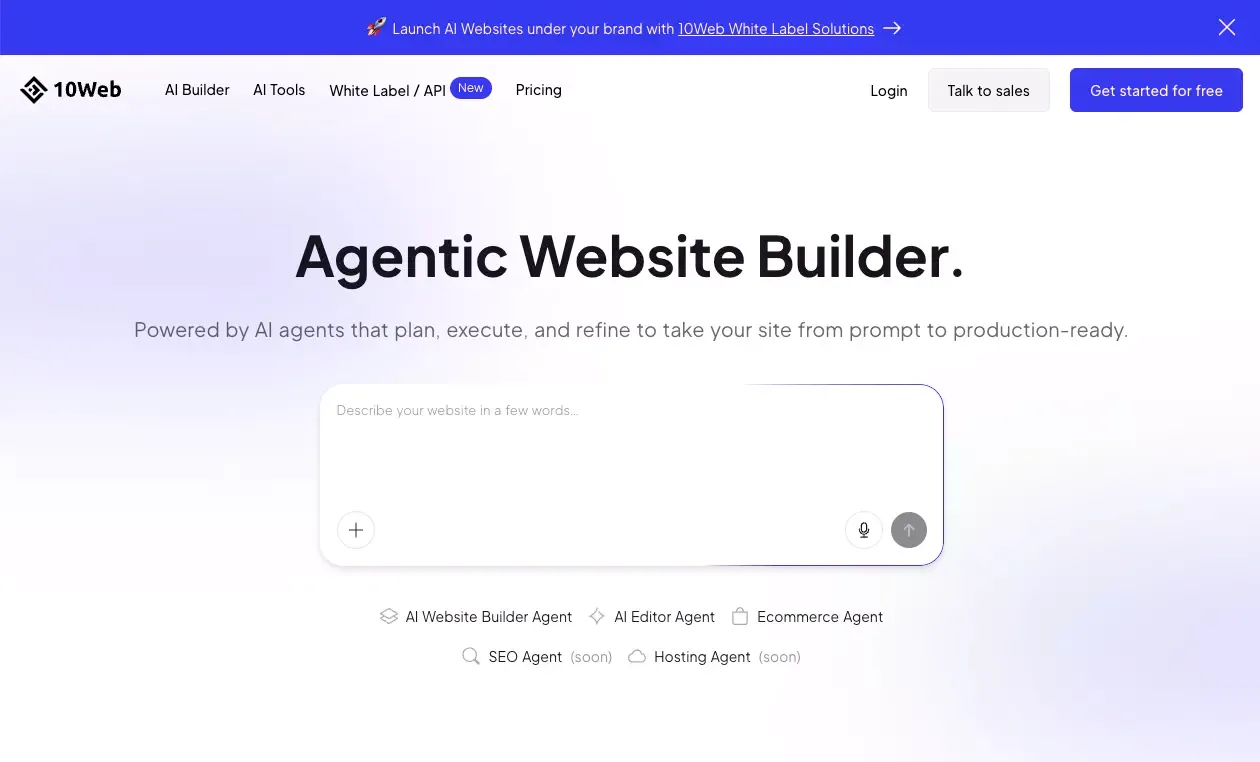
On paper, 10Web is a solid package. It combines AI website generation, chat-based editing, managed hosting, and ecommerce tooling around WordPress. That makes it appealing for anyone who wants to get a site live quickly without piecing together a full stack from scratch.
But that same setup can also become the reason people leave. In my view, the friction usually shows up in four areas: you want less WordPress overhead, more design flexibility, stronger ecommerce specialization, or a platform that goes beyond “website builder” into a broader product and growth workflow.
That is why this keyword is more interesting than it looks. People searching for “10Web alternatives” are rarely asking for a one-to-one replacement. Most are really asking a more practical question: what gives me the right mix of speed, control, SEO, and room to grow without locking me into a workflow I will outgrow in six months?
I reviewed the main options through that lens. Some are better for fast marketing sites. Some are better for SEO-heavy teams. Some are better if your project is slowly turning into something bigger than a simple website.
The Best 10Web Alternatives at a Glance
| Tool | Best for | Main strength | Main tradeoff |
|---|---|---|---|
| Atoms | Teams building beyond a simple site | Broader product-building and growth workflow | Less relevant if you specifically want WordPress |
| Framer | Fast, modern marketing sites | Speed, polish, and lightweight publishing | Not ideal for deeper ecommerce or large product workflows |
| Webflow | SEO and content-heavy teams | Strong CMS and structured SEO control | Steeper learning curve |
| Wix | Beginners who still want real flexibility | Balanced all-in-one experience | Less specialized than sharper competitors |
| Hostinger Website Builder | Budget-conscious users | Fast setup and low-friction publishing | Limited depth for larger projects |
| Squarespace | Elegant content-first websites | Clean design and low maintenance | Less flexible for advanced builds |
| Shopify | Ecommerce-first businesses | Store operations and product selling | Overkill for non-commerce sites |
| WordPress + Elementor | Users staying in WordPress | Familiar ecosystem and direct control | More hands-on setup and maintenance |
Why People Start Looking Beyond 10Web
The key thing to understand is that 10Web is not just a website builder. It is an AI-assisted WordPress workflow.
That can be a real advantage if you like WordPress, want hosting bundled in, and want AI to speed up page creation. But if you are specifically trying to reduce plugin complexity, escape WordPress maintenance, or move into a more flexible visual workflow, 10Web can start to feel like a faster version of the stack you were already trying to leave behind.
This is where many comparison articles miss the point. They focus too much on surface-level features like AI generation, templates, or ease of setup. Those things matter, but they are not usually what shapes the long-term decision.
The better question is this: what kind of work are you actually trying to do next?
If you only need a few landing pages, your answer will be different from a startup team building a product, a content team scaling programmatic SEO, or an ecommerce brand managing a large catalog. Once you frame it that way, the alternatives become much easier to evaluate.
1. Atoms
If I were leaving 10Web because the brief had already evolved from “I need a website” into “I need a site, a product, a workflow, and some way to grow it,” Atoms would be the first option I would look at.
What makes Atoms interesting is that it does not feel confined to the usual AI website builder category. It is better understood as a platform for building and shipping digital products, with the website being only one part of that larger system. That changes the comparison immediately. Instead of asking whether it can generate a page quickly, you start asking whether it fits the way your team wants to work over time as an app and website builder.
This is where Atoms feels different from 10Web. 10Web is strongest when the job is still mostly “build a WordPress site faster.” Atoms becomes more compelling when the real job is broader. If you are a startup team, solo founder, or growth-minded operator who knows the website is only one layer of the business, that wider scope is meaningful.
I would especially consider Atoms if your site is tied closely to product experiments, use case pages, launch cycles, and ongoing acquisition work. That kind of team often outgrows traditional builder logic faster than expected, especially if it needs an AI dashboard builder or an AI startup idea validator in the broader workflow.
Best for
Teams that want a broader build-and-grow workflow rather than just an AI-assisted website builder
What stands out
- Better fit for projects that are becoming products, not just websites
- More aligned with startup and growth workflows
- Natural option when the site is part of a larger business system
Where it may not fit
- Not the obvious choice if you specifically want WordPress familiarity
- Less relevant if your main requirement is simply a brochure site with minimal ambition
2. Framer
Framer is one of the strongest alternatives if your main goal is to publish a fast, polished marketing site without dragging WordPress along with you.
What I like about Framer is that it sits in a very useful middle ground. It is more design-forward than most AI builders, but it is not only for designers. It works well for startups, marketing teams, and founders who want a website that feels current, clean, and easy to update.
Compared with 10Web, Framer feels lighter. There is less platform weight. Fewer legacy assumptions. Less of that sense that you are managing an ecosystem behind the scenes.
That matters more than people admit. A website platform should not quietly become an operations burden. For many small teams, Framer wins simply because it keeps the publishing layer simple while still looking premium. If you want more context, both this and Framer alternatives are useful reference points.
Best for
Startups and teams that want fast, modern marketing sites
What stands out
- Strong visual polish with relatively fast publishing
- Good fit for landing pages, product pages, and content marketing
- Cleaner feeling than WordPress-heavy workflows
Where it may not fit
- Not the best choice for deep ecommerce needs
- Less suitable if your project is expanding into a more complex product environment
3. Webflow
Webflow is the alternative I would pick when SEO control, structured content, and team workflows matter more than raw speed.
It still earns its reputation for a reason. Webflow is one of the better options for teams that care about CMS structure, scalable content operations, cleaner page architecture, and stronger control over implementation details. If your marketing team thinks in terms of collections, templates, redirects, structured content, and repeatable systems, Webflow often makes immediate sense.
This is a very different value proposition from 10Web. 10Web says, in effect, “let AI and WordPress help you move faster.” Webflow says, “build a cleaner system and keep more control in-house.”
That distinction matters. I would not recommend Webflow just because it is popular. I would recommend it when your team will actually use the extra control it gives you. If they will not, then the learning curve becomes unnecessary overhead. Anyone weighing that tradeoff should also scan these Webflow alternatives.
Best for
Marketing and SEO teams that need structure and control
What stands out
- Strong CMS workflows for content-heavy sites
- Better fit for scalable SEO operations
- Good balance between visual design and system-level structure
Where it may not fit
- Heavier than Framer for simple projects
- Less beginner-friendly than Wix or Squarespace
4. Wix
Wix is still underrated in my opinion.
A lot of people hear “Wix” and assume it is only for very small sites or complete beginners. That view feels outdated. Wix has matured into a capable all-in-one platform for teams that want simplicity without giving up core SEO and publishing controls.
The reason I keep it on lists like this is that it is genuinely balanced. It is easier to approach than Webflow, less tied to one legacy ecosystem than 10Web, and more flexible than many people expect. For a non-technical team, that combination is valuable.
It is not the most opinionated tool in the market, and that is both a strength and a weakness. It rarely dominates a category, but it is often a safe and sensible choice when you want a builder that covers the basics well and does not force a complex setup. In that sense, it overlaps with what many people want from an AI website builder or a flexible AI page generator.
Best for
Beginners and non-technical teams that still care about SEO and flexibility
What stands out
- Accessible without being overly limited
- Good all-in-one choice for many business sites
- Easier transition for teams moving away from WordPress complexity
Where it may not fit
- Less specialized than the best design-first or SEO-first platforms
- May feel too general if you want a sharper, more focused tool
5. Hostinger Website Builder
Hostinger is the budget-friendly option that deserves more credit than it usually gets.
If your main goal is to get a site live quickly, keep costs low, and avoid technical complexity, it is a very rational alternative to 10Web. For freelancers, local businesses, side projects, and early experiments, that matters more than feature prestige.
Hostinger is not trying to be the most flexible or the most advanced. In many cases, that is exactly why it works. It reduces decision fatigue. You are not building a grand system. You are launching a working site and moving on, much like people looking for an instant website builder or a practical text-to-website workflow.
There is a ceiling, of course. Once your content model gets more sophisticated or your growth goals become more demanding, you may start feeling the limits. But that does not make it weak. It just means it is optimized for a smaller, clearer job.
Best for
Small businesses and users who want low-cost, low-friction setup
What stands out
- Fast to launch
- Budget-friendly compared with many alternatives
- Good fit for straightforward websites and smaller stores
Where it may not fit
- Not ideal for complex SEO programs
- Limited headroom for larger, more ambitious builds
6. Squarespace
Squarespace is not the most flexible builder on this list, but it is still one of the easiest to recommend for the right person.
What it does well is consistency. It gives you a polished result without asking you to make a hundred infrastructure decisions. That matters for service businesses, consultants, creators, portfolios, and content-first brands that want a site to feel clean and credible with minimal operational stress.
Compared with 10Web, Squarespace gives up some of the “AI builds the stack for me” appeal and most of the WordPress extensibility story. But honestly, that is part of its charm. Fewer moving pieces can be a real advantage.
I would not choose Squarespace for a highly customized SEO machine or a product-heavy roadmap. But for a beautiful, low-maintenance website that you can actually keep updated, it still makes a lot of sense, especially if your main need is closer to build your startup's first landing page with AI than a complex platform rollout.
Best for
Content-driven sites, service businesses, and elegant brand websites
What stands out
- Strong presentation with low maintenance
- Good option for teams that value simplicity and polish
- Easy to recommend when design consistency matters more than flexibility
Where it may not fit
- Not the strongest option for advanced customization
- Less suitable for complex growth systems or deeper product needs
7. Shopify
If your real question is not “What is the best 10Web alternative?” but “What should I use instead of 10Web for online selling?” then the answer is usually Shopify.
This is one of the cleanest decisions in the whole category. Shopify is built for commerce operations, not just page building. That changes everything. Product catalogs, collections, checkout, merchandising, store apps, and ecommerce workflows are not side features. They are the center of the platform.
10Web can absolutely support ecommerce through WooCommerce-based setups. But Shopify is more focused if selling is the core business model rather than one feature inside a broader site.
That is why I would not overcomplicate this one. If you are serious about ecommerce, Shopify belongs near the top of the shortlist. The same logic applies if you are evaluating an AI store builder, a dedicated AI ecommerce website builder, or a faster way to create a simple ecommerce page with AI.
Best for
Ecommerce-first brands and online stores
What stands out
- Built specifically for store operations
- Better fit than general website builders for product-heavy businesses
- Strong choice when commerce is the center of the business
Where it may not fit
- Less compelling for non-commerce websites
- Can feel excessive if you only sell a small number of products
8. WordPress + Elementor
This is the obvious option, but it still deserves a place on the list because it answers a very specific need.
Some users do not actually want to leave WordPress. They just want to stop paying for a more packaged WordPress workflow like 10Web. In that situation, WordPress plus Elementor is still a credible alternative.
The appeal is simple. You stay inside a familiar ecosystem, keep access to themes and plugins, and get more direct control over how your stack is assembled. That can be a good thing if you already know how you want to work and do not need the extra AI layer that 10Web provides.
I would describe the difference like this: 10Web is the more streamlined WordPress answer, while Elementor is the more self-directed WordPress answer.
Best for
Users who want to stay in WordPress but want more direct control
What stands out
- Familiar environment for WordPress users
- Flexible if you already know the ecosystem well
- Good fit for teams that want to assemble their own stack
Where it may not fit
- More hands-on setup and maintenance
- Not the right direction if you are trying to escape WordPress overhead entirely
Which 10Web Alternative Is Best for SEO?
This depends on what kind of SEO you are actually talking about.
If by SEO you mean clean on-page control, scalable content architecture, redirects, indexing settings, and structured publishing workflows, then I would lean toward Webflow first. Framer is also strong for lighter marketing sites, especially when speed and simplicity matter.
If by SEO you mean easy execution for a non-technical team, Wix and Squarespace are both more capable than many people assume. Wix gives you more flexibility. Squarespace gives you more restraint.
If by SEO you mean store SEO, Shopify is the specialist.
And if your SEO work is part of a larger acquisition system rather than just site publishing, Atoms becomes more relevant because it fits a broader build-and-grow workflow. That is particularly true if your team also cares about build your SaaS landing page with AI as part of the same growth motion.
The deeper insight here is that “SEO-friendly” is not one thing. A platform can be SEO-friendly for a solo founder and still be the wrong choice for a content team running dozens of landing pages, blog templates, use case pages, and international variants.
How I Would Choose Among These Options
When I compare 10Web alternatives, I do not start with features. I start with the real job.
If the job is to launch a polished startup site fast, I would choose Framer.
If the job is to give the marketing team stronger CMS and SEO control, I would choose Webflow.
If the job is to help a non-technical team publish without getting trapped in WordPress, I would look closely at Wix.
If the job is to keep things simple, beautiful, and low-maintenance, I would choose Squarespace.
If the job is to sell products seriously, I would choose Shopify.
If the job is to stay in WordPress but regain more direct control, I would choose Elementor.
If the job is no longer just “build a website,” I would take Atoms very seriously.
That, to me, is the biggest mistake people make with this keyword. They search for a “10Web alternative” as if they are shopping for one-to-one replacements. Usually they are not. They are really shopping for a better answer to the problem underneath.
Migration Tips Before You Leave 10Web
No matter which platform you choose, migration is where people lose traffic, not the builder itself.
Redirects, metadata continuity, indexing settings, sitemap quality, and canonical handling matter more than flashy AI generation. So before moving, I would always do the following:
- Map your current URLs
- Decide which pages actually need to survive
- Preserve titles, meta descriptions, headings, and content intent
- Check redirects and indexation immediately after launch
- Re-submit important pages in Google Search Console after the new site goes live
This advice is not glamorous, but it is what protects rankings in the real world.
Final Verdict
If I had to summarize the whole list in one sentence, it would be this:
10Web is a good choice if you want AI-assisted WordPress, but the best alternative depends on what you are trying to escape.
If you want a broader product-building direction, look at Atoms.
If you want a fast and polished marketing site, choose Framer.
If you want deeper SEO and CMS control, choose Webflow.
If you want beginner-friendly simplicity without giving up core flexibility, choose Wix.
If you want the strongest ecommerce answer, choose Shopify.
And if you still want WordPress, it is perfectly reasonable to consider Elementor instead of leaving the ecosystem entirely.
The right decision is less about which tool has the longest feature list and more about which one matches the next phase of your work.
Frequently asked questions
01What is the best 10Web alternative overall?
There is no single winner for everyone, but the strongest all-around shortlist is Atoms, Framer, Webflow, Wix, and Shopify. The best choice depends on whether you care most about product scope, design speed, SEO control, ease of use, or ecommerce depth.
02Which 10Web alternative is best for SEO?
For advanced SEO control, Webflow is usually the strongest choice. For lighter marketing-site SEO with fast publishing, Framer is a great option. For simple execution by non-technical teams, Wix and Squarespace are both solid.
03Which option is best if I want to avoid WordPress?
Framer, Webflow, Wix, Squarespace, Hostinger, and Shopify all remove the WordPress layer entirely. That is often the cleanest path if reducing maintenance is one of your main goals.
04What if I still want WordPress, just not 10Web?
Then WordPress plus Elementor is the most obvious path. It keeps you inside the WordPress ecosystem while giving you more direct control over the builder layer.
05Which 10Web alternative is best for ecommerce?
Shopify is the clearest ecommerce-first answer. Hostinger can work for smaller stores, and 10Web can support WooCommerce-based selling, but Shopify is usually the best fit when commerce is central to the business.
06Is 10Web still worth considering?
Yes. If you like WordPress, want AI-assisted setup, and want a more packaged workflow, 10Web is still a reasonable option. It only starts to feel limiting when your goals move outside that lane.
