
On this page
The best AI for market research depends on the question you need to answer. Public-web research helps you map a category; business intelligence adds document depth; competitive intelligence tracks rival activity; surveys collect customer evidence. Choose a tool by its sources and the decision it supports. These seven options cover those different jobs, with practical checks for turning a useful finding into a decision you can defend.
Overview of 7 AI market research tools
Start with the missing evidence in your current process. A competitor report, consumer survey, and social-listening analysis can inform the same launch, but they answer different questions.
| Tool | Best-fit task | Evidence or input | Useful output | What to verify |
|---|---|---|---|---|
| Atoms | Connecting market research with product building | Public sources and a product brief | Research findings and an editable web product | Sources, assumptions, and demand validation |
| Perplexity | Exploring a market on the public web | Web sources and research questions | Cited research synthesis | Whether the sources support each conclusion |
| AlphaSense | Investigating companies and industries | Business documents and licensed research | Document-backed industry analysis | Content access and relevance to the question |
| Crayon | Following competitors | Competitive signals and updates | Competitive intelligence for sales and marketing | The meaning and significance of each change |
| quantilope | Studying consumer preferences | Survey research and responses | Structured consumer insights | Sample, questions, and research design |
| Brandwatch | Understanding online conversations | Consumer discussion and social signals | Audience themes and emerging topics | Coverage and representativeness |
| ChatGPT | Developing and refining a research brief | Web research and supplied information | Research synthesis and analytical drafts | Sources, missing data, and assumptions |
These recommendations reflect documented capabilities and task fit. They are not a hands-on accuracy benchmark or a claim that one platform is best at every kind of research.
7 tools to consider for market research
Evaluate each option against the same question: what evidence will it help you obtain, and what work will remain before you can act on it?
Atoms
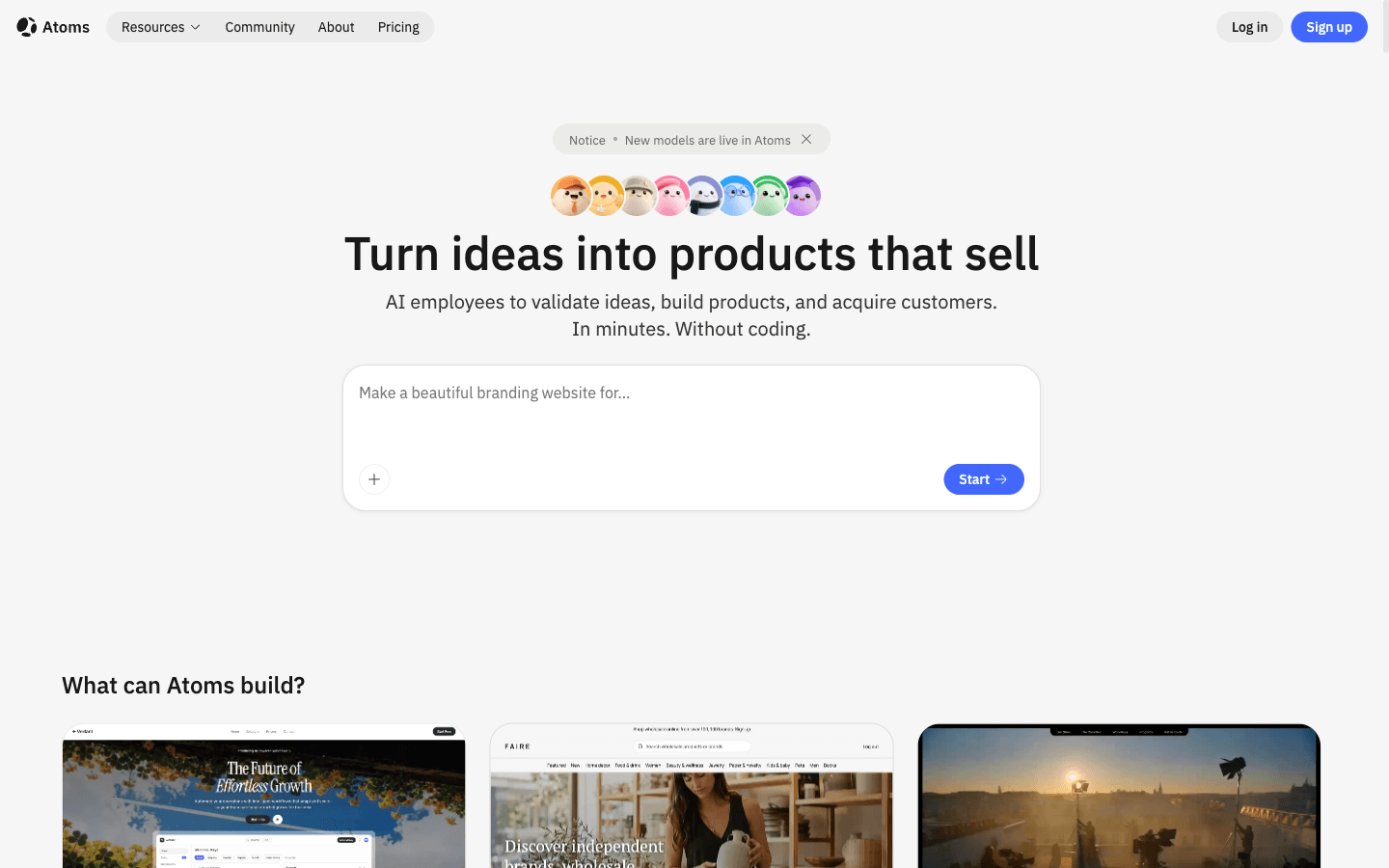
Atoms combines an AI product-building platform with a public-source market-research use case. It is worth considering when your next step is to turn an opportunity into a website or web application. The useful connection is between research and a buildable brief; a generated product still needs customer validation and review before launch.
Main features
- Scoped market research: The official market-research workflow describes gathering information from competitor websites, product pages, reviews, and industry sources. Start with a defined audience and geography so your report addresses the market you actually intend to enter.
- Structured findings: Research can cover competitors, audience segments, pricing benchmarks, and strategic recommendations. Inspect the underlying sources and separate observed facts from inferred opportunities before turning a report into a product requirement.
- Editable product creation: Describe the pages, interactions, and primary action for a website or web app. You can review a working preview and request changes, making a research-informed concept tangible enough to discuss or test.
Suitable for
- Founders exploring a category before building a first product.
- Product teams translating reviewed findings into a concrete application brief.
- Marketers preparing a landing page around a customer hypothesis.
Perplexity
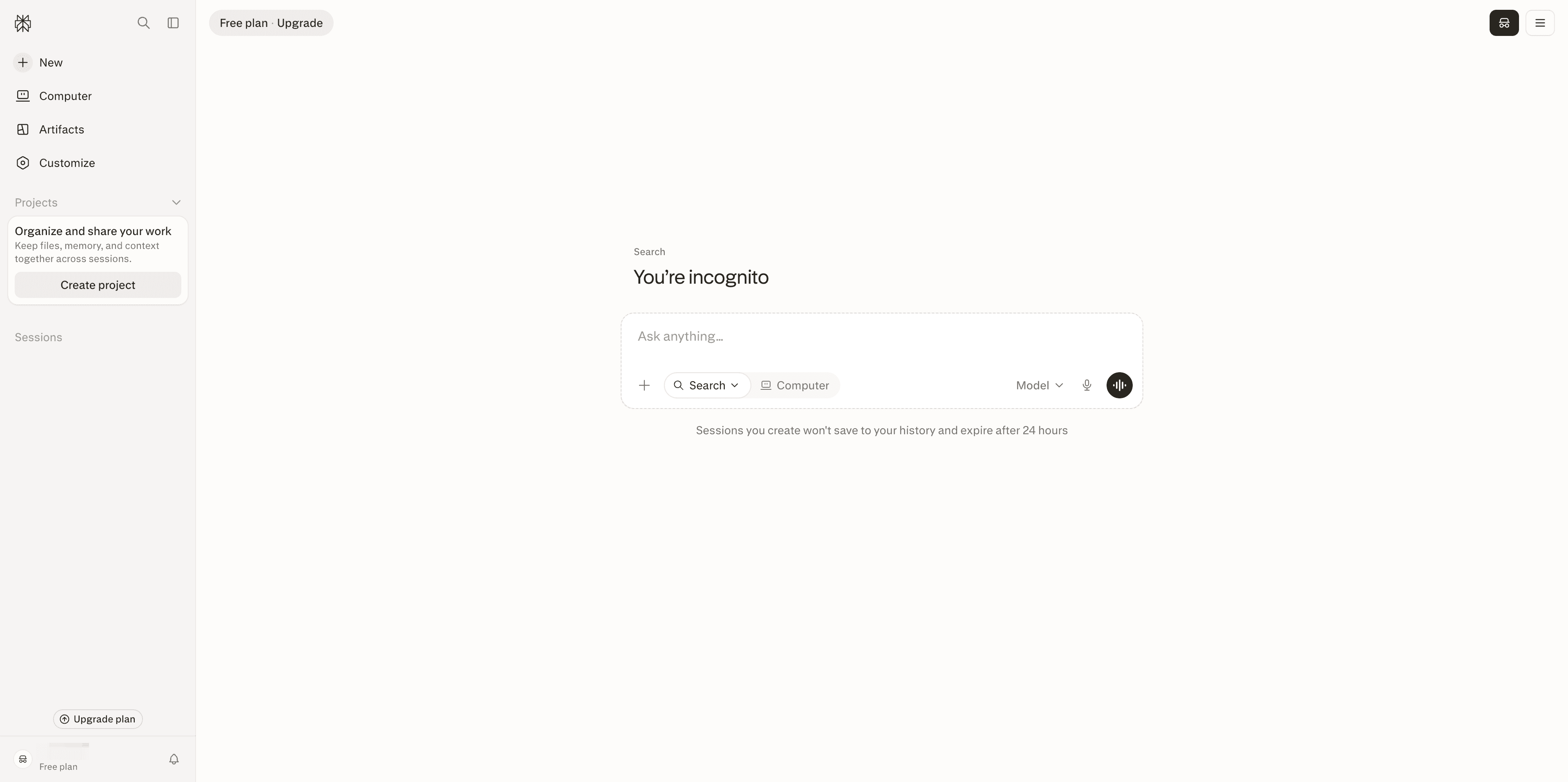
Perplexity is a useful starting point for market questions that require web discovery and cited synthesis. Its research capabilities help organize information across sources rather than leave you with a list of pages to read. Treat the result as a research aid: a citation makes a claim inspectable, but you still need to assess the source.
Main features
- Web-based discovery: Ask a defined question about a category, company, or trend. Use the results to identify relevant sources and new lines of inquiry, while checking that the geography and dates match your research scope.
- Cited synthesis: Research outputs connect findings with sources. Open the references behind important assertions and confirm that the original material supports the wording, especially when a report summarizes several different markets or time periods.
- Follow-up exploration: Refine the question to investigate a segment, compare explanations, or examine a disagreement. A focused follow-up is more useful than asking for additional detail without specifying what decision remains unresolved.
Suitable for
- Analysts beginning a category scan with public information.
- Marketers checking current positioning and visible competitor messaging.
- Small teams building a source list before deeper investigation.
AlphaSense
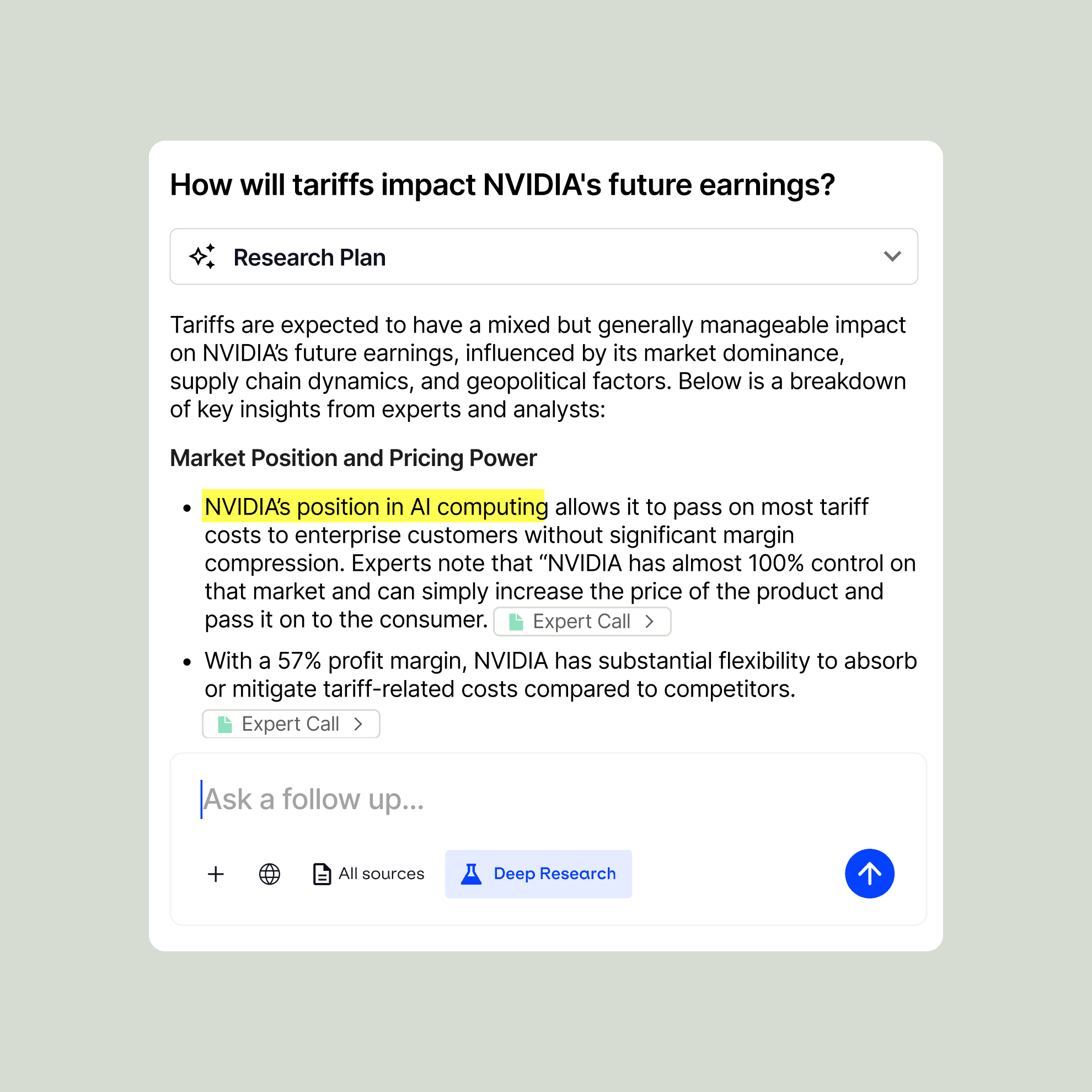
AlphaSense focuses on business and industry intelligence across documents such as company filings, broker research, and expert transcripts. Consider it when your question needs depth beyond public marketing pages. The decision starts with content fit: confirm that the material available to your account covers the companies, industries, and document types you need.
Main features
- Business-document search: Search a business-focused content collection for information relevant to a company or industry. This can help locate the evidence behind a market narrative instead of relying only on secondary summaries of that narrative.
- Research synthesis: AI-assisted analysis helps bring findings from documents together. Ask for the supporting material behind a conclusion and compare conflicting accounts, rather than treating a polished synthesis as the final investment or strategy judgment.
- Specialized source context: Filings, broker research, and expert transcripts provide different perspectives. Keep those perspectives distinct: a management statement, an analyst interpretation, and an expert opinion carry different evidential weight in a decision.
Suitable for
- Strategy teams investigating industry structure and company developments.
- Analysts who need business documents alongside public-web sources.
- Consultants comparing evidence across a defined set of organizations.
Crayon
Crayon is a competitive-intelligence option for teams that need to follow rival activity and make that information useful to sales and marketing. Its focus is ongoing competitive context rather than a one-off answer about a broad market. The analytical work remains important: detecting an update does not establish why a competitor made it or whether it matters.
Main features
- Competitive signals: Monitor competitor activity and surface relevant updates. Define what deserves attention for your team, such as a positioning change or product announcement, so a stream of updates supports an actual competitive question.
- AI-assisted interpretation: Summarization and prioritization help teams process competitive information. Verify the original update before interpreting it as a strategic shift, and distinguish the observable change from your explanation of its likely purpose.
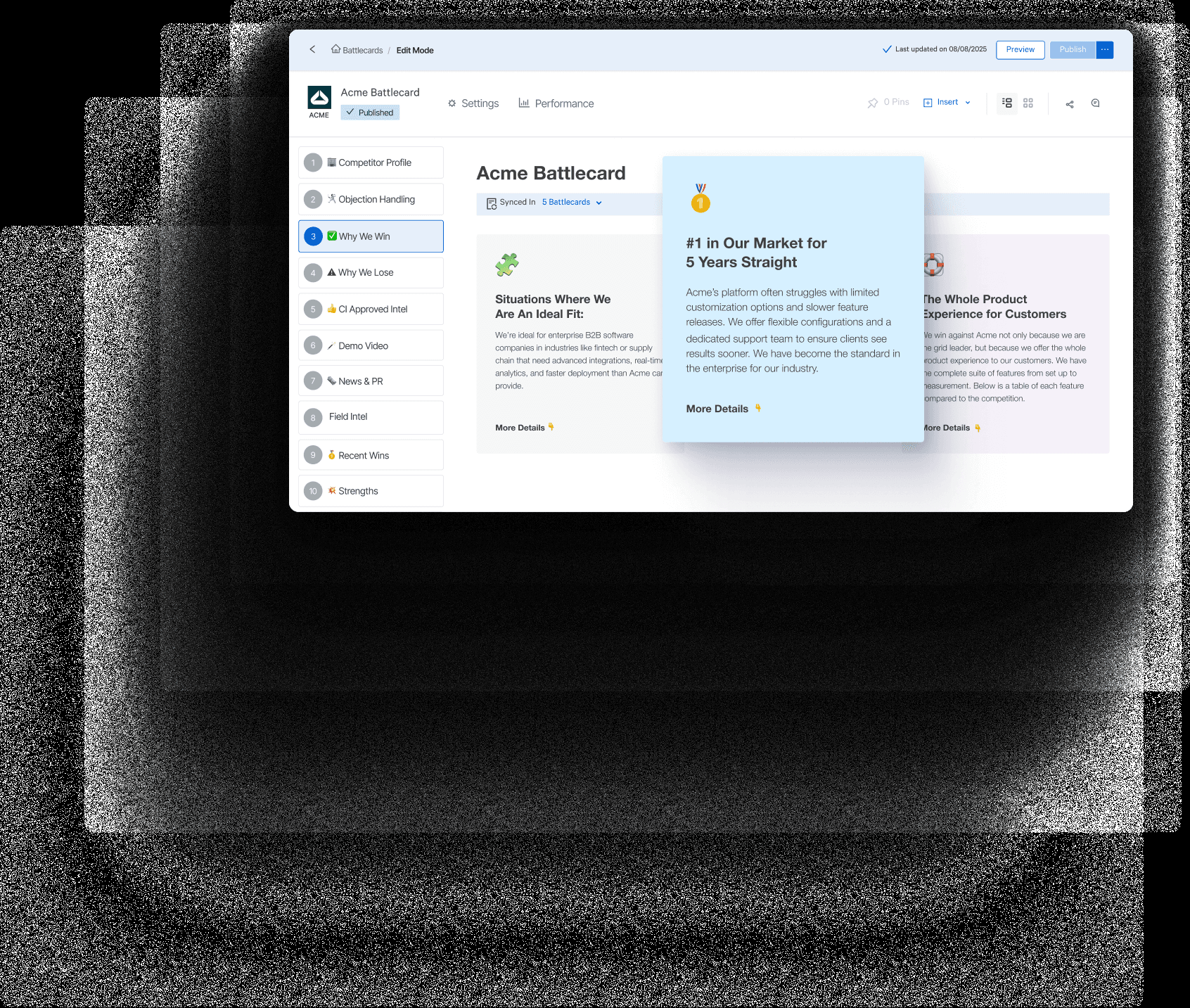
- Sales enablement: Competitive findings can support materials such as battlecards and team updates. Assign a reviewer and a refresh date so the information used in a customer conversation remains accurate and relevant to that conversation.
Suitable for
- Product marketers maintaining a competitive-intelligence program.
- Sales teams needing usable context about recurring competitors.
- B2B teams coordinating competitive information across departments.
quantilope
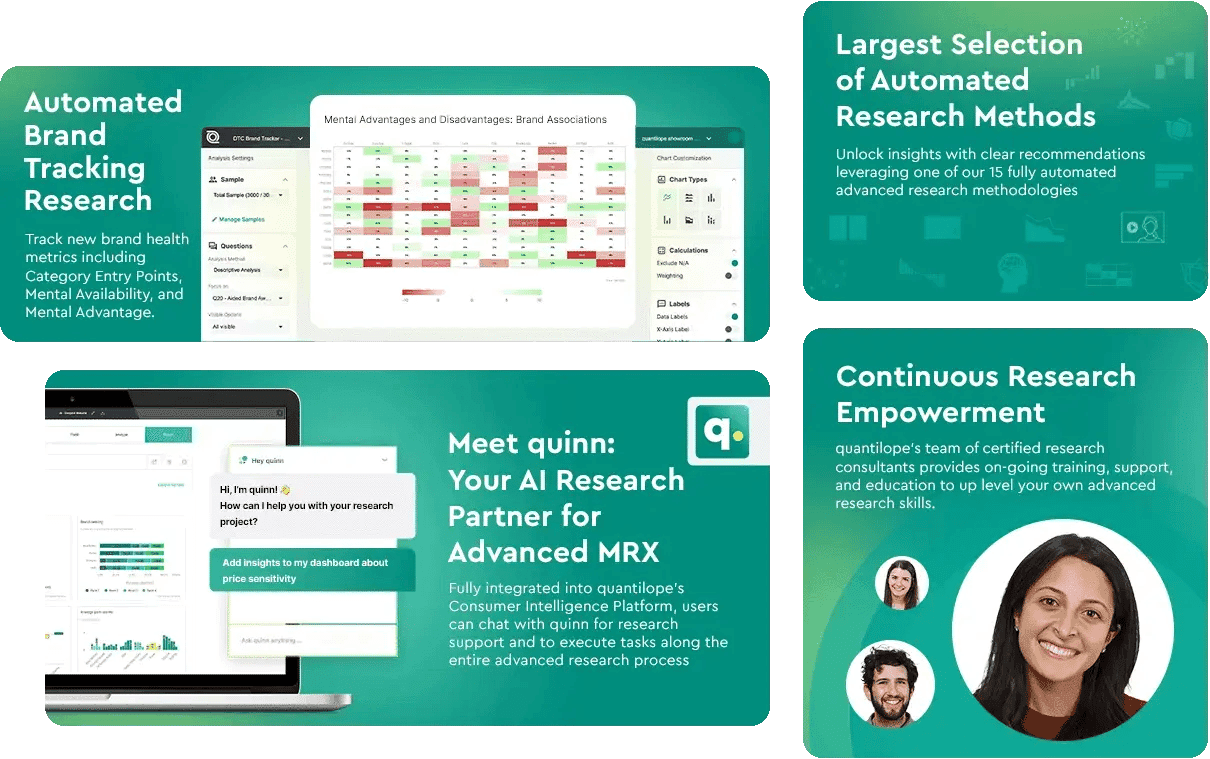
quantilope supports consumer research through research automation, survey workflows, and AI-assisted insights. It fits questions about what a defined group of consumers thinks or prefers, rather than only what companies say publicly. Before interpreting the output, examine the sample and questionnaire: automated analysis cannot make a poorly scoped research design answer the right question.
Main features
- Survey-based evidence: Collect responses around a defined consumer question. Decide who should participate and what comparison you need before collecting data, so the resulting findings address the intended audience rather than a convenient but mismatched sample.
- Research automation: Automated research methods and analysis can reduce repetitive handling of responses. Use that support to spend more attention on design and interpretation, including whether a question leads respondents toward an answer you already expect.
- Consumer insights: Organize research into findings that can inform a product or marketing decision. Keep the population, context, and uncertainty attached to each conclusion so colleagues understand where the result applies and where further research is needed.
Suitable for
- Consumer-insights teams researching preferences within a defined audience.
- Product teams comparing customer reactions to possible propositions.
- Marketers who need survey evidence alongside desk research.
Brandwatch
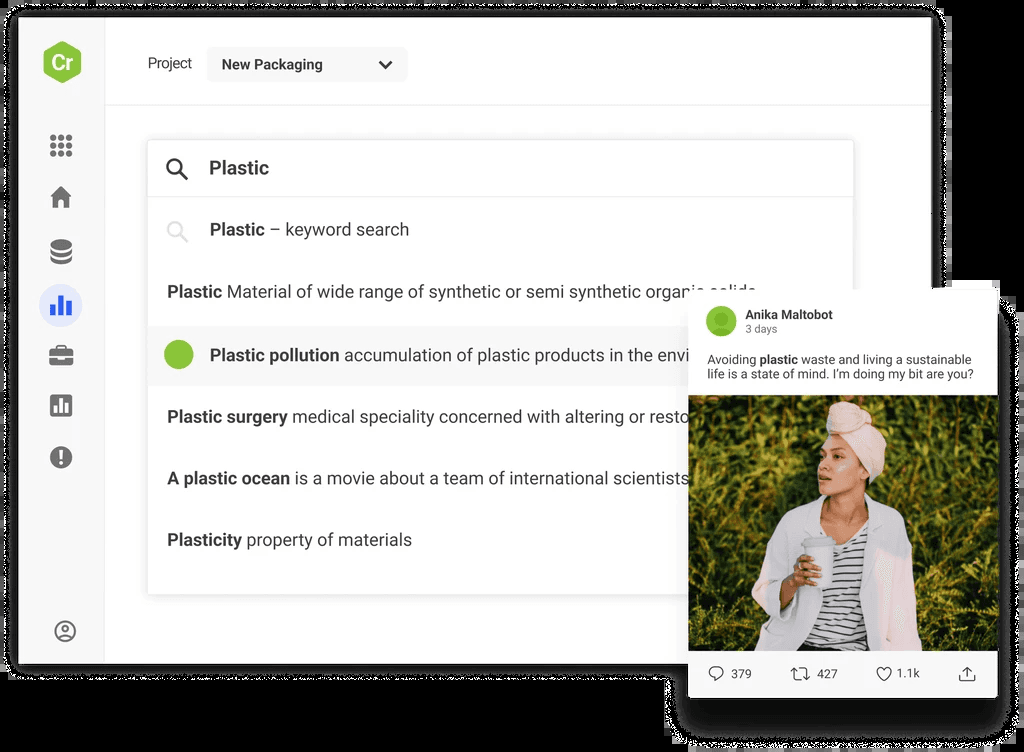
Brandwatch offers consumer intelligence and analysis of online conversations. It is a sensible option when the question concerns audience language, recurring themes, or emerging discussion around a category. Listening helps you understand the conversations your dataset captures; avoid presenting those conversations as a representative survey of every customer in the market.
Main features
- Conversation analysis: Bring structure to consumer discussion and identify themes worth investigating. Look at examples behind a theme so you can distinguish a repeated customer concern from an ambiguous phrase, campaign reaction, or unrelated conversation.
- Audience and market context: Explore how people discuss brands and categories. Use those patterns to inform interview questions or messaging hypotheses, then check whether they apply to the audience segment your product is intended to serve.
- Trend discovery: AI-assisted analysis can surface topics for further investigation. Examine the time period and source coverage before calling a topic a durable market trend; a temporary discussion spike may require a different response.
Suitable for
- Brand teams researching consumer language and recurring concerns.
- Marketers exploring themes to investigate through customer interviews.
- Research teams adding online discussion to a broader evidence mix.
ChatGPT
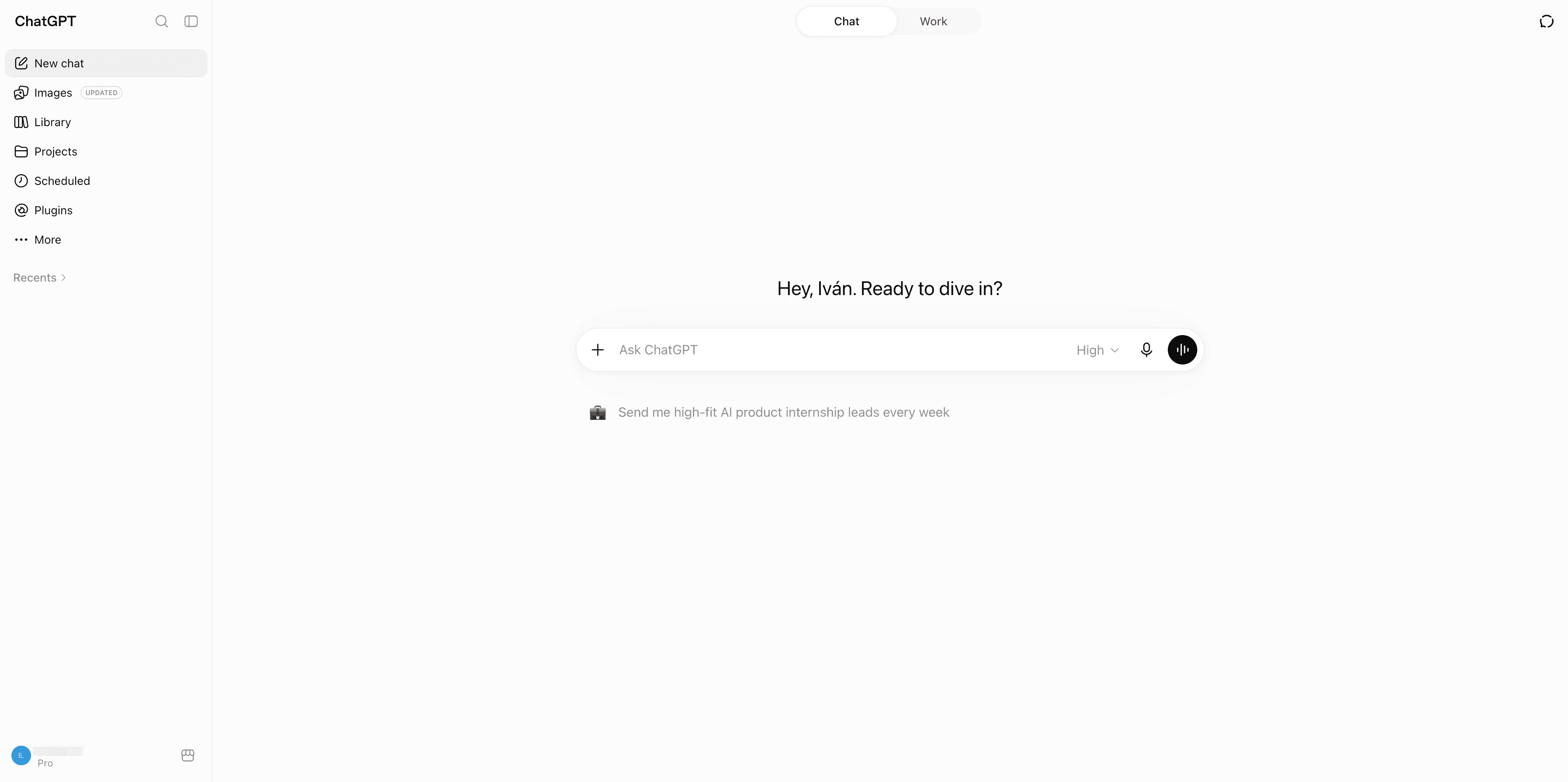
ChatGPT offers a flexible research and analysis workflow, including deep research for web-based synthesis. It can help develop a research brief and analyze supplied information alongside external material. Specify the required sources and output clearly. A useful draft should show what is established, what is inferred, and which missing information prevents a stronger recommendation.
Main features
- Deep research: Investigate a defined market question through web-based research and synthesis. Ask for source dates and conflicting evidence so the report helps you evaluate the landscape rather than merely reinforce your initial assumption about the market.
- Provided-information analysis: Bring relevant information into the task to keep the analysis tied to your business context. Explain the meaning of each input and identify gaps, especially when combining internal observations with external estimates or commentary.
- Iterative refinement: Revise the scope, comparison criteria, or report structure through follow-up instructions. Ask the assistant to expose assumptions and missing evidence before asking for a firmer recommendation; more confident wording is not a substitute for better support.
Suitable for
- Teams developing an initial research brief and comparison framework.
- Analysts refining a synthesis using supplied business information.
- Founders exploring assumptions before choosing a more specialized research tool.
How to choose AI market research tools with actionable insights
Choose the decision first, then the evidence, then the tool. “Understand the market” is too broad; “decide which audience to interview before building an onboarding product” creates a useful research boundary.
For AI market research tools for competitive analysis, check whether you need an initial landscape or ongoing monitoring. A cited web report can help map competitors. A competitive-intelligence workflow is more appropriate when updates must feed a recurring sales or marketing process.
For AI market research tools with actionable insights, insist on a visible chain from observation to proposed action. Here is a hypothetical example, not a finding about a real company:
| Stage | Example | Check before proceeding |
|---|---|---|
| Observation | A competitor's dated homepage emphasizes fast setup | Confirm the wording and capture date |
| Hypothesis | Setup effort may be a buying barrier | Look for customer evidence and alternative explanations |
| Decision | Test a proposition built around simpler onboarding | Define the intended audience and change |
| Validation | Compare qualified responses or activation with an agreed baseline | Decide the measure and evaluation period in advance |
The observation alone does not prove the hypothesis. A competitor may emphasize setup because it is easy to advertise, while customers actually choose on support or integrations. Keep that alternative explanation in the brief.
Ask the same initial question across a small shortlist. Inspect the important claims, measure how much correction is needed, and check whether you can reuse the output in your team's decision process. Confirm current plans, content access, and relevant limits before committing.
Use a scoped starter prompt:
Research the market for an onboarding product for small B2B software teams in our target country. Compare named competitors using current public product and pricing pages. Separate dated facts, hypotheses, and unknowns. Include sources, contradictions, evidence gaps, and customer questions to investigate. Return a table of finding, supporting evidence, decision implication, and proposed validation.
The benefits of using AI market research tools are most useful when they reduce repetitive discovery, sorting, or synthesis and make supporting evidence easier to review. Judge the benefit by the quality of the next decision and the work you still need to perform. A longer report, more charts, or stronger language does not automatically improve either.
How Atoms turns market findings into a product to test
Atoms is an AI product-building platform that turns natural-language requirements into editable websites and web applications. Its AI market research agent use case connects public-source research with a product-building workflow. After reviewing a finding, describe a focused experience that will help you investigate the remaining customer question.
- Define the research scope: Name the audience, category, and competitive question. Review sources and uncertain assumptions before treating a recommendation as a requirement.
- Turn findings into a brief: Specify the proposed product, relevant pages, core interaction, and next action for visitors. Describe a hypothesis to test rather than declaring demand validated.
- Build and refine: Ask for a website or web application, inspect the preview, and request focused changes. Review integrations, accessibility, security, and deployment settings before launch.
For example, you might propose a landing page that explains one onboarding benefit and collects interest. Define how you will recruit relevant visitors and evaluate responses; the page itself is only the experience supporting the test.
The following projects illustrate concrete product experiences and positioning. They are examples of what was built, not evidence that market research validated their demand.
Running Shoe Brand Store FEATHERSTEP is an e-commerce website centered on lightweight running shoes. It illustrates a storefront organized around a particular product proposition.
Noise-cancelling Headphone Store Website Silent Press is an e-commerce website for a noise-cancelling headphone brand. It illustrates how a defined product category can become a concrete web experience.
Technical Outerwear Brand Store STORMLINE is an e-commerce website for technical outdoor apparel. Its weather-oriented proposition illustrates a positioning direction expressed through a storefront.
Turn a reviewed market insight into a product you can test. Build with Atoms.
Browse more Atoms project examples to see different product formats before deciding what your own research-informed brief should describe.
Conclusion
Choose a research tool by the evidence your decision requires, then verify the findings that would change your next step. Use public sources for exploration, specialized intelligence for depth, and customer research when the question needs customer evidence. Keep assumptions visible and turn recommendations into measurable tests. When you have a reviewed opportunity and a focused product brief, build the next version with Atoms.
A little more clarity
Frequently asked questions
01Q1: Can AI replace customer interviews?
Use AI to prepare questions, organize findings, and identify assumptions to investigate. Customer interviews provide evidence about people's experiences and motivations that a public-source report may not contain. Whether you need interviews depends on the question, but an AI-generated summary should not be treated as proof that customers want your proposed product.
02Q2: Which tool should a small team try for competitor research?
Start with the task. Perplexity or ChatGPT can help explore public sources for an initial comparison. Consider Crayon when competitor updates need to support a recurring sales or marketing process. Test a narrow question first, review the evidence, and check current access and plans before choosing a longer-term workflow.
03Q3: How do I check an AI-generated market-size estimate?
Trace the estimate to its source and check the year, geography, category definition, and method. Separate reported figures from calculations and assumptions. If the source measures a broader category than your product addresses, label that mismatch. Ask for the missing inputs rather than accepting a precise number with an unclear basis.
04Q4: Can Atoms turn a research finding into an app?
Atoms can build an editable website or web application from a natural-language brief. Translate reviewed findings into specific users, pages, data needs, and interactions, then inspect the generated experience. Treat customer fit, integrations, and production review as separate responsibilities before launching the resulting product or using it in a test.
05Q5: Does a cited Atoms report prove there is demand?
A cited report helps you inspect the public evidence used in a research task. It does not, by itself, establish willingness to pay or customer adoption. Review the sources, identify the assumptions that matter, and choose an appropriate next validation step, such as relevant customer conversations or a clearly measured product experiment.
Share this article
 Posts
Posts 