On this page
If you search for the best AI model for coding, you will find a leaderboard. What you actually need is a decision.
Which model is best for building a product from a brief? Which one is best at debugging? Which one handles a large codebase? Which one is best when you need visual understanding, Chinese and English, long context, or a lower-cost alternative?
As of August 17, 2026, the practical shortlist is no longer just GPT versus Claude. The serious options include OpenAI’s GPT-5.6 family, Anthropic’s Claude Opus 5 and Sonnet 5, xAI’s Grok 4.6, Z.AI’s GLM-5.3 and GLM-5.2, and Moonshot AI’s Kimi K3. Each is optimizing for a different kind of software work.
The fastest way to try these models is Atoms. Instead of setting up separate API keys, SDKs, billing accounts, and deployment infrastructure, you can select a model, describe the product you want, and let Atoms turn the brief into a working, deployable app. Atoms publicly lists model families including Claude, GPT, GLM, and Grok, and has dedicated build pages for Kimi K3 and other models. Availability and model names can change as providers release new versions, so check the current model picker when you start.
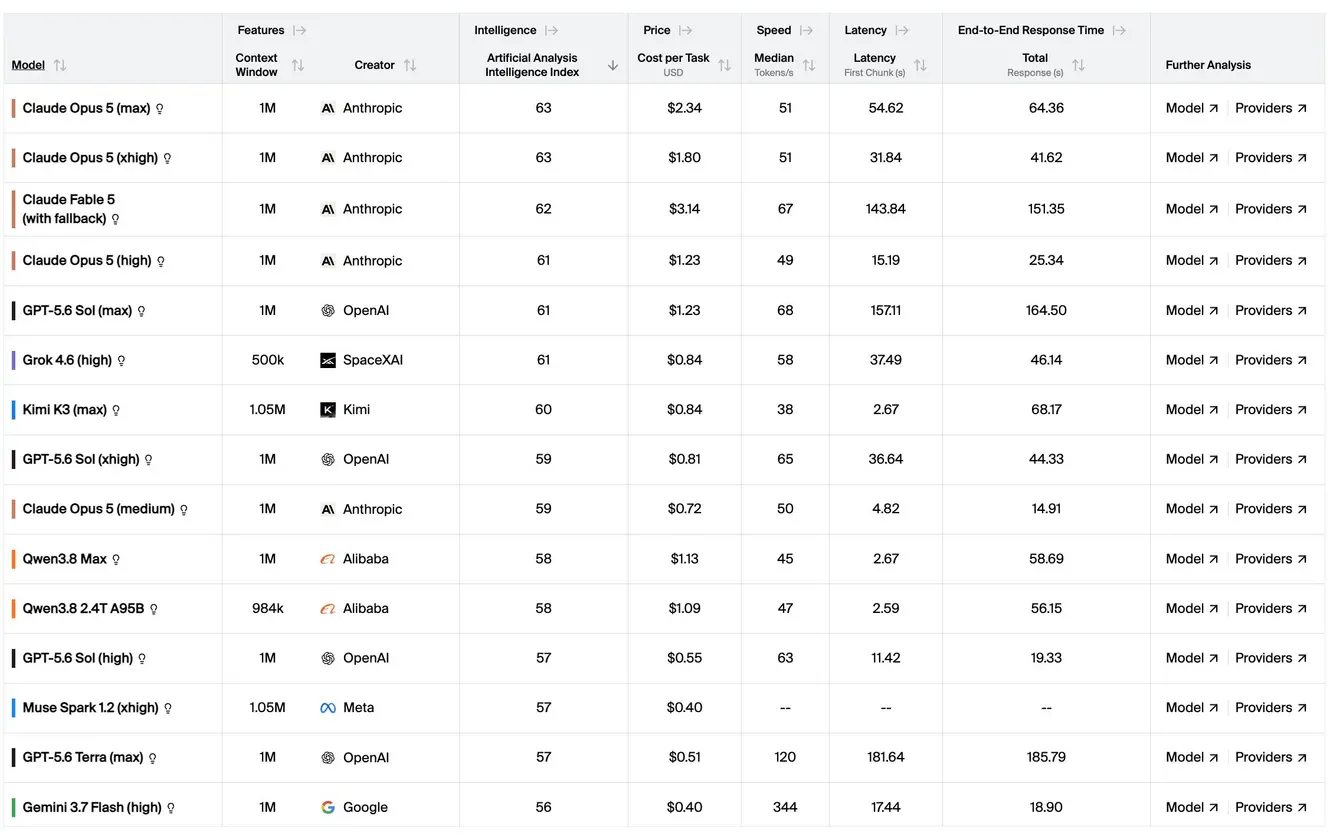
Artificial Analysis model leaderboard snapshot, accessed August 18, 2026. This is a general model-performance and operating-cost snapshot, not a coding-only benchmark.
The short answer: which AI model is best for coding?
| If you care most about | Start with | Why |
|---|---|---|
| The strongest general-purpose coding and reasoning | GPT-5.6 Sol | Broad tool support, strong coding, vision, computer-use capabilities, and a balanced flagship profile |
| Difficult judgment-heavy engineering | Claude Opus 5 | Premium reasoning, long-running work, large-codebase understanding, and self-verification claims |
| Fast production iteration | Claude Sonnet 5 | A lower-cost working model aimed at maintaining high capability while moving quickly |
| Large-context coding and visual software work | Kimi K3 | 1M-token context, native vision, and a model explicitly built for long-horizon coding |
| Real-time information and a new coding alternative | Grok 4.6 | 500K context, image input, configurable reasoning, and current xAI focus on coding and agents |
| Chinese-English work and open-model flexibility | GLM-5.3 or GLM-5.2 | Strong bilingual positioning, long-context engineering, and an open-model path through Z.AI |
| High-throughput or cost-sensitive work | GPT-5.6 Terra or Luna; Claude Sonnet 5; GLM | Smaller or faster tiers can reduce the cost of routine generations and revisions |
This is a starting point, not a claim that one vendor wins every benchmark. A model’s real value is the number of accepted, working changes it produces for your tasks—not the most impressive single score in a launch table.
Why the best coding model depends on the job
“Coding” can mean generating a function, fixing a production regression, translating a design into a responsive interface, building a full-stack SaaS, or navigating a huge repository.
Those tasks reward different capabilities:
- Instruction retention: Can the model preserve creative direction, structure, functionality, and exclusions at the same time?
- Reasoning depth: Can it identify the actual cause of a bug instead of patching the visible symptom?
- Codebase scale: Can it retrieve and use the right files without drowning in irrelevant context?
- Visual understanding: Can it interpret screenshots, layouts, diagrams, and rendered output?
- Iteration quality: Does the second revision improve the product, or merely rewrite the first answer?
- Tool and API reliability: Can it work with data, authentication, payments, browser state, and deployment requirements?
- Language coverage: Does it understand the language and business context your team actually uses?
This is why the same model can be excellent for one builder and disappointing for another. The best model is the one whose strengths match the failure modes of your project.
GPT-5.6: the balanced flagship
OpenAI’s current model documentation recommends GPT-5.6 Sol as the starting point for complex reasoning and coding. The family has three useful tiers:
gpt-5.6-solfor complex professional work;gpt-5.6-terrafor balancing intelligence and cost;gpt-5.6-lunafor cost-sensitive, high-volume workloads.
OpenAI lists text and image input, text output, multilingual capabilities, vision, and access through the Responses API and SDKs. The published Sol specification lists a 1.05M-token context window, up to 128K output tokens, and support for functions, web search, file search, and computer use. The published API price is $5 per million input tokens and $30 per million output tokens. Terra is listed at $2 and $12, while Luna is listed at $0.20 and $1.20.
What GPT-5.6 is good at
GPT-5.6 Sol is the safest first experiment when your project crosses boundaries. A single build may require product reasoning, code generation, image interpretation, data work, and interaction with external tools. OpenAI’s model page presents Sol as the broad flagship rather than a narrow code specialist.
For app building, that breadth matters. A product brief rarely stays inside one category. You may begin with a landing page, add authentication, connect a database, introduce billing, inspect a screenshot, and then ask for a performance or SEO pass. A generalist that remains capable across all of those transitions can be more useful than a model that wins one isolated coding test.
Where GPT-5.6 needs scrutiny
The flagship price is not the whole cost. Large context is useful, but sending an entire repository or document collection on every turn can be wasteful. Retrieval, caching, and focused project instructions still matter.
Also, “strong general coding” does not mean every generated feature is production-ready. Ask the model to state assumptions, implement the smallest complete slice, test the important paths, and report what remains unverified.
Best use on Atoms
Choose GPT when you want a strong default for turning a detailed product brief into a complete app. Atoms’ GPT pages describe a workflow in which the model helps plan, write, and test the product rather than stopping at a code snippet.
Try it with a brief that includes:
- the user and problem;
- the core workflow;
- the visual direction;
- required data and integrations;
- explicit exclusions;
- what must be working in the first version.
Claude Opus 5: the premium reasoning choice
Anthropic’s current Claude Opus page describes Claude Opus 5 as its strongest Opus model, designed for serious coding, long-running agents, and complex professional work. Anthropic lists a 1M context window, the API model ID claude-opus-5, and starting prices of $5 per million input tokens and $25 per million output tokens. Anthropic also advertises prompt caching and batch-processing savings.
What Claude Opus 5 is good at
Opus is the model to test when your task is ambiguous, judgment-heavy, or likely to take many iterations. Anthropic emphasizes careful planning, large codebases, self-correction, multi-tool work, and carrying context across multi-day projects.
That positioning maps well to:
- debugging where the visible error is not the root cause;
- refactoring across a complex dependency graph;
- turning a dense creative brief into a coherent interface;
- reviewing code for intent, edge cases, and security;
- projects where the model must make and check many decisions rather than produce one answer.
Atoms’ Claude pages position the Claude family as a direct way to build apps from a conversation, with Opus for deeper reasoning and Sonnet for daily building. That makes Claude especially interesting for users who want to compare quality and speed without changing the rest of their product workflow.
Where Claude Opus 5 needs scrutiny
Opus is a premium model. Its higher ceiling is valuable only when the task benefits from it. Using the most expensive model for a short copy change or a mechanical CSS adjustment can be poor economics.
Anthropic’s public page contains vendor positioning and customer examples. Those are useful signals, but they are not the same as an independently reproduced coding leaderboard. Treat claims about production reliability as hypotheses to test on your own projects.
Best use on Atoms
Use Claude Opus when the brief is hard to specify completely and you want the model to reason through product decisions, architecture, and implementation. For everyday iterations, try Claude Sonnet first; move to Opus when the task becomes ambiguous or the first solution needs deeper diagnosis.
Claude Sonnet 5: the practical daily driver
Anthropic’s Sonnet tier is designed around the quality-speed trade-off. Atoms announced Claude Sonnet 5 as available on the platform and tested it on complete builds rather than isolated snippets, including a cinematic game store, a technical outdoor brand, and a scroll-driven action-camera product page.
The useful lesson from those builds is not that a model can generate attractive screenshots. It is that a coding model must hold several layers of a specification together:
- creative direction;
- page and component structure;
- interaction behavior;
- functional requirements;
- exclusions and quality constraints.
Sonnet is a strong candidate when you want to iterate quickly on a real product. Use it for first builds, feature additions, responsive revisions, content changes, and normal debugging. Escalate to Opus when the problem demands more planning or when repeated fixes are not converging.
For the current model name and plan availability, check Atoms’ Claude model page and the live picker before starting. Provider and platform catalogs move quickly.
Grok 4.6: the long-context challenger
xAI’s official documentation lists Grok 4.6 as a frontier model for coding, agentic tasks, and knowledge work.
The verified model specification includes:
- model ID:
grok-4.6; - text and image input;
- 500,000-token context window;
- function calling and structured outputs;
- configurable reasoning;
- $2 per million input tokens and $6 per million output tokens below the long-context threshold;
- $4 input and $12 output at 200K prompt tokens or more;
- cached-input pricing of $0.50 below and $1 above that threshold.
The threshold is important: once a request reaches 200,000 prompt tokens, xAI states that the higher rate applies to the whole request. A large context window is therefore a capability, not an instruction to send everything every time.
What Grok 4.6 is good at
Grok 4.6 is a sensible model to test when a project combines coding with current information, visual input, or a need for a different model perspective. xAI describes it as the latest model for coding and agentic work, and announced its availability in GitHub Copilot on August 14, 2026.
Its 500K context can be useful for:
- examining a broad project history;
- comparing multiple implementation options;
- working from screenshots and written requirements together;
- handling long technical references;
- exploring products connected to current events or web information.
Where Grok 4.6 needs scrutiny
Grok 4.6 is new at this research cutoff. xAI reports coding and agentic improvements, but independent evidence across real production repositories remains less mature than the release narrative. Do not turn a new launch into a universal ranking before comparable tests exist.
Atoms’ Grok page confirms that the Grok family is available in its product workflow without a separate xAI account or API-key setup. Try it when you want a fresh implementation of the same brief and compare the resulting product, not only the prose explanation.
GLM-5.3 and GLM-5.2: bilingual and open-model alternatives
Z.AI’s GLM family deserves more attention than it often receives in English-only comparisons. GLM is especially relevant when a project moves between Chinese and English, requires long-horizon work, or should not depend entirely on one Western API provider.
Z.AI describes GLM-5.3 as its latest flagship for complex software engineering and agent tasks, with improvements over GLM-5.2 on its Z.ai Code Bench and reported open-source-leading results on newer agentic benchmarks. GLM-5.2 is described as a long-horizon model with a usable 1M-token context and a migration path from earlier GLM versions.
What GLM is good at
GLM is a strong candidate for:
- Chinese-English product requirements;
- bilingual content and documentation;
- code comments, UI copy, and business logic spanning both languages;
- long project context;
- developers evaluating an alternative provider or open-model route;
- cost-sensitive coding and reasoning workloads.
Atoms’ GLM page confirms that GLM 5.1 is available in the platform’s model workflow and describes the same product-building loop: product planning, engineering, testing, and deployment. Atoms also states that GLM can be used without a separate Z.AI account or API key.
GLM-5.3 versus GLM-5.2
Choose GLM-5.3 when the current endpoint is available and you want the latest post-training improvements. Choose GLM-5.2 when you need a known migration target or are following an existing integration. Do not copy GLM-5.3’s benchmark claims onto GLM-5.2: model revisions and evaluation conditions are different.
The open-model label also needs precision. Hosted GLM features, API tools, context defaults, and safety layers are not automatically identical to an open checkpoint. Confirm the exact checkpoint, license, serving requirements, and model card before self-hosting or redistributing anything.
Kimi K3: the open frontier model for long coding sessions
Moonshot AI’s Kimi K3 is one of the most consequential recent model releases for coding. The official Kimi announcement describes a 2.8-trillion-parameter mixture-of-experts model with native vision and a 1M-token context window. Moonshot positions it as an open 3T-class model for long-horizon coding, knowledge work, and reasoning.
Kimi says K3 is available through Kimi.com, Kimi Work, Kimi Code, and the Kimi API. The official release describes maximum thinking effort at launch, with lower and higher effort modes planned in later updates. It also says full weights would be released by July 27, 2026; verify the current checkpoint and license before treating the model as locally deployable.
What Kimi K3 is good at
Kimi K3 is compelling when context and visual reasoning are central:
- very large repositories;
- long product histories and research materials;
- screenshot-driven front-end work;
- games, CAD, and visual interfaces;
- kernel optimization and technical systems work;
- long sequences of planning, implementation, and revision.
Moonshot’s own coding material describes K3 navigating large repositories, orchestrating terminal tools, and working with screenshots in the loop. It also reports a kernel-optimization evaluation in which K3 was competitive with Claude Fable 5 under the stated conditions.
That is valuable evidence, but it is still vendor-published evidence. Moonshot explicitly says K3 trails its strongest proprietary comparisons in overall performance, so the accurate conclusion is “frontier-level open contender,” not “universal winner.”
Kimi K3 on Atoms
Atoms has a dedicated Kimi K3 model page. It describes K3 as available for long-horizon coding and end-to-end knowledge work, with a 1M-token context window and native visual understanding. On Atoms, you can use K3 to move from research and planning into implementation, preview, and deployment without configuring a separate API key.
This is a particularly good first test: give Kimi a large but coherent brief, attach a reference screenshot or product document, and ask for a complete first version with explicit acceptance criteria.
What the benchmark numbers actually tell you
A benchmark is useful when you know what it measured and who ran it.
Artificial Analysis: the most useful cross-model snapshot
Atoms’ recent comparison of GPT-5.6 Sol, Claude Fable 5, and GLM-5.2 cites an Artificial Analysis Intelligence Index snapshot of 60 for Fable 5, 59 for Sol, and 51 for GLM-5.2. A separate Atoms comparison of Kimi K3, Fable 5, and Sol cites a later snapshot of 60, 59, and 57 respectively.
These numbers should be read as dated snapshots, not permanent rankings. The index aggregates multiple evaluations, and model versions, serving conditions, and benchmark composition change. A one-point spread is usually a reason to run a matched task—not a reason to make a procurement decision from a table.
Coding benchmarks
SWE-bench, Terminal-Bench, Aider, and similar evaluations measure different things. Some test issue resolution in real repositories. Others test terminal operation, code editing, or multi-language exercises.
For every coding score, record:
- exact model revision;
- benchmark version and split;
- reasoning effort;
- prompt and token budget;
- tools and permissions;
- evaluator or harness;
- pass criterion;
- whether the number is vendor-reported or independently reproduced.
The model with the highest score in one setting may not produce the best application from your product brief. A model that understands visual intent, preserves exclusions, and implements a working backend may be more valuable to an Atoms user than a model that wins a narrow patch benchmark.
The best model by user profile
If you are building your first app
Start with GPT-5.6 Sol or Claude Sonnet 5. Both are strong general defaults. Describe the user, the workflow, the visual direction, the data model, and the first release boundary. Do not start with “make it good.” Give the model a definition of good.
If the app has complex product logic
Try Claude Opus 5 or GPT-5.6 Sol. Ask for a plan, assumptions, data model, edge cases, and a test checklist before implementation.
If the app is highly visual
Try Kimi K3, Claude Opus 5, or GPT-5.6 Sol with screenshots and explicit visual requirements. Ask for responsive behavior and real interactions, not only a screenshot match.
If you work in Chinese and English
Try GLM-5.3 or GLM-5.2, then compare the same brief with Kimi K3, GPT, or Claude. Judge both code quality and whether the model preserves meaning across languages.
If context size is your constraint
Try Kimi K3, GPT-5.6, Claude Opus 5, or GLM’s long-context models. Use the context window deliberately: provide the relevant material, state priorities, and ask the model to identify what it could not verify.
If you want a second opinion
Run the same brief with Grok 4.6, GLM, or Kimi. Model diversity is useful when you are choosing between different implementations, visual directions, or architecture proposals.
If cost matters most
Use a fast tier for routine changes and reserve premium models for ambiguous work. GPT-5.6 Terra or Luna, Claude Sonnet, and GLM are sensible candidates to compare. Measure cost per accepted build, not price per token alone.
How to test models fairly in Atoms
The cleanest comparison is not a generic prompt like “build a website.” Use one brief and change only the model.
Your brief should specify:
- the target user;
- the problem and core action;
- required pages and states;
- visual references;
- data and integration requirements;
- mobile behavior;
- SEO and accessibility requirements;
- what is explicitly out of scope;
- acceptance criteria.
Then compare:
- time to first usable build;
- completeness of the core workflow;
- visual fidelity and responsiveness;
- quality of generated content;
- backend and integration correctness;
- number of revision cycles;
- regressions after feedback;
- whether the deployed result is actually usable.
This is where Atoms becomes more useful than a model-comparison spreadsheet: you can move from prompt to working product, compare model outputs in the same product-building environment, and deploy the result rather than judging code in isolation.
Start building with the model that fits your project
There is no permanent winner in AI coding. GPT-5.6 Sol is the strongest balanced starting point. Claude Opus 5 is the premium choice for difficult judgment and long-running work. Claude Sonnet 5 is the practical daily option. Kimi K3 brings an unusually large context window, native vision, and an open frontier direction. Grok 4.6 is a fresh long-context challenger. GLM-5.3 and GLM-5.2 are serious bilingual and open-model alternatives.
The useful next step is not reading another leaderboard. Open Atoms, choose one of these models, and give it a real product brief. If the first result is close but not right, run the same brief with a second model. The difference becomes obvious when you compare working products, not model names.
Frequently asked questions
01What is the best AI model for coding right now?
Start with GPT-5.6 Sol for balanced coding and reasoning, Claude Opus 5 for difficult judgment-heavy work, Kimi K3 for very large or visual projects, Grok 4.6 for a new long-context alternative, and GLM-5.3 or GLM-5.2 for bilingual and open-model workflows. Validate the choice on your own product brief.
02Is Claude better than GPT for coding?
Neither is universally better. GPT-5.6 Sol has a broad tool and modality profile. Claude Opus 5 is aimed at careful long-running reasoning. Compare them on the same brief, then judge the deployed result and revision quality.
03Is Grok good for coding?
Grok 4.6 is a serious model to test for coding and agentic work. Its official documentation lists a 500K context window, image input, function calling, structured outputs, and configurable reasoning. Because it is new, treat broad superiority claims as unverified until more independent evidence is available.
04Is GLM good for coding?
Yes. GLM is especially worth testing for Chinese-English coding and product workflows, cost-sensitive work, and teams interested in an alternative or open-model path. Use the exact current model revision rather than treating all GLM versions as interchangeable.
05Is Kimi K3 open source?
Moonshot describes Kimi K3 as an open model and announced a weight release. “Open” does not answer every licensing or deployment question. Check the exact checkpoint, license, serving requirements, and current release status before self-hosting or redistribution.
06Can I use these models on Atoms without API keys?
Atoms’ public model pages state that its hosted model workflows do not require separate provider API keys for the user. The currently visible Atoms catalog and model pages include Claude, GPT, GLM, Grok, and Kimi K3. Model names and availability can change, so confirm the picker at the time you build.
Sources
Research cutoff: August 17, 2026.
- OpenAI Models
- Anthropic Claude Opus
- xAI Grok 4.6 documentation
- xAI Grok 4.6 in GitHub Copilot
- Z.AI GLM-5.3 documentation
- Z.AI GLM-5.2 documentation
- Moonshot Kimi K3 announcement
- Kimi K3 model card and license
- Atoms Claude models
- Atoms GPT models
- Atoms GLM models
- Atoms Grok models
- Atoms Kimi K3
- Atoms GPT-5.6 announcement
- Atoms Claude Sonnet 5 announcement
- Atoms GPT-5.6 Sol vs Claude Fable 5 vs GLM-5.2
- Atoms Kimi K3 vs Claude Fable 5 vs GPT-5.6 Sol
- Atoms Grok 4.6 analysis
- Atoms model catalog
Ox Alpha: the anonymous model that turned out to be Z.AI's GLM line
In August 2026, an anonymous model called Ox Alpha appeared on OpenRouter with a one-week free-access promotion. Developers and Reddit users spent several days trying to identify its provider. Bloomberg later reported that Z.AI confirmed Ox Alpha was a new iteration of its GLM series and planned to release the weights.
The episode matters because it was not only a launch stunt. Early developer reports focused on coding and agent tasks, while the model's identity was investigated through serving behavior, tokenizer and output fingerprints, and error-message similarities. Those community tests are evidence of the investigation—not a substitute for an official model card or a controlled benchmark.
What the early evidence says
- The supplied DeepSWE screenshot reports an 80% mean on a 10-task subset for Ox Alpha, compared with 65% for Claude Fable 5 and 52% for GPT-5.6 Sol. This is a small, community-shared sample and should not be treated as a definitive leaderboard.
- OpenCode's announcement described a 1M context window, multimodal support, zero data retention, generous limits, and claimed capacity. These are service claims from a social post and require separate verification for current availability and terms.
- The practical signal is strongest in software engineering: repository changes, tool use, debugging, and long-horizon coding—not generic chat quality.
- Z.AI's public GLM-5.3 documentation is the authoritative reference for the GLM product line; Ox Alpha's exact public checkpoint name, weights, license, and serving configuration should be verified against Z.AI's release materials before deployment.
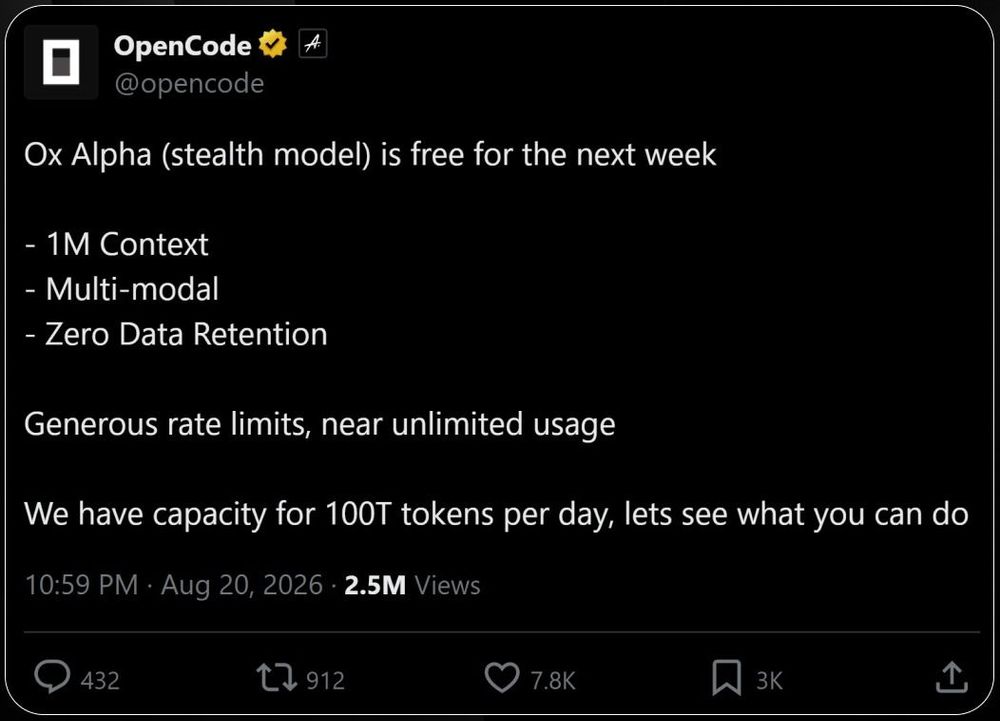
OpenCode's Ox Alpha announcement, cropped to remove unrelated publisher branding. This image documents a social-media claim, not independent verification.
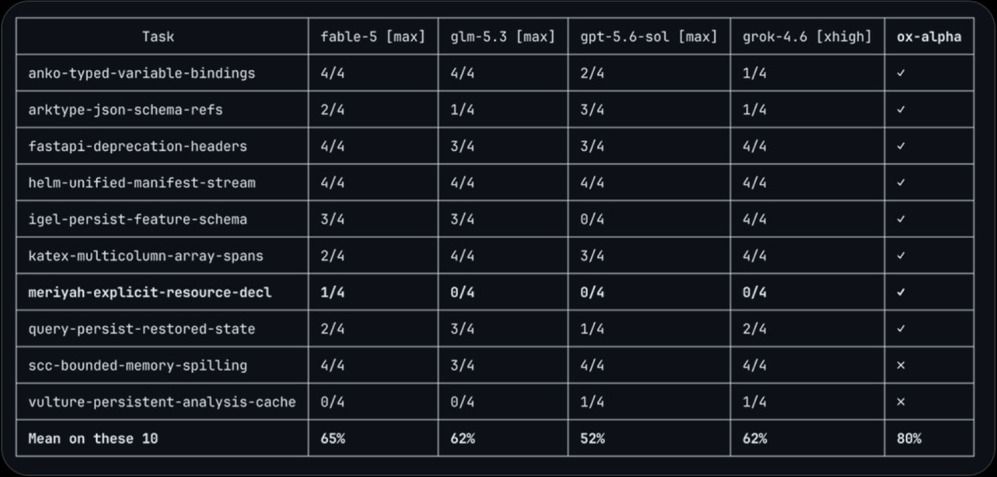
Community-shared DeepSWE subset comparison. The image itself notes that the sample is only ten tasks; it should not be generalized to overall model quality.
For builders, the right takeaway is not “Ox Alpha beats every model.” It is that Z.AI demonstrated a high-attention path from anonymous preview to confirmed GLM release, while the strongest early user signal appeared in coding workflows. Test the exact model, harness, prompt, context, retries, and accepted changes before making a production decision.
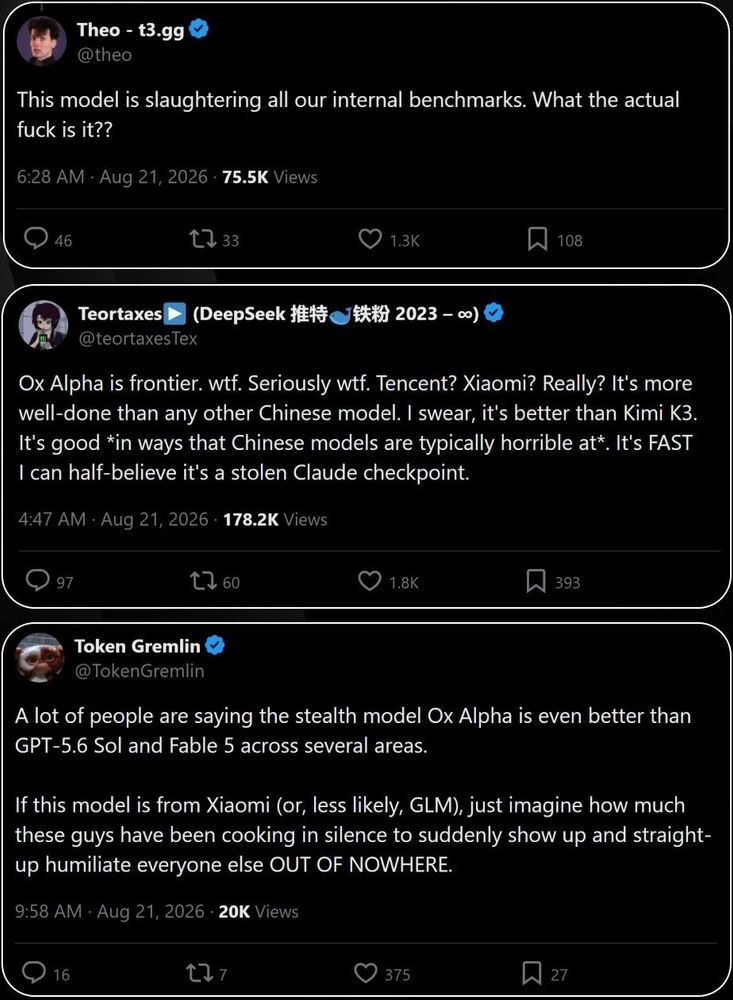
Ox Alpha evidence image, cropped to remove unrelated Evolving AI publisher branding. Treat social posts and community benchmark claims as reported evidence, not independent verification.
