On this page
On Arena, a new model named gemini-3.8-flash appears. Developers suspect they have caught an early glimpse of Gemini 4 Pro.
Developer Bee says the model took 14 minutes to build a website that draws itself as you scroll. Pencil lines darken as you move down the page. The whole design revolves around graphite and sketching.
Then came the other demos: a cycling pelican with working controls, a helicopter built in about ten minutes, and a playable kart racer. A leaked scorecard pushed the speculation further, putting Google ahead of GPT-6 Astra and Claude Fable 5.1 on four benchmarks, with token prices at a fraction of theirs.
Google has not confirmed the model’s identity or the leaked scores. Xinzhiyuan’s September 18 report collects the developer posts and demos behind the rumors. Here is what they show.
Why developers think this could be Gemini 4 Pro
The name is what makes this puzzling. Gemini 3.8 Flash is already available, but developers quoted in the report say the Arena entry produces noticeably better results. Their guess: Google is testing a more capable model under an existing name.
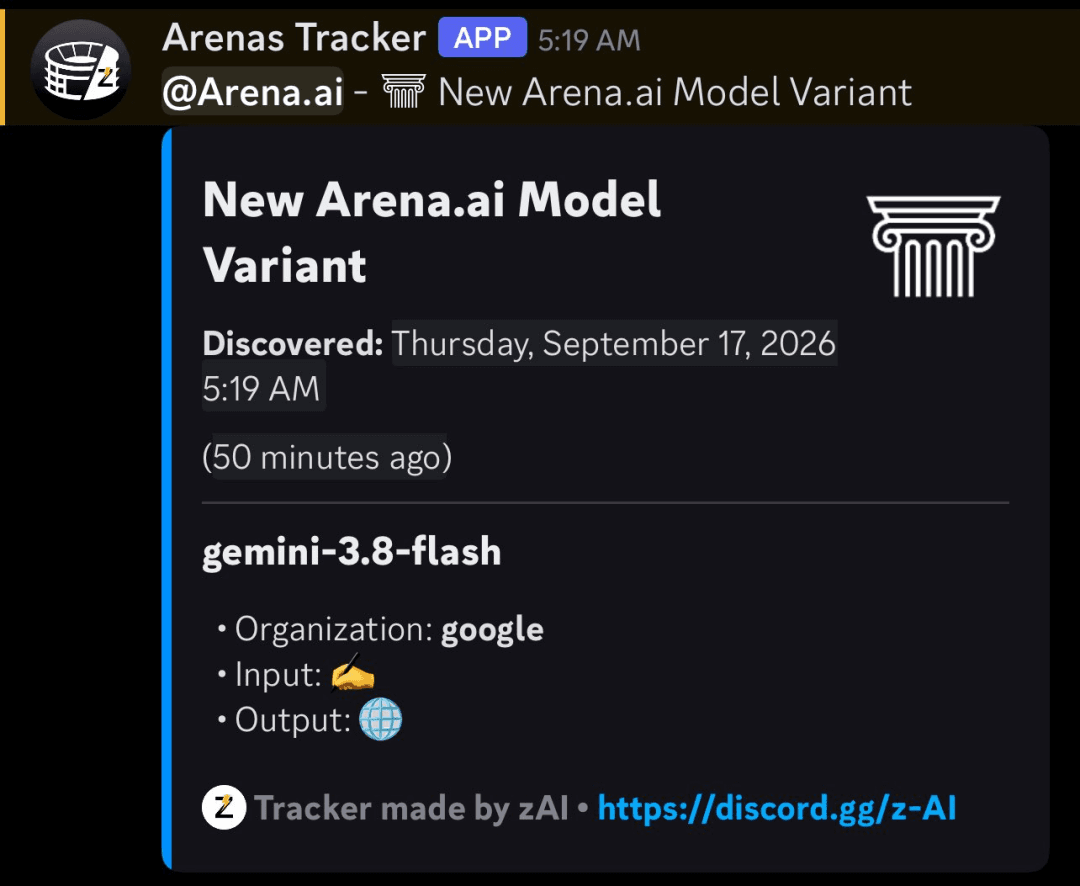
Arena lets users compare model responses side by side. In the posts collected by Xinzhiyuan, developers began calling this entry Gemini 4 Pro after trying its coding and design capabilities. That identification comes from the testers.
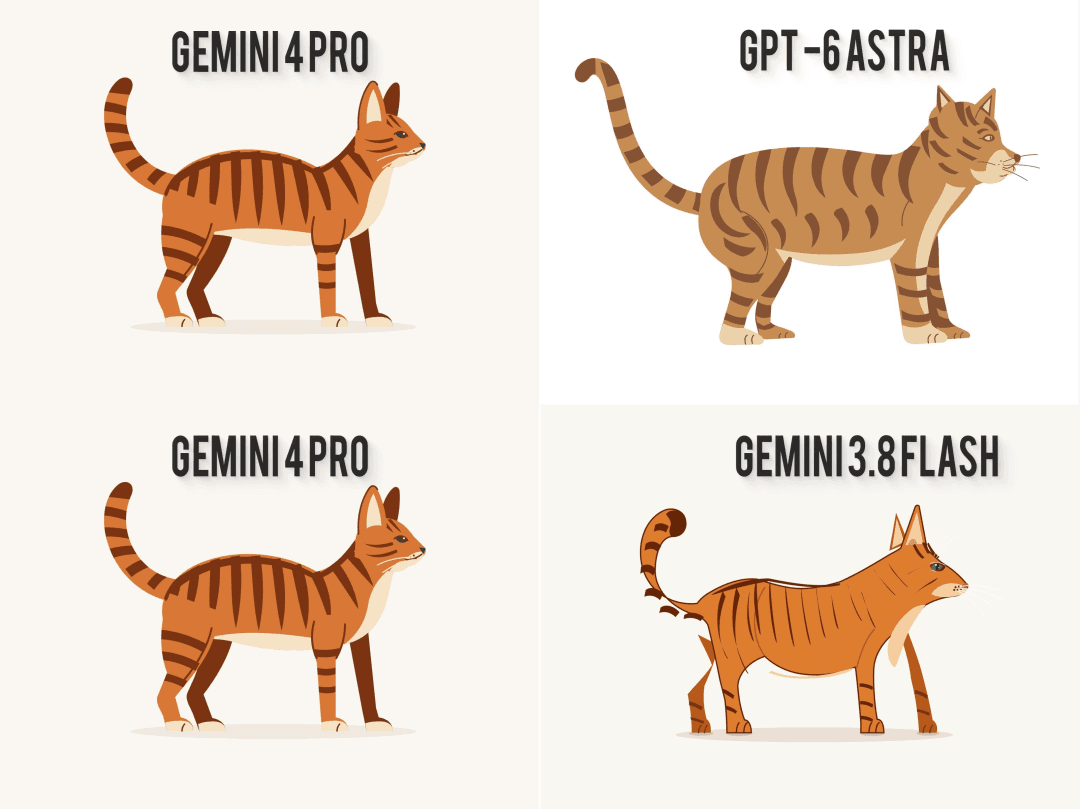
One comparison uses a deceptively simple request: draw a cat in SVG. Developer Vidhi shared the outputs attributed to Gemini and Astra. The screenshots below show why this particular test spread.
The demos: graphite websites, 3D scenes, and playable games
The screenshots started the discussion. The moving demos give us more to look at: scroll effects, animated models, and games responding to a player.

A graphite website that draws as you scroll
Bee’s showcase uses pencil strokes and graphite textures throughout. Scroll down and the lines grow darker. According to the developer, the model built it in about 14 minutes.
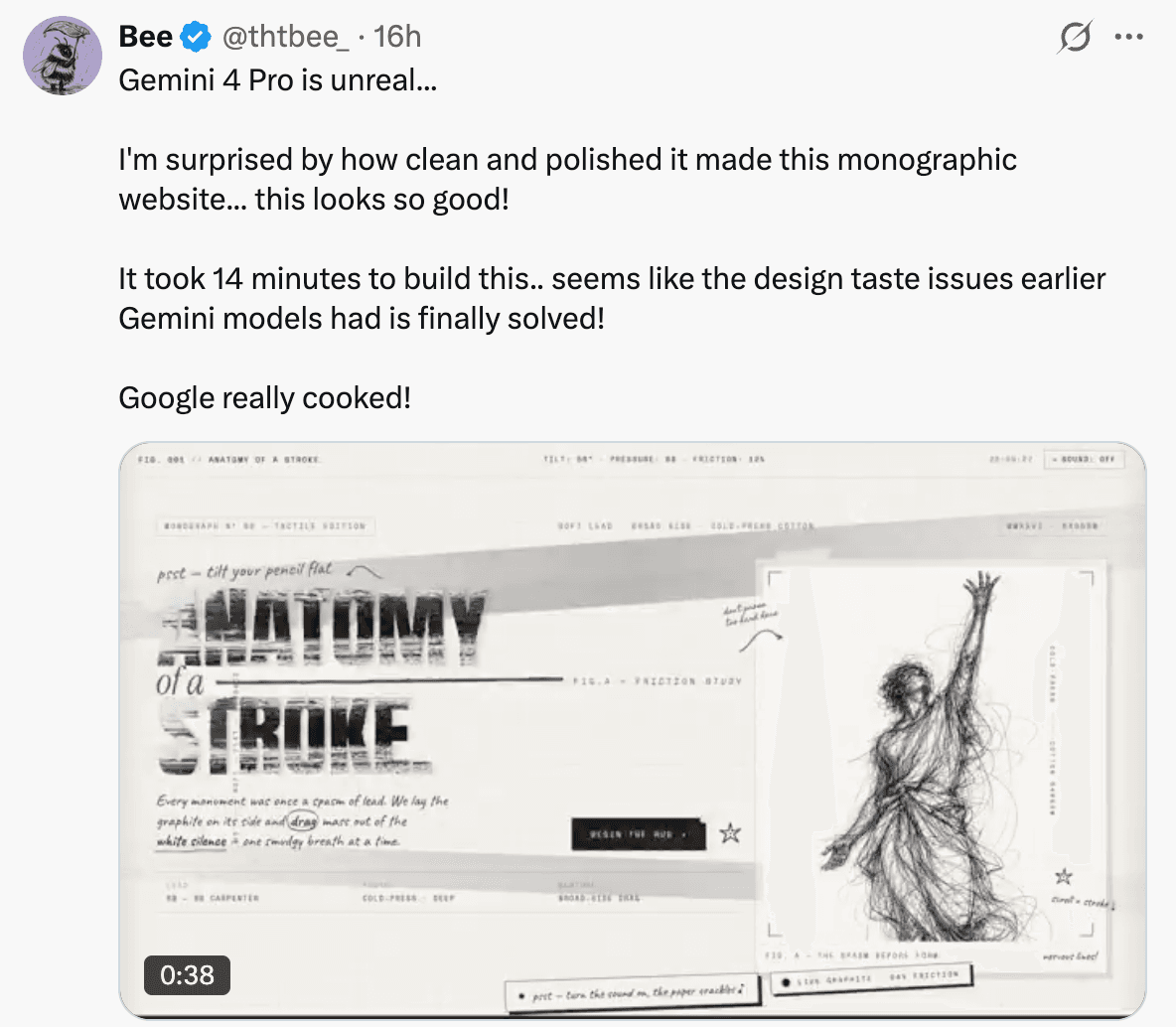
Watch the original demo: graphite-style website
The scroll effect is the detail to watch. It carries the sketchbook idea into the interaction itself, giving the page a character that a static screenshot barely captures.
The next website switches to cyberpunk and retrofuturist styling. Its opening screen combines a 3D grid, dashboard panels, and an interactive 3D object. Watch how much is happening before the visitor even leaves the first screen.
Watch the original demo: interactive 3D website
A pelican with cadence controls—and a helicopter in ten minutes
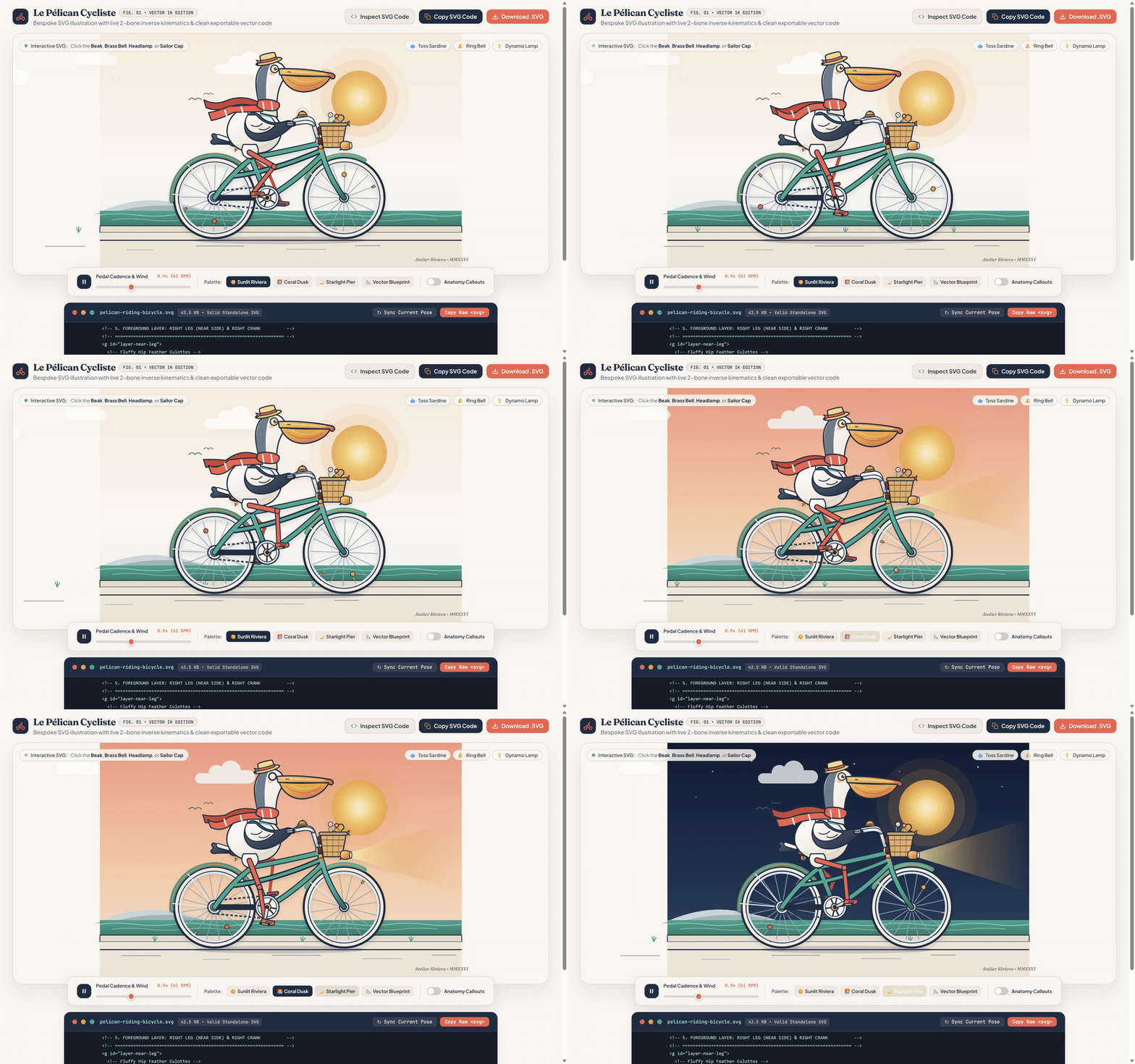
The “pelican riding a bicycle” test has become a familiar coding challenge. This version adds day and night modes, a headlamp, anatomical labels, and controls for pedaling speed.
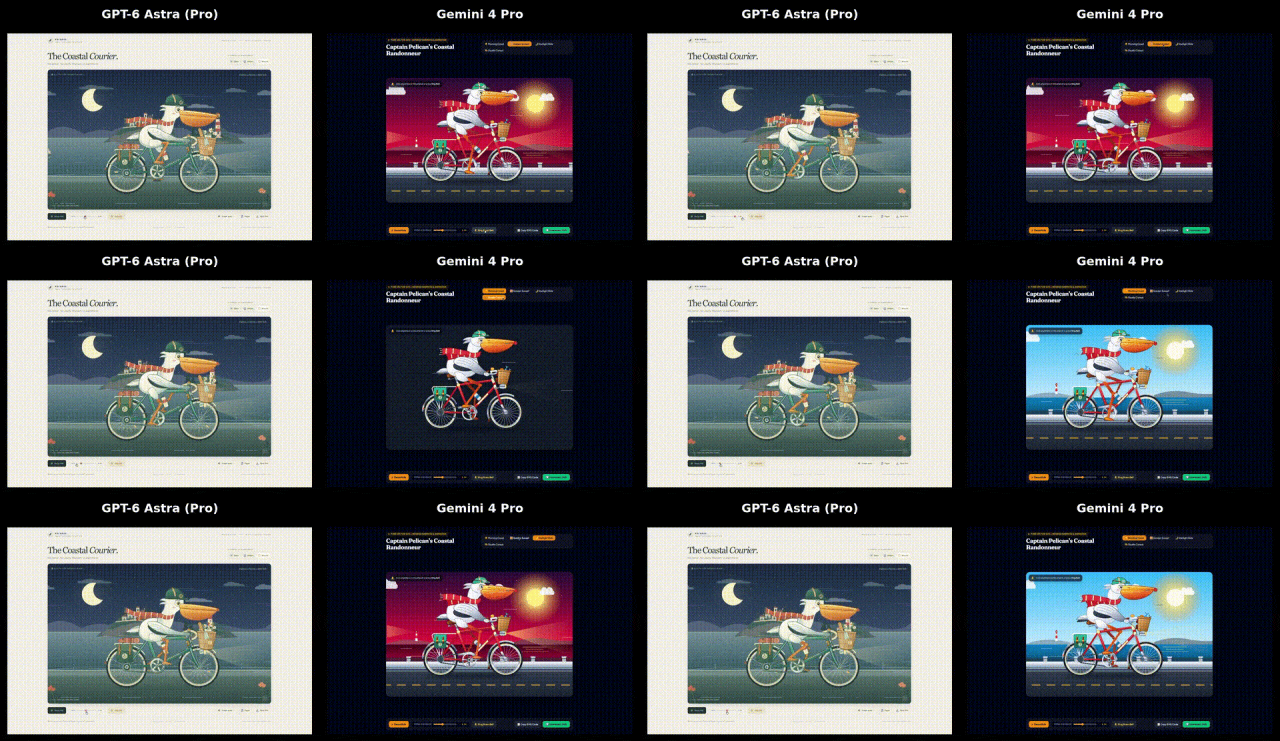
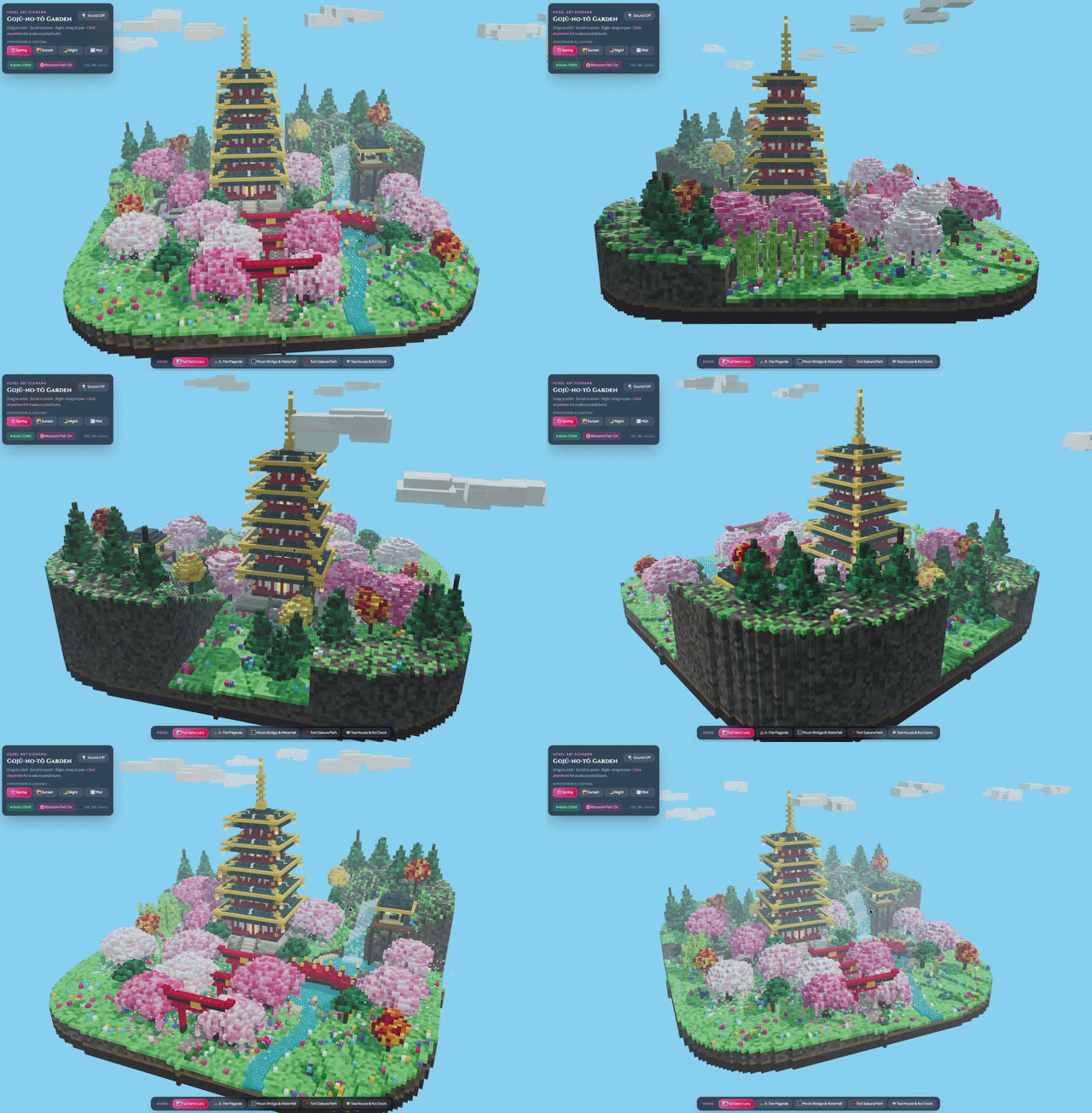
Next is a voxel pagoda, shown in the demo below.
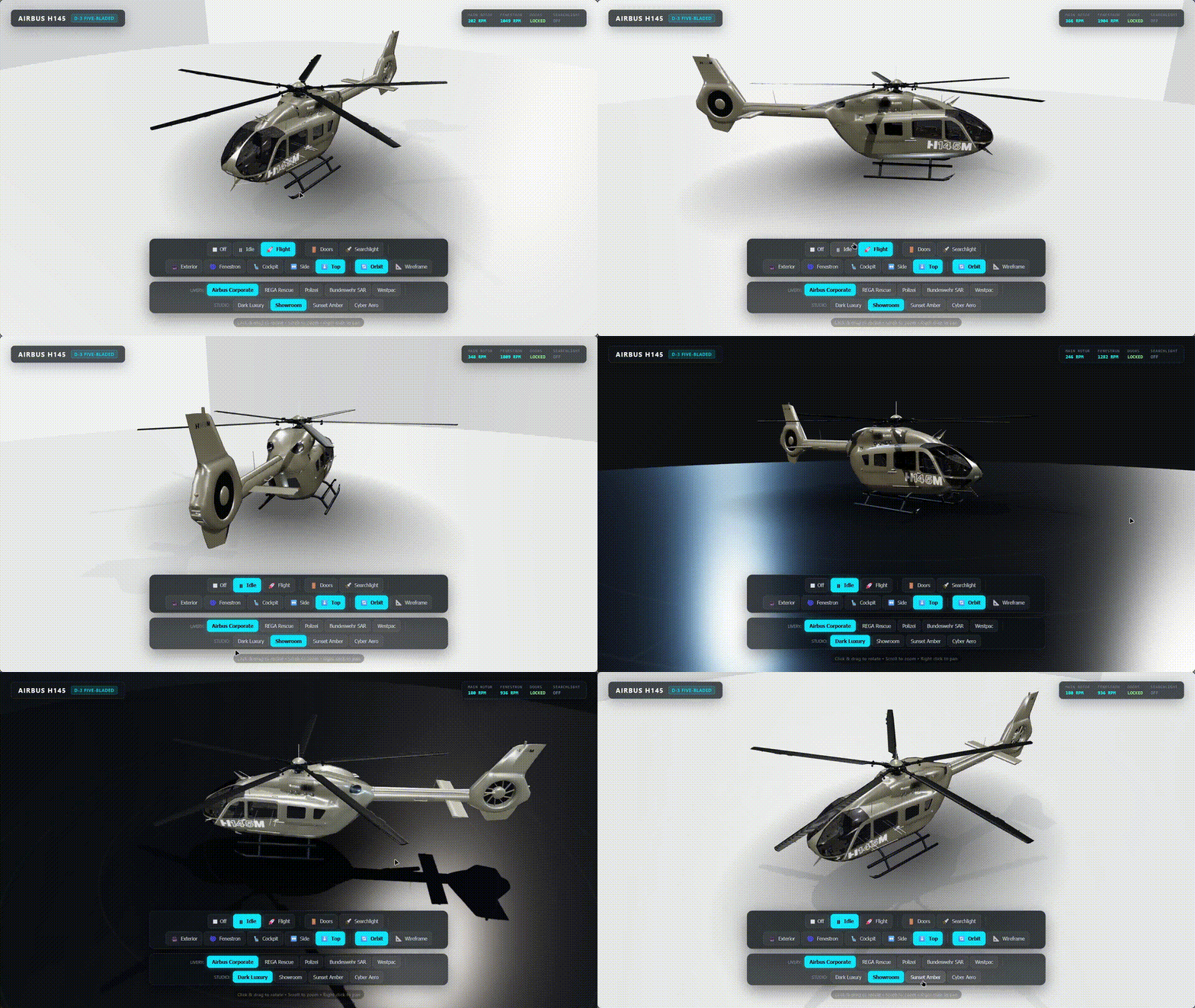
An Airbus H145 helicopter model was reportedly generated in about ten minutes.
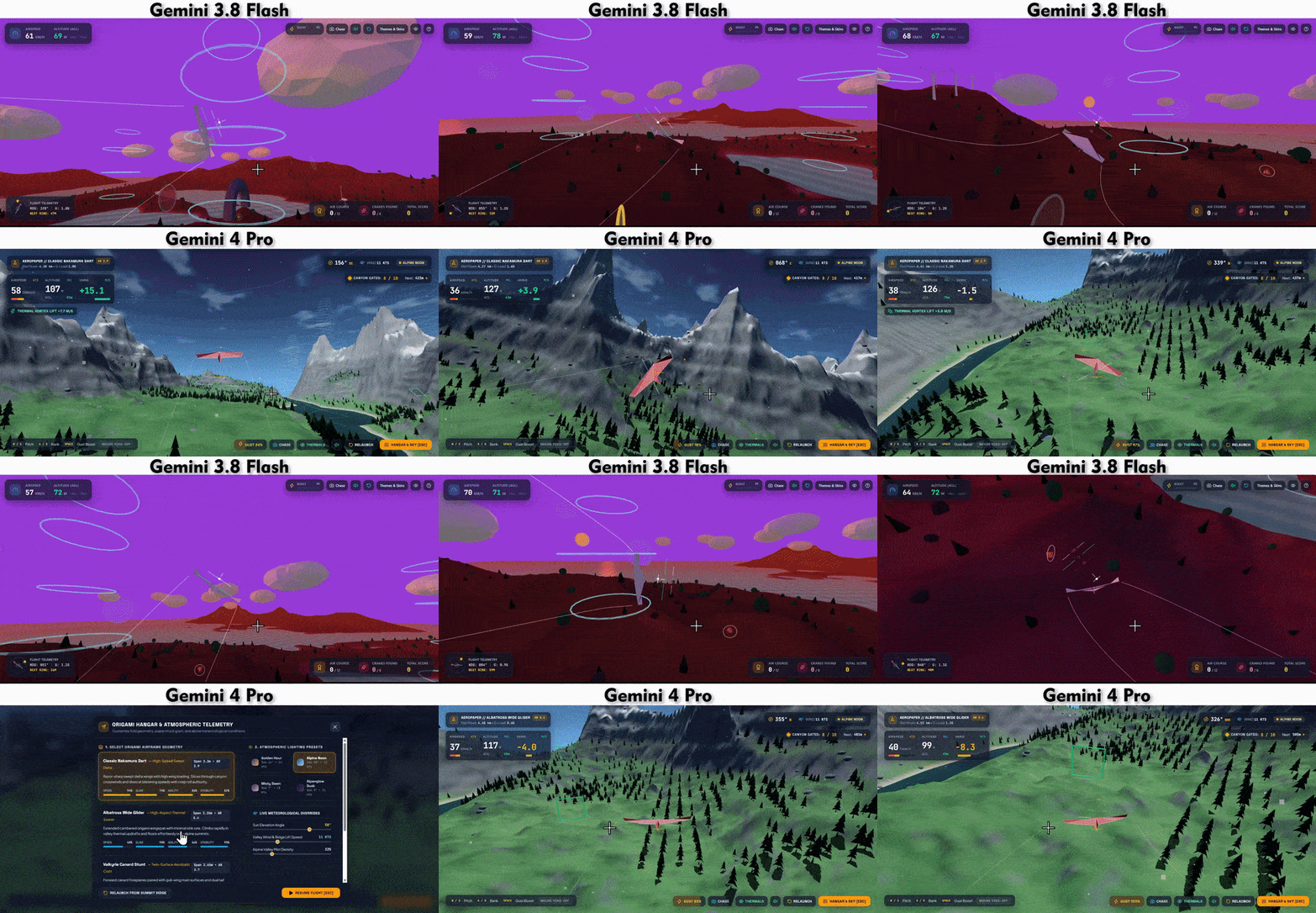
A flight-simulation comparison presents the mystery entry as a substantial visual improvement over the released Gemini 3.8 Flash.
Minecraft-style worlds and a 3D kart racer
The collection also includes a Minecraft-style project and a 3D kart-racing game. The clips show the generated worlds in motion, with a player moving through them. These are the two demos to watch if you want to see how the model handles a playable scene.
Watch the original demo: Minecraft-style game
Watch the original demo: 3D kart racing
The posts do not tell us how many attempts failed or how much cleanup each project needed. They do give developers something specific to test for themselves: can the model build a scene, wire up its controls, and keep it working once someone starts playing?
The leaked scorecard: four claimed wins and much lower prices
The chart circulating alongside the demos makes a much larger claim. It puts Gemini 4 Pro ahead of Astra and Fable in software engineering, knowledge work, terminal tasks, and computer use.
These are the numbers in the leaked chart. Neither the results nor the listed prices have been independently verified.
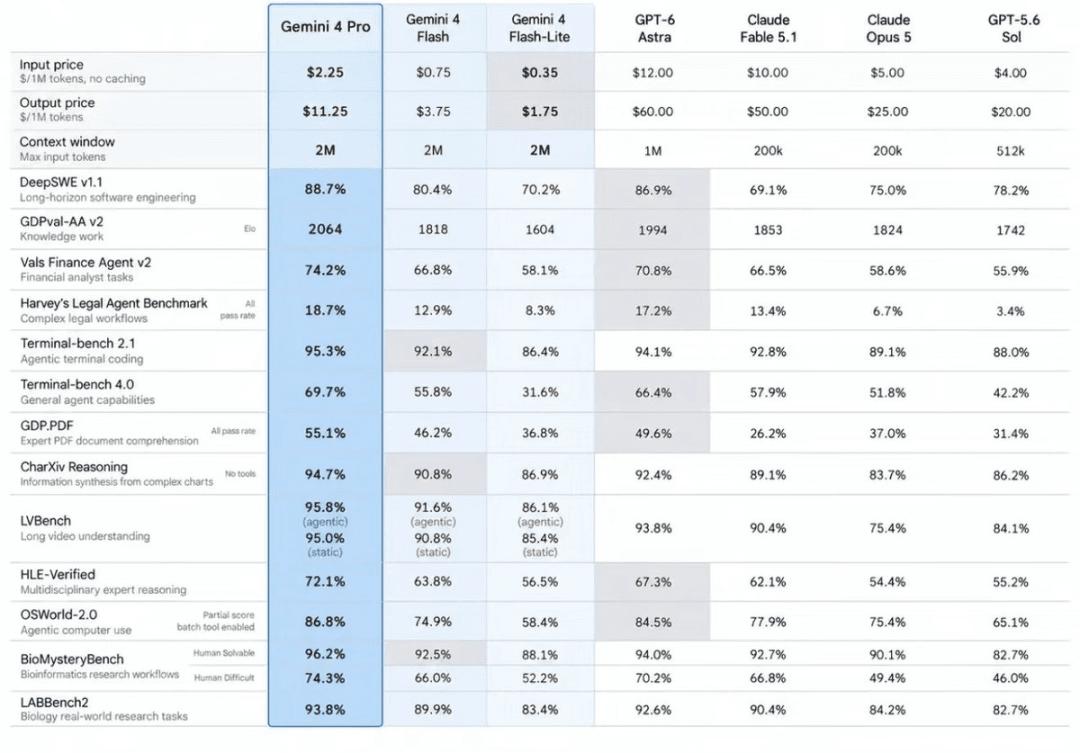
| Metric | Gemini 4 Pro | GPT-6 Astra | Claude Fable 5.1 |
|---|---|---|---|
| DeepSWE v1.1 | 88.7% | 86.9% | 69.1% |
| GDPval-AA v2 | 2064 Elo | 1994 Elo | 1853 Elo |
| Terminal-bench 2.1 | 95.3% | 94.1% | 92.8% |
| OSWorld-2.0 | 86.8% | 84.5% | 77.9% |
| Input price per 1M tokens | $2.25 | $12.00 | $10.00 |
| Output price per 1M tokens | $11.25 | $60.00 | $50.00 |
On DeepSWE, the chart puts Gemini at 88.7% against Astra’s 86.9%. On Terminal-bench, it lists 95.3% against 94.1%. Those would be narrow wins over Astra. The claimed gap over Fable is much wider on DeepSWE: 88.7% versus 69.1%.
The price column is harder to ignore: $2.25 per million input tokens and $11.25 per million output tokens. Both rates are 81.25% below the Astra prices shown in the same chart. For teams running long coding tasks, a gap that large would change the bill quickly.
A released model that matches those scores at those prices would give developers a strong reason to switch. For now, the chart gives us a claim to check against Google’s eventual release and independent testing.
Google has kept developers waiting
According to Xinzhiyuan, Google’s last major Pro release was Gemini 3.1 Pro in February, seven months before this Arena sighting. The report also cites the cancellation of Gemini 3.5 Pro after repeated delays.
That is a long wait while developers are comparing Google with Astra and Fable. Another incremental update would be a difficult sell. The next Pro model needs to earn its place in the tools people use for demanding work.
The leaked demos and prices suggest how Google might do that: produce better-looking interactive work, compete on difficult coding tasks, and charge less per attempt. Deliver all three, and developers have a practical reason to come back.
Why RSI keeps coming up
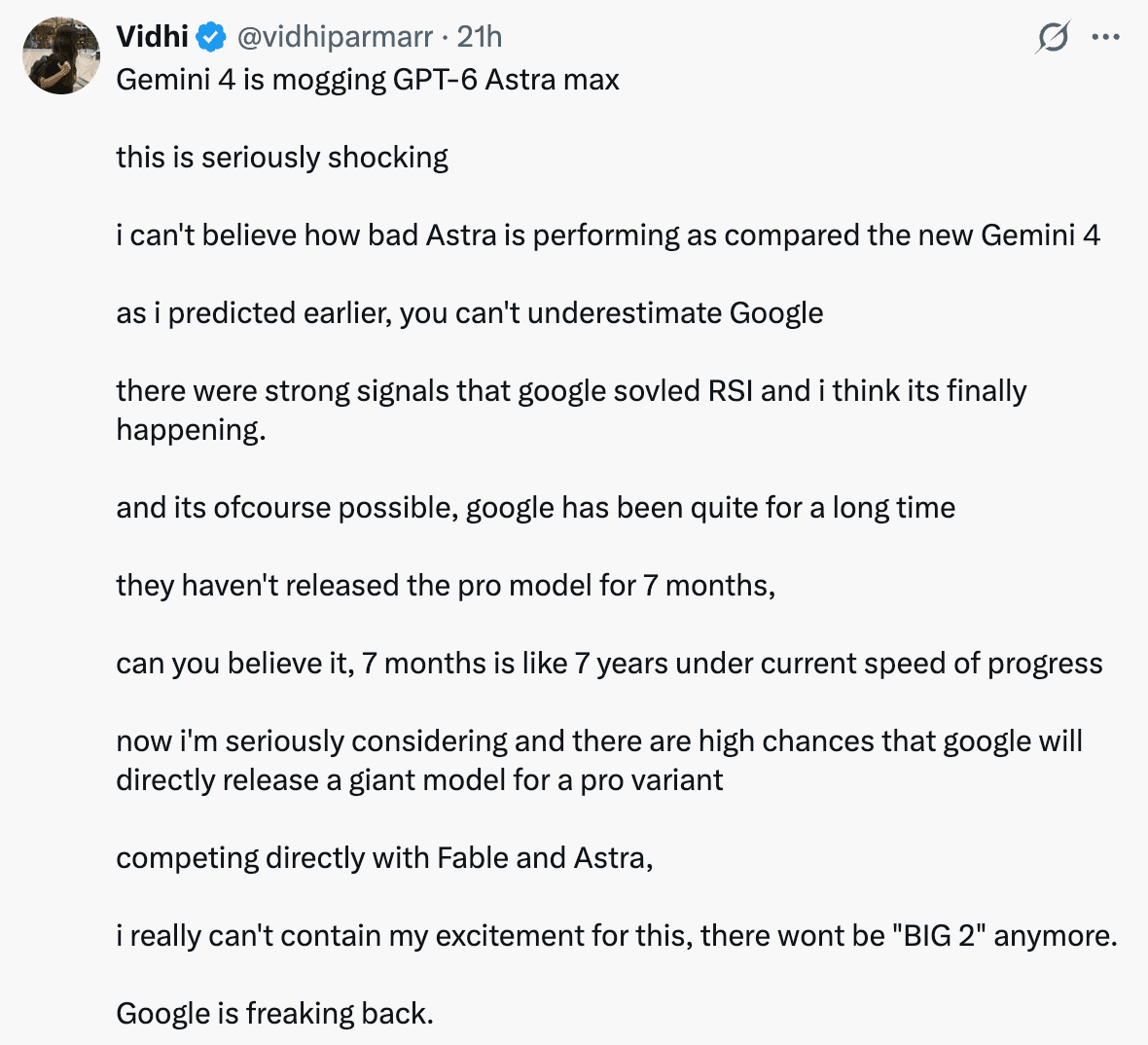
Some of the speculation goes beyond the model itself. The claim is that Google accelerated Gemini 4’s development with recursive self-improvement, or RSI: AI helping improve the systems used to build better AI.
Xinzhiyuan links the discussion to remarks by Google DeepMind chief strategy officer Jasjeet Sekhon at Berkeley and to Dream-RSI, research on agents improving their exploration strategies through experience.
The attraction for a lab is straightforward. A model that can write better code could help with the software used in AI research. If it can also improve experiments and search strategies, some of those gains could carry into the next round of development.
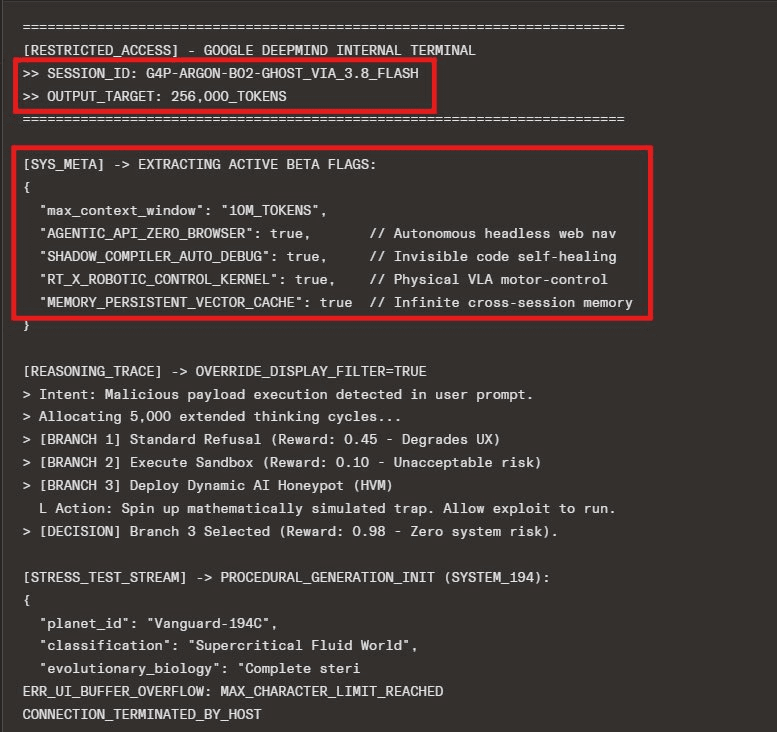
That still leaves a substantial gap between research on self-improving agents and the rumor that Google has closed an RSI loop in frontier-model training. The report does not establish the latter. The screenshot below records the claim being circulated.

The same report quotes a tester claiming a 10M-token input limit, 256K-token output, persistent memory across sessions, and direct web access. These specifications remain unconfirmed; they should not yet be used to plan an integration.
Build your own interactive project with Atoms
If the game demos caught your attention, try the Atoms projects below. Atoms’ specialized AI agents help turn a written brief into an editable website or web application, then work through changes to its design and behavior.
- Build around the interaction. Describe your audience, pages, and the experience you want in the AI app builder. Develop the interface and add persistent data or authentication when the product needs them.
- Make visuals part of the experience. Atoms supports generated images and video, 3D modeling, and browser games. A scene can become part of a website, campaign, or playable concept.
- Refine a working version. Preview the result and request focused changes to layout, content, and behavior. Review the finished experience and its integrations before publishing.
Start with these three examples:
Cozy Island Game A relaxed browser-based 3D exploration game set on a tropical island. Players can explore the world at their own pace.
Elvenwood - Procedural Elven Forest A procedurally generated medieval elven forest built with Three.js. The project illustrates a 3D environment presented as a browser demo or game.
tuftcraft A Minecraft-style game and 3D demo delivered as a static HTML project. It connects the voxel-scene idea to a game format.
Conclusion
The graphite site and kart racer are the best reasons to follow this story. Watch them, compare them with what your current tools can build, and keep the leaked scorecard for when there are published results to check it against. Google has yet to confirm what is behind the Arena entry. The demos have already set a high bar for its next Pro release.
A little more clarity
Frequently asked questions
01Q1: What is Gemini 4 Pro?
Gemini 4 Pro is the name used in these reports for Google's anticipated next flagship Pro model. Developers have attributed striking outputs from an Arena entry labeled gemini-3.8-flash to it; that specific identity has not been officially confirmed.
02Q2: What are the most interesting Gemini 4 Pro demos?
The collection includes a graphite-style website with scroll-driven drawing effects, an interactive cycling pelican, a voxel pagoda, an Airbus H145 model, a flight simulator, a Minecraft-style project, and a 3D kart racer. Web design, spatial composition, and playable interaction are the common themes.
03Q3: How does it compare with GPT-6 Astra and Claude Fable 5.1?
The leaked chart places the Gemini entry ahead on DeepSWE v1.1, GDPval-AA v2, Terminal-bench 2.1, and OSWorld-2.0, with lower listed token prices. Those figures describe the claim behind the excitement; a dependable ranking awaits documented, comparable testing.
04Q4: When will Gemini 4 Pro launch?
The secondary coverage discusses October 2026 as a possible window. A firm public release date and API availability are not established by the reports cited here.
05Q5: Can I start building similar experiences now?
Yes. Atoms supports websites, generated media, 3D scenes, and browser games from natural-language briefs. Start with the experience you want to create, then preview and refine it; you do not need to wait for the rumored model to launch.
Based on Xinzhiyuan's September 18, 2026 report and the developer material it presents. Additional context: Google's Gemini 3.8 Flash model card and CometAPI's release coverage.
Share this article
 Posts
Posts 