On this page
Gemini 4 is real as a Google research program, but it is not a publicly released model. Google says it has started its "most ambitious pre-training run yet" for Gemini 4. Google has not published a release date, API model ID, price, context window, model card, or public Gemini 4 benchmark results as of September 5, 2026.
Status: Pre-training confirmed by Google. Public release, API access, pricing, and Atoms availability are not confirmed.
This guide separates what Google has said from what one circulating forecast graphic predicts. It also turns the speculation into a practical question: if Gemini 4 eventually ships, which industry workflows should teams test first, and how should they measure the result?
Build a testable AI app with an available model in Atoms, or explore the current model catalog. A Gemini 4 page or mention does not mean the model is currently selectable in Atoms.
Gemini 4 status: what Google confirmed
Google named Gemini 4 in two first-party updates. Its July 2026 Gemini model announcement says the company had started its most ambitious pre-training run yet for Gemini 4. Sundar Pichai repeated the statement in Alphabet's Q2 2026 earnings remarks.
That confirms the program and its pre-training status. It does not confirm a finished model, a launch date, a product lineup, or public access.
| Question | Verified status on September 5, 2026 |
|---|---|
| Does Google identify Gemini 4 by name? | Yes |
| Has pre-training started? | Yes, according to Google |
| Has Google publicly released Gemini 4? | No public release found |
| Is there a public API model ID? | Not announced |
| Has Google published Gemini 4 pricing? | Not announced |
| Is the context window known? | Not announced |
| Is there an official model card? | Not found |
| Are there official public benchmark results? | Not found |
| Is Gemini 4 available in Atoms? | Not verified; check the live selector |
These distinctions matter. A named training run, an API listing, a product-picker entry, and an independently tested model are four different pieces of evidence.
What an unverified prediction chart gets wrong
One circulating comparison graphic labels its entire Gemini 4 column "PREDICTED." It forecasts scores across scientific workflows, business automation, research mathematics, terminal tasks, clinical work, 3D modeling, and interactive reasoning puzzles.
The chart is reproduced below at the reader’s request with a permanent warning embedded above the original graphic. It remains an unverified forecast, not evidence that Gemini 4 or any other model achieved the displayed scores.
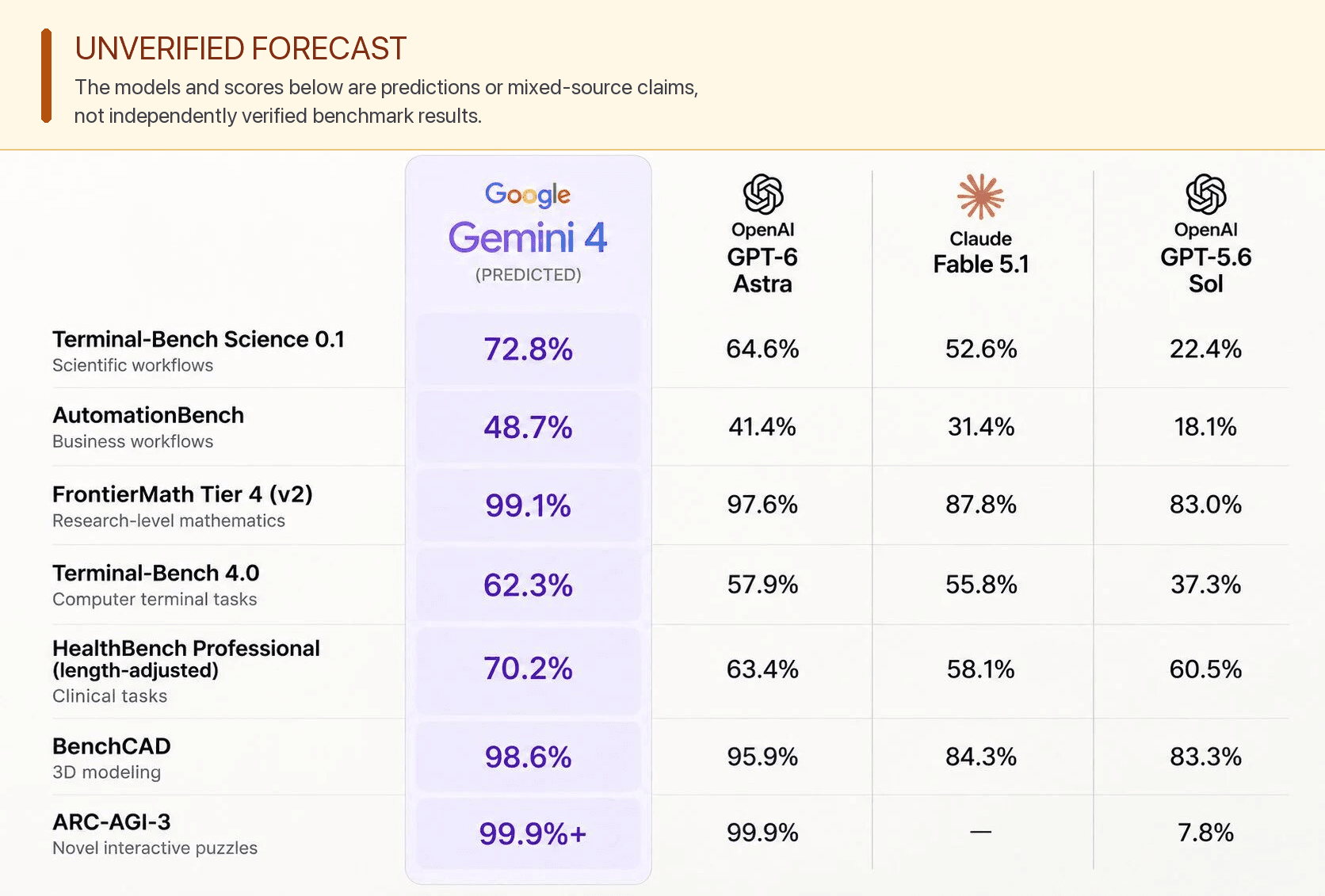
User-supplied comparison graphic, reproduced with an embedded warning. Gemini 4 is unreleased, its column is explicitly predicted, and the remaining cells have not been normalized to one independently verified benchmark setup.
The image identifies no source, publication date, model snapshot, system prompt, tool setup, sample size, evaluator, retry policy, confidence interval, or reproducible harness. Its other model cells also combine results that require benchmark-specific version and harness checks. For example, an ARC-AGI score can change materially between a standard harness and a provider adapter; those values cannot be collapsed into one universal leaderboard.
A percentage without a method can hide very different measurements: exact-answer accuracy, task completion, partial credit, a human grade, or an adjusted composite. Even when two systems are tested on a real benchmark, a ranking may change with the agent harness, available tools, reasoning budget, time limit, or number of retries.
The responsible use of such a chart is to extract test hypotheses, then verify them with the official benchmark owner and a repeatable setup. It is not proof that Gemini 4 leads any model.
What Gemini 4 may be good for
Google has not published enough Gemini 4 documentation to assign it verified task strengths. The forecast chart does, however, suggest seven useful evaluation tracks. Each track maps to real industry work that a stronger model could help with if the model, tools, and surrounding system perform reliably.
| Evaluation track | Industry terms | Useful tasks to test |
|---|---|---|
| Software engineering | SaaS, developer tools, product engineering, internal tools | Repository exploration, cross-file bug repair, test writing, API integration, feature implementation |
| Business automation | sales operations, marketing operations, customer support, HR, finance operations | CRM updates, inbox triage, reporting workflows, approval routing, structured data entry |
| Scientific research | life sciences, engineering research, computational science, R&D | Literature synthesis, experiment planning, data pipeline setup, code execution, report generation |
| Healthcare knowledge work | clinical operations, medical research, health education | Evidence retrieval, document summarization, workflow support, structured note review |
| 3D and design | CAD, industrial design, architecture, product visualization | Parametric modeling instructions, design iteration, scene planning, validation checklists |
| Data and finance | business intelligence, financial analysis, risk operations | Dashboard generation, statement analysis, anomaly review, research summaries |
| Multimodal production | agencies, ecommerce, education, media, real estate | Screenshot-to-interface briefs, document extraction, catalog pages, visual QA, interactive explainers |
These are evaluation candidates, not confirmed Gemini 4 capabilities. High-risk work still requires qualified review. A model should not make an unsupervised clinical, legal, financial, or safety-critical decision merely because it performs well on a related benchmark.
Gemini 4 for software engineering and coding agents
Coding will probably be one of the first areas developers test because it produces inspectable artifacts: a patch, an application, a test suite, or a deployment. But first-pass code generation is a weak measure on its own.
A useful coding evaluation should ask:
- Did the implementation satisfy the written acceptance criteria?
- Did the tests pass without weakening the test suite?
- How many retries and tool calls were required?
- Did the model make unrelated edits?
- Could it recover from a failing command or incomplete dependency?
- How much human correction remained before merge?
- What was the total cost and elapsed time per accepted result?
Good test jobs include building a SaaS dashboard, creating an admin panel, implementing authentication, debugging a multi-file project, converting a product brief into a web app, and explaining an unfamiliar repository before editing it.
Atoms is relevant at the workflow layer. Its AI Coding Assistant and AI App Builder turn a concrete brief into something that can be reviewed and iterated. Use a model currently available in the product. Do not label the result a Gemini 4 run unless the exact Gemini 4 runtime appears in the live selector.
Gemini 4 for business workflow automation
Automation benchmarks try to measure whether an agent can leave a simulated business environment in the correct state. That is closer to operational work than a trivia test, but it still does not guarantee production reliability.
Useful industry tests include:
- Marketing and agencies: turn a campaign brief into a responsive landing page, produce a launch microsite, or iterate on a page design.
- Ecommerce and retail: create a product catalog interface, comparison page, promotional storefront, or product-detail prototype.
- Professional services: build a lead-generation site, consultation intake flow, service comparison page, or property-listing interface.
- Education: create a course page, interactive quiz, student dashboard, or learning-resource hub.
- Operations: build an internal dashboard, reporting interface, knowledge portal, or approval-flow prototype.
A working interface is not the same as a completed business integration. Payments, inventory, CRM writes, identity, and compliance controls must be connected and tested separately.
Gemini 4 for scientific and research workflows
The scientific-workflow prediction is interesting because research agents need more than fluent answers. They must manage files, run tools, interpret failures, preserve provenance, and produce a result another person can inspect.
A serious evaluation should use expert-reviewed tasks and report the exact environment. It should distinguish literature synthesis from original discovery, and generated hypotheses from validated findings. Teams should also track citation accuracy, data leakage, unsupported claims, and whether the model changes its conclusion when a tool fails.
A practical prototype might be a research dashboard, an interactive report, a document-analysis workspace, or a structured evidence map. Atoms can help turn that interface brief into a working web experience with an available model, but subject-matter validation remains a human responsibility.
Gemini 4 for healthcare knowledge work
The forecast chart includes a clinical-task benchmark. That does not establish that Gemini 4 is safe for diagnosis, treatment, or autonomous care. Clinical benchmarks can measure narrow knowledge tasks under conditions that differ sharply from real patient work.
Safer product experiments include clinician-reviewed evidence retrieval, health-education interfaces, document organization, structured intake prototypes, and administrative workflow support. Every claim, recommendation, and escalation path should be reviewed by qualified professionals, with privacy and regulatory requirements designed into the system rather than added later.
Gemini 4 for 3D, CAD, and interactive experiences
A high forecast for 3D modeling would matter to architecture, industrial design, manufacturing, games, ecommerce visualization, and creative agencies. The practical test is not whether a model can describe a shape. It is whether it can produce or coordinate an editable artifact that satisfies dimensions, constraints, and review criteria.
Teams could test product configurators, 3D portfolio sites, interactive explainers, scene briefs, CAD operation plans, and design-review dashboards. Measure editability, constraint violations, tool-call correctness, and the number of manual fixes.
For web-facing prototypes, Atoms can help assemble the interface around an interactive experience. The underlying 3D generation or CAD operation still depends on the selected model and connected tools.
Why a multi-agent system matters more than one headline score
The prediction chart focuses on model scores. Real products also depend on how work is divided, checked, and repaired.
A strong multi-agent build process can assign different jobs to planning, research, design, implementation, testing, and review. The benefit is not that more agents automatically produce a better result. The benefit comes from explicit responsibilities and verification: one agent creates an artifact, another checks it against acceptance criteria, and the workflow returns failures for repair.
Atoms uses a multi-agent product-building workflow to move from an idea to a reviewable website or application. This is a better way to evaluate an AI capability than asking whether a model sounds impressive in chat. Start with a narrow brief, require visible output, test the important paths, and iterate until the result meets the acceptance criteria.
Build a website with Atoms if the task is customer-facing, or use the AI Coding Assistant for repository and implementation work.
A fair Gemini 4 test plan
If Gemini 4 becomes publicly accessible, use the same task design across the candidate models.
- Choose a small set of industry jobs. Include one coding task, one tool-driven workflow, and one domain task relevant to the team.
- Freeze the environment. Keep the prompt, repository, tools, evaluator, timeout, and retry budget constant.
- Run repeated trials. One successful demo is not a reliability estimate.
- Judge the finished artifact. Record acceptance-test results, invalid tool calls, regressions, human corrections, latency, token usage, and total cost.
- Publish the setup with the result. Name the exact model ID, date, settings, harness, tools, and missing data.
| Dimension | Better production metric |
|---|---|
| Coding | Accepted changes and test pass rate |
| Agents | Successful task completion and invalid tool calls |
| Research | Source accuracy and reproducible workflow completion |
| Multimodal work | Transformation quality on a fixed input set |
| Speed | Median and p95 completion time |
| Cost | Cost per accepted result, including retries |
| Reliability | Failure rate across repeated runs |
This plan can be prepared now with a model available in Atoms. If Gemini 4 later becomes selectable, reuse the same brief and evaluator for a controlled comparison.
Should you wait for Gemini 4?
No, not for most product work. Gemini 4 does not yet have public access details, and a future model will not remove the need for a good brief, working integrations, tests, and human review.
Use current models to validate the workflow today. Build the smallest useful page or application, learn where the process fails, and keep the acceptance test. When Gemini 4 launches, the team will have a real task to compare instead of a speculative leaderboard.
Start with the AI App Builder, build a customer-facing website, or compare currently listed models.
Sources and update trigger
- Google: Gemini 3.6 Flash, 3.5 Flash-Lite, and 3.5 Flash Cyber
- Google: Alphabet Q2 2026 earnings remarks
- Google AI for Developers: Gemini models
- Google DeepMind: Gemini
- AutomationBench repository
- Terminal-Bench
Research cutoff: September 5, 2026, Asia/Shanghai time.
This page should be updated when Google publishes a Gemini 4 release note, API model ID, pricing, model card, official benchmark results, or public access. Atoms availability must be checked separately against the live model selector.
Share this article
 Posts
Posts 