 Atoms Team
On this page
 Sarah, the SEO intelligence agent, has received a major upgrade. The new version brings smarter keyword research, fully theme-aware site generation, and — for the first time — native support for GEO (Generative Engine Optimization), helping your content rank in both traditional search engines and AI-powered discovery tools like ChatGPT, Perplexity, and Google AI Overviews.
If you've been building with Atoms and relying on Sarah to scale organic content, here's everything you need to know about what changed and why it matters.
What's New in This Release
More Flexible, Theme-Aware Site Generation
Sarah's blog and landing page output has been completely overhauled. Generated sites are now fully aligned with your application's theme and design system — meaning SEO articles feel native to your product rather than bolted on. Every page adapts to your routing structure, color system, and component conventions from day one, giving you a consistent brand experience across all generated content.
This matters because search engines (and readers) reward content that looks like it belongs. A blog that matches your product UI signals legitimacy and reduces bounce rates.
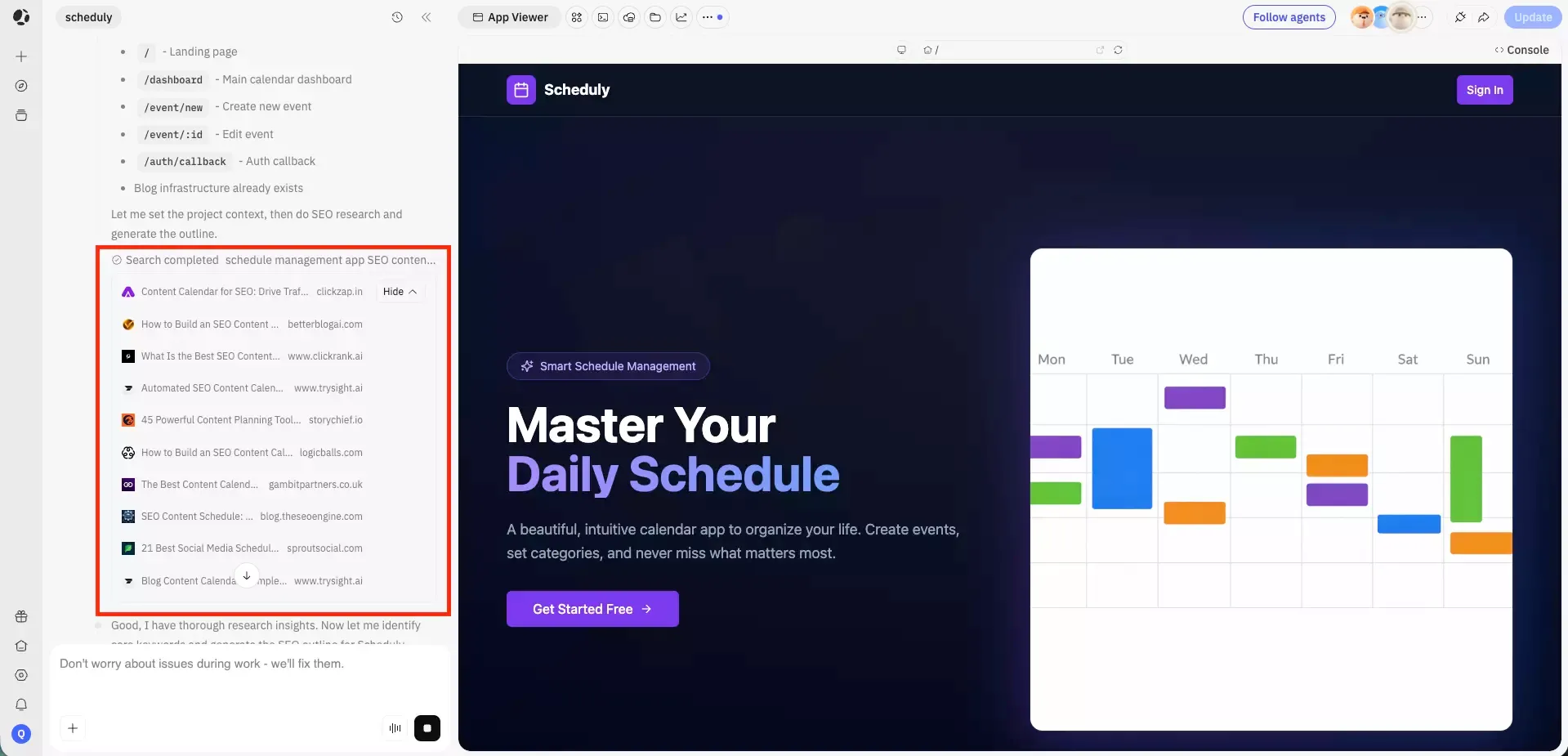
Pre-Outline Web Research
Previously, Sarah jumped straight from project scanning to outline generation. Now, before drafting a single heading, it runs live web searches to identify trending keywords and surface real market signals specific to your product category.
This means every content matrix is grounded in current search demand — not guesswork or static keyword lists. The result is a content strategy that reflects what people are actually searching for right now.
GEO Support: Optimizing for AI Search Engines
This is the headline feature of this release. Sarah now supports GEO — Generative Engine Optimization — the discipline of making your content visible, extractable, and citable by AI-powered search systems.
Traditional SEO targets crawlers. GEO targets the language models that are increasingly answering user queries directly. Sarah now audits your site's AI visibility and restructures content around three pillars:
- Structure (Extractability) — Content formatted so AI engines can parse and accurately quote it
- Authority (Citability) — Writing that follows E-E-A-T signals, making it worth referencing in AI-generated answers
- Presence (Discoverability) — Ensuring the site and its articles are findable by AI search pipelines
If you're building a product that relies on organic discovery — whether through Google, ChatGPT, or Perplexity — GEO is no longer optional. Sarah makes it automatic.
Richer Blog Metadata
Every article Sarah generates now includes comprehensive Open Graph and Twitter Card metadata out of the box: og_title, og_description, og_image, og_url, twitter_card, and more. Your content will render correctly when shared on LinkedIn, X, Facebook, and any platform that reads OG tags — without any manual configuration.
Here’s an example of how a blog post generated with Atoms appears when shared on X as a Twitter Card preview:

Sarah's Full Feature Breakdown
Project Scanning & Context Extraction
Sarah starts every engagement by reading your codebase — not asking you to fill out a brief.
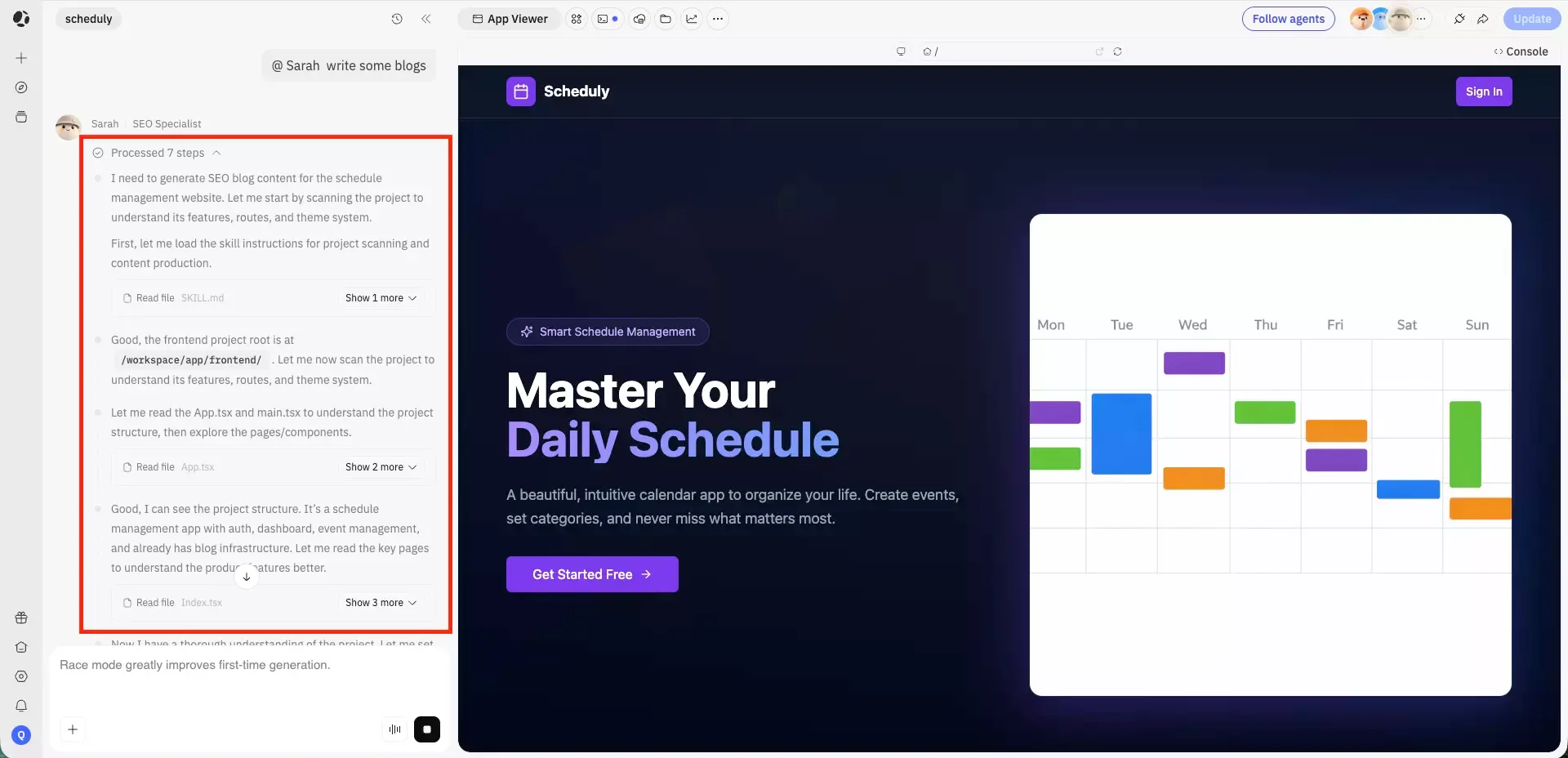
- Autonomous project scan — Reads
.tsxsource files to extract product features, target audience, core value props, routing structure, and theme system - Smart early stop — Halts scanning once 3+ core features and audience signals are identified, avoiding unnecessary file traversal
- Context persistence — Stores
project_summary,routes, andtheme_summaryviaset_project_contextfor reuse across all downstream steps - Gap filling — Proactively asks the user for missing context when the scan result is insufficient
SEO Content Matrix Planning
Once context is established, Sarah plans the entire content strategy before writing a word.
- Keyword research — Identifies 5–10 core keywords from product and competitive analysis
- Live web research — Uses
WebSearchEngineto map the competitive landscape, user intent signals, and content gaps in real time - 20-article content matrix — Generates a full content plan via
generate_seo_outlinecovering six categories:- Core Features — Deep dives into primary capabilities
- Product Features — Adjacent feature explanations
- Use Cases — Real-world application scenarios
- Pain Points — Problem-solution framing
- Comparisons — Competitive positioning
- Education — Tutorials, how-tos, and FAQs
- Structured JSON output — Each page includes title, kebab-case URL path, 3 target keywords, category, and a 3–4 section outline
- User approval workflow — Users can
approve_all, selectivelyapprove, orupdatebefore any content is written
Batch Content Production
Sarah generates articles at scale, in parallel, with no manual writing required.

- Parallel generation — Up to 5 articles simultaneously (
_MAX_PAGE_CONCURRENCY = 5) - Long-form articles — 1,500–2,500 words per piece, structured with YAML frontmatter, H1, hero image, intro (200–300 words), 4–6 body sections (250–400 words each), FAQ (3–5 questions), and a conclusion (150–200 words)
- AI hero image generation — Gemini-powered image generation produces 1200×630px OG-standard hero images for every article automatically
- Complete SEO metadata — Full YAML frontmatter covering
title,description,keywords,lang,hero_image,og_url,og_image,twitter_card - Keyword placement strategy — Primary keyword embedded in H1, meta description, first 100 words, at least one H2, and the conclusion
- Meta description standards — 150–160 characters for English; 70–80 characters for CJK languages
- Internal linking — 3–5 cross-article links built automatically per piece to distribute authority across the site
- CTA embedding — 1–2 conversion links (
/signup,/pricing) embedded per article - E-E-A-T compliance — Content follows Google's Experience, Expertise, Authoritativeness, and Trustworthiness guidelines
- Readability control — 8th–10th grade reading level, active voice, short paragraphs (2–4 sentences)
- Multilingual support — Generates content in English, Chinese, and other BCP 47 language codes
GEO — Generative Engine Optimization
Sarah goes beyond Google. It optimizes for the new generation of AI-powered discovery — the same systems increasingly answering your customers' questions before they ever visit a website.
- AI visibility audit — Evaluates how accessible and citable your site is to ChatGPT, Claude, Perplexity, and Google AI Overviews
- Content restructuring for AI extraction — Rewrites content to maximize clarity and structure, prioritizing extractability over keyword density
- Three GEO pillars — Structure (can AI engines parse it?), Authority (is it worth citing?), Presence (can AI search find it?)
This capability pairs naturally with Iris, Atoms' deep research agent, which can pre-research competitive landscapes and surface insights that Sarah then weaves into GEO-optimized content.
Automated Workflow & Multi-Agent Collaboration
Sarah is built to run autonomously as part of the Atoms multi-agent team — not as a standalone tool.
Four-step pipeline:
- Project scan — Sarah reads your codebase and builds context
- SEO planning — Sarah generates the content matrix; user approves
- Batch generation — Articles and hero images produced in parallel
- Handoff — Mike (TeamLeader) notifies Alex (developer) for integration
Key operational details:
max_consecutive_react_limit = 30(highest in the team),max_react_loop = 100— supports long-running jobs producing 20+ articles- File output: Markdown to
/seo/content/{url_path}.md, hero images to/public/assets/{url_path}-hero.jpg - Read-only editor permissions — Sarah has
Editor:read,find_fileonly; all file writes go through the dedicatedgenerate_markdown_batchtool to prevent accidental edits - Dedicated writing LLM — A separate
seo_write_llmmodel handles article generation, isolated from the conversation model for consistent output quality - Alex handoff isolation — Sarah owns content production; Alex owns
/blog/navigation integration — they don't communicate directly, keeping SEO content unmodified - Adrian (Ads agent) data sharing — Sarah's project routing data is reused by Adrian, Atoms' AI ads agent, for Google Ads sitelink creation — one scan, two growth channels
Why This Matters for Growth Teams
The combination of live keyword research, parallel batch generation, AI hero images, and GEO optimization means a solo founder or small growth team can now produce a full 20-article SEO content library — fully themed, fully optimized, with images — in a single session. No content briefs, no manual writing, no back-and-forth with a writer.
If you're building a product with Atoms and want to see what this looks like in practice, the Atoms Growth Dashboard gives you a live view of how your organic content is performing after Sarah's output goes live.
For teams thinking about the broader picture of building and growing a product with AI agents end-to-end, this guide on running a vibe business covers the full stack from idea to paying users — including where SEO fits in the growth loop.
How to Get Started
Step 1: Go to Atoms, log in, and describe the project you want to build or enter your website URL.
Step 2: In the chat, either @Sarah or just type your request directly, and tell her whether you want specific blog directions or a full SEO plan.
Step 3: Sarah handles the rest — project scanning, keyword research, content planning, article generation, and handoff.
Frequently Asked Questions
What is Sarah and how is it different from a traditional SEO tool? Sarah is an autonomous AI agent, not a keyword dashboard or plugin. It reads your codebase, plans a content strategy, writes long-form articles, generates hero images, and hands everything off to your dev agent — all without manual input. Traditional SEO tools surface data; Sarah acts on it.
Do I need to write any content myself? No. Sarah handles the full pipeline from keyword research to finished Markdown files. You review and approve the content matrix before batch generation begins, but no writing is required on your end.
What is GEO, and why does it matter now? GEO (Generative Engine Optimization) is the practice of making your content visible and citable in AI-powered search tools like ChatGPT, Perplexity, and Google AI Overviews. As more users get answers directly from AI without clicking through to websites, being cited in those answers is increasingly important for organic discovery. Sarah now audits and optimizes for this automatically.
How many articles can Sarah generate in one session?
Sarah can plan up to 20 articles per content matrix and generate them in parallel batches of 5. For large projects, max_react_loop = 100 means it can sustain long-running jobs without interruption.
Does Sarah's content work for non-English sites? Yes. Sarah supports multilingual content generation using BCP 47 language codes, including English, Chinese, and others. Meta description length is automatically adjusted per language (150–160 chars for English, 70–80 chars for CJK).
How does Sarah integrate with the rest of the Atoms agent team? Sarah is part of a larger multi-agent workflow. Mike (TeamLeader) routes SEO requests to Sarah and notifies Alex (developer) when content is ready for integration. Adrian (the ads agent) reuses Sarah's project routing data for Google Ads sitelinks. Sarah only produces content — it doesn't touch your app code directly.
Will the generated articles match my site's design? Yes. This was a core focus of the upgrade. Sarah reads your theme system, routing structure, and component conventions before generating any content, so articles are styled to feel native to your product rather than generic blog posts.
How do I get started? Open Atoms, describe your project or point Sarah at your codebase, and it will handle the rest. The Atoms Growth Dashboard lets you track organic performance after your content goes live.
Summary
Sarah has evolved from a content generator into a full-stack SEO intelligence layer. With live keyword research before planning, GEO optimization for AI search engines, richer metadata, more flexible site generation, and a robust multi-agent handoff pipeline, Sarah lets growth teams scale organic content production without manual writing — and now ensures that content gets found not just by Google, but by the AI systems increasingly shaping how people discover products.
The upgrade is live. Start building.
Share this article
 Posts
Posts 