 Maya Chen
On this page
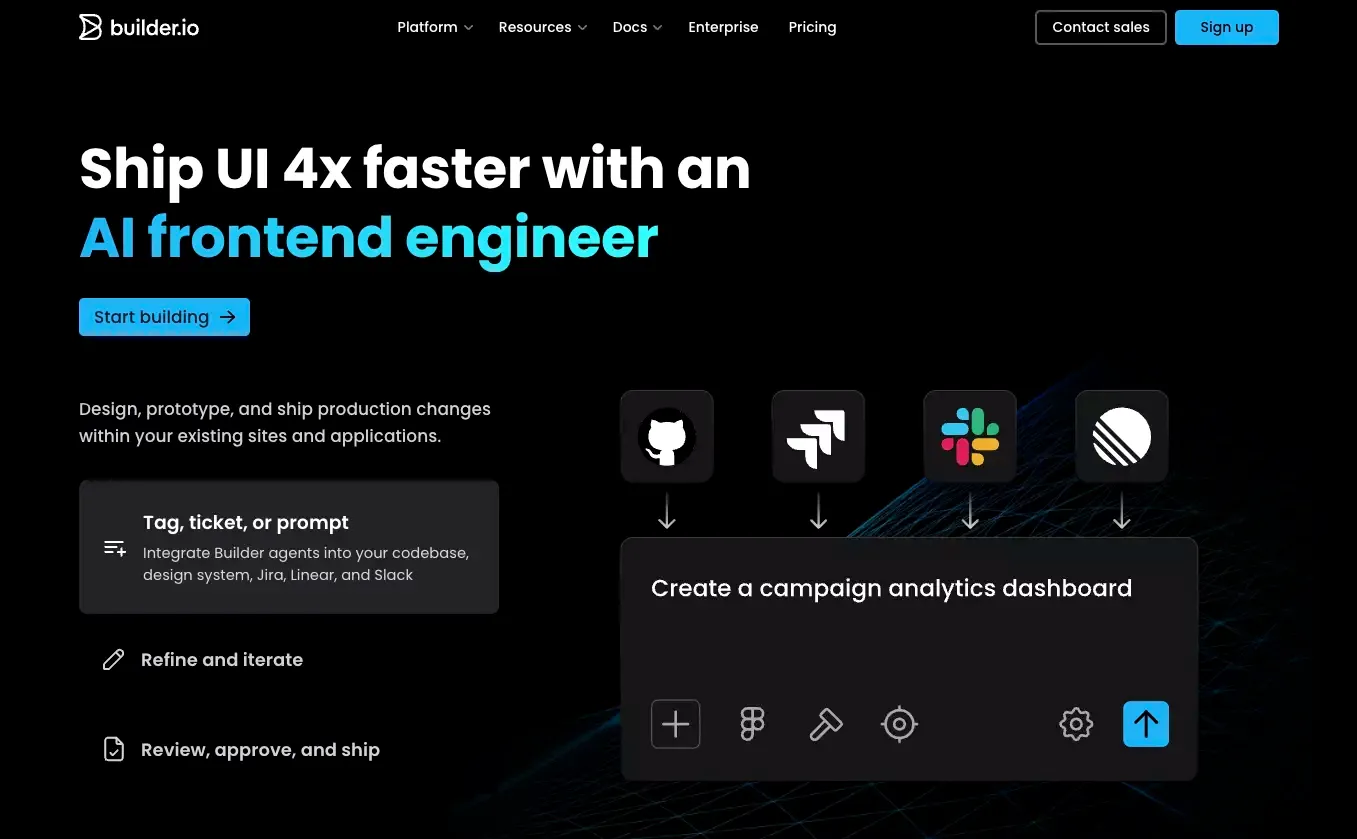 If you are searching for Builder alternatives, you are probably not confused about what Builder does. You are more likely at a decision point. Maybe you want a stronger visual workflow. Maybe you need better content modeling. Or maybe you want something that gets you from idea to live product with fewer moving parts.
Builder still sits in an interesting spot. It covers visual editing, headless CMS workflows, landing pages, marketing sites, and more flexible frontend setups. That is exactly why choosing an alternative is not as simple as picking another page builder. Different teams leave for very different reasons.
What I noticed when comparing the current market is this: most teams are not looking for a random substitute. They are looking for a better fit. Some want more design freedom. Some want stronger content architecture. Others want a broader workflow that includes building, launching, and iterating, not just editing pages.
This is my honest shortlist based on that lens.
Why Teams Start Looking for Builder Alternatives
Where Builder Still Works Well
It still makes sense for visual headless content workflows
Builder is still a strong option for teams that want a visual layer on top of a headless setup. That is still valuable. It helps bridge the gap between content teams and developers, which is often the hardest part of modern CMS work.
It covers more than simple landing pages
One thing I would not dismiss is range. Builder is not just a visual editing platform. It can fit into broader website and application workflows, especially if your team already thinks in components and frontend systems.
Why Alternatives Start Looking Better
The real question is not “better or worse”
The better question is: better for what?
That is where most comparison articles get lazy. They throw a list of tools at you, then stop. But the real choice usually comes down to one of these priorities:
- Better visual website production
- Better structured content operations
- Better developer control
- Better speed from idea to launch
Most teams hit one of three walls
In my view, teams usually move away from Builder for one of three reasons:
- They want a more polished design-first website workflow
- They need stronger content modeling and governance
- They want a bigger all-in-one workflow instead of a tool focused mainly on visual content editing
That is why the alternatives below are quite different from each other. They are not solving the exact same problem.
How I Judge a Good Builder Alternative
I care about four things most
1. Can non-technical users actually ship with it?
A tool can look impressive in a demo and still be frustrating in real use. If marketers, founders, or operators cannot make meaningful progress without developer help, that matters.
2. Does the content model stay clean as the business grows?
This is where many teams make the wrong call. A tool can feel fast in month one and messy in month six. Good structure becomes more important over time, not less.
3. How much control does the team keep?
Some teams are fine with a managed platform. Others want deeper ownership of the stack. Neither view is wrong, but the answer changes which tools make sense.
4. Does the tool help after the page is built?
This is an underrated point. Publishing a page is not the same thing as launching a product. Some tools are best at editing and publishing. Others are trying to cover research, build, deployment, and iteration in one flow, closer to coding agents than a standalone page editor.
The Best Builder Alternatives
1. Atoms
Best for teams that want to go from idea to live product fast
Atoms stands out because it is not just trying to replace a visual editor. It is trying to shorten the whole journey from idea to launch. That changes the comparison.
If your real frustration with Builder is that you still need too many other tools around it, Atoms is one of the most interesting alternatives. It feels more like an app and website builder than a pure CMS or page editing tool.
Why I would put Atoms first for some teams
If I were a founder, solo operator, or small team trying to move fast, I would look at Atoms early. It makes more sense than a CMS-first platform when the goal is not just managing content, but getting something real live without stitching together a fragmented stack. That is especially true if you care about an AI website builder workflow instead of only a visual editor.
That is the key difference. Atoms is strongest when speed, execution, and end-to-end workflow matter more than classic enterprise CMS structure.
Where I would be cautious
I would not choose Atoms first for a large content-heavy organization that mainly needs governance, localization, and complex editorial operations. In that case, a more CMS-centered platform may be the better choice.
2. Webflow
Best for polished marketing websites with strong visual control
Webflow is still one of the easiest recommendations for design-led teams. It gives you a strong visual building experience, a mature CMS, hosting, and solid SEO controls in one product.
That combination is hard to beat if the website itself is the main product surface, especially when the real goal is shipping polished pages faster, not building a full product launch page workflow from scratch.
Why I still rate it highly
What I like about Webflow is that it stays clear about its strengths. It is very good for marketing sites, SaaS landing pages, branded websites, and content-driven experiences that need polish and speed.
For many teams, that is enough. In fact, it is more than enough.
Where it becomes less ideal
If your needs move deeper into structured content operations or complex product logic, Webflow starts to feel narrower. It is excellent at what it does, but it is still most natural as a website platform first.
3. Sanity
Best for structured content teams that want flexibility
Sanity is a strong choice when content modeling is the real problem. If your team cares about reusable content, flexible schemas, and long-term structure, Sanity is one of the best options in this space.
Why Sanity makes sense as a Builder alternative
Builder can be a good fit when the visual editing layer is central. Sanity makes more sense when content architecture is central.
That sounds subtle, but it is not. It changes how your whole system grows.
The tradeoff
Sanity is powerful, but it usually asks for a more deliberate setup. I would not pitch it as the easiest option for a non-technical team starting from scratch. I would pitch it as one of the smartest long-term bets for teams that take content structure seriously.
4. Contentful
Best for enterprises managing content across brands and channels
Contentful is a strong enterprise choice for teams that care about scale, consistency, and multi-channel content operations. It is less about quick visual magic and more about reliable, structured content management.
Why I would choose it
I would look at Contentful when governance, reuse, and cross-channel publishing are the real priorities. It becomes more attractive as the organization gets larger and content workflows get more complex.
The downside
For smaller teams, Contentful can feel heavier than necessary. It is often the right answer for bigger systems, but not always the most enjoyable one for fast-moving early teams.
5. Storyblok
Best for teams that want visual editing plus headless flexibility
Storyblok is one of the closest direct alternatives to Builder. It combines headless CMS ideas with a visual editor and reusable component-based workflows.
If you like the general category Builder sits in, Storyblok is an obvious product to compare side by side.
Why it is one of the most natural replacements
Storyblok makes sense for teams that want marketers to work visually while developers still keep flexibility in the stack. That balance is exactly why it keeps showing up in serious comparisons.
Where it fits best
I like Storyblok most for teams that want a modern CMS with strong collaboration between content and engineering. I like it less as a broader all-in-one build platform.
6. Strapi
Best for developers who want open-source control
Strapi is a great option when control matters more than convenience. It appeals to teams that want a customizable, developer-first CMS without giving up editorial usability entirely.
Why I would pick it
I would choose Strapi if the team wants more ownership of the system and more freedom in how the backend is shaped. It is especially attractive for engineering-led teams that dislike tool lock-in and would rather work closer to an AI code editor or AI code generator workflow than a heavily managed visual stack.
The tradeoff
You do not usually choose Strapi because it is the easiest path on day one. You choose it because you want more control on day one hundred. That is a very real tradeoff.
7. Framer
Best for fast-moving teams building beautiful websites
Framer is a very strong option for teams that care most about speed, visual polish, and simple website production. It is especially compelling for startups, personal brands, and marketing teams that want something attractive live quickly.
Why I rate it highly
Framer feels light in a good way. It makes momentum easy. For many website projects, that matters more than a deep feature list.
Where I would not force it
If your team needs heavy structured content systems or deep backend control, Framer is probably not the best long-term fit. It is strongest when the site itself is the main focus.
8. Plasmic
Best for teams that want visual building inside a real codebase
Plasmic is one of the more interesting alternatives for teams that do not want to choose between code and visual building. It is designed to work with real codebases, which makes it appealing for modern product teams.
Why it stands out
If Builder feels too constrained but you still want a visual layer, Plasmic is worth a close look. It is especially useful when the team wants a visual system that integrates with the existing engineering workflow instead of replacing it.
My caveat
Plasmic makes the most sense when components, code integration, and product-level flexibility matter. If all you want is a clean marketing site, it may be more power than you need.
Which Builder Alternative I Would Choose by Use Case
If I wanted the fastest path from idea to launch
I would start with Atoms
This is where Atoms feels most compelling. It is a better fit when the problem is not just page editing, but getting from concept to something live with less friction. That usually pairs well with an AI startup idea validator before you even begin building.
If I wanted the best marketing site workflow
I would shortlist Webflow and Framer
Webflow feels stronger for mature website and CMS workflows. Framer feels stronger for fast execution and visual simplicity. Both are easier to recommend than a heavy structured content platform when the website is the core deliverable, and teams comparing Framer more broadly should also look at these Framer alternatives.
If I cared most about content architecture
I would look at Sanity, Contentful, or Storyblok
These three belong in the serious content operations bucket, but for different reasons:
- Sanity for flexible structured content
- Contentful for enterprise-scale composable content
- Storyblok for visual editing plus modular content workflows
If I wanted more developer control
I would choose Strapi or Plasmic
Strapi is stronger when open-source ownership and backend flexibility are the priorities. Plasmic is stronger when you want visual building that works closely with an existing codebase. If the real goal is to ship a production-ready AI app builder experience while keeping engineering flexibility, that distinction matters.
Final Verdict
My honest take
Builder is still good, but it is no longer the obvious default
Builder still makes sense for teams that want visual editing on top of a headless setup. That part is real. But the market around it has grown up. Today, there are better choices if your main priority is design-first website production, structured content operations, open-source control, or a faster idea-to-launch workflow.
If I had to make the shortlist today
I would not start with ten tabs and a giant spreadsheet. I would start with four names based on the actual bottleneck:
- Atoms if you want idea-to-launch speed
- Webflow if you want the strongest all-around website workflow
- Sanity if structured content is the main issue
- Storyblok if you want a close replacement for the visual-headless model
That is the cleanest shortlist I can give.
Frequently asked questions
01Is Builder still worth using in 2026?
Yes, for the right team
If your team values visual editing plus headless delivery, Builder is still relevant. I would not leave just because alternatives are popular. I would leave only if another platform better matches your next stage.
02Which Builder alternative is easiest for non-technical users?
Usually Webflow, Framer, or Atoms
Webflow and Framer are easier picks for visual website building. Atoms becomes especially attractive when the user wants more than a site and values a broader AI-assisted workflow, including things like an AI market research agent.
03Which Builder alternative is best for SEO?
For websites, I would look first at Webflow or Framer
Both are strong for SEO-sensitive site publishing. If the goal is scaling structured SEO content operations across a larger system, Sanity or Contentful may be the better fit. For earlier-stage teams evaluating simpler publishing stacks, this guide to the best AI website builder for beginners is also relevant.
04Which Builder alternative is best for teams that need both speed and flexibility?
My answer is Atoms or Plasmic, but for different reasons
I would look at Atoms if I wanted end-to-end momentum from idea to launch. I would look at Plasmic if I wanted a visual layer that works with a real codebase and keeps engineering flexibility. For teams that want a wider journey from concept to launch, the real comparison is often less about a page editor and more about how you run from idea to paying users.
