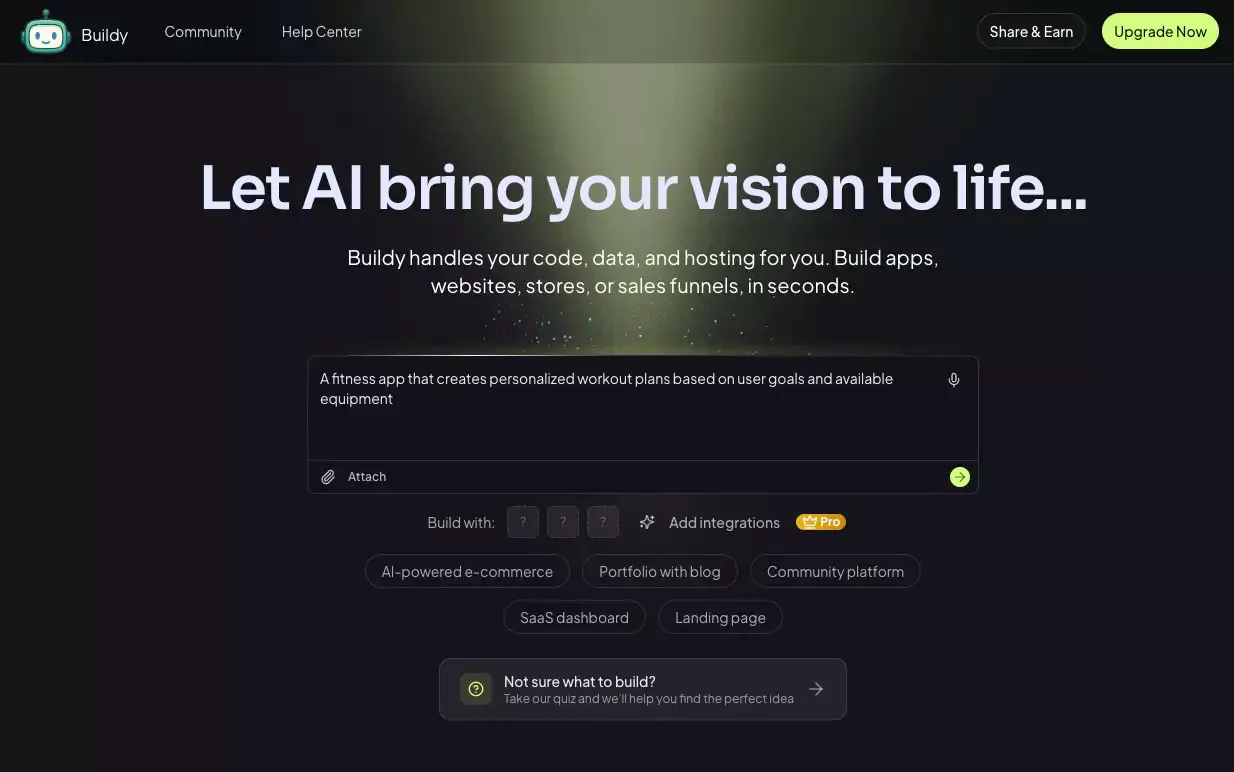
 If you are researching Buildy AI, you are probably asking a simple question: is it actually a useful AI business builder, or just another tool with a big promise and a thin product underneath?
After reviewing Buildy AI’s website, product documentation, and public user feedback, my view is this: Buildy is more capable than many AI builders that stop at basic page generation. It combines app building, branding, payments, email, automation, and business workflow features in one product. That said, it is still an early-stage platform in some areas, and a few parts of its broader vision are ahead of what looks fully mature today.
In this review, I break down what Buildy AI does well, where it feels different, who it is best for, what real users seem to think, and when an alternative may make more sense.
Buildy AI Review: My Quick Verdict
The short answer
Buildy AI is not just a website generator. It is trying to be an AI business builder that helps users go from idea to launch with strategy, branding, app or site creation, payments, email, automation, and support workflows in one place.
That is what makes it interesting. It is also what makes it harder to judge. Products with this much scope can feel powerful when the workflow clicks, but they can also feel uneven if one or two layers are still developing.
My take is that Buildy looks strongest for non-technical founders and operators who care more about launching quickly than controlling every technical detail. It looks less convincing for teams that need mature engineering flexibility, broad authentication support, or a large body of independent user validation.
Quick verdict table
| Category | My take |
|---|---|
| Overall impression | Ambitious and more substantial than many AI builder tools |
| Best for | Non-technical founders, solo operators, small businesses, agencies |
| Biggest strength | Broad all-in-one workflow from business setup to launch |
| Biggest weakness | Some parts of the vision still feel early or lightly validated |
| Product depth | Real app-building substance, not just page generation |
| Confidence level | Promising, but not fully de-risked |
What Is Buildy AI?
Buildy AI’s core positioning
Buildy AI presents itself as more than a builder. It positions itself as a product that gives you an AI team for strategy, design, development, marketing, and operations.
That framing matters. Most AI builders sell speed. Buildy is trying to sell business outcomes.
Instead of saying, “describe an app and we will build it,” Buildy is effectively saying, “describe the business you want, and we will help you shape, build, and launch it.” That makes it feel closer to a guided business idea generator than a simple page maker.
What the product appears to be in practice
Under the marketing story, Buildy also has a more concrete product layer. Its docs describe a text-to-app platform with built-in database support, APIs, authentication, backend logic, AI integration, email integration, and deployment.
That makes Buildy more than a landing page tool. It sits somewhere between an app and website builder and a business-in-a-box platform.
I think that is the fairest way to describe it. It is not just helping users generate screens. It is trying to reduce the work of assembling the product stack around those screens.
Key Features
A seven-agent workflow
One of Buildy AI’s main differentiators is its agent structure. The product frames itself around seven AI roles:
- Strategist AI
- Designer AI
- Engineer AI
- Marketer AI
- Operator AI
- Analyst AI
- Optimizer AI
The first five are central to the current product story. The last two appear to be part of the broader roadmap.
Strategist AI
This part of the product is focused on market research, positioning, pricing, and planning.
For beginners, this is useful because the hardest part is often not building the software. It is deciding what to build, who it is for, and how to package it. In practice, that puts it close to an AI market research agent or an AI startup idea validator.
Designer AI
Designer AI covers visual identity and front-end presentation, including brand assets, layouts, and visual styling.
This is important because many founder-oriented tools build something functional but leave the user with a weak brand layer. Buildy is clearly trying to close that gap, which is where an AI web designer angle becomes relevant.
Engineer AI
Engineer AI is the most important part of the stack if you care about actual product depth.
Based on the docs, Buildy includes:
- built-in database support
- default CRUD APIs
- authentication
- row-level security
- backend functions
- deployment
- custom domain support
- GitHub sync
This is where Buildy feels more serious than many AI builders that mainly generate front-end output. It is much closer to a real AI website builder or full AI app builder workflow.
Marketer AI
Buildy also extends into launch support. The product story includes email sequences, ad assets, SEO setup, and marketing assistance.
That makes sense for its target audience. Many first-time founders do not fail because they cannot build a page. They fail because they do not know how to go from “something exists” to “someone finds and buys it.” That is also why pages around building a SaaS landing page matter in this category.
Operator AI
Operator AI covers workflows like chatbots, voice agents, reminders, support flows, and automation.
This is one of the more distinctive parts of Buildy’s positioning. It is not just trying to help users launch. It is also trying to help them run the business after launch, which overlaps with the use case of an AI chatbot builder.
Built-in full-stack infrastructure
The documentation gives Buildy more credibility than a lot of AI builder products because it spells out real backend primitives.
Database and APIs
Each project comes with a built-in database by default, and entities get CRUD APIs automatically.
That matters because it means Buildy can support apps with real data and not just static pages.
Authentication and access control
Buildy includes authentication and a default user system. It also supports row-level security and access rules.
This gives users a real foundation for private apps, user-specific data, and permission logic.
The main limitation is that documented auth support appears narrow right now. That may be fine for simple use cases, but it is still a real constraint for more serious SaaS products.
AI and email integration
Buildy includes native AI and email workflows, which helps reduce setup friction.
For the users it is targeting, this is a real advantage. Most beginners do not want to manage API keys, third-party infrastructure, or separate service configuration just to send emails or add AI features.
GitHub sync and code ownership
Buildy also documents two-way GitHub sync and emphasizes code ownership.
That is an important trust signal in this category. Even users who never plan to leave a platform still care about not feeling trapped inside it.
What Makes Buildy AI Different?
It sells a business workflow, not just a build workflow
This is the biggest insight I took away while researching Buildy.
Many AI builders help users create something. Buildy is trying to help users create and operate something.
That difference sounds small, but it is not. It changes the product category.
A lot of founder tools focus on the build step. Buildy is trying to cover the steps before and after that:
- business idea shaping
- positioning
- branding
- product creation
- payments
- email setup
- support workflows
- automations
That broader workflow is what makes Buildy stand out.
It balances beginner positioning with real product infrastructure
Another thing that stood out is the contrast between Buildy’s friendly business-facing messaging and the actual technical depth in the docs.
This is one of its strongest qualities. The homepage feels accessible. The docs suggest the product has enough technical structure to back up more than a demo.
That combination is hard to do well. If Buildy improves execution over time, this may become one of its real long-term advantages.
Who Buildy AI Is Best For
Best for non-technical founders
If you are a first-time founder or solo operator, Buildy makes a lot of sense on paper.
You probably do not want five separate tools for:
- landing pages
- databases
- auth
- payments
- support
- automation
You want one workflow that gets you to launch faster. Buildy is clearly designed for that type of user.
Best for small businesses and fast-moving operators
I can also see the appeal for local businesses, consultants, service businesses, and agencies that need to launch branded experiences or lightweight products quickly.
The value here is not just speed. It is reduced coordination cost. That is the same reason people often compare tools in guides to the best website builders for small business.
Less ideal for more demanding SaaS teams
If your needs are more technical, Buildy becomes less obvious.
I would be more cautious if your product requires:
- broader authentication options
- highly customized backend architecture
- advanced engineering workflows
- stronger proof from a large public user base
In those cases, Buildy may still be worth testing, but I would not treat it as the default choice.
Buildy AI Pros and Cons
Pros
Broad all-in-one workflow
Buildy does a better job than many tools at connecting planning, branding, building, launching, and operating.
That is not just a feature list advantage. It reduces workflow fragmentation for the user.
Real app-building depth
The built-in database, APIs, auth, access control, AI, email, deployment, and GitHub sync suggest that Buildy is not just generating surface-level output.
That gives it more substance than many AI builders that look polished in a demo but feel shallow once you ask how the app actually works. It belongs in the same broader discussion as the best AI app builders and top no-code app builders.
Beginner-friendly framing
Buildy is clearly designed to lower the barrier for non-technical users.
That matters because many products in this category still assume the user knows too much about product strategy or implementation.
Cons
Some of the bigger vision still feels early
Buildy’s broader story is compelling, but some layers appear to be ahead of the current maturity level.
That does not make the product weak. It just means users should separate the product vision from the fully proven stack.
Limited public validation
One of the biggest weaknesses right now is not necessarily the product itself. It is the depth of public proof.
There are positive signals from user feedback, but the public review footprint is still relatively small. That makes it harder to judge consistency over time.
Auth flexibility appears limited
For some projects, narrow auth support is not a big deal.
For others, it is a blocker. This is one of the clearer product limitations today.
What Real Users Seem to Think
Positive themes
My summary of public sentiment comes mainly from Buildy’s Trustpilot page, plus at least one user review post in Buildy’s Skool community.
The positive themes are fairly consistent, though the sample size is still small:
- easy to use
- fast to build with
- helpful for non-technical users
- useful for getting websites, apps, or funnels live quickly
These themes appear repeatedly in public reviews and in Buildy’s own customer stories, although the latter should be treated as first-party testimonials rather than independent review sources.
Negative themes
The clearest public criticism I found comes from negative Trustpilot feedback, mainly around support responsiveness and product consistency.
I would be careful not to overstate this into a broad market verdict, because the public review sample is still limited. A more precise conclusion is that early public sentiment is directionally positive, but there are still signs of support and product-polish risk that matter for business-critical use cases.
My interpretation of the reviews
I do not think the right takeaway is “users love it” or “users are frustrated.”
The more accurate reading is this: user sentiment is promising, but still early.
That is a healthy middle-ground conclusion. It avoids two common mistakes:
- treating a small number of positive reviews as proof of category leadership
- dismissing an early product just because its public footprint is not yet large
Buildy AI Alternatives
When Buildy still makes the most sense
Buildy is a strong option if your main goal is to launch a business quickly and keep everything in one workflow.
That is especially true if you want help with:
- positioning
- branding
- website or app generation
- payments
- basic automation
- support setup
In that job-to-be-done, Buildy’s breadth is a real asset.
When Atoms is the more natural alternative
If your center of gravity is less about “business setup” and more about “building and shipping a real digital product,” Atoms is one of the more natural alternatives to compare.
Atoms makes more sense when you care more about:
- full-stack app and website generation
- backend structure
- deployment
- payments
- GitHub-oriented workflow
- code ownership
- growth tooling
If that is the angle you care about most, a dedicated Buildy AI alternative comparison is usually a better next step, especially for teams evaluating product depth, extensibility, and coding agents.
My practical split is simple.
Choose Buildy if
You want a founder-friendly platform that helps you move from idea to launch with less tool sprawl.
Choose Atoms if
You want a more product-oriented workflow for building apps or websites, especially if you care more about product depth and extensibility than business-in-a-box framing.
Final Verdict
Is Buildy AI worth trying?
Yes, I think Buildy AI is worth trying if you fit its ideal user profile.
It looks more credible than many products in this space because it has real product depth under the hood, not just broad homepage messaging. The docs show that clearly.
But I would still describe it as promising rather than fully proven.
The upside is obvious:
- broad workflow coverage
- real backend capabilities
- strong beginner accessibility
The main caution is also obvious:
- some parts of the bigger vision still feel early
- public validation is still limited
- a few platform constraints matter depending on your product
My bottom line is this: Buildy is not just hype. It is a real product with a differentiated angle. But it is best understood as an ambitious founder launch platform that is still maturing, not as a fully settled winner for every serious software use case.
FAQ
Is Buildy AI a website builder or an app builder?
It is best described as both. Buildy positions itself as an AI business builder, but the product also includes real app-building infrastructure like database support, APIs, authentication, backend logic, and deployment.
Does Buildy AI require coding?
Buildy is clearly designed for users with little or no coding background. Its value proposition is built around reducing setup complexity and letting users build through guided workflows.
Does Buildy AI have real backend features?
Yes. The product documentation suggests that it includes meaningful backend capabilities, not just front-end generation.
What is Buildy AI best for?
It is best for non-technical founders, solo operators, small businesses, and anyone who wants to launch quickly with fewer tools.
What is the biggest limitation right now?
The biggest limitation is maturity. Buildy’s vision is broad and compelling, but some parts of that vision appear to be more developed than others.
 Posts
Posts 