 Maya Chen
On this page
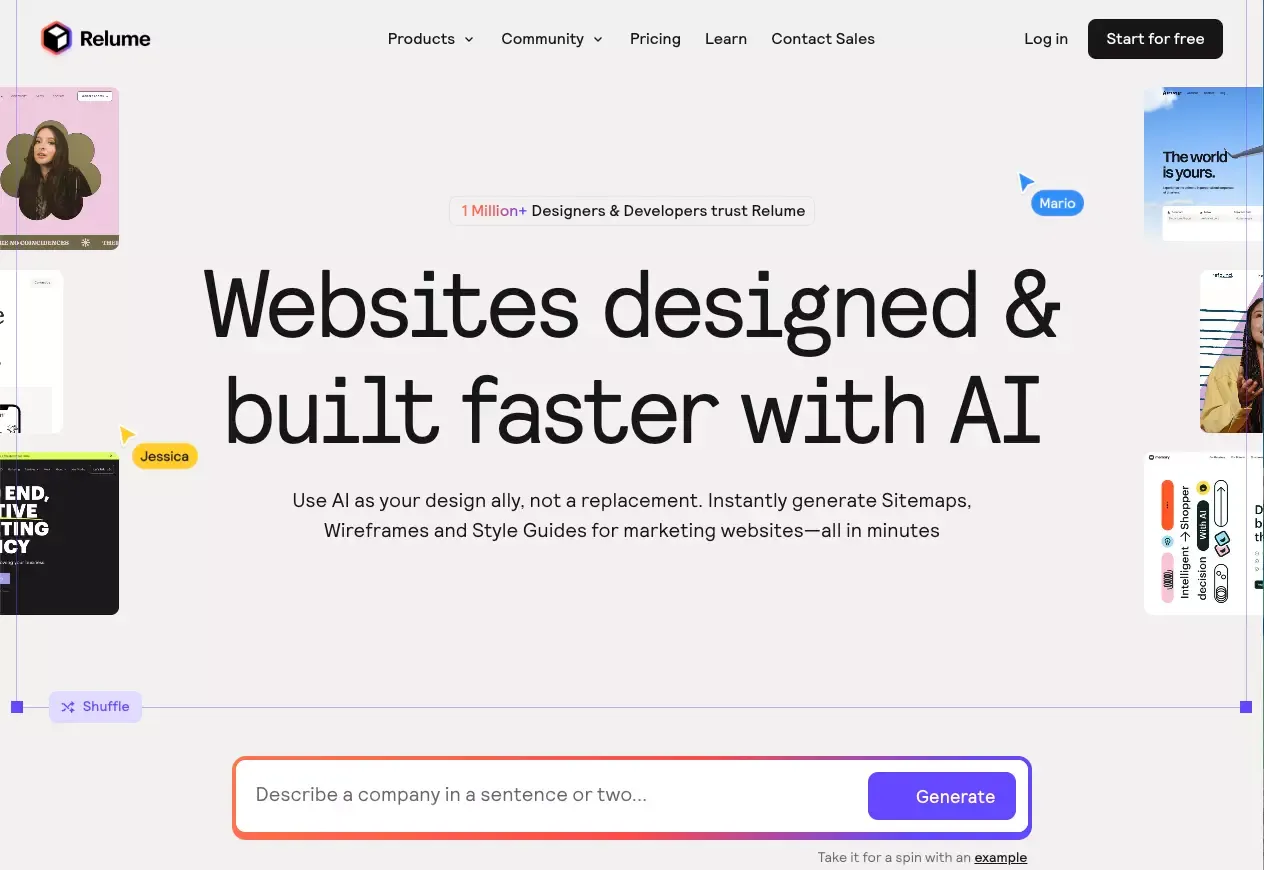 When I look at Relume, I do not think of it as a generic AI website builder. I think of it as a very specific kind of workflow tool. It is built for sitemaps, wireframes, and style guides, and that is exactly why so many teams like it. It helps people get past the blank page quickly. But that is also why some users start looking elsewhere. Once you need more than planning and early design, you begin to notice the limits of a planning-first workflow.
That is the real reason this keyword matters. People searching for Relume alternatives are usually not looking for a clone. They are trying to solve the next problem in the workflow. Some want a faster way to publish. Some want deeper customization. Some want better code output. And some want a more complete path from idea to live product.
After reviewing the space, my view is simple: Relume is strongest at the planning layer. If you want to move beyond that layer into publishing, backend logic, product delivery, or code ownership, several alternatives make more sense.
What Relume Is Good At
Relume is strong at helping teams structure a website quickly. That is still its biggest advantage. If you are working on a marketing site and you need to go from a vague idea to a sitemap, then to wireframes, then to a clearer design direction, Relume is useful. It reduces friction in the early phase and gives teams something concrete to react to.
That matters more than people admit. A lot of website projects do not fail because the team cannot build. They fail because the team cannot align. Relume solves that early alignment problem well. It gives marketers, designers, and stakeholders a shared artifact to discuss before the real build begins.
But structure is not the same as shipping. A sitemap is not a live site. A wireframe is not a working app. That is where many users start to feel the gap.
Why People Look for Relume Alternatives
The most common reason is simple: they want more than a starting point.
Sometimes that means they want to publish a polished website faster. Sometimes it means they want actual frontend and backend output. Sometimes it means they want stronger CMS and SEO controls. And sometimes it means they are not operating in a Webflow-centered workflow, so Relume feels like one step in a process that still requires too many other tools.
I think that is the most useful way to evaluate alternatives. Do not ask, “What is most similar to Relume?” Ask, “What do I need that Relume does not finish for me?”
How I Chose the Best Relume Alternatives
I looked at tools through four practical lenses:
- Full product building: tools that go beyond planning and help generate working products
- Fast website publishing: tools that help turn ideas into live websites quickly
- Wireframing and UX exploration: tools that are especially good for quick concepting and design iteration
- Planning and collaboration: tools that focus on structure, sitemaps, user flows, and stakeholder alignment
That matters because this category gets mixed up all the time. Some tools here are design accelerators. Some are website builders. Some are product-generation platforms. Some are planning systems. They are all alternatives in a broad sense, but not all for the same reason.
Quick Comparison of the Best Relume Alternatives
| Tool | Best For | Biggest Strength | Main Trade-Off |
|---|---|---|---|
| Atoms | Full product building | Goes beyond wireframes into frontend, backend, and deployment | More than some users need for simple site planning |
| Framer | Fast polished website publishing | Beautiful live sites with fast iteration | Less suited for complex product workflows |
| Webflow | Long-term website control | Strong CMS, hosting, SEO, and visual control | Broader and heavier than simple planning tools |
| DhiWise | Developer-heavy workflows | Design-to-code and app-oriented output | Less appealing for purely marketing-site teams |
| Uizard | Quick prototyping | Fast, low-friction wireframes and concepts | Not meant to be the final website platform |
| Claritee | Planning and approvals | Content-first structure and collaboration | Less about final publishing |
| B12 | Business websites | Fast AI-assisted business site creation | Less control for design-heavy teams |
| Tilda | Content-led landing pages | Flexible visual composition | Less focused on AI planning |
| UX Pilot | Figma-oriented teams | Fast AI wireframing and UI generation | Narrower scope than full builders |
| FlowMapp | Sitemap and web planning | Excellent information architecture and flows | Not built for final product delivery |
10 Best Relume Alternatives
1. Atoms
If the problem is not planning, but finishing, Atoms is the one I would look at first.
What makes Atoms different is that it is not trying to stop at wireframes. It is built around a broader workflow: idea, planning, UI generation, frontend, backend, auth, payments, preview, and deployment. That makes it a very different proposition from a sitemap-first tool.
This is why Atoms feels like a strong alternative for founders, operators, and teams who want to go from prompt to something real. If your frustration with Relume is that it helps you start but not ship, Atoms solves a more complete version of the problem.
That does not mean it replaces Relume for every use case. If all you need is structured website planning for a marketing team, Relume may still feel more focused. But if you want to move from concept into product output without stitching together too many tools, Atoms is one of the most practical options in this category. That is especially true if you need an AI app builder, an AI dashboard builder, or an app and website builder.
Best for
Teams that want to go beyond wireframes and move closer to a real shipped product.
Why it stands out
- Stronger end-to-end workflow
- Better fit for app, SaaS, dashboard, and internal tool use cases
- More useful when the final goal is a working product, not just a design starting point
Main trade-off
It may be broader than necessary for teams that only want website planning.
2. Framer
Framer is one of the clearest alternatives if your main goal is getting a polished website live fast.
I like Framer because it collapses the distance between idea and publish. It is not just a place to explore page structure. It is already a live publishing environment. For marketing teams, startup launches, personal brands, and landing pages, that makes a big difference.
Framer is especially strong when visual polish matters. It tends to feel closer to a finished website than a planning-first tool. If you are the kind of user who gets impatient with wireframes because you really want to see the final page, Framer is often the better fit. For a closer comparison, Framer alternatives are relevant.
Best for
Marketing sites, landing pages, and fast publishing.
Why it stands out
- Beautiful visual output
- Fast path from idea to live site
- Good for design-led teams that care about polish
Main trade-off
Not the best choice for complex backend workflows or broader product-building needs.
3. Webflow
Webflow is the stronger choice when you want more ownership over the live website itself.
A lot of people searching for a Relume alternative do not actually need another idea tool. They need a better long-term website platform. That is where Webflow makes sense. It offers a stronger operational layer with CMS, hosting, integrations, custom code options, and deeper site control.
In practice, Webflow is often the right answer when a team has moved beyond early-stage planning and wants a system that can support real content operations, growth work, and ongoing iteration. It is a bigger platform, which means more flexibility and more complexity. If that is your lane, these Webflow alternatives are useful context too.
Best for
Teams that want long-term control over their marketing site and CMS.
Why it stands out
- Strong CMS and publishing layer
- Better for ongoing content and SEO operations
- More control over the actual live website
Main trade-off
Heavier than a lightweight planning tool, especially for early exploration.
4. DhiWise
DhiWise is more developer-oriented than most tools in this list, and that is exactly why it matters.
If your team cares about design-to-code workflows, production-ready output, and app-oriented implementation, DhiWise makes more sense than a website planning tool. It is closer to the build layer, which changes the value proposition entirely.
I would not recommend DhiWise to every Relume user. But I would absolutely recommend it to teams where engineering speed matters more than visual planning. It is not just about getting unstuck creatively. It is about reducing implementation time. That makes it conceptually closer to an AI dashboard generator or an HTML website builder AI than to a sitemap-only workflow.
Best for
Developer-heavy teams that want design-to-code acceleration.
Why it stands out
- Better aligned with engineering workflows
- More relevant for app and product teams
- Stronger when code output matters
Main trade-off
Less appealing for users who mainly need marketing-site ideation.
5. Uizard
Uizard is a better option when you want fast concepting without much setup.
That is what I like about it. It lowers the barrier. You can sketch, generate, and iterate quickly without treating the process like a formal website production workflow. For non-designers, early-stage product thinkers, and teams that just need something visual to react to, that simplicity is a real advantage.
Compared with Relume, Uizard feels lighter. It is less about structured web planning and more about getting ideas into visible form. In that sense, it sits closer to an AI page generator or an instant website builder than to a full publishing stack.
Best for
Quick wireframes, product concepts, and low-friction prototyping.
Why it stands out
- Easy to start
- Good for non-designers
- Useful for idea exploration and rough validation
Main trade-off
Not designed to be the full live-site or product delivery platform.
6. Claritee
Claritee is one of the more underrated options in this space because it approaches the problem from a planning and alignment angle.
Some teams do not need flashy generation. They need clean structure, clear flows, content hierarchy, and approval workflows. That is where Claritee becomes useful. It feels less like a momentum tool and more like a project clarity tool.
I think it is especially relevant for agencies, stakeholder-heavy projects, and teams that need more process around the early stage. Relume helps teams move fast. Claritee helps teams move clearly. Those are not the same thing. For agency-oriented work, adjacent use cases like an AI agency website builder or an AI content creator website builder point to a more execution-ready next step.
Best for
Agency workflows, planning-heavy projects, and collaborative approvals.
Why it stands out
- Good for structured alignment
- Useful when content and flows matter
- Better fit for projects with many reviewers or stakeholders
Main trade-off
Less focused on fast final publishing.
7. B12
B12 is a practical alternative for business users who do not want to spend much time inside a design workflow.
That is the key distinction. If your goal is to get a credible business website online quickly, B12 is often more direct than Relume. You are not using AI to plan first and then moving elsewhere to build. You are starting closer to a finished site.
I would especially look at B12 for service businesses, small teams, and solo operators who care more about speed and convenience than deep design-system control. In practice, that is the kind of user who often wants an AI website builder, an AI consulting website builder, or the best AI website builder for beginners.
Best for
Service businesses and users who want a fast AI-assisted website.
Why it stands out
- Direct path to a business-ready site
- Lower operational burden
- Better fit for users who want convenience
Main trade-off
Less flexible for design-heavy or product-heavy workflows.
8. Tilda
Tilda is a strong option for content-led pages, landing pages, and visually expressive websites.
It is not the most obvious Relume alternative, but it solves a different problem well. If your main goal is to create attractive, high-control page layouts without leaning too hard into developer workflows, Tilda is worth considering.
I see it as a good fit for campaigns, editorial pages, portfolios, and stylish brand sites. It is less about AI-guided planning and more about visual composition. The closest matching jobs here are often build your product launch page with AI, build your SaaS landing page with AI, or build your startup's first landing page with AI.
Best for
Content-led sites, editorial pages, and visual landing pages.
Why it stands out
- Flexible page design
- Strong for visually expressive layouts
- Good middle ground between templates and full custom builds
Main trade-off
Less focused on AI-assisted structure and planning.
9. UX Pilot
UX Pilot is more relevant than Relume when the main goal is AI-assisted screen design inside a Figma-centered workflow.
That makes it especially useful for product teams. If you care about screens, flows, and rapid UI generation more than website hierarchy, UX Pilot feels closer to the real problem you are trying to solve.
This is why I would not treat it as a universal Relume replacement. It is better understood as a specialized alternative for UI and UX teams. For teams moving from screens toward something shippable, create an MVP showcase page with AI is a useful adjacent reference.
Best for
Product designers and Figma-oriented teams.
Why it stands out
- Fast wireframing and UI generation
- Better match for product design workflows
- Useful for teams already living in Figma
Main trade-off
Narrower use case than broader website or product builders.
10. FlowMapp
FlowMapp is one of the closest planning-focused alternatives to Relume.
If your work revolves around sitemaps, information architecture, user flows, content structure, and web planning, FlowMapp makes a lot of sense. It is especially valuable for agencies and teams handling larger websites where structure is not just a nice-to-have, but a real part of project success.
What I like about FlowMapp is that it knows what it is. It is not pretending to be the final publishing platform. It is built to make planning clearer.
Best for
Website planning, information architecture, and stakeholder collaboration.
Why it stands out
- Strong sitemap and flow planning
- Good for larger site projects
- Helpful when structure is the core challenge
Main trade-off
Not built for final shipping or working product delivery.
Which Relume Alternative Is Best for Different Use Cases
Best for founders
Atoms is the strongest choice if the goal is to move beyond wireframes and get closer to a working product.
Best for marketers
Framer is a smart pick for fast publishing and high-quality visual output.
Webflow is stronger if the site will need long-term content and SEO operations.
Best for agencies
Webflow, Claritee, and FlowMapp all make sense here, depending on whether the priority is publishing, approvals, or planning.
Best for designers
Framer is strong for live marketing sites.
UX Pilot is stronger for Figma-oriented product design work.
Best for developer-heavy teams
DhiWise is the clearest fit when code output and implementation speed matter.
My Final Take
I do not think the best Relume alternative is always another wireframing tool. That is where many comparison posts get too shallow.
The better question is: what do you wish Relume did next?
If the answer is publish faster, I would look at Framer or Webflow.
If the answer is help me build something real, I would look at Atoms or DhiWise.
If the answer is improve planning and alignment, I would compare Claritee and FlowMapp.
If the answer is turn rough ideas into visuals quickly, Uizard and UX Pilot are more relevant.
For me, the most compelling option overall is Atoms, because it solves the most common reason people move on from Relume in the first place. They do not just want structure. They want progress. They want to move from planning to product without rebuilding the entire workflow from scratch.
That said, the best choice depends on where your process actually breaks. And that is the part most listicles skip. Picking the right alternative is less about which tool is most popular and more about which layer of work you are trying to accelerate.
FAQs About Relume Alternatives
What is the best Relume alternative for founders?
If you want to move beyond planning and closer to a usable product, Atoms is one of the strongest choices.
What is the best Relume alternative for marketers?
For fast, polished publishing, Framer is a great fit. For longer-term site management and CMS depth, Webflow is stronger.
What is the best Relume alternative for agencies?
For agencies, I would compare Webflow, Claritee, and FlowMapp depending on whether the priority is live-site delivery, collaborative approvals, or planning.
Is there a better Relume alternative for developers?
Yes. DhiWise is a stronger fit for developer-oriented workflows, especially when code output matters.
Is Relume still worth using?
Yes. Relume is still worth using if your main need is fast website structure, early wireframes, and a smoother starting point for website planning. It becomes less compelling when you need a more complete path to publishing or product delivery.
