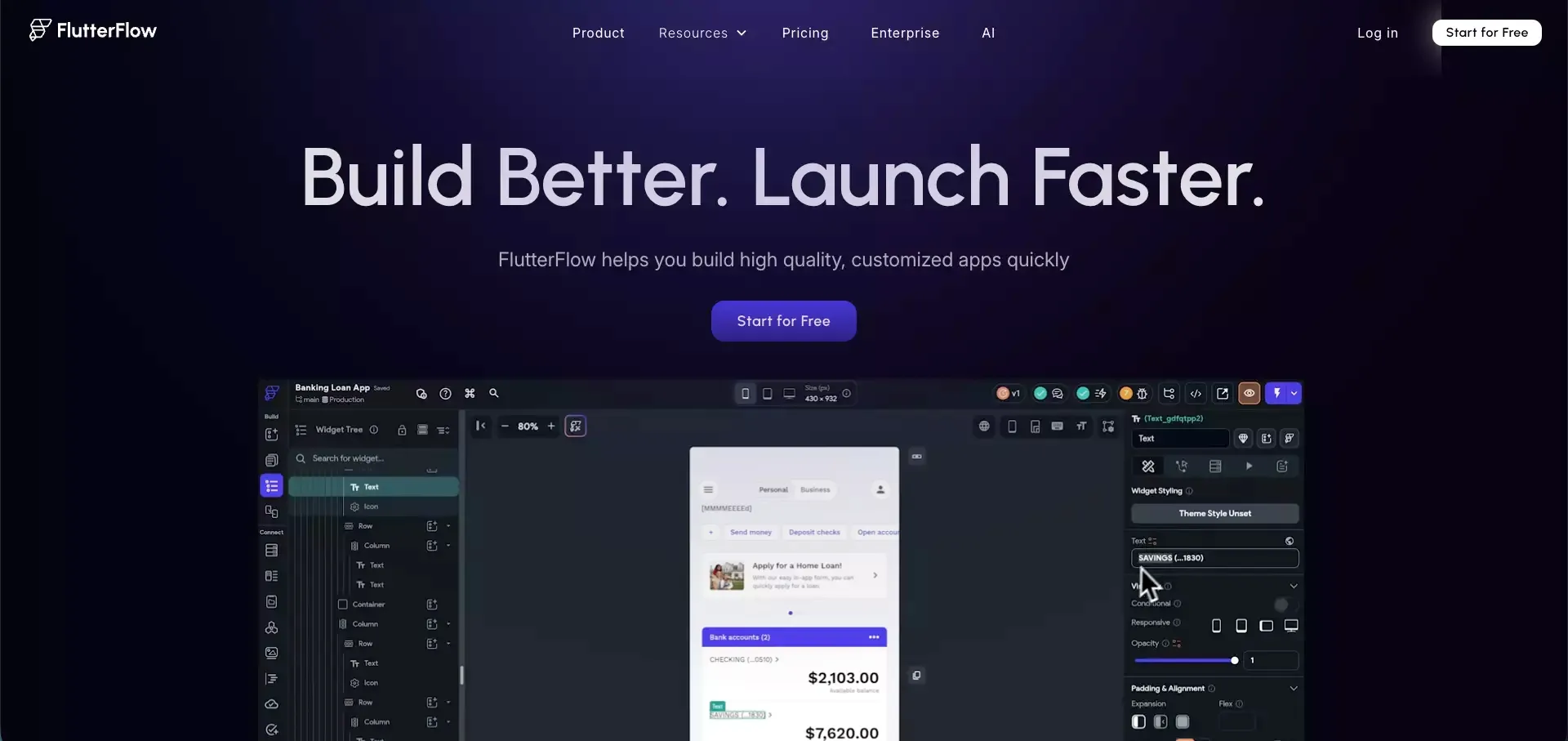
 FlutterFlow is still one of the most credible visual app builders in the market. I would not switch away from it casually.
But that is also the trap.
A lot of teams do not outgrow FlutterFlow because it fails. They outgrow it because their project changes shape. What started as a visual app build becomes a broader product problem. Or it turns into an internal ops tool. Or the team decides code ownership matters more than speed. Once that happens, the "best FlutterFlow alternative" is no longer a single product. It depends on what you are trying to optimize for.
That is the frame I used here.
Instead of forcing every tool into the same bucket, I compared them by real use case: AI-assisted full-stack product building, internal tools, complex web apps, native mobile MVPs, and developer handoff. That approach is more honest. It is also more useful.
Why Look for Alternatives to FlutterFlow?
FlutterFlow still makes sense for a lot of teams. It gives you a visual builder, cross-platform deployment, backend integrations, and code export. For the right project, that is a strong package.
Still, there are a few recurring reasons people start looking elsewhere.
Common reasons teams move beyond FlutterFlow
- Their app becomes more web-first than mobile-first
- They want more help with product planning, not just interface building
- They are building internal tools, portals, or ops workflows rather than consumer apps
- They care more about code ownership and developer handoff
- They want a simpler path for non-technical teams
- They need deeper workflow logic, broader integrations, or a better fit for their stack
What I think a good alternative should improve
| What teams want | What that usually means |
|---|---|
| Faster launch | Less setup and fewer moving parts |
| Better fit for web apps | Stronger full-stack web workflows |
| Easier internal tooling | Better database, permission, and dashboard patterns |
| More AI help | Support beyond layout generation |
| More control | Cleaner export, code access, or developer handoff |
| Less friction for non-technical users | Simpler builder, clearer abstractions, and fewer setup decisions |
Quick Comparison of the Best FlutterFlow Alternatives
| Platform | Best for | Strength | Main trade-off |
|---|---|---|---|
| Atoms | AI-assisted full-stack product building | Broader product workflow, from idea to launch | Less aligned with a pure Flutter-native workflow |
| Nowa | Flutter-style visual building with AI | Closest conceptual match to FlutterFlow | Smaller ecosystem and less market maturity |
| Bubble | Complex web apps | Deep workflow logic and full-stack flexibility | Higher learning curve |
| Retool | Internal tools for technical teams | Strong API, database, and ops workflows | Not ideal for polished consumer apps |
| Glide | Data-driven business apps | Fast path from spreadsheets or data tables to useful apps | Less flexible for custom product UX |
| Softr | Portals and business apps | Easy setup for non-technical teams | Advanced customization can feel limited |
| AppSheet | Google-centric workflow apps | Strong for structured business processes | Functional, but not design-forward |
| Adalo | Simple native mobile MVPs | Easy way to launch a mobile app quickly | Lower ceiling as complexity grows |
| Draftbit | React Native apps with code ownership | Better for developer handoff and code control | Less beginner-friendly than simpler builders |
Best FlutterFlow Alternatives by Use Case
Atoms
Best for AI-assisted full-stack product building
Atoms is not just trying to be another AI app builder. That is why it stands out.
The main difference is scope. It is built around a broader "build the business, not only the interface" workflow. That includes ideation, research, product definition, app creation, deployment, and growth-oriented tasks. If your frustration with FlutterFlow is that it still leaves too much work outside the tool, Atoms becomes interesting very quickly.
Where Atoms feels stronger than FlutterFlow
- Better fit for founders who want help beyond UI building
- More aligned with end-to-end product creation using an AI prototype generator
- Useful when launch speed matters as much as app structure
- Stronger appeal for teams that want coding agents to handle more of the workflow
Where FlutterFlow may still be the better fit
- You are committed to a Flutter-centered workflow
- Your main priority is visual app construction, not broader product support
- You want a more established category leader in visual app building
My take
I would not describe Atoms as the closest FlutterFlow substitute. I would describe it as a broader alternative. That matters. If you want a tool that helps build a business-ready product, Atoms deserves to be near the top. If you want the closest visual Flutter-like replacement, Nowa is the more direct comparison.
Nowa
Best for teams that want a Flutter-like alternative
If you want something that feels closest in spirit to FlutterFlow, I would start with Nowa.
It stays in a similar lane: Flutter-based app creation, visual editing, AI assistance, cross-platform deployment, and source-code access. That makes it one of the few alternatives that actually overlaps with FlutterFlow at the level of workflow and mental model.
Why Nowa is a strong direct alternative
- Built around Flutter app creation
- Combines visual building with AI assistance
- Supports source code access
- Covers iOS, Android, web, and broader deployment paths
Where I would be cautious
- Smaller market presence
- Fewer proof points than FlutterFlow
- Less ecosystem depth and less community gravity
My take
Nowa is one of the rare alternatives that makes sense for someone who likes the FlutterFlow category, but wants a different product philosophy. It is not just "another no-code builder." It is a more direct competitor than Bubble, Glide, or Softr.
Bubble
Best for complex web apps
Bubble remains one of the most serious alternatives on this list, especially for web apps with deeper logic.
When teams leave FlutterFlow because they need more flexibility, more workflow control, or a stronger full-stack web environment, Bubble is often where they land. It asks more from you, but it also gives more back.
Why Bubble still matters
- Mature platform for full-stack web app building
- Strong workflow and logic depth
- Broad template, plugin, and community ecosystem
- Better fit for teams building complex browser-based products
Where Bubble is not a clean answer
- It is not simpler than FlutterFlow
- It can feel heavy for smaller or non-technical teams
- It is often too much if you only need a lightweight internal app
My take
Bubble is not the "easy alternative." It is the "more capable, more demanding" alternative. I would consider it when product complexity is rising and the team is ready to accept a steeper curve.
Retool
Best for internal tools with technical complexity
Retool solves a different problem, but it solves it extremely well.
If you are building admin panels, support consoles, AI-powered operations dashboards, or internal systems that sit on top of existing APIs and databases, Retool is often a more rational choice than trying to force a product builder into an ops workflow.
Why Retool belongs on this list
- Excellent for internal software
- Deep integrations with APIs, databases, and business systems
- Strong fit for developer or technical ops teams
- Useful when speed matters, but system connectivity matters more
Where it is a mismatch
- Not ideal for polished public-facing apps
- Less suited for customer-facing product UX
- Overkill for simpler portals or spreadsheet-driven use cases
My take
Retool is not a one-to-one FlutterFlow replacement. It is a correction for teams that realize they are actually building internal software.
Glide
Best for fast, data-driven business apps
Glide is one of the easiest tools to recommend when the real problem is operational, not product-led.
It is especially good when your app is mostly about structured data, lightweight workflows, and getting useful software in front of a team fast. If you can describe the app as "a cleaner way to work with our business data," Glide is probably a better fit than FlutterFlow.
Where Glide works well
- Internal tools
- Team dashboards
- Client or staff portals
- Lightweight CRMs
- Spreadsheet-driven workflows
Where it becomes limiting
- Highly custom UI
- More unusual product logic
- Consumer-facing product experiences
- Mobile-first app ambitions that go beyond a business app shell
My take
Glide is not exciting in the same way some AI builders are. It is practical. That is often more valuable.
Softr
Best for portals and non-technical teams
Softr is one of the most approachable products in this category. That is its real advantage.
If the team is non-technical and the job is to build a portal, directory, dashboard, intranet, or internal app on top of structured data, Softr reduces friction fast. It is one of the easiest tools here to explain to a business team.
Why Softr works
- Low setup friction
- Strong fit for client, member, and employee portals
- Useful permissions model
- Friendly for teams that want speed without much technical setup
Where I see the ceiling
- Advanced workflow depth
- Heavy customization
- More product-like, differentiated UX
- Unusual logic patterns
My take
Softr is strong because it knows what it is. It does not try to be everything. If your use case fits the shape of the product, it can be one of the fastest wins on this list.
AppSheet
Best for Google Workspace-heavy organizations
AppSheet is the most process-oriented option here.
I would look at it when the app is really about forms, approvals, field workflows, inventory, checklists, or internal business processes. It is not the most design-led tool in this space, but that is not the point. Its value is operational structure.
Where AppSheet is a good fit
- Teams already living inside Google Workspace
- Workflow-heavy internal apps
- Business process automation
- Structured, rules-based use cases
Where it is weaker
- Product polish
- Brand-heavy user experience
- Modern startup-style front-end expectations
- More differentiated app interactions
My take
AppSheet is easy to underestimate because it is less flashy. But for the right company, it is more useful than a prettier builder with the wrong workflow model.
Adalo
Best for simple native mobile MVPs
Adalo is still worth considering if your main priority is speed to a native mobile launch.
It gives you a more direct path to building native iOS and Android apps, plus web support, without asking for a lot of setup complexity. That makes it attractive for founders who want to create an MVP with AI and get it into users' hands quickly.
What Adalo does well
- Simple native mobile app path
- Visual multi-screen building
- Easier for non-technical founders to grasp
- Good fit for early MVPs
Where it can struggle
- More advanced logic
- Complex app architecture
- Custom product behavior
- Teams that know they will need deeper control later
My take
Adalo is one of the easiest answers if the brief is simple: launch a mobile MVP fast. I would not choose it for maximum flexibility. I would choose it for momentum.
Draftbit
Best for developer handoff and code ownership
Draftbit is where I would look when code ownership is a serious requirement, not just a nice extra.
That makes it different from many visual builders. The appeal is not only that you can build visually. It is that you can build visually and then move into a more developer-led workflow with cleaner React Native export.
Why Draftbit stands out
- Good match for React Native-oriented teams
- Better handoff story for engineering teams
- Stronger long-term control than many beginner-friendly builders
- Useful when visual speed and code access both matter
Where it is not ideal
- Teams that want maximum simplicity
- Buyers who do not care about developer handoff
- Projects where the visual layer is more important than the exported codebase
My take
Draftbit is the control-oriented mobile option on this list. If the future includes developers taking over the app, it becomes much more appealing.
How to Choose the Right FlutterFlow Alternative
Start with the product type
This is the first filter. It removes a lot of confusion.
| If you are building... | Start here |
|---|---|
| AI-assisted full-stack product | Atoms |
| Flutter-like visual app workflow | Nowa |
| Complex web app | Bubble |
| Internal tool for technical teams | Retool |
| Data-driven business app | Glide |
| Portal for non-technical team | Softr |
| Google-centric workflow app | AppSheet |
| Simple native mobile MVP | Adalo |
| Mobile app with code handoff | Draftbit |
Decide what matters more: speed or control
A lot of teams say they want both. Usually they have to choose.
If speed matters more
- Glide
- Softr
- Adalo
- AppSheet
If control matters more
- Bubble
- Draftbit
- FlutterFlow
- Nowa
If broader AI help matters more
- Atoms
Evaluate the backend and workflow early
This part gets ignored too often.
Before choosing a platform, I would pressure-test these questions:
- Where does the data live?
- How much auth and permissions complexity do you need?
- Do you need payments, custom APIs, or business logic early?
- Will the app stay simple, or does complexity grow fast?
- Will engineers eventually need to own the codebase?
Those questions matter more than template quality or homepage polish.
When FlutterFlow Still Makes Sense
Not every comparison article says this clearly enough, so I will.
FlutterFlow is still a good choice when:
- You want a visual builder with real cross-platform ambition
- You like the Flutter-centered model
- Code export matters
- You are building a genuine app product, not an internal workflow tool
- The team is comfortable with a slightly more technical setup
Sometimes the best alternative to FlutterFlow is no alternative at all. Sometimes the right move is staying put.
Final Verdict - My top picks by scenario
| Scenario | Best fit |
|---|---|
| AI-assisted product building | Atoms |
| Closest FlutterFlow-style alternative | Nowa |
| Complex web apps | Bubble |
| Technical internal tools | Retool |
| Fast business apps from data | Glide |
| Portals for non-technical teams | Softr |
| Google-centric process apps | AppSheet |
| Simple native mobile MVPs | Adalo |
| React Native handoff and code control | Draftbit |
If I were choosing today, I would not ask which platform is "best" in the abstract.
I would ask a narrower question: what kind of app am I building, who needs to work on it, and what kind of control will I care about six months from now?
That is usually where the right answer shows up.
FAQs
What is the closest FlutterFlow alternative?
Nowa is one of the closest alternatives in spirit because it also centers on Flutter-style app creation, visual building, AI support, and source-code access.
Which FlutterFlow alternative is best for web apps?
For complex web apps, Bubble is the strongest option on this list. For AI-assisted product creation that goes beyond interface building, Atoms is also worth a serious look.
Which alternative is best for internal tools?
Retool, Glide, Softr, and AppSheet are all strong, but they fit different teams. Retool is best for technical internal systems. Glide and Softr are better for faster business apps. AppSheet is strongest in Google-heavy workflow environments.
Which option is best for simple mobile MVPs?
Adalo is a strong choice when your goal is to launch a native mobile MVP quickly without much setup overhead.
Which FlutterFlow alternative is best for code ownership?
Draftbit stands out when code export and React Native handoff matter a lot. Nowa is also relevant if you want source-code access in a Flutter-centered workflow.
Is FlutterFlow still worth using in 2026?
Yes. It still makes sense for teams that want a visual cross-platform builder with strong app-building capabilities and code export, especially when the project still fits a Flutter-style workflow.
