 Maya Chen
On this page
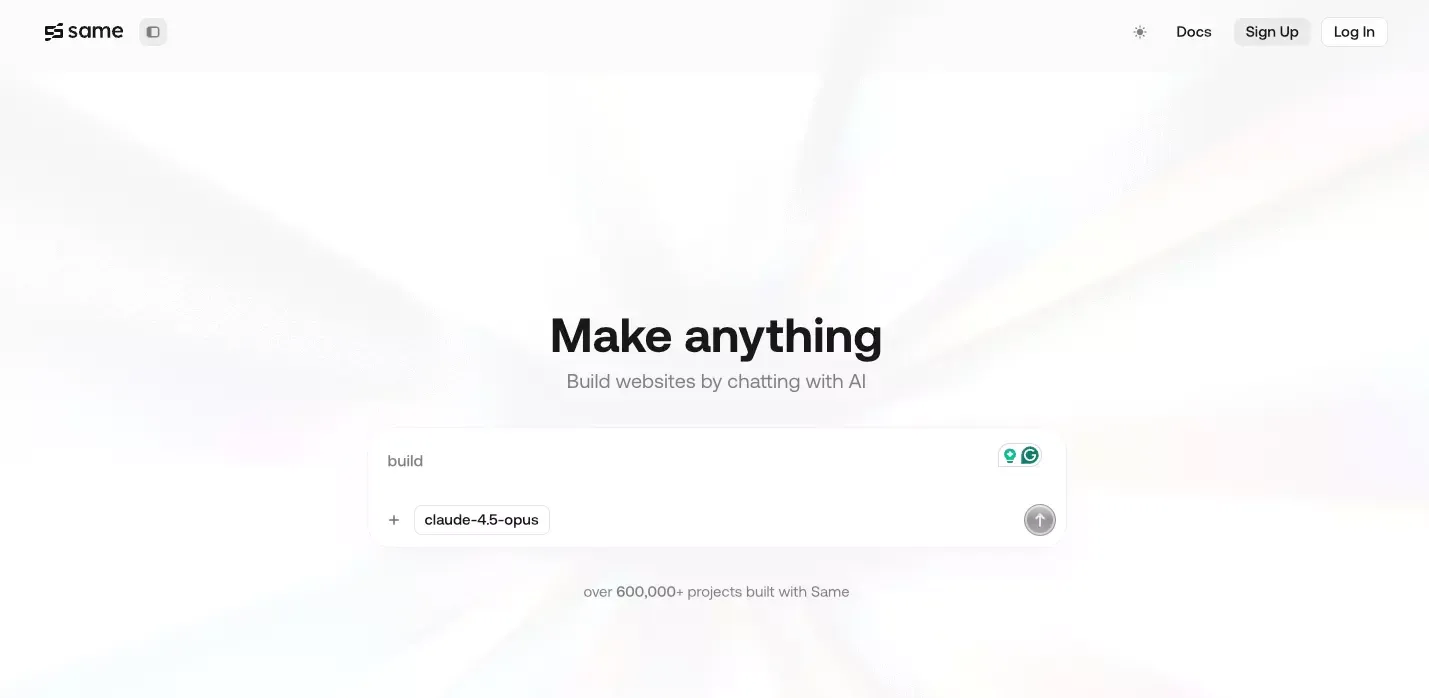 Same.new is better than a lot of people give it credit for. It is not just a one-shot site cloner. You can start from a URL, a screenshot, or a plain-language prompt. You can also edit, deploy, sync with GitHub, and connect services like Neon, Supabase, and Clerk.
That said, when I look at tools in this category, I always separate two questions. First, can it give me a strong first version fast? Second, can I keep building without the workflow fighting me a week later?
That is where alternatives start to matter. Some tools are better for visual refinement. Some are better for full-stack shipping. Some are much better when I want explicit code control.
Why People Start Looking for Same.new Alternatives
Where Same.new works well
What I like about Same.new is how easy it is to get started. I can paste a URL to clone a site, upload a screenshot, or describe an idea in plain English. That makes it useful for quick experiments, layout exploration, and early MVP work.
It also supports live editing, prompt-based changes, deployment, and GitHub-connected workflows. So this is not some shallow mockup tool. It clearly aims to do more than generate a static page.
Where Same.new starts to feel limiting
My issue is not that Same.new is too simple. It is that its core value still leans heavily on prompt-led creation and transformation.
Once a project becomes more serious, I usually start asking different questions:
- How easy is it to manage backend logic?
- Can I structure the product cleanly after the first prompt?
- Do I have enough control over code, infra, and workflow?
- Is this tool best for building, or just best for starting?
In other words, Same.new is easy to start with. It is not always the tool I would choose to finish with.
What to Look for in a Good Same.new Alternative
A lot of AI builders can give me a decent first screen. That part is no longer special. What matters more is what happens after the first impressive demo.
Here is what I pay attention to:
| What to evaluate | Why it matters |
|---|---|
| Product depth | A good tool should support real app logic, not just UI output |
| Workflow continuity | It should help me keep iterating, not trap me in one-shot generation |
| Ownership | GitHub sync, export options, and code access matter if the project grows |
| Backend support | Auth, database, APIs, and deployment should not feel like afterthoughts |
| Team fit | The right tool for a founder is not always the right one for a designer or engineer |
That last point is the most important. These tools are all called “alternatives,” but they solve different bottlenecks.
Best Same.new Alternatives to Consider
1. Atoms
Best for teams that want idea-to-product workflow in one place
If I had to put one option first for people who want more than a clone, I would put Atoms at the top.
The reason is simple. Atoms feels broader than a typical prompt builder. It is designed more like a system for turning ideas into real products, not just turning prompts into screens. It covers planning, app structure, frontend and backend work, auth, database, and payments in a more unified way.
That changes the experience. Same.new is strong when I want to move quickly from a reference into a working version. Atoms makes more sense when I want a fuller AI app builder workflow from the start.
Why it stands out
- Better fit for SaaS apps, internal tools, and real product workflows
- More complete path from idea to launch
- Stronger product layer, not just generation layer
- Useful when launch readiness matters as much as speed
Possible trade-offs
- It may feel like more platform than I need for a tiny prototype
- If my only goal is a quick frontend clone, it may be heavier than necessary
2. Bolt.new
Best for fast web app generation in the browser
Bolt is one of the cleanest choices when I want speed. The browser-native workflow is a big part of the appeal. I can go from text prompt to working web app quickly, and I do not need to piece together a bunch of tools to get started.
Compared with Same.new, Bolt feels less centered on cloning from references and more centered on generating and shipping browser-based apps fast.
Best for
- Fast app generation
- Browser-first workflows
- People who want a quick path from idea to deploy
Where it may fall short
- Not my first pick for deeper long-term codebase stewardship
- Better at speed than at product orchestration
3. v0
Best for UI generation and frontend-first workflows
v0 is still one of the strongest options when the real bottleneck is interface speed. It does a very good job with frontend generation, design iteration, and fast deployment. If the project is visually led, it is hard to ignore.
I would place v0 above Same.new when the main goal is building polished interfaces quickly. It feels more explicitly design-oriented, and that matters when the frontend is the product.
| Area | v0 | Same.new |
|---|---|---|
| UI generation | Stronger | Strong |
| Design refinement | Stronger | Good |
| Prompt-first cloning | Good | Stronger |
| Frontend-first workflows | Stronger | Good |
v0 is not only for pretty screens anymore, but I still think its strongest identity is frontend-first.
4. Replit
Best for people who want one place to prompt, build, and deploy
Replit has become much more relevant in this space. What makes it stand out is that it combines natural-language building with an actual development environment.
That matters because sometimes I do not just want an AI to generate the app. I want to keep working on it in a place that already feels like software, not just like a builder.
Why I would pick Replit
- Good for moving from prompt to deploy quickly
- Better fit when I expect the project to keep evolving
- Useful for both technical and non-technical users
- Strong middle ground between builder and dev environment
Replit and Same.new overlap on the fast-start promise. But Replit feels more natural once the project becomes an ongoing piece of work.
5. Cursor
Best for developers who want deeper code control
Cursor is the least “builder-like” tool on this list, but it absolutely belongs here.
A lot of people searching for Same.new alternatives are not really asking for a better clone tool. They are asking whether it is time to move from prompt builder to AI coding assistant workflow.
That is where Cursor wins. It is much better when I want:
- explicit code control
- deeper editing and debugging
- an editor-first workflow
- AI help inside a real AI code editor environment
I would switch from Same.new to Cursor when I care less about fast visual generation and more about code quality, maintainability, and control.
6. Lovable
Best for fast full-stack app creation with clearer ownership paths
Lovable is one of the closest conceptual alternatives to Same.new. It keeps the conversational AI-builder feeling, but it offers a stronger platform story around full-stack app creation, cloud support, portability, and code ownership.
That makes it appealing for people who like the speed of Same.new but want a clearer path into a more complete product setup.
What I like about Lovable
- Strong full-stack direction
- More explicit ownership and portability story
- Good fit for fast product prototyping
- Easier to imagine as a bridge to production work
What to keep in mind
- It still lives in the fast-build category, so long-term workflow quality depends on project needs
- It is strongest when I want speed plus a more complete full-stack path
7. Bubble
Best for no-code teams that want visual control
Bubble is different from most tools in this list, and that is exactly why it is worth including.
It is not trying to be the coolest vibe-coding product. It is trying to be a serious no-code application platform. That makes it a strong alternative for teams that want visual control over data, logic, workflows, and structure.
Compared with Same.new, the difference is mostly philosophical:
| If you want... | Better fit |
|---|---|
| Prompt-native building | Same.new |
| Visual no-code control | Bubble |
| Fast first version | Same.new |
| Structured visual editing over time | Bubble |
I would not pick Bubble for the fastest first draft. I would pick it when I want a no-code system I can keep shaping deliberately over time.
Side-by-Side Thinking: Which One Fits What?
If I want the broadest idea-to-product workflow, I would look at Atoms first.
If I want the fastest browser-based web app generation loop, I would shortlist Bolt.new and Replit.
If the project is heavily visual and frontend-led, v0 is still one of the strongest choices.
If I want explicit code control, Cursor is the clear move.
If I want a more managed full-stack AI builder with stronger ownership paths, Lovable is one of the closest Same.new alternatives in spirit.
If I want visual no-code control instead of prompt-heavy building, Bubble still deserves respect.
How I Would Choose the Right Same.new Alternative
A lot of people think they need a “better Same.new.” Usually that is not the real question. The real question is what kind of workflow they actually need next.
Pick Atoms if you want more product, not just more code
This is my clearest opinion in the list. If your goal is not just to generate an app but to launch something real, Atoms makes a lot of sense.
It fits better when you care about things like:
- product structure
- auth and payments
- database setup
- a fuller path from idea to execution
Pick v0 or Bolt if your pain is frontend speed
If your frustration is mainly that you want a cleaner UI-generation flow or faster app output in the browser, these two are the obvious places to look.
- Choose v0 for more design-oriented frontend work
- Choose Bolt.new for very fast browser-based generation
Pick Replit or Lovable if you want a more complete build path
These two sit in a strong middle ground.
They keep the conversational AI-builder feel, but they also connect that experience to a more complete app and website builder workflow. That makes them more attractive once the project starts feeling like real software rather than a demo.
Pick Cursor if you are graduating into AI-assisted engineering
Cursor is the right move when I no longer want an AI builder deciding too much for me.
I still want AI speed. I just want it inside a coding workflow I can fully inspect, edit, and own, especially when coding agents and editor-level control matter more than visual generation.
Final Verdict
If all you need is to start from a URL, screenshot, or rough prompt and get something visible quickly, Same.new is still a valid tool. It is flexible, fast, and more capable than its reputation suggests.
But if I were choosing the best Same.new alternative for more serious product work, my shortlist would look like this:
| Tool | Best for |
|---|---|
| Atoms | Idea-to-product workflow and launch-ready apps |
| Lovable | Conversational full-stack building with clearer ownership paths |
| v0 | UI generation and frontend polish |
| Replit | AI building inside a broader dev environment |
| Cursor | Maximum code control |
| Bubble | Long-term visual no-code control |
| Bolt.new | Fast browser-based app generation |
My blunt take is this: Same.new is good at getting me started. The alternatives become more compelling when I already know what kind of builder I want to become.
Frequently asked questions
01What is the best Same.new alternative?
There is no single winner for everyone. If your goal is shipping a more complete product workflow, Atoms is a strong pick. If you want a conversational full-stack builder, Lovable alternatives is one of the closest comparison paths. If you want frontend speed, v0 is hard to ignore.
02Which Same.new alternative is best for full-stack apps?
Atoms, Lovable, Replit, and Bubble are all strong options, but they approach full-stack work differently. Atoms is stronger on product workflow. Lovable is strong on fast full-stack building. Replit works well when you want a development environment too. Bubble is better for visual no-code app teams.
03Is Same.new only for cloning websites?
No. It can start from a URL or screenshot, but it also supports plain-language app building, direct editing, deployment, and fuller AI website builder workflows.
04Which Same.new alternative is best for beginners?
For non-technical beginners, I would first look at Atoms, Replit, Lovable, and Bubble. The right choice depends on whether you want product guidance, easy deployment, or stronger visual control. If you want a broader starting point, the guide to the best AI website builder for beginners is also relevant.
05Which Same.new alternative is best for developers?
For developers, Cursor, Replit, Bolt.new, and v0 usually make the most sense. Cursor is strongest for editor-first control. Replit is good for AI-assisted building in one environment. Bolt is great for fast browser-based generation. v0 is especially strong when frontend speed matters most.
