
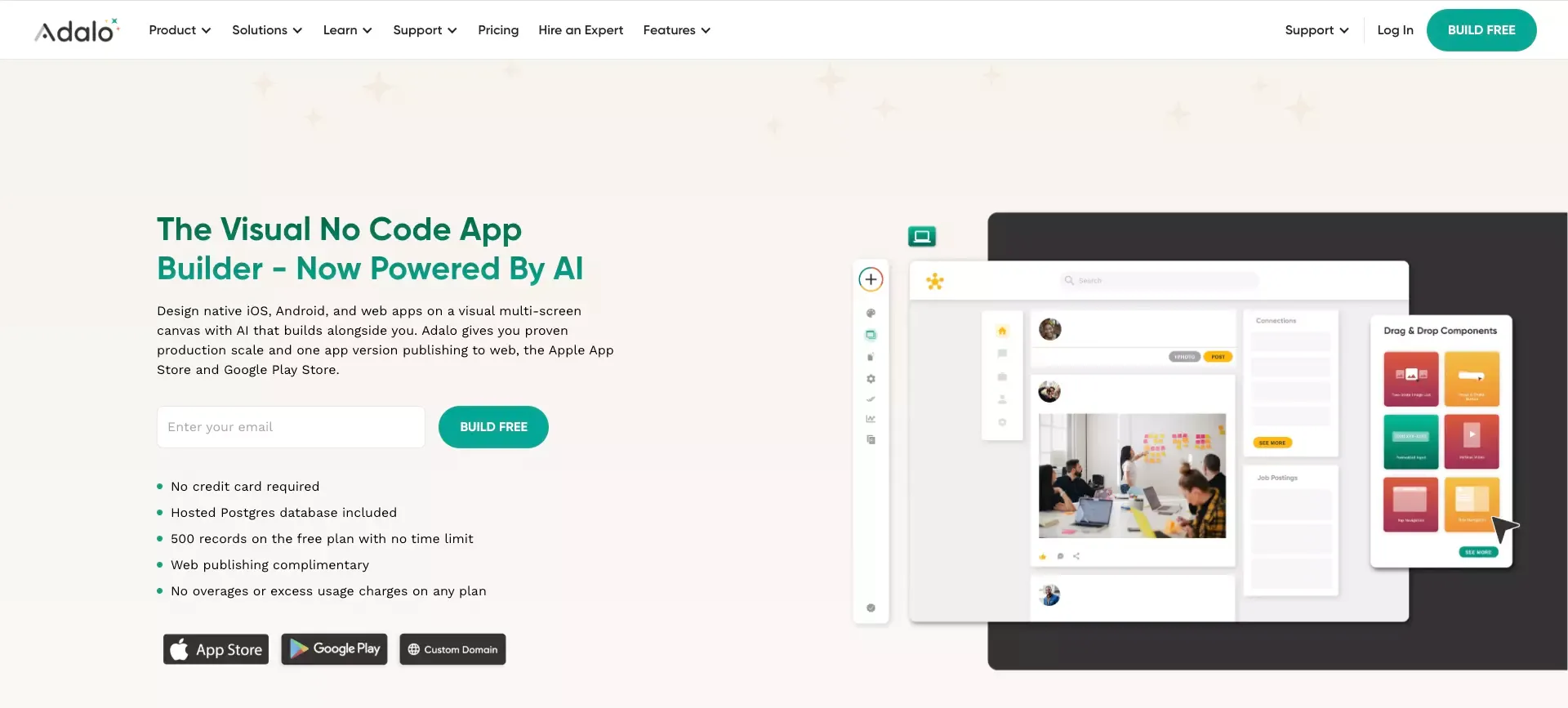
 Adalo still has a real place in no-code.
It gives non-technical founders a visual builder, cross-platform publishing, and a relatively approachable way to get an app live. That is still valuable.
But after reviewing the current landscape, I do not think "Adalo alternative" is one clean category anymore.
Most people searching this term are actually trying to solve one of these problems:
- They want a stronger mobile app builder
- They need a better platform for web apps or SaaS
- They want a faster way to build internal tools
- They want a more AI-assisted path from idea to product
Once I separated those jobs, the shortlist became much clearer.
The main tools worth looking at are:
- Atoms
- FlutterFlow
- Bubble
- Glide
- Draftbit
- Thunkable
- Softr
- Noloco
They are not interchangeable. Some are best for mobile. Some are much better for web apps. Some are really internal tool platforms, not true substitutes for every Adalo use case.
That is why so many "best Adalo alternatives" articles feel vague. They throw different categories into one list and pretend the tools do the same job.
Best Adalo Alternatives to Consider
Atoms
Best for
- Founders building beyond a basic MVP
- Teams that want a broader product-building workflow
- People who want more AI assistance across the build process
What I liked
- Feels broader than a classic AI app builder
- More useful when the goal is to get to a usable product, not just a prototype
- Better fit for SaaS ideas, internal tools, dashboards, and launch-oriented projects
Where it stands out
What makes Atoms interesting is its scope.
Adalo is still centered on helping you build the app itself. Atoms feels more like it is trying to help with the full path around the app too: validating the startup idea, structuring the product, and pushing it toward launch with coding agents carrying more of the workflow.
That makes it more compelling for founders who are still figuring out what the product should be, not just where to place screens and buttons.
Where it may not be the best fit
- Probably not the first choice for a very small CRUD demo
- Less appealing if all you want is a simple app builder and nothing else
Choose Atoms over Adalo if
- You want a faster path from idea to product
- You care about product direction, not just screen assembly
- You expect the project to become more ambitious over time
FlutterFlow
Best for
- Teams building polished mobile apps
- Users who want more control than Adalo offers
- Builders who care about customization and long-term flexibility
What I liked
- Stronger mobile app story than Adalo
- Better fit for teams that want deeper customization
- More credible option for serious app growth
Where it stands out
FlutterFlow is the cleanest answer if your main complaint about Adalo is that it starts to feel limiting.
It asks more from the user, but that extra complexity comes with more control. If I were building a polished mobile product and expected it to get more complex over time, FlutterFlow would be near the top of my list.
Where it may not be the best fit
- Less beginner-friendly than Adalo
- Can feel heavier for very simple MVPs
Choose FlutterFlow over Adalo if
- Mobile quality matters more than simplicity
- You want more customization from the start
- You do not want to outgrow the tool too quickly
Bubble
Best for
- Web-first SaaS products
- Logic-heavy applications
- Teams that need more product depth and workflow complexity
What I liked
- Strong option for serious web apps
- Better suited to layered workflows, admin systems, and custom logic
- Feels like a platform you can stretch much further
Where it stands out
Bubble is not just another version of Adalo.
It is a different path.
If the product is clearly web-first and has real SaaS ambitions, Bubble usually makes more sense than trying to force a simpler builder to do a more complex job. If you are weighing Bubble against other options, reading about Bubble alternatives can help clarify where it sits in the broader landscape.
Where it may not be the best fit
- Not ideal if your main priority is a native-style mobile experience
- Comes with more complexity and more decisions
Choose Bubble over Adalo if
- You are building a serious web app
- You need custom workflows and more logic depth
- You are willing to trade simplicity for flexibility
Glide
Best for
- Internal tools
- Data-driven apps
- Teams that want speed over deep customization
What I liked
- Very fast to get started
- Great for turning structured data into usable apps
- Strong fit for business workflows and utility apps
Where it stands out
Glide is a very different type of alternative.
I would choose it when the app is really a layer on top of data. That includes dashboards, workflow tools, operations apps, and internal utilities.
I would not choose it for a product that needs a highly custom consumer-facing experience.
Where it may not be the best fit
- Narrower than Bubble or FlutterFlow
- Less suitable for highly custom product experiences
Choose Glide over Adalo if
- Your app is built around existing data
- You want to move fast
- Internal usefulness matters more than product-level customization
Draftbit
Best for
- Teams that care about mobile UI control
- Builders who may need developer handoff later
- Users who want more flexibility than a typical no-code mobile builder
What I liked
- More customizable than lighter mobile builders
- Better fit for design-conscious teams
- Stronger option when technical depth may matter later
Where it stands out
Draftbit sits in an interesting middle ground.
It is more serious than simple no-code app builders, but it still keeps a visual workflow. That makes it attractive for teams who want more control without jumping fully into traditional development from day one.
Where it may not be the best fit
- Not the easiest starting point for beginners
- Better for teams with clearer product requirements
Choose Draftbit over Adalo if
- Design flexibility matters a lot
- You expect developers to get involved later
- You want more control over the app layer
Thunkable
Best for
- Mobile-first no-code projects
- Apps that need phone features
- Builders who want straightforward app-store publishing
What I liked
- Good match for mobile-focused projects
- Useful for apps that rely on device capabilities
- Practical option for teams staying close to mobile use cases
Where it stands out
Thunkable makes the most sense when the project is clearly about mobile.
If you need camera access, geolocation, push notifications, or similar device features, it becomes much more relevant than a generic no-code comparison list might suggest.
Where it may not be the best fit
- Less compelling for broader SaaS or business platform ideas
- More focused on mobile than on full product workflows
Choose Thunkable over Adalo if
- Your use case is mobile-first
- Device integration matters
- You want a focused app-building tool, not a broader product platform
Softr
Best for
- Client portals
- Member areas
- Lightweight business apps
- Structured internal workflows
What I liked
- Easy to understand and easy to launch
- Strong fit for business-facing use cases
- More natural than Adalo for portals and operational apps
Where it stands out
Softr is often a better answer than Adalo when the real project is not a traditional app at all.
A lot of teams just need a useful portal, workspace, or internal system. Softr is closer to that problem from the start, which makes it easier to recommend for those scenarios.
Where it may not be the best fit
- Less suited to products that need deeper custom logic
- Not the strongest option for highly custom app behavior
Choose Softr over Adalo if
- You are building a portal or member area
- You want a lightweight business app
- Your project is structured and process-driven rather than product-heavy
Noloco
Best for
- Internal operations tools
- Workflow-heavy business systems
- Teams replacing spreadsheets with structured software
What I liked
- Very strong fit for internal operations
- Natural for permission-heavy and process-heavy tools
- Better aligned with operational business software than Adalo
Where it stands out
Noloco is one of the clearest alternatives on this list because it does not try to be everything.
It is especially strong for internal CRMs, approval apps, recruiting systems, agency workflows, and other operational tools. When that is the real use case, it feels like a more natural choice than Adalo.
Where it may not be the best fit
- Not the best fit for broad consumer-facing products
- Less relevant if you want a more public app experience
Choose Noloco over Adalo if
- Your app is mainly for internal operations
- Permissions, workflows, and structured data matter
- You want software for a team process, not a public-facing product
Quick Comparison Table
| Tool | Best For | Main Strength | Main Limitation |
|---|---|---|---|
| Atoms | AI-assisted product building | Broader idea-to-product workflow | Less relevant for very simple demos |
| FlutterFlow | Advanced mobile apps | More control and flexibility | Harder learning curve |
| Bubble | Web-first SaaS | Strong logic and workflow depth | More complexity |
| Glide | Data-driven internal apps | Fastest path from data to app | Less custom product flexibility |
| Draftbit | Design-conscious mobile teams | More UI control and code handoff potential | Not as beginner-friendly |
| Thunkable | Device-heavy mobile apps | Strong mobile and hardware features | Narrower long-term product scope |
| Softr | Portals and business apps | Very practical for structured workflows | Limited for deeper app logic |
| Noloco | Internal operations software | Excellent for process-heavy tools | Less suited to public-facing products |
Which Adalo Alternative Is Best for Your Use Case?
If you want a better mobile app builder
Start with:
- FlutterFlow for deeper customization and a more serious mobile environment
- Draftbit if design flexibility and future developer handoff matter
- Thunkable if device features and mobile publishing are central to the project
Adalo still belongs in this group for simpler apps. But if mobile quality or long-term flexibility matters more, I would look beyond it.
If you want to build a web-first SaaS product
Start with:
- Bubble for logic-heavy SaaS products
- Atoms if you want a more AI-led route from AI prototype to launched product
This is where Adalo stops being the obvious choice. Once the product becomes more like software and less like a simple app shell, specialized platforms make more sense.
If you need an internal tool, portal, or operations app
Start with:
- Glide for speed and data-backed tools
- Softr for portals, member areas, and lightweight business apps
- Noloco for operations-heavy internal systems
This is the category where people make the wrong choice most often. If the work is really operational and data-driven, Adalo is rarely the cleanest fit.
If you want an AI-assisted path from idea to product
Start with:
- Atoms if you want AI to support the broader product-building process
- FlutterFlow, Bubble, and others if you mainly want AI help with generation inside the builder
This distinction matters. Some tools use AI to speed up layout or setup. Others try to support the product more broadly. Those are not the same promise.
What Most "Adalo Alternative" Lists Get Wrong
The first mistake is treating all no-code tools as if they solve the same problem.
They do not.
A spreadsheet-to-app tool is not really competing in the same way as a native-style mobile builder. And a web-first SaaS platform is not the same thing as a portal builder.
The second mistake is using "no-code" as the main decision point.
That is too broad to be useful.
The better questions are:
- Do you need native mobile or is web enough?
- Is the product public-facing or internal?
- Are you building a SaaS product or an operational tool?
- Do you need strong customization later?
- Do you want AI help with screens, workflows, or the full product process?
Once you answer those, the shortlist gets much easier. It is also worth looking at Glide alternatives if your project sits in the internal-tool or data-app space, since that comparison surfaces a different set of relevant trade-offs.
My Final Verdict
If I had to summarize it simply, I would say this:
There is no single best Adalo alternative. There are better alternatives for different jobs.
My practical picks would be:
- FlutterFlow for native-style mobile app building
- Bubble for web-first SaaS and logic-heavy products
- Glide, Softr, or Noloco for internal tools and business workflows
- Atoms for a more AI-led route from idea to usable product
Adalo is not obsolete.
It is still a strong option if you want a visual builder with a relatively approachable setup and cross-platform publishing. I just would not treat it as the default choice anymore.
The market is more specialized now. That is good news for buyers. It means you can choose a tool that actually matches the product you are building instead of forcing one builder to do everything.
FAQs About Adalo Alternatives
What is the best Adalo alternative for beginners?
For simple business apps or portals, Softr and Glide are often easier starting points.
If app-store publishing is still your main goal and the app is fairly simple, Adalo itself remains beginner-friendly.
Which Adalo alternative is best for mobile apps?
FlutterFlow is the strongest all-around choice for teams that want more serious mobile control.
Thunkable is also a strong option if device features and fast mobile publishing matter most.
Which Adalo alternative is best for web apps?
Bubble is the strongest option here if you are building a web-first product with custom logic and more serious workflow depth.
Which Adalo alternative is best for internal tools?
The strongest options are usually:
- Noloco for operational systems
- Softr for portals and structured business apps
- Glide for fast, data-backed internal tools
Is Adalo still worth using in 2026?
Yes.
It is still a good option for founders who want a visual builder and a relatively simple way to publish across web, iOS, and Android.
I just would not assume it is the best fit for SaaS, internal tools, or more advanced mobile projects without comparing it against more specialized platforms first.
 Posts
Posts 